Most of your customers are shopping on a phone. They find you through an ad in their Instagram feed, browse from the couch, and check out with a thumb and a face scan.
If your marketing still treats mobile as a smaller version of the desktop experience, you're underserving the majority of your audience.
Mobile marketing for ecommerce is how you reach, sell to, and keep customers who shop on their phones. It spans your website, the channels you use to bring people in, the messages you send them, and the app some of them will shop in most. It isn't one tactic. It's a handful of things working together, each built around how people actually use a phone.
Get it right and you capture more of the traffic that's already landing on your store from mobile, and you turn one-time mobile buyers into repeat ones. Before the tactics, it's worth seeing how much of your business is already happening on a phone.
Why Mobile Marketing Matters for Ecommerce Brands
Mobile isn't a slice of ecommerce anymore. It's the main way people shop.
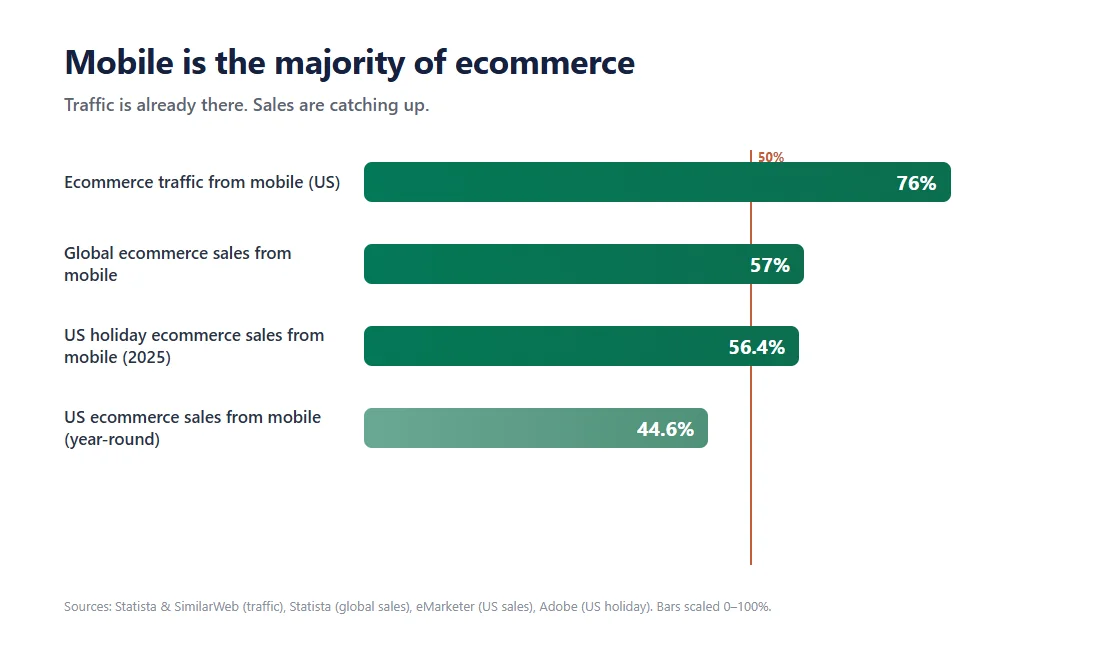
Between 75% and 77% of all ecommerce website traffic now comes from a phone (Statista, SimilarWeb). For most stores, the desktop visitor is the exception, not the rule.
Sales have followed. 56.4% of US online sales over the 2025 holiday season came from mobile, up from 54.5% the year before (Adobe). Globally, mobile already accounts for around 57% of ecommerce sales (Statista).
The US has trailed that number historically, sitting closer to 44.6% of ecommerce sales (eMarketer), but it's climbing fast and on pace to pass 49% by 2027.
There's a catch, and it's where the opportunity is. Mobile converts at roughly half the rate of desktop. So most stores are getting the majority of their traffic on the surface that turns the fewest visitors into buyers.
Fix that, and every visit and every dollar of acquisition spend goes further. The rest comes down to seven things.
7 Elements of a Strong Ecommerce Mobile Marketing Strategy
These run roughly in the order you should tackle them. Get the place you're sending people working first, then drive the right traffic to it, then keep the shoppers you win coming back.
There's little point pouring acquisition budget into a store that doesn't convert on a phone, and little point in retention channels before you have customers to retain.
A Mobile-First Website
Everything else sits on top of your mobile site, so it goes first. Mobile-first means the phone version is the one you design for, not a desktop site squeezed onto a smaller screen. Pages load fast, text is readable without pinching, and the buttons are large enough to tap with a thumb.
Checkout is where this matters most. Mobile shoppers abandon quickly when a form is long or fiddly, which is a big part of why mobile conversion trails desktop.
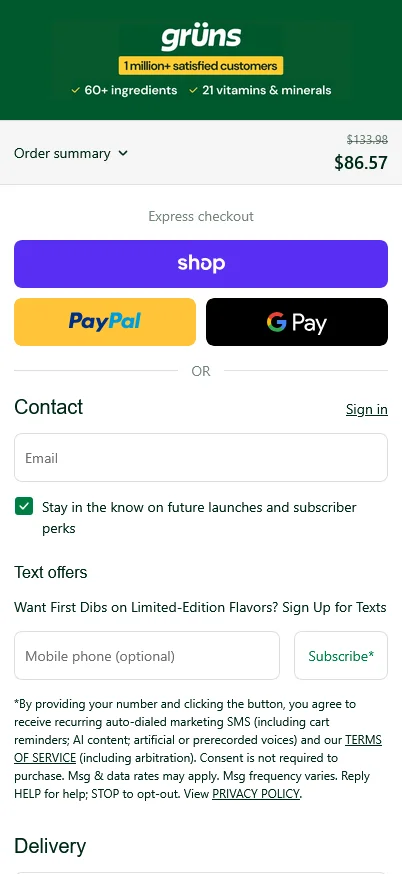
Keep the path to purchase short: cut the number of steps, offer guest checkout, turn on address and card autofill, and support the wallets people already have set up.
Apple Pay, Google Pay, and Shop Pay let someone buy in a couple of taps instead of typing out card details, and Shopify's own data shows Shop Pay converts up to 50% better than guest checkout.
This is the baseline. None of the channels below pay off if the store they point to is hard to use on a phone.
A Mobile Shopping Experience That Converts
A site that works on mobile and a site that sells on mobile are two different things.
People shop on their phones in short, distracted bursts, often one-handed, often mid-something-else. The experience has to suit that.
Product pages do most of the selling, so they earn the most attention. Lead with strong images, put the price, key details, and the add-to-cart button where a thumb can reach them without scrolling, and surface reviews and ratings early so shoppers get their proof without hunting for it.
Search and navigation deserve the same treatment. A prominent search bar, sensible filters, and short menus help someone find a product in a few taps.
The faster a shopper gets from landing to the right product to checkout, the more of your mobile traffic turns into revenue.
Mobile Acquisition Channels
This is the core of mobile marketing: how you get mobile shoppers in front of your store in the first place.
The biggest acquisition channels are already mobile by default, so the question isn't whether to market on mobile, it's whether your campaigns are built for how people use these apps.
Paid social is where most brands start. Meta, TikTok, and Pinterest are vertical, fast-scrolling, sound-off feeds, and the creative has to match.
Vertical video that makes its point in the first second or two will outperform a repurposed landscape ad every time. The same logic applies to search and shopping ads, where the majority of clicks now come from phones, and the listing, the price, and the page it leads to all get judged on a small screen.
Influencer and affiliate marketing belong here too. This content is watched almost entirely on phones, and it sends people straight to your store on the same device.
Whatever the channel, two things decide whether the spend works. The creative has to be built for a small vertical screen, and the page you send people to has to load fast and convert, which loops back to the first two elements.
It's also worth tracking mobile and desktop performance separately, since a campaign that looks fine on average can be quietly underperforming on the device most of your audience is using.
Mobile-Friendly Email
Email is still one of the best-value channels in ecommerce, and it's a mobile channel whether you treat it as one or not.
Most people open email on their phones, so an email that only looks right on a desktop is an email that’s broken to most of your list.
Design for the phone. Use a single-column layout, keep subject lines short enough not to get cut off, write tap-friendly buttons instead of tiny text links, and lead with one clear action.
Combined with good segmentation, mobile-first email keeps you in front of past customers at almost no cost per send.
SMS Marketing
SMS reaches people directly, and it gets opened fast. A text lands on the lock screen and rarely goes unread, which makes it powerful for anything time-sensitive: a product launch, a restock, the start of a sale, a shipping update.
The trade-off is cost and tolerance. You pay per message, and people are quicker to opt out of texts than email, so SMS rewards restraint.
Use it for moments that matter to the customer rather than routine promotion, and it stays a high-performing channel instead of becoming one people mute.
A Mobile App
For your most engaged customers, a mobile app is the strongest channel you can give them.
An app is a direct line to your customers - and for the shopper, a more mobile-friendly, more convenient way to access your store. It lives on their home screen, and opens with one tap, instead of locked behind a browser and a URL.
That shift in access changes behavior. App shoppers tend to buy more often and spend more per order than the same people on mobile web.
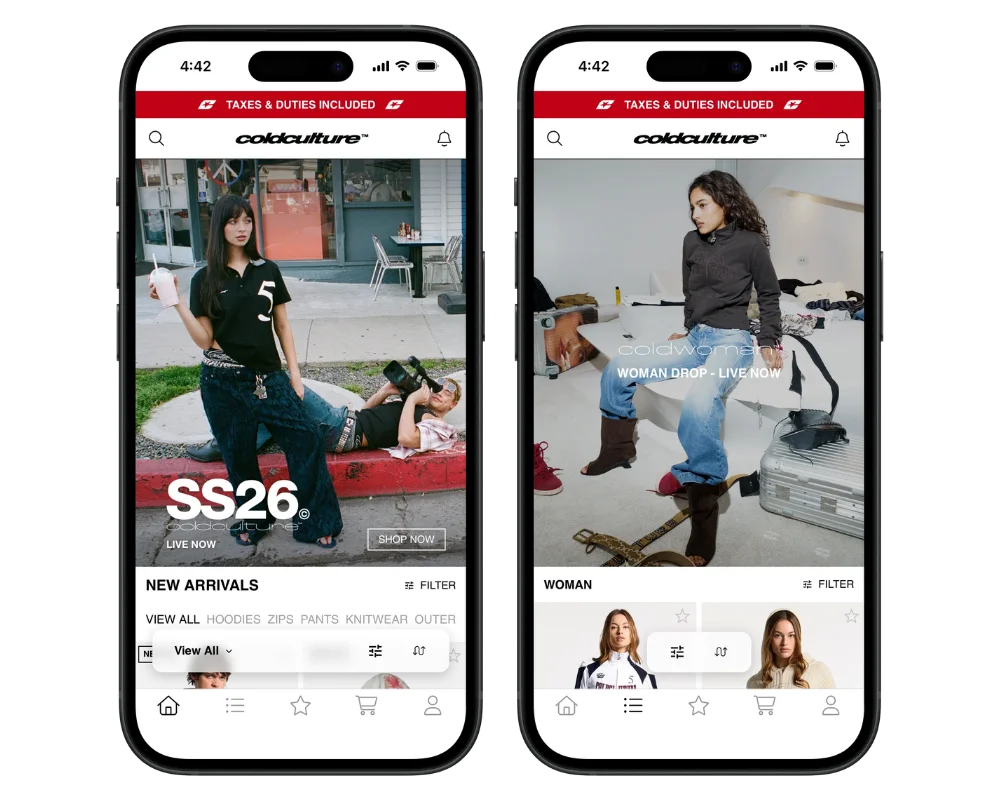
Pharmazone, an online pharmacy running on Shopify, sees 63% of its online revenue come through its app from around 15% of its customers, with conversions and average order value both running far higher in-app than on the web.
Fashion brand XCVI reports 4.8x higher revenue per app user and a 30% lift in average order value. Those gains compound into higher average order value and customer lifetime value over time.
An app is also still a genuine edge, because fewer than 0.5% of Shopify stores have one. The reason more brands don't is cost: a custom native build runs anywhere from $150,000 to $500,000 and needs an ongoing mobile team.
MobiLoud is the best way around that. It turns your existing website into native iOS and Android apps and manages them for you, so you get a real app on your customers' phones without the custom-development bill or a second codebase to maintain.
Push Notifications
Push notifications land on the lock screen, reach around 95% of recipients, and cost nothing to send. They're the cheapest and one of the highest-visibility channels in ecommerce, and they don't get filtered into a promotions tab or throttled by an algorithm the way email and social are.
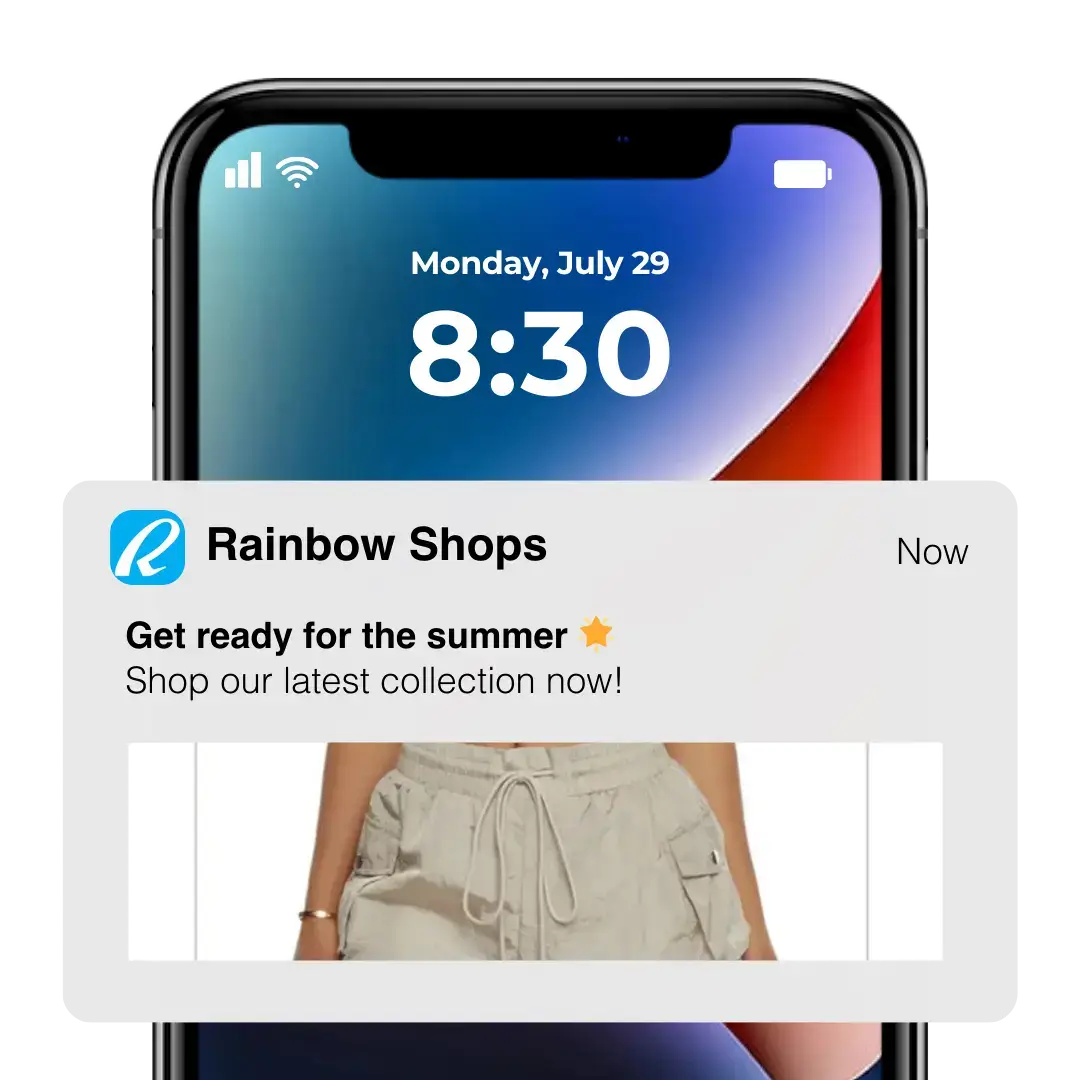
That makes push ideal for the moments that drive repeat revenue: a back-in-stock alert, a flash sale, an order update, or abandoned cart recovery, where brands have reported six figures a month in recovered revenue from this one automation.
To send native push notifications, you’ll need an app first; which is another reason why it’s so worthwhile to launch your own mobile app.
Final Thoughts
Mobile marketing should be a priority for all ecommerce brands today.
Nailing your mobile marketing strategy isn't one big move. It's getting a handful of things right in the right order.
Start with the destination: a mobile-first website and a checkout that converts on a phone. Then make the on-site experience suit how people shop on mobile.
With that in place, put your acquisition budget into the social and search channels where mobile shoppers already are, built with creative that fits the feed.
Then keep the customers you win with email, SMS, and, for your best shoppers, an app and the push notifications it brings with it.
If the app is the piece you're missing, the easiest next step is to get in touch with us at MobiLoud and get a free preview of your app. You’ll see what it could look like, how the build and launch works, and how much of a boost you could get by launching your own app.