Getting new customers keeps getting more expensive.
You can optimize your ads, improve your creative and tighten up your conversion funnel. But the landscape is simply getting more difficult, and making it continuously harder for ecommerce brands to make a regular profit on new customers.
While you can, and should, work on optimizing your acquisition funnel with the aim of first-order profitability, one of the highest leverage plays against rising CAC is not necessarily addressing the cost it takes to bring in a new customer; but the value you get from each one you bring in.
That’s where mobile apps could be your best asset in the fight against skyrocketing acquisition costs.
Keep reading and we’ll explain why, plus share a breakdown of the current state of CAC and average CAC benchmarks across various industries.
The Ecommerce CAC Problem
Customer acquisition cost, or CAC, is the average amount you spend to turn someone into a paying customer.
The basic formula is:
Total sales and marketing spend ÷ Number of new customers acquired = CAC
If you spend $15,000 on marketing in a month and acquire 200 new customers, your CAC is $75.
The problem is that customer acquisition costs are climbing.
Current ecommerce benchmarks suggest CAC rose around 40-60% between 2023 and 2025. Google Ads CPCs also increased by 12.88% year over year in 2025, while 87% of industries saw higher search advertising costs.
The state of CAC in ecommerce comes from several forces pushing in the same direction:
- More competition in paid ad auctions
- Less accurate targeting and attribution
- Privacy changes limiting customer data
- Major retailers spending aggressively to dominate attention
- Increasing creative and campaign management costs
Better creative, stronger landing pages, improved targeting and a smoother checkout can all bring your effective CAC down.
But you can’t fully control the cost of attention.
There will always be other brands bidding for the same customers. And, naturally, as those platforms become more competitive, acquisition gets more expensive.
That’s why you want to consider other approaches to the CAC problem, rather than just trying to put the genie back in the bottle and go back to the good old days of cheap Facebook CAC.
What Is the Average CAC for Ecommerce?
It’s difficult to find a single universal ecommerce CAC benchmark.
Different studies use different datasets, attribution models and cost definitions. Some include agency fees, salaries and creative production. Others calculate CAC mainly from direct advertising spend. And no one has complete data over how much every brand is spending to acquire customers.
Still, most current sources place average ecommerce CAC somewhere between $68 and $84.
A broader range of around $50 to $90 is normal across many ecommerce categories. A CAC above that isn’t automatically bad, especially for brands with high order values, strong margins or high customer lifetime value. But it’s good to know the ballpark averages, so you can start get an idea of where you sit.
Average Ecommerce CAC by Industry
Your vertical has a major impact on what a healthy acquisition cost looks like.
Here are some industry averages we’ve compiled from several sources (full data is not available for every category):
| Industry | Average CAC | Typical range |
|---|---|---|
| Food and beverage | $45-$53 | $25-$80 |
| Pet supplies | $52 | $30-$90 |
| Household goods | $58 | — |
| Beauty and personal care | $61-$68 | $28-$120 |
| Fashion and apparel | $66-$72 | $32-$250 |
| Sporting goods | $67 | — |
| Consumer electronics | $76-$85 | $35-$150 |
| Furniture | $77 | — |
| Home and lifestyle | $98 | $45-$300 |
| Jewelry | $91 | — |
| Luxury goods | $175 | $120-$400 |
Sources: First Page Sage (2025, 80+ clients), Upcounting (2025).
There are some clear differences between categories.
Food and beverage brands tend to have relatively low acquisition costs. The purchase decision is usually low-risk, and there’s a natural opportunity for customers to buy again.
Luxury brands spend much more to acquire each customer, but they can support that cost through larger orders, higher margins and stronger lifetime value.
Fashion and consumer electronics sit in a tougher position. Acquisition costs are rising, while repeat purchase frequency is typically less predictable.
But none of these benchmarks tell you whether your CAC is actually good.
For that, you need to know what happens after the first purchase.
CAC Alone Doesn’t Tell The Full Story
Imagine two brands both pay $75 to acquire a customer.
The first customer places one $90 order and never buys again.
The second customer places four $90 orders over the following year.
The CAC is identical. But the economics are completely different.
That’s why you shouldn’t evaluate CAC in isolation. It needs to be measured against:
- Customer lifetime value
- Gross margin
- Average order value
- Purchase frequency
- Repeat customer rate
- Retention
- CAC payback period
The most common way to connect these metrics is through your LTV:CAC ratio.
This compares how much a customer is worth over their lifetime with what you spent to acquire them.
A 3:1 ratio is often used as the standard target. That means you generate $3 in lifetime value for every $1 spent on acquisition. Below 2:1 is generally tight, while 4:1 or higher gives you more room to cover operational costs and reinvest in growth.
The exact target depends on your margins and business model.
But the overall principle is simple:
A higher customer value makes the same CAC more sustainable.
You can improve the equation from either side.
You can lower acquisition costs.
Or you can increase the revenue and profit generated by each customer.
Most brands should work on both. But there’s often more room to create value on the retention side than there is to keep squeezing acquisition costs lower.
The Mobile App Impact on CAC
Launching a mobile app won’t make Meta charge less for an impression. It won’t lower your Google CPC, or stop competitors from bidding against you.
The impact on acquisition is actually very thin. But that’s not the idea.
The idea is to drive more value on average after the initial acquisition.
Say you pay $75 to acquire a customer who makes one $90 purchase.
You haven’t made much back once you account for product costs, fulfillment, returns, payment processing and other operating expenses.
Now imagine that customer downloads your app and places three more orders over the next year.
Your CAC is still $75.
But it’s now supporting $360 in revenue rather than $90.
That can make a real difference at scale.
How Mobile Apps Improve Ecommerce CAC Economics
Mobile apps improve CAC economics in several ways.
Having an app creates more opportunities to reach customers, reduces the friction involved in returning to your store and makes it easier for your most engaged customers to keep buying.
Over time, these improvements compound. What you get is more repeat purchases, higher LTV, and more return, on average, from the same CAC.
Here are a few of the core mechanics that drive this.
Push Notifications Give You an Owned Re-Engagement Channel
Once a customer has downloaded your app and enabled notifications, you can reach them directly on their lock screen with push notifications.
You don’t have to pay an ad platform to put your brand in front of them again.
You can send push notifications for:
- Product launches
- Promotions and flash sales
- Abandoned carts
- Back-in-stock products
- Price drops
- Loyalty rewards
- Subscription reminders
- Replenishment campaigns
- Personalized recommendations
- New content and announcements
The marginal cost of sending a push notification is effectively zero. You can send 1,000 or 1,000,000 notifications without paying for every impression or click.
At scale, that matters a whole lot, making subsequent purchases essentially $0 CAC.
Apps Increase Purchase Frequency
An app gives customers a much smoother, more permanent way to come back and buy again.
Your icon is there on their home screen. The customer stays logged in. Their account, cart and preferences are readily available. Opening your store takes one tap.
This regularly naturally leads to more sessions and engagement.
MobiLoud customers regularly see app users visit far more often than mobile web users. Tadashi Shoji sees 3.8 times more sessions per app user. Freedom Rave Wear sees 5.75 times more. John Varvatos sees 12 times more.
Not every extra session leads to a sale. But every session is another opportunity for someone to discover a new product, or reorder something they use regularly.
Apps Increase Average Order Value
Mobile apps also increase how much customers spend when they do buy.
A focused app experience removes a lot of the friction and distraction that comes with shopping in a mobile browser.
Customers don’t have multiple browser tabs competing for their attention. They stay logged in. Navigation is faster. Returning to a product or cart is easier. The whole experience feels more focused on the brand.
Across MobiLoud customers with live apps, average order value lifts of 10-50% are typical. Both Sleefs and XCVI see approximately 30% higher AOV through their apps.
That lift has a direct impact on acquisition economics. Not on the first purchase (since these don’t come through your app); but on repeat purchases from regular customers, a higher AOV means more value from each customer, and higher payback on the same CAC.
Apps Help Retain Your Most Valuable Customers
App users aren’t a random selection of your audience.
The people who download your app are likely to be your most engaged customers.
They already know your brand. They’ve bought from you before, and they love your brand enough to download your app and keep it on their phone.
These are the most valuable customers you have. Without a reliable re-engagement channel, some will naturally drift away, the way you lose contact with your best friend from elementary school over time, if you don’t make an effort to stay in touch.
The mobile app keeps these customers close, and reduces the chance of the relationship decaying and your best customers slipping away.
Apps Help Recover Revenue You Would Otherwise Lose
Abandoned cart recovery is another clear example of how mobile apps help you drive more long term revenue, against the same CAC.
Apps are one of the best ways to recover abandoned carts.
With an app, you can send a push notification for abandoned carts, landing right on your customer’s lock screen.
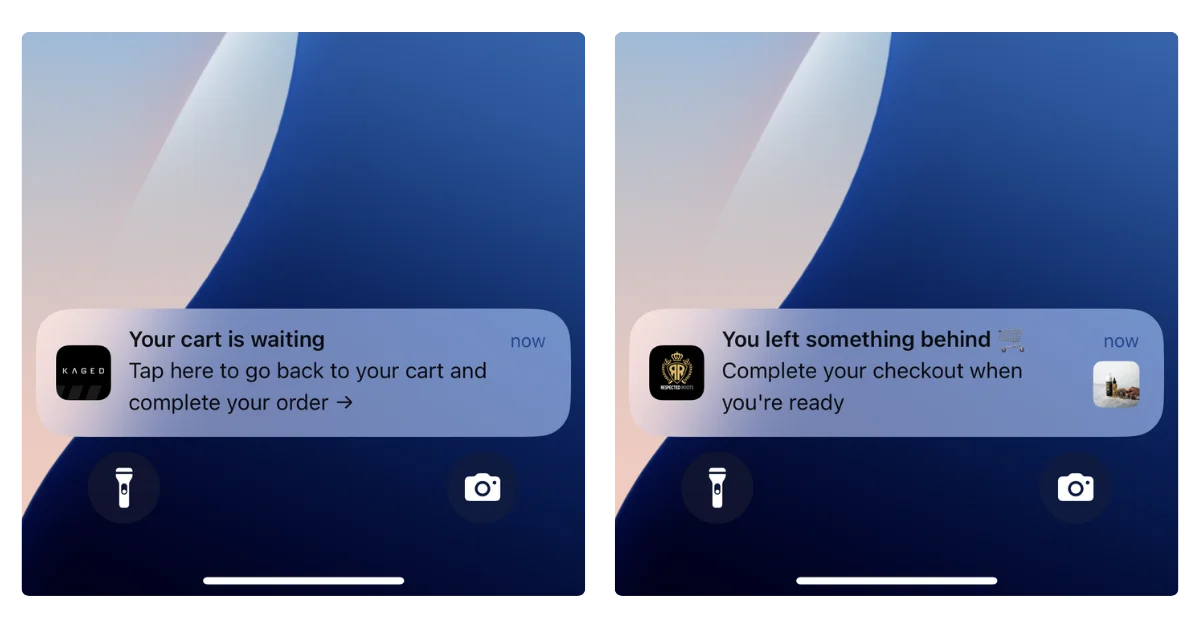
The notification appears quickly, links straight back to the cart and creates a simple path to purchase.
A number of brands we’ve worked with at MobiLoud generate five or six figures in new revenue per month with abandoned cart notifications. One brand, Pharmazone, has an abandoned cart campaign that converts at 22%.
That’s around 1 in every 4 abandoned carts recovered. Net-new revenue that would have otherwise been lost.
There’s no ad spend needed to recover these sales, no per-message cost. Just a free, quick reminder that’s guaranteed to be seen.
A Simple Example of How an App Changes the CAC Equation
Here’s a simplified example.
(These figures are illustrative rather than industry benchmarks).
| Metric | Website-only customer | App customer |
|---|---|---|
| Customer acquisition cost | $75 | $75 |
| Average order value | $90 | $105 |
| Orders per year | 1.5 | 3 |
| Annual revenue per customer | $135 | $315 |
| Revenue:CAC ratio | 1.8:1 | 4.2:1 |
Both customers cost the same amount to acquire.
The customer who downloads your app places more orders and spends more per order.
That means the original $75 acquisition investment produces an additional $180 in annual revenue.
The exact lift will be different for every brand. But this is the commercial case for a mobile app in one table - and why it’s your secret weapon against rising CAC.
How MobiLoud Helps You Get More From Every Customer
MobiLoud gives established ecommerce brands a more practical way to launch a mobile app.
Instead of rebuilding your store as a completely separate product, we turn your existing website into native iOS and Android apps.
You keep the shopping experience you already have.
That includes your:
- Product pages
- Collections
- Checkout
- Customer accounts
- Loyalty program
- Subscriptions
- Reviews
- Search
- Personalization
- Upsells and recommendations
- Custom features
- Third-party integrations
You don’t need to recreate your store in a restrictive drag-and-drop app builder.
You don’t need to manage a separate app storefront.
And you don’t need to maintain two completely different ecommerce experiences.
Your website is the foundation, the main source of truth. Changes made to the site flow through to the app, while MobiLoud adds the native functionality needed to deliver a polished app experience.
You also get push notifications, app store submission, and an experienced team to handle the technical work.
That lets you focus on the parts that generate commercial value:
- Driving app downloads
- Building an engaged app audience
- Sending relevant push campaigns
- Recovering abandoned carts
- Increasing repeat purchases
- Retaining your highest-value customers
You’ve already invested heavily in acquiring your customers.
MobiLoud helps you get more from those relationships without taking on the cost and complexity of custom app development.
Final Thoughts
Rising CAC is a real problem.
But endlessly trying to force acquisition costs down isn’t the only answer.
There’s a floor to what you’ll pay for attention. Advertising platforms will keep changing, competitors will keep bidding and acquiring new customers will remain expensive.
A mobile app doesn’t remove those pressures.
It helps you build a stronger business despite them.
By increasing purchase frequency, average order value and retention - and giving you an owned push notification channel - an app helps you generate a better return from every customer you acquire.
Your CAC remains the same, but on average, each customer becomes more valuable.
This is, by far, the most effective solution for the ecommerce CAC problem you’re dealing with today.