
Enterprise mobile app development is the process of building, launching, and maintaining native iOS and Android apps for large-scale businesses.
For ecommerce brands doing $50M+ in annual revenue, that process of launching a mobile app looks very different than it does for a small Shopify store. The stakes are higher, the tech stacks are more complex, and the wrong approach can burn six figures before you have anything to show for it.
The business case of mobile apps isn't up for debate anymore. As of 2026, app users convert at 3-4x the rate of mobile web visitors, deliver 2.8-5x higher lifetime value, and generate a disproportionate share of revenue relative to their size as a customer segment.
For enterprise brands, even a modest lift in mobile conversion and retention translates to millions in incremental revenue. That's a board-level growth lever, not just another middling asset.
But enterprise ecommerce isn't Shopify with a premium theme. You're running dozens of integrations, custom checkout flows, multi-region storefronts, and a tech stack that took years to build.
The mobile app solutions designed for small and mid-market merchants simply weren't built for this level of complexity.
This guide breaks down what enterprise brands actually need from mobile app development in 2026, where the common approaches fall short, and how to evaluate your options without burning a year and a six-figure budget finding out.
Why Do So Few Enterprise Brands Have Mobile Apps?
Only 1 out of every 5 US brands with $5M+ in monthly revenue currently have a mobile app. If we reduce the threshold to $1M-$5M per month in revenue, that drops to less than 1 in 10.
At a time where mobile-first commerce is the default and omnichannel presence is table stakes, that's a striking gap.
It exists for a reason. Building a mobile app that actually works for an enterprise ecommerce operation is hard. Not because the technology doesn't exist, but because most solutions on the market were designed for a different kind of business.
A DTC brand on Shopify with 15 apps and a standard checkout can spin up a mobile app in a few weeks using a platform-specific builder.
An enterprise brand running Salesforce Commerce Cloud with Algolia search, Dynamic Yield personalization, Klaviyo email flows, a custom loyalty program, and localized storefronts across six countries?
That's a different problem entirely.
The gap comes down to three things:
Stack complexity
A typical enterprise ecommerce operation runs 80-100+ integrations that directly touch the customer experience.
Reviews, search, personalization, subscriptions, loyalty, live chat, payment gateways, fraud detection, tax calculation, shipping logic.
Each one represents functionality that has to be replicated or preserved in any mobile app.
Organizational risk tolerance
Enterprise teams have seen 70% of digital transformation initiatives fail to meet their objectives (McKinsey's number, not ours).
A poorly executed mobile app launch doesn't just waste budget. It creates customer service headaches, breaks trust with your best customers, and makes internal stakeholders gun-shy about the next mobile initiative.
The maintenance burden
Launching is only half the problem. Enterprise brands update their websites constantly: new product lines, seasonal campaigns, promotions, landing pages, A/B tests.
Any mobile app strategy that requires maintaining a separate content pipeline is a non-starter for teams already stretched thin.
How Do Enterprise Brands Build Mobile Apps Today?
There are three paths you might have been looking at to build your mobile app. For the majority of enterprise ecommerce brands, none are perfect.
Let’s break them down in more detail.
Path 1: Custom Native Development
The traditional enterprise answer: hire an agency or build an internal team, spend $250K-$500K+, and build a fully custom iOS and Android app from scratch.
Whether the team uses native Swift/Kotlin, cross-platform frameworks like React Native or Flutter, or a combination, the project scope is roughly the same.
For the world's largest retailers (think Amazon, Walmart, Target), this makes sense. They have dedicated mobile engineering teams, the budget to sustain it, and enough app users to warrant a fully independent codebase.
For most enterprise brands in the $50M-$500M range, it's a different calculus. Custom development means:
- 6-12+ months to launch. Your competitors with apps are capturing mobile revenue while you're still in sprint planning.
- Rebuilding your entire integration stack. Every integration on your website needs a corresponding mobile implementation. At $30,000-$50,000 per integration (build plus first-year maintenance), a stack of 30 integrations could cost over a million dollars in API work alone.
- Permanent parallel maintenance. Every website update, every new product feature, every promotional campaign now has to be built twice. You need a dedicated mobile team, or your app falls behind your website within months.
- Ongoing engineering costs of $150K-$300K+ per year just to keep the app updated, handle OS changes, and maintain integrations.
Custom development is the right choice when your mobile app needs to do something fundamentally different from your website.
For ecommerce brands, that’s rarely necessary. You’re not building a mobile-native multimedia app. You’re not building the next Netflix or TikTok. You’re just taking what already exists – your web store – and turning it into a native app.
Building a fully custom, fully native app from the ground up means paying for a solution to a problem that doesn't need to be this expensive.
Path 2: Platform-Specific App Builders
Hundreds of no-code, drag and drop app builders have made mobile apps accessible for a wide range of ecommerce brands.
These tools are fast, affordable, and purpose-built for the Shopify ecosystem.
They’re excellent for what they were designed for. But enterprise ecommerce, with its complex stacks and cross-platform requirements, sits outside their sweet spot.
You’re likely to run into walls like:
Platform lock-in
Most app builders only work with Shopify. The list of app vendors that work with non-Shopify stores is extremely thin.
If you're on Salesforce Commerce Cloud, Adobe Commerce (Magento), BigCommerce Enterprise, commercetools, or a custom headless stack, these tools simply don't support your platform.
API limitations
App builders that connect to Shopify's Storefront API are working with a subset of your store's actual functionality. The API returns product data, not your rendered storefront. That means custom Liquid code, JavaScript-dependent features, and third-party app widgets may not translate to your app.
Integration gaps
Some of your most valuable integrations may require enterprise-tier pricing from the app builder, or may not be supported at all. When a tool like Algolia search or ReCharge subscriptions doesn't work in your app, your customers get a degraded experience compared to your website.
Feature ceilings
Drag-and-drop builders give you a templated app layout, not your actual store experience. For enterprise brands that have invested heavily in their website UX, being forced into a template is a significant step backward.
Path 3: Progressive Web Apps (PWAs)
PWAs promise app-like experiences without building a native app.
For enterprise brands already running sophisticated web stacks, the appeal is obvious: no App Store submission, no separate codebase, works across all platforms. And most enterprise-level, headless or composable commerce platforms support PWA functionality out of the box.
But a PWA is not a mobile app.
PWAs can’t be published to the App Stores, they’re limited on push notification functionality, customers rarely go through the process to add them to the home screen, and their support on iOS is limited.
A PWA is an excellent mobile web enhancement. But a replacement for a native app? It is not.
Can You Turn an Enterprise Ecommerce Website Into a Native App?
There's a fourth approach that most enterprise evaluation frameworks miss because it doesn't fit neatly into the "build vs buy" dichotomy: taking your existing website and extending it into a native mobile app.
Instead of rebuilding your ecommerce experience from scratch (custom dev) or recreating it through an API (app builders), your actual website powers a native iOS and Android app, with native functionality layered on top.
Everything you've built on the web carries over. Your customers get a native app experience, built on (and fully synced with) your existing web experience.
This solves a number of key hurdles for enterprise ecommerce brands:
Every integration carries over automatically
Algolia search, Dynamic Yield personalization, ReCharge subscriptions, LoyaltyLion rewards, Gorgias live chat. Even niche tools or custom features.
If it works on your website, it works in the app. No rebuilding, no re-integrating, no gaps in the customer experience.
For a brand running 80+ integrations, this eliminates millions in potential re-implementation costs, as well as potential feature gaps.
Your content stays in sync
When you update a product page, launch a promotion, redesign a landing page, it's live in the app the moment it's live on your site.
With traditional app development approaches, your marketing team could spend hours and hours on parallel updates, trying to keep the website and app experiences consistent.
The real cost isn’t just the time you spend – it’s the drag on your focus, and the inevitability that the two platforms will fall out of sync if you try to manage this manually.
The “website to app” approach solves this problem in one shot.
Platform doesn't matter
Whether you're on Shopify Plus, Salesforce Commerce Cloud, Adobe Commerce, a headless stack, or something entirely custom, you can launch your app without spending hundreds of thousands on a custom build.
The approach works because it builds on your website, not your platform's API.
Native capabilities where they count
Push notifications (for promotions, order updates, automated abandoned cart and behavioral campaigns, more), deep linking, native navigation, an icon on your customer’s home screen, and App Store presence.
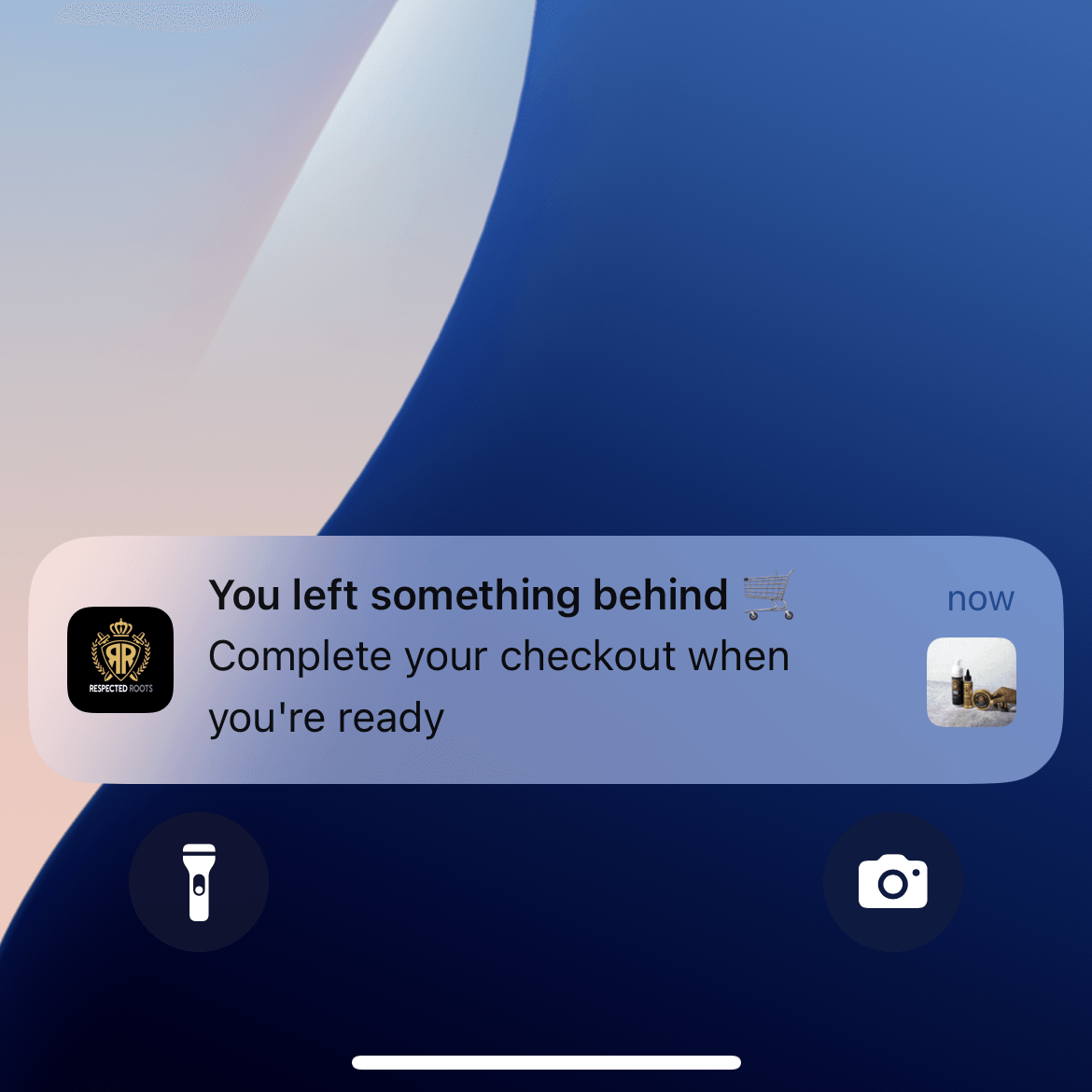
Your app will have all the features a real mobile app needs. It’s not a “lite” version of a mobile app, it’s not a PWA, it’s not a shortcut. It’s a real mobile app.
Launch in weeks, not months
Because you're not rebuilding your store, the development cycle compresses dramatically. You could go live in just 6-8 weeks – contrast that to a custom build which runs months, potentially years.
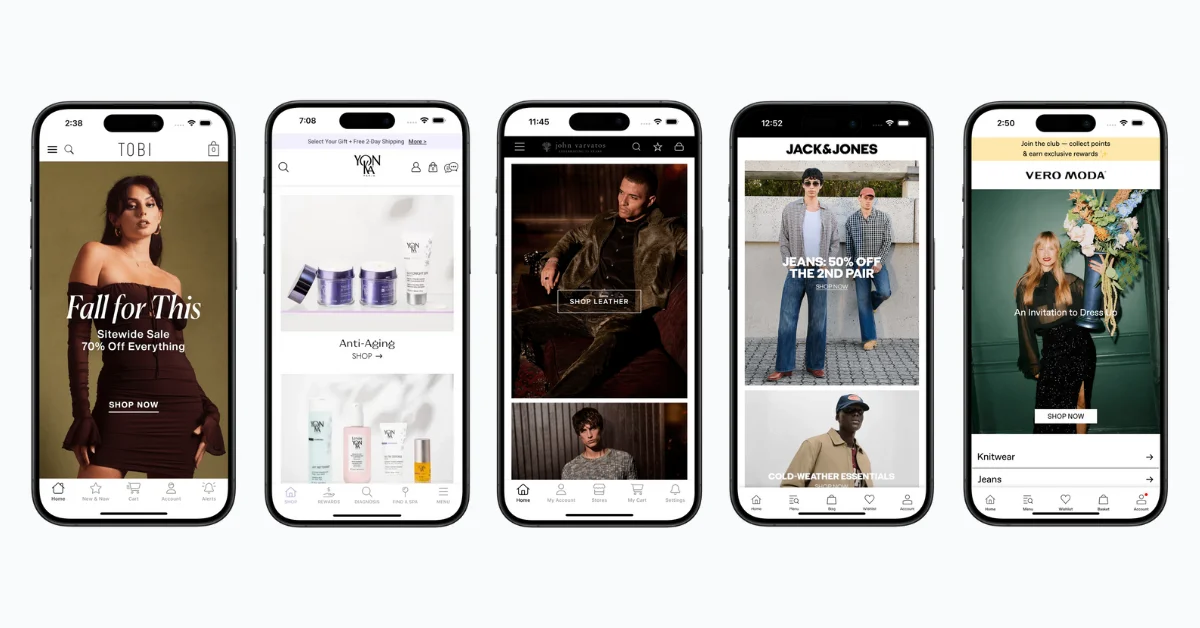
This is the approach MobiLoud takes. It's how brands like Bestseller (parent of Jack & Jones, Vero Moda, ONLY), John Varvatos, Tadashi Shoji, and many more run high-ROI, low-maintenance mobile apps.
How These Approaches Compare
Let’s break down the core differences between the four enterprise mobile app development paths discussed above:
| Custom Dev | App Builders | PWA | Website-to-App | |
|---|---|---|---|---|
| Cost | $250K-$500K+ | $200-$1,000/mo | Dev time only | ~$1,499/mo |
| Time to Launch | 6-12+ months | 2-6 weeks | Varies | 6-8 weeks |
| Integration Support | Must rebuild each | Limited | Full (web-based) | Full |
| Platform Support | Any | Shopify only | Any | Any |
| Ongoing Maintenance | $150K-$300K/yr | DIY | Dev team | Done for you |
| App Store Presence | Yes | Yes | No | Yes |
| Push Notifications | Yes (if you build it) | Yes | Limited | Yes |
| Best For | Unique app features (AR, offline) | Small-mid Shopify stores | Mobile web enhancement | Enterprise with complex stacks |
What Should Enterprise Brands Look for in a Mobile App?
Enterprise mobile app requirements look different from mid-market brands or SMBs. After watching brands at this scale evaluate and struggle with mobile strategies, a clear set of non-negotiables emerges:
1. Full Tech Stack Preservation
This is the big one. Your website runs on a stack you've spent years building and optimizing. Reviews, search, personalization, subscriptions, loyalty, analytics, A/B testing, payment gateways, custom checkout flows. You want this to carry over to your app.
Any mobile app strategy that requires rebuilding or replacing those integrations is asking you to take on enormous cost and risk for a problem you've already solved. The right approach preserves your entire stack.
2. Zero Duplicate Content Management
Enterprise ecommerce teams are already managing content across multiple channels. Adding a parallel content pipeline for a mobile app (separate product uploads, separate promotional content, separate navigation updates) creates operational overhead that compounds over time.
The app should reflect your website in real time. Update your site, and the app updates automatically.
3. Platform Compatibility
Enterprise ecommerce runs on a wide range of platforms: Shopify Plus, Salesforce Commerce Cloud, Adobe Commerce, BigCommerce Enterprise, commercetools, custom headless builds.
Your mobile app solution needs to work with your existing ecommerce platform; you’re not going to replatform your website just to make it work with your app.
4. Enterprise-Grade Support and SLAs
When your app is generating millions in revenue, you need more than a support ticket queue. Dedicated success managers, guaranteed response times, direct access to engineering, and proactive monitoring are baseline requirements.
5. Multi-Region and Multi-Language Support
Enterprise brands operating across markets need apps that handle localized storefronts, multiple currencies, and regional compliance requirements without building separate apps for each market.
6. Security and Compliance
SOC 2 compliance, GDPR readiness, data encryption in transit and at rest, SSO support, and data handling policies that satisfy your legal and procurement teams.
Enterprise evaluation processes require documentation on all of these, and many app solutions built for SMBs simply don't have them.
7. Scalability
Your app needs to handle traffic spikes during flash sales, product drops, and peak shopping seasons (Black Friday, holiday) without degradation. An approach that ties into your existing web infrastructure inherits whatever scalability your website already has, rather than introducing a new bottleneck.
8. Speed to Market With Low Risk
Perhaps counterintuitively, enterprise brands often need to move faster, not slower, than smaller competitors.
A 12-month custom development cycle means 12 months of lost mobile revenue. The ideal solution launches in weeks, not months, without cutting corners on quality or functionality.
What Kind of ROI Can You Expect From a Mobile App?
MobiLoud’s Ecommerce Mobile App Benchmark Report analyzed performance data across multiple ecommerce brands.
Here's the difference that mobile apps make.
Revenue contribution
Brands with mobile apps see anywhere from 10-35% of their revenue, on average, through their apps.
This typically comes from a much smaller share of users – and the gap can be extreme in outlying cases.
A wellness and pharmacy brand we worked with had 16% of its customers using the app. But those users generated 62% of their total online revenue. Revenue contribution was nearly 4x higher than the app's share of traffic.
It’s not the only example. Junior Couture, a luxury children' s fashion brand, drove 50% of their BFCM revenue in 2025 through their app – from just 5% of their total customers.
Higher conversion rates
Each app session is much more likely to lead to a sale.
One converted at 9.1% inside the app versus 1.1% on mobile web. That's an 8x lift.
Another, a luxury fashion label saw a 10x lift in conversion rate from app versus mobile web (2.56% vs 0.23%).
Higher average order values
App shoppers spend more.
The data shows 10-50% higher AOV from app users compared to mobile web visitors, driven by deeper browsing sessions and stronger purchase intent.
Real revenue from push notifications
One brand generated over $31,000 in push notification revenue in its first month after turning on push campaigns, with nearly half from automated abandoned cart notifications alone.
Across multiple brands, abandoned cart push notifications generate $10,000-$200,000+ in monthly revenue.
That’s just one campaign. And for all push notifications, there’s no marginal cost per send, making the revenue you gain from push campaigns much more profitable than other channels.
“The power of push notifications is so strong. In a world where people open email less and less each day, everyone is jumping into SMS which is crazy expensive, and people are starting to tune these out too, being able to do push notifications is the reason you do an app.”
Engagement metrics reflecting habit formation
App users average 2.1-4.7 sessions per user (compared to roughly 1 session per mobile web visitor), with session times of 5-7 minutes.
These aren't one-time visitors. They're repeat customers building a shopping habit.
Stronger lifetime value
App users deliver 2.8-5x higher CLV than web-only shoppers, and 60% of first-time app buyers go on to make at least one more purchase.
For an enterprise brand doing $50M+ in annual revenue, capturing even 10-15% of that through a mobile app channel (with higher conversion rates and AOV) represents a significant revenue opportunity.
How To Choose an Enterprise Mobile App Development Partner
Vendor marketing in this space is thick. If you're evaluating mobile app options for your enterprise ecommerce operation, here's a framework for cutting through it:
Ask about your specific tech stack
Don't accept "we integrate with 100+ tools" at face value. Provide your actual list of integrations and ask which ones will work in the app, which require additional development, and which won't work at all. The answer tells you everything about the real cost and timeline.
Calculate the true total cost of ownership
For most agencies, custom builds and legacy software, the license fee or development quote is just the starting point. Factor in:
- Integration rebuilding costs ($30K-$50K per integration for custom dev)
- Ongoing maintenance (typically 15-20% of initial build cost per year for custom)
- Internal team resources required to manage the app
- Opportunity cost of a long development timeline
A website-to-app approach like MobiLoud removes all of this; giving you a mobile app of similar quality, for a predictable monthly cost that’s negligible compared to what you’re already spending on software.
Test with your actual website
Ask for a preview or proof of concept built on your real website, not a demo app. You need to see how your integrations, checkout flow, and custom features behave inside the app.
Evaluate the support model
For enterprise, "support" means a named account manager, guaranteed SLAs, direct access to engineering for edge cases, and proactive monitoring. Anything less creates risk for a revenue-generating channel.
Understand the update cycle
How do website changes propagate to the app? Is there a delay? Do you need to request updates? The ideal answer is "instantly and automatically.”
"We don't have to worry about the app. MobiLoud handles everything on the backend, and our website updates are automatically reflected."
Check App Store compliance track record
App Store review can be unpredictable, especially for ecommerce apps. Ask how many apps the vendor has submitted, what their approval rate looks like, and how they handle rejection. A vendor with thousands of approved apps will navigate this process more efficiently than one with dozens.
Next Steps
MobiLoud works with enterprise ecommerce brands on Shopify Plus, Salesforce Commerce Cloud, Adobe Commerce, BigCommerce, and fully custom stacks.
It’s the best way for most enterprise commerce brands to launch a mobile app.
The process is straightforward:
- Book a strategy call. Share your website URL and discuss your goals, tech stack, and requirements. No commitment, no pressure. The call helps both sides assess fit.
- Get a custom app preview. The MobiLoud team builds a working preview of your native app so you can see exactly how your website looks, feels, and performs as an app.
- Launch. MobiLoud handles everything from build to App Store submission to ongoing maintenance. Your app goes live on iOS and Android while your team stays focused on running the business.
MobiLoud has built 2,000+ apps since 2013, including for enterprise brands like Bestseller, John Varvatos, and BuyBuyBaby. You get predictable pricing, with no revenue share, and a fully managed service to support your tech team and handle everything to do with the mobile app.
Book a free strategy call to see how your website can become a mobile app, and learn whether MobiLoud is the right partner to make it happen.