



















Next.js brings a lot to the table. The flexibility of server-side rendering, dynamic routing, the ability to craft a shopping experience that actually matches your brand.
It’s a powerful way to build a custom headless storefront - product pages, checkout flow, search, filtering, loyalty integrations, all of it, running on your stack, on your terms - along with the benefits of Shopify’s commerce backend.
The next step for your brand, after perfecting your website, is launching your own mobile app.
The natural instinct is to look at tools like Capacitor, or to scope out a React Native build. Both seem reasonable on paper. But once you dig in, you'll find that these paths either strip away the features that make your Next.js storefront powerful, or require you to rebuild everything from scratch (which is a major ongoing investment - and risks turning your ecommerce business into a tech company).
There is a simpler way. This guide walks you through the options and shows you the fastest (and most effective) path from Next.js storefront to native mobile app.
Can You Build a Mobile App from a Next.js Shopify Storefront?
Yes. But how you do it matters enormously.
Your Next.js storefront sits on top of Shopify's Storefront API, handling everything from product rendering to checkout. It's a custom frontend, which means it doesn't plug into Shopify's ecosystem of no-code app builders. Those tools are designed for standard Shopify themes, not headless architectures.
That leaves you with three realistic paths to launch a mobile app.
The Capacitor Route (Deceptively Simple)
Capacitor, by Ionic, is a cross-platform runtime that packages a web app inside a native container. Since your storefront is already a web app, this seems like the obvious choice.
Here's the problem: Capacitor requires a static export of your Next.js app. That means setting output: 'export' in your Next.js config. And when you do that, you lose the features that made Next.js worth choosing in the first place.
According to Next.js documentation, static exports don't support:
- Server-side rendering (SSR)
- Incremental Static Regeneration (ISR)
- API routes
- Middleware
- Server actions
- Dynamic routes with dynamicParams
- Image optimization (default loader)
- Cookies, rewrites, redirects
Your Next.js storefront likely depends on several of these. SSR for personalized product pages. ISR for keeping thousands of product listings fresh without full rebuilds. Middleware for geo-based redirects or A/B testing. API routes for custom checkout logic or third-party integrations.
Strip those away and you're left with a static single-page app. That's not what you built.
And the performance issues compound the problem. Developers consistently report animation jank and frame drops on Android, with some seeing "30fps on extremely basic apps." For a premium shopping experience, that's not acceptable.
There's also the App Store risk. Apple's Guideline 4.2 (Minimum Functionality) explicitly targets repackaged websites. Ionic's own team advises against using server.url for production apps. Review outcomes are inconsistent, and rejection after weeks of work is a real possibility.
The Full Rebuild Route (React Native, Flutter, or Custom Native)
The other option is to rebuild your storefront as a native app using React Native, Flutter, or native Swift/Kotlin.
This means essentially building your frontend all over again from scratch. Product pages, filters, cart interactions, integrations with loyalty or reviews apps. You’re going to have to rebuild most of this using mobile-native components and Shopify's Storefront API via GraphQL.
For context, Shopify itself migrated its own app to React Native. It took five years and required a mix of native and web developers working across 300 screens per platform.
Your storefront isn't 300 screens, but the math still hurts:
- Initial build: $50,000 to $200,000+ depending on complexity
- Timeline: 3 to 12 months
- Ongoing maintenance: $15,000 to $50,000+ per year (conservatively)
- Staffing: You'll likely need at least one dedicated mobile developer, or an agency on retainer
And once you ship, you're managing two separate codebases permanently. Every feature update, every design change, every new integration has to be built twice, once for web and once for mobile.
“If we had unlimited time and money, we would probably go for a custom native app, but that is half a million to a million a year to maintain.”
-- David Cost, VP of Ecommerce at Rainbow Shops
The full rebuild only makes sense if your mobile app needs to do something fundamentally different from your website. If the core experience is the same (browsing products, checking out, managing accounts), rebuilding it is solving a problem that doesn't exist.
The Website-to-App Route (MobiLoud)
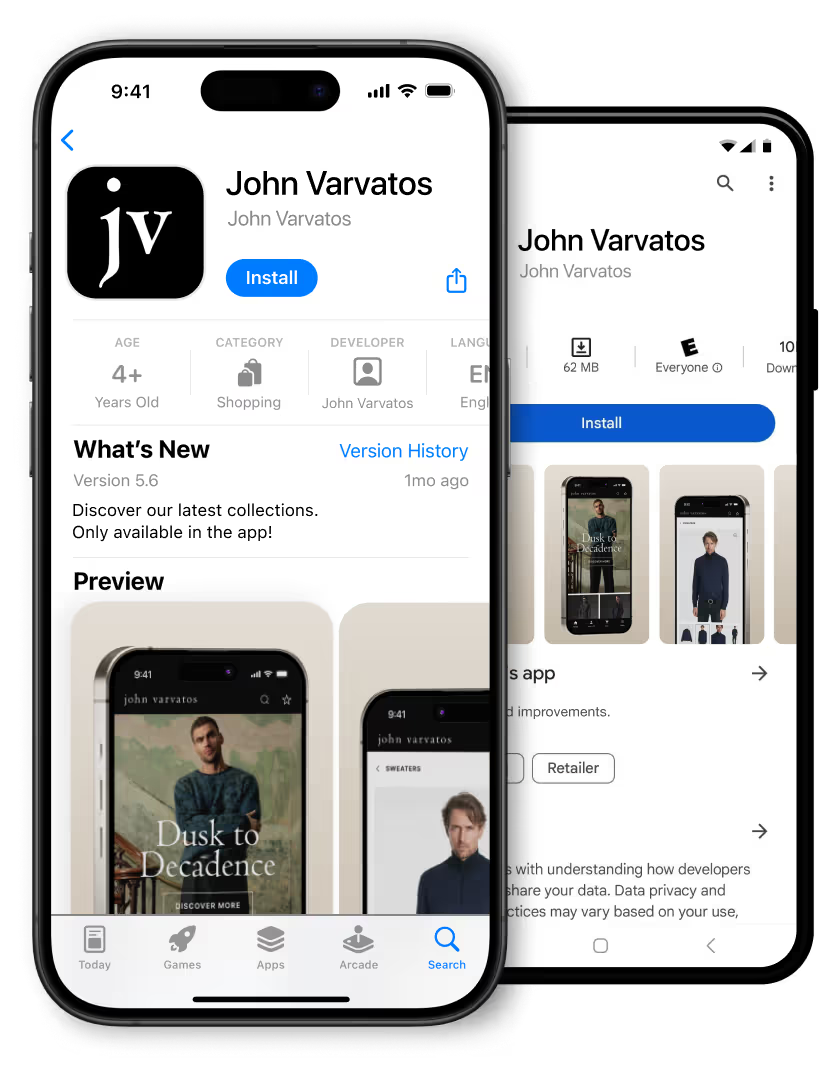
There's a third path: take the Next.js storefront you've already built and extend it into a native mobile app with MobiLoud.
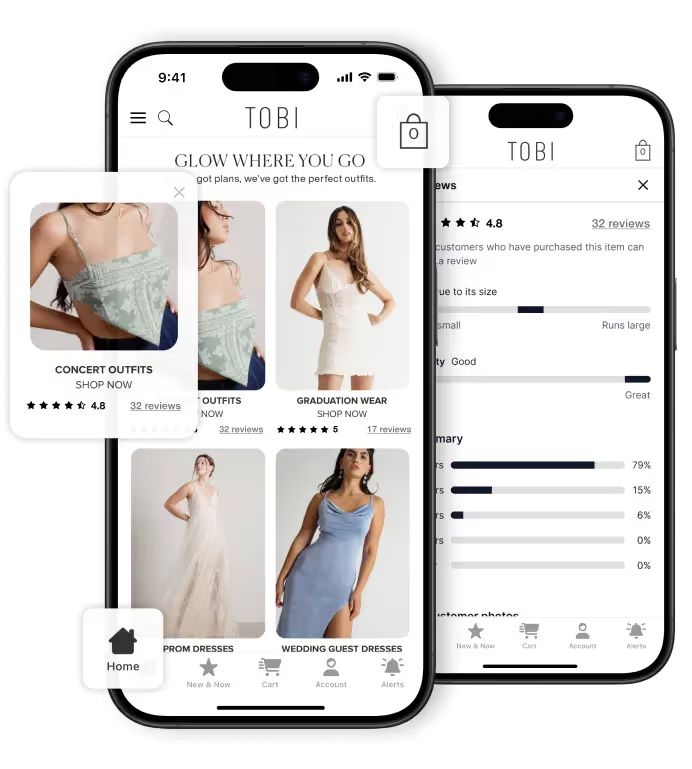
Your storefront IS the app. Every custom component, every server-rendered page, every integration, all delivered inside a native iOS and Android app with native capabilities layered on top.
No static export. No stripping SSR or ISR. No rebuilding your product catalog in a different framework. Your Next.js storefront runs exactly as you built it, with the addition of push notifications, native navigation, a home screen icon, deep linking, and App Store listings.
The cost is a fraction of a custom build, and the launch takes weeks, not months.

Why MobiLoud Is the Best Way to Turn Your Next.js Storefront Into a Mobile App
With MobiLoud, it's 100x more efficient than building a custom native app, and the end result is essentially the same as what you'd get if you rebuilt from scratch (with significantly less operational overhead as well).
Your Entire Custom Frontend Carries Over
You chose Next.js and built a custom storefront because the standard Shopify theme wasn't enough. Maybe you needed custom product configurators, advanced filtering, personalized recommendations, or a checkout flow tailored to your business.
With MobiLoud, all of that carries over. There's no compatibility list to check. No API translation layer. No "supported features" matrix. If it works on your website, it works in the app.
This includes your third-party integrations: Klaviyo, Yotpo, Algolia, Nosto, whatever tools you've connected to your storefront. They all work, because the app is powered by your website.
No Additional Headcount
A Capacitor implementation needs someone who understands Xcode, Android Studio, native certificate management, and the quirks of WebView rendering across devices. A React Native rebuild needs a mobile developer (or team) on payroll.
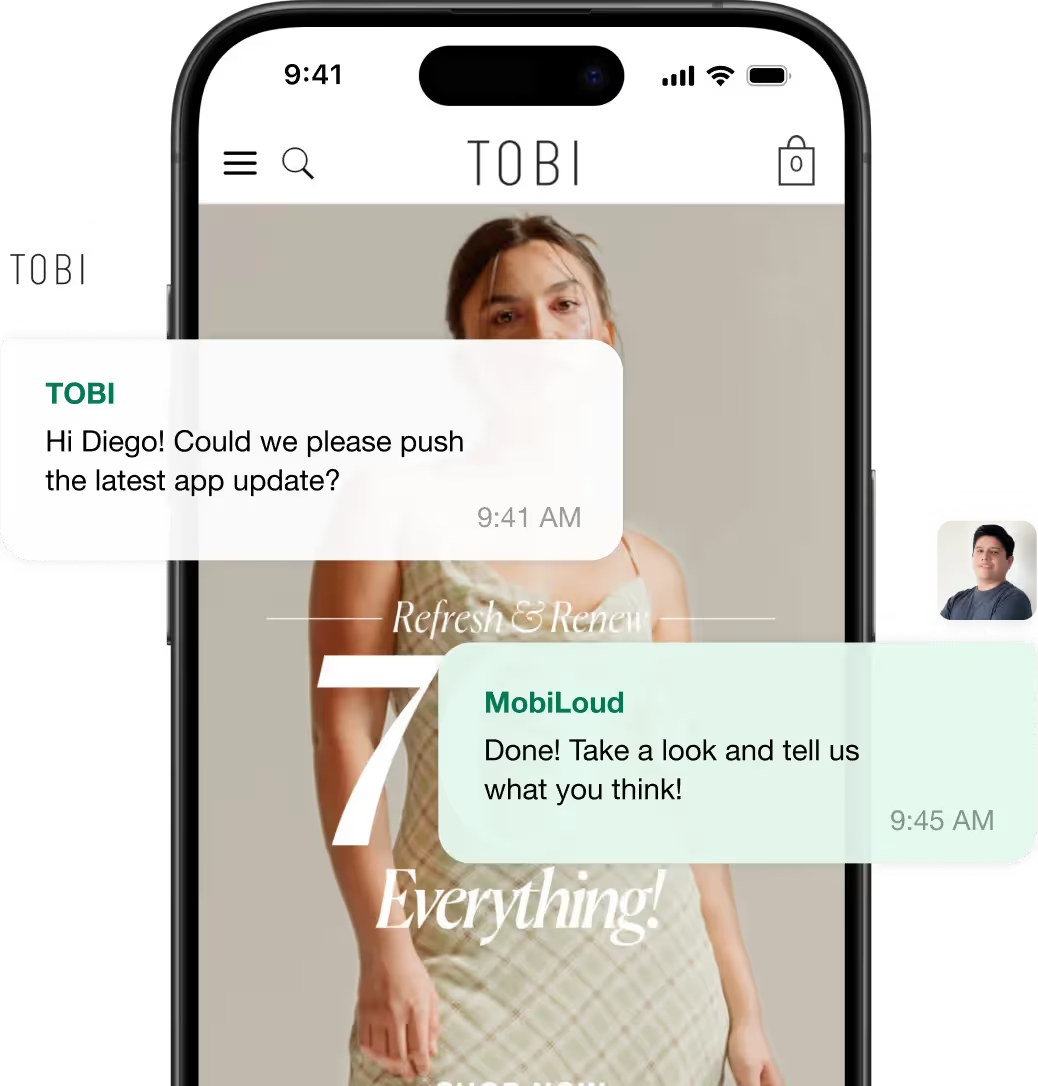
MobiLoud is a fully managed service. We build the app, handle submission to the App Store and Google Play, and maintain it going forward. OS updates, app store policy changes, native SDK upgrades: that's on us.
"When I heard about MobiLoud and that we could turn our website into a native app without additional development resources, it made perfect sense."
-- Steven Kachtan, CIO, buybuyBaby
Your team keeps doing what they're already doing: working on your Next.js storefront. When you update the website, the app updates automatically.
No SSR/ISR Sacrifice
This is the critical difference from Capacitor. MobiLoud doesn't require a static export of your Next.js app. Your server-side rendering, incremental static regeneration, middleware, API routes, dynamic routing: all of it keeps working.
You didn't invest in a headless architecture just to flatten it into a static SPA for mobile. With MobiLoud, you don't have to.
Update Once, Update Everywhere
Managing two codebases is the biggest hidden cost of going native. Every product launch, every seasonal campaign, every A/B test, everything has to be duplicated.
With MobiLoud, your app syncs with your website automatically. Push a change to your Next.js storefront and it's live in the app immediately.
There’s no separate deployment, version mismatches, or app update approval cycle for content changes.
"You don't need to maintain two systems. You update the website, and it shows up in the app. That saves us so much time."
-- Eric Lowe, Director of Ecommerce, XCVI
Native Features Where They Matter
Your app isn't just your website in a different container. MobiLoud adds the native capabilities you need from a mobile app (which are the reason you’re going for an app in the first place):
- Push notifications for abandoned carts, new arrivals, and promotions
- Home screen icon so your brand sits next to Amazon and Instagram on your customer's phone
- Native navigation with smooth transitions and tab bars
- Deep linking so marketing campaigns open directly in the app
- App Store presence on both Apple and Google Play
A lot of brands get it wrong by thinking their mobile app needs to be completely different from their website. Realistically, these are the only major additions you need. The core shopping experience doesn’t need to be that much different to what you already built.
How MobiLoud Turns Your Next.js Shopify Store into a Mobile App
The process is straightforward, and MobiLoud handles most of it.
1. Get a Free Preview
Book a free strategy call and we’ll put together an interactive preview of your Next.js storefront as a native app. You can see exactly what it looks like and how it feels before committing to anything. No cost, no obligation.
2. App Build
Once you give the go-ahead, we build your native apps. This includes the native layer with push notifications, native navigation, your app icon, splash screen, deep linking, and any extras needed for your specific storefront.
3. Testing and QA
We run comprehensive tests across iOS and Android devices. You test on your own devices and provide feedback. We iterate until everything is right.
4. App Store Submission
MobiLoud handles Apple App Store and Google Play submission, including all compliance requirements, metadata, and screenshots. No dealing with provisioning profiles or signing certificates.
5. Launch and Ongoing Support
Your app goes live. MobiLoud handles OS updates, app store policy changes, maintenance, and ongoing support. You keep working on your Next.js storefront, and the app keeps pace automatically.
The whole process could take just four weeks from first call to App Store. Compare that to a 6-12 month timeline to build a custom native app.
Brands we work with often use the term “no-brainer”, and we’re inclined to agree with them.
Next Steps
MobiLoud is the simplest, fastest way to turn your Next.js Shopify storefront into a native mobile app.
The cost is less than 1% of what a custom native build would run you. The timeline is weeks, not months. And you don't sacrifice a single feature you've built on the web.
Your Next.js storefront already works. It's responsive, fast, and optimized for mobile browsers. Why spend $100,000+ and six months rebuilding it in React Native when you can extend it into a native app and launch in 30 days?
Here's how to get started:
- Book your strategy call - We'll discuss your storefront, your goals, and whether MobiLoud is the right fit. No commitment.
- Get your custom app preview - See your Next.js storefront as a native app before you commit to anything.
- Launch in 30 days - We handle everything, from build to App Store submission. You keep building on your website.
We've built 2,000+ apps over the last 10 years, including a range of custom storefronts and global ecommerce brands. We know what it takes to get you an app that drives real ROI.
Book a free 30-minute strategy call to learn more, and get all your questions answered.


