Table of contents
Running a multi-storefront ecommerce business creates a specific problem the moment you decide to build a mobile app: how do you fit a dozen storefronts into a product the user taps once to open?
This can be a major roadblock for global brands, brands with B2B and B2C stores, wholesale/retail, brands with buy/sell platforms, and a lot of other edge cases where you have multiple “stores” under one banner.
A lot of the time, launching a mobile app for these brands either means launching separate apps with their own listings, reviews and update cycles, or a heavily complex development project, which could reach into the high six-figures in cost.
Neither of these options are ideal. If your brand falls into this category, you’ll likely want to find a simpler way to build and maintain one, unified mobile app.
Keep reading for the full picture.
What Is a "Multi-Storefront" Ecommerce Business?
Most businesses that land here fall into one of four patterns.
The underlying app requirement is the same in all four: a single installed product has to serve several distinct commerce experiences without forcing shoppers to download separate apps.
Multi-storefront apps let both audiences coexist without building two completely separate apps, as long as each audience is gated into its own flow after login.
Multi-Region or Multi-Country Brands
This is a common scenario. A brand sells in several countries, often with localized storefronts covering language, currency, shipping rules, and catalog differences.
We commonly hear from brands that run anywhere from three to fifteen regional storefronts. They might operate in the US, UK, Brazil, and multiple EU countries, with different sites, but the same brand across all.
B2B and DTC or Wholesale and Retail Splits
Brands might run a consumer-facing DTC storefront alongside a wholesale or B2B storefront on the same domain. The two experiences share a brand but differ on almost everything that matters commercially. Catalog, pricing, login-gated access, checkout, and sometimes the underlying platform all diverge.
New Retail and Buy/Sell or Refurbished Storefronts
Electronics retailers, collectibles platforms, sneaker marketplaces, and luxury resale brands frequently run a new-product catalog alongside a buy/sell, trade-in, or refurbished storefront.
Each side is under the same brand, but the commerce logic is genuinely different: new retail on one side with standard checkout and fulfillment, peer-to-peer or refurbished on the other with condition grading, seller payouts, escrow, and different trust and review flows.
Multi-Brand Retail Groups
Many enterprise brand portfolios exist with a number of individual brands under their umbrella.
Think Unilever (as well as countless smaller portfolio companies).
Most of the time, these groups will offer individual apps for each brand. But in some cases, the brands are combined and offered in the same web/app experience.
Sub-Brands, Clubs, or Portfolio Experiences
Less common, but the same mechanic supports it. Sports clubs, franchise networks, and brands that let users pick which "world" to enter on first launch all fit the multi-storefront pattern.
The Edge Cases That Make Multi-Storefront Apps Hard
On paper, a multi-storefront app sounds like a simple routing problem. After all, on web it’s easy - there’s no problem showing the right locale to the right user.
In practice, the real-world shape of multi-storefront ecommerce creates edge cases that break most app infrastructure.
Different Ecommerce Platforms Per Region
International brands grow by acquisition, partnership, and regional hand-off, which often means the US site often runs on Shopify while the Latin American sites run on VTEX, the European sites on Magento, and a Middle Eastern site on Salla or a custom build.
Most app builders assume a single backend platform and cannot route one app to several different ones. Custom native teams can technically handle it, but every new platform is a new integration project. You’re turning a $50-$100K project into one that could touch seven figures.
Separate Authentication and Checkout Flows Per Storefront
Each regional or brand storefront often has its own account system, checkout rails, and loyalty platform. A shopper who signs up in the US does not automatically have an account in Germany. The app has to respect each storefront's auth logic instead of flattening everything into one global user table.
Language, Currency, Catalog, and Tax Logic
These are not decorative differences. A shopper seeing US dollars when their card charges in euros is a returns event waiting to happen. Every region has its own SKUs, VAT treatment, shipping windows, and locally relevant promotions. The app cannot paper over any of that.
Platform-Specific Payment Rails
Pix in Brazil, iDEAL in the Netherlands, Klarna in the Nordics, Cash on Delivery across the Middle East. Each storefront needs to pass through the payment methods shoppers in that region actually use.
If the app bypasses the website's checkout, those methods have to be re-integrated from scratch.
Why the Default Has Been "One App Per Storefront"
The combination above is exactly why most mobile app platforms default to the simplest possible architecture: one app, one backend, one storefront. Multiply by regions and you get a portfolio of apps. That architecture is easier for the vendor, worse for the brand, and worse for the shopper.
The Multi-App Problem
Separating different languages, catalogs, logic etc is easy enough if you say “we’re going to launch different apps for each location” (or for B2B & B2C, wholesale & retail).
Sometimes this is the best approach. In a lot of cases, it’s not (particularly global brands).
Different apps means:
- Different app store listings
- Different reviews
- Different rankings and ASO signals
- Different update cycles
It’s just so much more to juggle. One app for all your properties streamlines it tremendously.
How MobiLoud Builds You a Multi-Storefront Mobile App
There’s a perfect solution for global brands, and other multi-faceted ecommerce brands that need to integrate multiple “stores” in one mobile app.
MobiLoud builds a single app that can run multiple configurations. Each configuration is the complete definition of one storefront experience, covering navigation, styling, URLs, auth, push setup, and native behaviors. One app can hold as many configurations as the business needs.
How It Works (In Practice)
The UX most brands use is straightforward. On first launch, the app shows a menu - typically flags with country names, or logos with brand names - and the shopper picks theirs.
The app loads that configuration, and everything from that point forward is the storefront they selected.
If the shopper wants to switch later (traveling, expats, browsing another market), they change their selection from the settings screen.
Under each configuration, the app points at whatever website powers that storefront. That could be Shopify in the US. VTEX in Brazil. Magento in Germany. BigCommerce in Australia. The app doesn’t care what platform powers each storefront.
The same thing runs true if you want different brand stores in one app, or a B2B and B2C retail, or a traditional storefront and a P2P marketplace.
You can ship this with:
- One iOS app and one Android app
- One App Store listing and one Play Store listing
- One native binary to maintain across platform updates and OS releases
- One dashboard to manage every storefront's configuration
- One set of native features (push, deep linking, native checkout upgrades) applied across all configurations
Each storefront remains independent (and managed via the web, as you currently do it), with their own:
- Content, catalog, pricing, and checkout
- Language, currency, tax, and payment methods
- User accounts and order history
- Push notification segmentation
- Analytics, attribution, and reporting
Most MobiLoud customers with multi-storefront setups ship a single multi-configuration app. It is the recommended default because it compounds review signal, ranks under one App Store listing per region, and gives marketing teams one asset to promote instead of a portfolio.
We’ve done this for multiple customers, the most notable being Bestseller. This international, family-owned fashion company has over 20 brands, with most operating in a number of different markets (their products are sold in over 90 countries altogether).
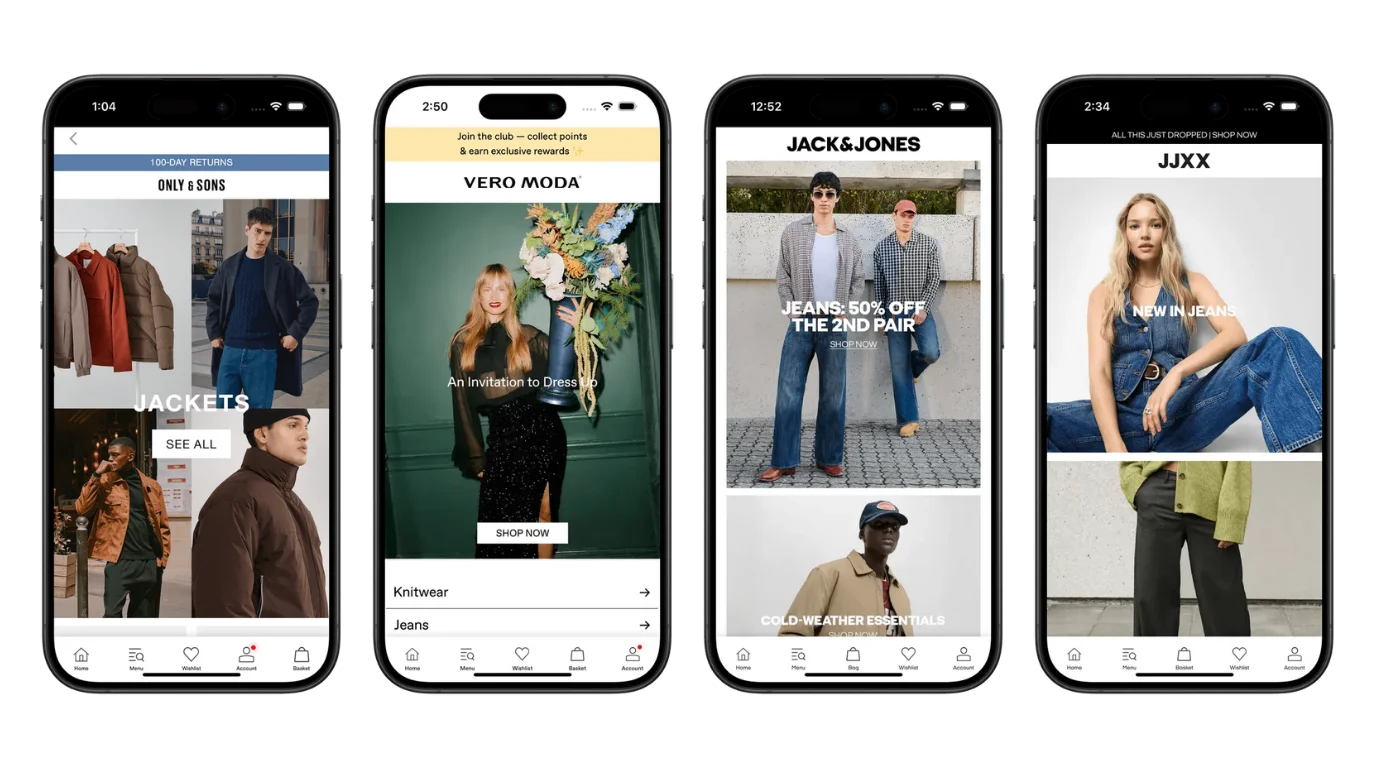
For several of their brands, we helped them launch apps that combine each of their brands’ locations inside of one app.
No “Jack & Jones US”, “Jack & Jones Germany”, “Jack & Jones Denmark” etc - just one Jack & Jones app, that customers in all of their supported markets can use and switch to their own region.
“Through history we’ve tried doing what MobiLoud does. We couldn’t find another company that could offer the same features at the same price point, same time to market, and make it as easy as MobiLoud could.”
-- Svend Hansen, Product Owner at Bestseller
It’s just one example of how MobiLoud can easily accommodate some of the most difficult ecommerce configurations, and simplify the process of launching and maintaining mobile apps.
Running multiple storefronts?
See what one app could look like.
MobiLoud’s Multi-Storefront Solution vs the Alternatives
The two broad alternatives to launch a mobile app would be to custom-build apps from scratch, or use a DIY no-code app builder.
Generally speaking, neither are ideal. Let’s break it down:
Custom Native Development
Custom native development can handle multi-storefront apps. By definition, if you’re coding apps from scratch, there’s nothing you can’t do.
But the problem is, the complexity of this kind of project is brutal.
Custom “from scratch” builds are long and costly and difficult to maintain in the first place. You’re usually looking at $100K+, just for the first build (not taking into account the ongoing maintenance cost).
Now, by integrating multiple storefronts, potentially with different platforms, different APIs, auth flows, payment gateways, backend logic, you’re adding multiples to the complexity (and cost).
In the best case, we typically don’t recommend building from scratch if you’re an ecommerce store. It’s even worse with edge cases like these. You’re turning what could be a high-ROI project into an operational nightmare.
No-Code App Builders
The other alternative is to use a no-code tool.
These tools are a great way to build an app, for certain types of stores. But they’ll likely struggle with more complicated setups.
Most, on their higher plans, support currency localization. But that usually doesn’t cover brands with completely different storefronts for each region.
And almost certainly not brands with starkly different B2B and B2C channels, or P2P selling.
You’re often going to end up with separate apps, which as we’ve established, generally isn’t ideal.
Also, these tools are explicitly tied to the platforms they’ve built API integrations with (usually only Shopify).
If you’re a brand with a US store on Shopify, but selling on PrestaShop in the EU and Salesforce Commerce Cloud in Australia, there’s basically no way you’ll be able to ship one unified app with these no-code app builders.
Running multi-region or multi-brand ecommerce?
Your team already maintains every storefront in the format that works best for each region: different platforms, different currencies, different checkouts. You don't need to rebuild that architecture for the app.
MobiLoud extends every one of your storefronts into one native app, with one App Store listing and one dashboard to manage it all. Around 6-8 weeks from kickoff to live in both stores.
Book a Free Strategy CallHow to Turn Your Multi-Config Ecommerce Store Into a Unified Mobile App
MobiLoud is the easiest, most effective way for ecommerce stores with multiple configurations to launch a mobile app that features all of their configs under one banner.
The operational cost, the marketing cost, and the shopper experience are all so much better compared to the portfolio-of-apps model.
And you get this one, unified app, without the massive complexity of a custom app built from scratch.
If you do need separate apps, we can of course accommodate that too. The key point is that we work for you - you don’t adapt your store, your tech stack, and your desired output to fit our platform.
If you want a closer look at what’s possible, get in touch - get a free preview and we’ll show you an interactive demo, and walk you through how we’ll turn your multi-config setup into the perfect mobile app.

Andrew Buck
Head of Content
Andrew is a content marketer with close to 10 years' experience creating digitally-native content. He has written extensively on topics related to Shopify, Amazon, ecommerce and digital marketing, drawing on previous experience in high-traffic retail and customer service. He started his marketing career with LandingCube, a SaaS tool for Amazon sellers, and has since progressed to work with numerous successful startups, creating helpful and engaging content, which has been referenced in thousands of publications, including Forbes, the New York Times, and many more leading websites. Now, Andrew runs all content operations for MobiLoud.