Despite more people buying on their phones than ever before, and the barrier of entry to mobile apps being lower than ever before, a relatively small share of ecommerce stores have their own app.
The number one objection I hear when I tell a brand owner to launch an app is: "Won't most of the revenue just come from people who would have bought on my website anyway?"
It’s a fair question to ask. If you’re going to invest in a mobile app (or any channel), you want to be confident that it’s going to add a real, incremental lift to your business.
So is this a real concern? Are mobile apps just shifting revenue from one channel to another? Or is it a channel that can add real numbers to your bottom line?
We’ve published more than 2,000 apps since 2013, for hundreds of high-revenue ecommerce brands among others. So we’ve got a lot of data to work with.
Here’s what it tells us.
Will a Mobile App Just Cannibalize My Website Sales?
The short answer: some overlap exists, and pretending otherwise would be dishonest.
A portion of the customers who buy through your app would have purchased on your website if the app didn't exist. That's true.
But framing app revenue as either "incremental" or "cannibalized" misses what's actually going on. The more useful question isn't "where did this sale happen?" It's "would this customer have spent this much, this often, at all?"
That distinction matters because apps don't just give customers a different place to buy. They change how customers behave.
More frequent visits. Larger orders. Purchases triggered by push notifications that wouldn't have happened otherwise.
Even when a sale "moves" from web to app, the customer's spending patterns shift in ways that increase their total value over time.
This is the difference between channel shift (same revenue, different screen) and behavioral lift (more revenue, period). The data consistently shows the latter.
How Mobile Apps Drive Revenue That Wouldn't Exist Otherwise
There are four distinct mechanisms that drive genuinely new revenue through mobile apps. Each one is measurable, and each contributes to the gap between what a customer spends on your website versus what they spend when they have your app.
Let’s take a look now.
Lower Friction – More Frequent Visits
When your store is one tap away on a customer's home screen, they visit more often. It’s simple friction economics.
Opening an app takes one tap. Visiting your website on mobile means opening a browser, typing a URL or searching, then navigating to what they want.
The difference shows up clearly in session data from brands we work with.
- Tadashi Shoji sees 3.8x more sessions per app user compared to mobile web visitors.
- John Varvatos sees 12x more sessions from app users.
- Freedom Rave Wear sees 5.75x.
These extra sessions aren't all replacing web visits. A couple, maybe. But John Varvatos isn’t taking people who visit the website 12x more than the average user and shifting them to their mobile app.
These are additional moments when a customer opens your store because the barrier is low enough that it happens on a whim, during a commute, while waiting in line.
Each of those sessions is an opportunity to buy - that didn't exist before.
Better Experience – Larger Orders
App users also spend more per visit.
Across brands with live apps, AOV lifts of 10-50% are typical. Sleefs sees 30% higher AOV in their app. XCVI sees the same.
Native apps load faster, offer fewer distractions (no browser tabs, no URL bar, no competing notifications from other sites), and feel more like a dedicated shopping experience.
That keeps shoppers engaged for longer, spending more time in your store. And as anyone with a background in retail will tell you, the longer someone spends in a store, the more they’ll buy.
Push Notifications Reach Customers When Your Website Can't
This is the strongest argument for incrementality, because push notifications are a channel that literally does not exist without an app.
When you send a push notification, you're reaching customers who aren't browsing your site, aren't checking their email, and aren't thinking about you at that moment.
A notification appears on their lock screen, and suddenly they're back in your store. That purchase wouldn't have happened otherwise.
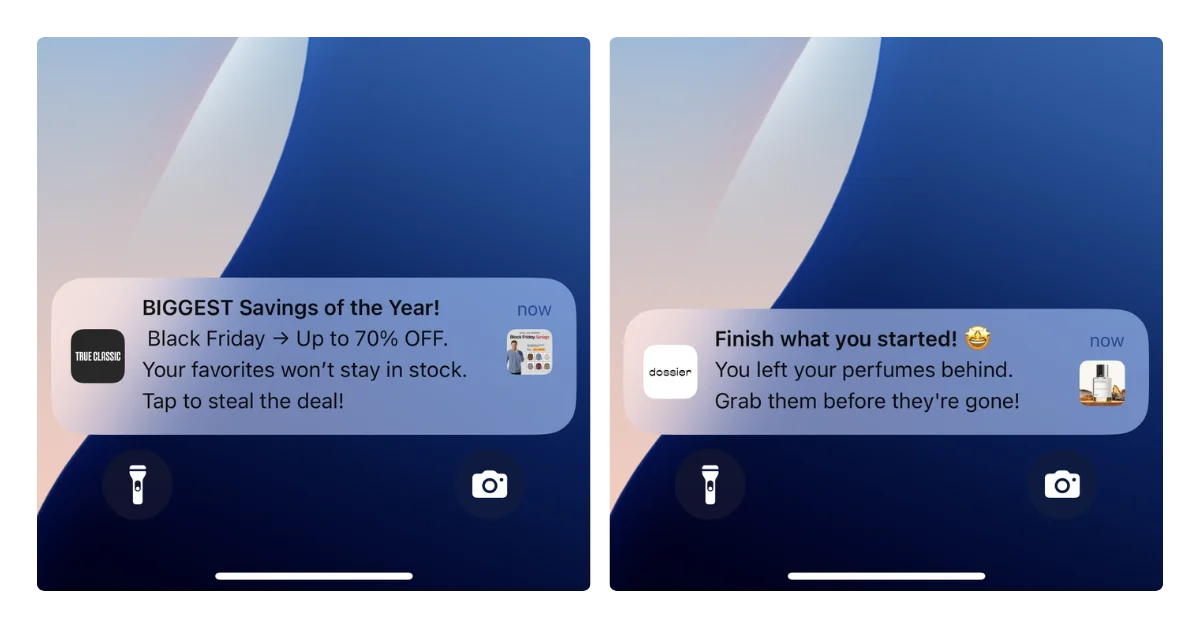
Abandoned cart push notifications are especially clear-cut.
Your website has no way to tap a customer on the shoulder and say "you left something in your cart" through a lock screen notification. Email works fairly well, but not nearly as well as a push notification.
Push lands instantly, is almost guaranteed to be seen, and sends the customer right back to the app, which increases the chance of a conversion.
The revenue impact of abandoned cart push is no joke. Brands we work with generate anywhere from $20K to $200K per month just from abandoned cart push notifications.
Online pharmacy Pharmazone runs abandoned cart push that converts at 22%. That’s almost 1 in 4 notifications leading to a sale.
Revenue from abandoned cart push notifications is revenue from a channel that didn't exist before the app launched. By definition, it's incremental.
App Users Become More Valuable Customers
The incrementality argument gets stronger the longer you look at it. App users don't just spend more per transaction; they compound in value over months and years.
App users:
- Stay customers for longer.
- Purchase more over time.
- Become more valuable customers over time.
The app sets a powerful flywheel in motion.
Research from Smile.io across 1.1 billion shoppers shows that a first-time buyer has just a 27% chance of making a second purchase. But once they do, the probability of a third jumps to 49%. After a third purchase, it climbs to 62%.
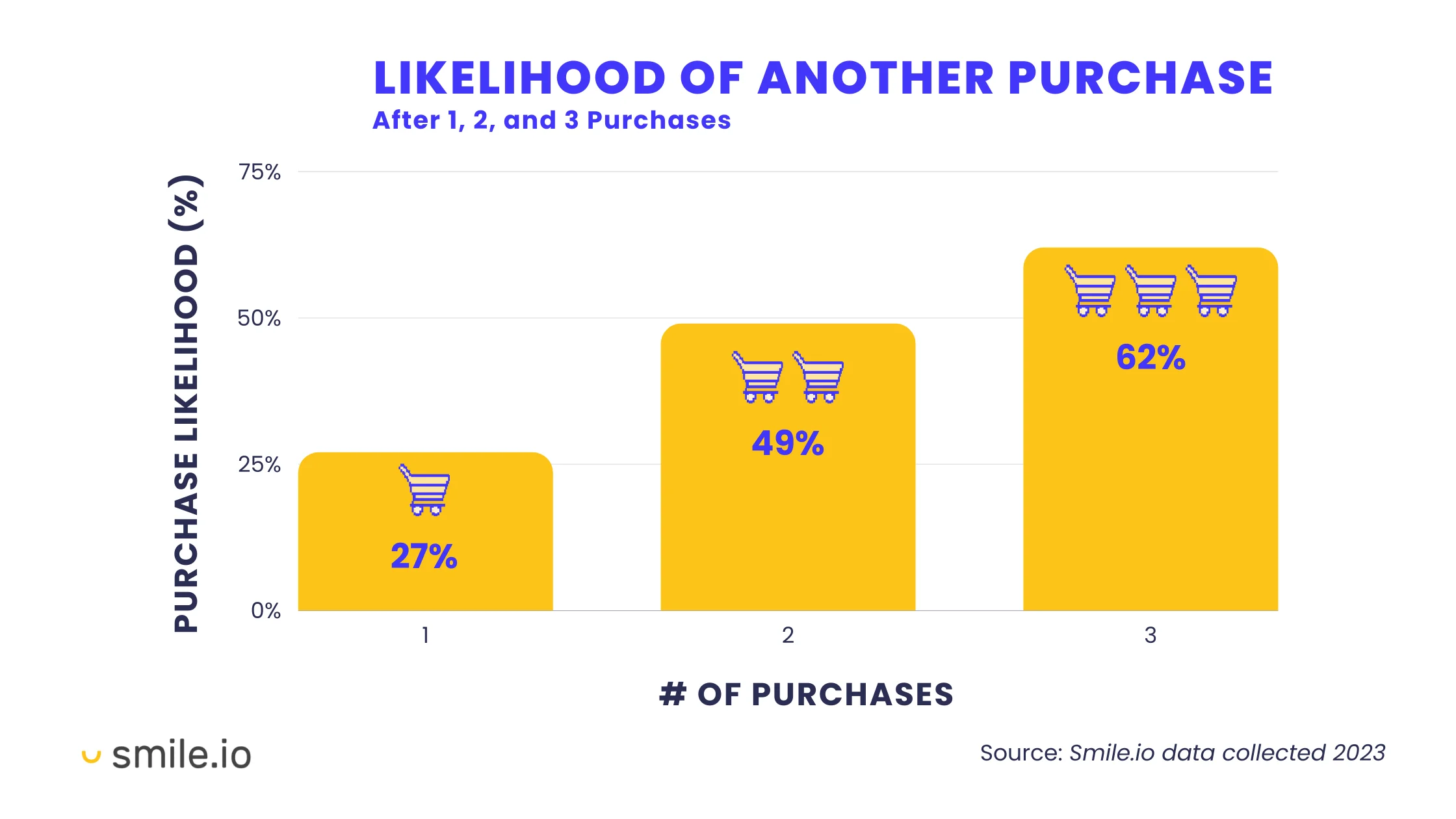
Each purchase makes the next one more likely. And customers don't just buy more often; they spend more each time too.
Average order values grow roughly 30% within six months and 45% over three years as trust and familiarity deepen.
The combination of a home screen icon, push-driven re-engagement, and a frictionless shopping experience gets customers past that critical second and third purchase faster. Even if their first app purchase would have happened on the website, the fifth, tenth, and fifteenth purchases may not have.
That long-tail compounding is where the real incremental value lives.
"The app's been invaluable to us. The cost we're paying versus what we're getting back is tenfold."
-- Nick Barbarise, Director of IT at John Varvatos
The Crazy Value of App Users (and the Retention Question)
One thing we constantly see: app users contribute far more revenue than the average shopper.
Let’s take a look at some real data from MobiLoud brands (see more in the MobiLoud Ecommerce Benchmark Report).
We have a fashion brand where just 2% of mobile traffic comes through the app, but that 2% generates 35% of mobile revenue.
The pattern doesn’t stop there. Junior Couture, a luxury childrenswear brand on Salesforce Commerce Cloud, sees an extreme impact:
"Only about 5% of users are on the app, but they generate around 50% of sales."
-- Narasimha Pinnelli, Architect at Junior Couture
More examples:
- Pharmazone sees 63% of online revenue from their app.
- Kiokii, with roughly 10% of their customer base using the app, generates 35% of total online revenue through it.
- Tadashi Shoji gets 18% of total online revenue from their app, with app users generating 10x more revenue per user than mobile web visitors.
But here’s your response - “you’re just proving that incrementality is false! Apps only generate more revenue because they’re already your most valuable customers!”
Perhaps. If we take that as the truth, and say that an app user who spent $500 this year would have spent the exact same amount on the website, there’s still value in the app.
Mobile apps keep customers closer. They’re a direct line to the customer, an owned channel, where you control the relationship.
That increases retention. And it does so for the customers who matter the most - your top spenders, your top 20% who are worth the most to retain.
Why "Incremental vs Cannibalized" Is the Wrong Framing
Trying to classify every app dollar as either "new" or "stolen from the website" is a bit like asking whether your loyalty program cannibalizes non-loyalty purchases.
Of course some of your loyalty members would have bought anyway. But the program changes their behavior in ways that increase total spend. You don't shut down the loyalty program because some members were already customers.
Or if you look at your 10% first purchase discount and wonder if these customers would have bought at full price instead.
The same logic applies to apps. Even the portion of app revenue that "would have happened on the website" still carries value.
Customers buying through the app are in a faster, more focused environment. Their experience is better, their satisfaction is higher, and their likelihood of returning is greater.
That has downstream effects on retention and lifetime value that are hard to attribute to a single transaction but very real at the portfolio level.
Some Mobile App Revenue is Incremental. Not All
Here's where the math makes the incrementality debate somewhat academic.
Brands with mobile apps typically see 10-35% of total online revenue flow through the app channel. Let's meet in the middle and say 25%.
Now let's be deliberately conservative and assume only half of that is truly incremental, that the other half would have happened on the website anyway.
That still leaves a 12.5% net revenue lift from launching an app.
What does 12.5% incremental revenue look like at different scales?
| Annual Revenue | App Revenue (25%) | Incremental Lift (12.5%) |
|---|---|---|
| $10M | $2.5M | $1.25M in new revenue |
| $20M | $5M | $2.5M in new revenue |
| $50M | $12.5M | $6.25M in new revenue |
| $100M | $25M | $12.5M in new revenue |
A managed app service like MobiLoud costs under $25K per year. Even the $10M brand in this scenario is looking at a 50x return on the incremental revenue alone, and that's using assumptions that are deliberately stacked against the app.
And remember: this is the conservative case. It assumes half the app revenue is cannibalized. In practice, the combination of push notification revenue, higher AOV, stronger retention and increased purchase frequency suggests the truly incremental share is likely higher than 50%.
How Can You Measure Whether Your App Revenue Is Incremental?
If you want to move past theory and measure incrementality for your own brand, there are four practical ways to get an idea of how much mobile revenue is actually incremental.
- Watch total revenue after launch. If app revenue is purely cannibalized from the web, your total online revenue stays flat after launching the app, with web revenue dropping by whatever the app generates. If total revenue goes up, the app is driving incremental value.
- Compare per-user metrics. Look at ARPU (average revenue per user), purchase frequency, and AOV for app users versus web users. The delta between these numbers represents behavioral lift. It could still indicate higher quality customers moving from one platform to another; but concentrating these customers in a high-retention channel is worth it, as we discussed.
- Track push notification revenue. Abandoned cart recovery, promotional campaigns, and re-engagement pushes all generate revenue through a channel that didn't exist before your app. This revenue is incremental by definition.
- Monitor web revenue post-launch. Does your web revenue drop by the same amount as your app revenue generates? Or does it stay steady?
Want an estimate of how much revenue your app could add? Use our free Ecommerce App Revenue Calculator to find out.
Ready to Launch?
The fastest way to answer the incrementality question for your own brand is to see real data from your own store.
And the easiest way to launch your own mobile app, and see the incremental lift it can provide, is with MobiLoud.
MobiLoud turns your existing website into a full-featured mobile app, with minimal overhead, no technical debt, and a team to support you and handle everything for you.
You could be live in 6-8 weeks, with an app that retains everything you’ve worked so hard to build for your store - PDPs, collections, personalization features, site search, subscriptions, and everything else you rely on to drive revenue.
Get a free consultation to see what your app could look like, and what the return could be. No commitment required. If the math doesn't work for your brand, we'll tell you.