Food and beverage brands have a built-in advantage most ecommerce categories don't: your product runs out.
Nobody buys a couch every month. But coffee, protein powder, sparkling water, meal kits, supplements, and snacks? Those are consumable, predictable, and mean a virtually infinite conveyor belt of sales.
That consumption cycle is the foundation for the strongest mobile app business case in ecommerce. When your customers buy the same products repeatedly, an app becomes their default reorder channel. It keeps your best customers close, and drives consistent repeat sales at high margins.
This is the complete guide to mobile app development for food and beverage: covering why F&B brands need their own mobile apps, what you can learn from brands like Starbucks, Nespresso, and McDonalds, and how to get your own app live (without spending hundreds of thousands of dollars).
Why Food and Beverage Brands Need a Mobile App
F&B is one of the strongest verticals for mobile apps.
Your customers already shop on their phones and buy the same products on a predictable cycle. An app turns that cycle into a habit, gives you a direct channel to reach customers with push notifications, and makes your loyalty program more visible and more used.
Just about every F&B brand should have a mobile app. Here are a few reasons why.
The Mobile-First F&B Shopper
Certain sources find that mobile accounts for 74.5% of traffic to online food brands.
Shoppers look for convenience and speed, having been conditioned to do so by the likes of Amazon and Walmart.
Mobile apps deliver that. They provide a better mobile user experience than browser-based sites, especially for shoppers who want to come back and buy regularly (who are also the customers with the highest revenue potential).
Your buyers are already on mobile - an app meets them where they are, with a user experience more tailored to their habits.
App Users Shop Differently
App users convert more, shop longer, and spend more than mobile web visitors.
MobiLoud’s Ecommerce Mobile App Benchmark Report finds that mobile shoppers view 4.2x more products per session than mobile web visitors and spend significantly more time per session.
They also convert up to 7x higher, have 10-50% higher AOV, and generate 3.5-7x higher revenue per user on average.
Launching an app means launching a channel that performs better, and cultivates high-value customers.
Apps Are the Perfect Replenishment Engine
F&B products run out on a predictable schedule. Coffee pods every 2-4 weeks. Protein powder every month. Sparkling water every couple of weeks. This consumption cycle is the strongest argument for a mobile app.
In an app, replenishment becomes effortless. A push notification reminds the customer they're likely running low. One tap reorders. The subscription management screen lets them pause, skip, or swap without emailing support.
Compare that to the mobile web experience: open browser, navigate to site, log in, find the product, add to cart, enter payment. The app wins on convenience every time.
Nespresso is the perfect example of this. Their app tracks capsule usage (through machine connectivity), sends timely reorder prompts, and offers AutoReplenish for automatic recurring orders. It's the model for any consumable F&B brand.
Push Notifications as a Lever for Retention and Purchase Frequency
Push notifications are one of the strongest reasons to have a mobile app. They reach customers instantly, on their lock screen, with near-perfect visibility and no per-send cost.
For F&B brands, push maps directly to natural purchasing triggers.
- Reorder reminders timed to consumption cycles.
Subscription management alerts. - New flavor and limited-batch drops.
- Loyalty point nudges.
- Recipe suggestions featuring products the customer has purchased.
It’s the perfect channel for an F&B brand. Consistent nudges both keep your brand top of mind, and can drive a meaningful lift in repeat purchases.
For a consumable category where the next purchase is always around the corner, push is the most efficient retention marketing channel available.
Enhancing Loyalty
F&B brands run on loyalty. Almost every successful brand has a loyalty program, specifically to incentivize shoppers to come back more often, spend more, and buy from them (not the competition).
Apps elevate your loyalty program, making it work harder, and deliver more value.
When your loyalty program lives in the app, it becomes more visible and more used. Real-time points balances. Tier progress. Exclusive offers. Early access to drops. All of it lives on the customer's home screen, one tap away.
The Best Food and Beverage Mobile App Examples: What You Can Learn From Them
There are plenty of successful F&B apps to take inspiration from. Your brand may not be operating on the same scale as Starbucks or Nespresso, but you can still take a lot away from the experiences these brands have built.
Starbucks: The Gold Standard for Mobile Commerce
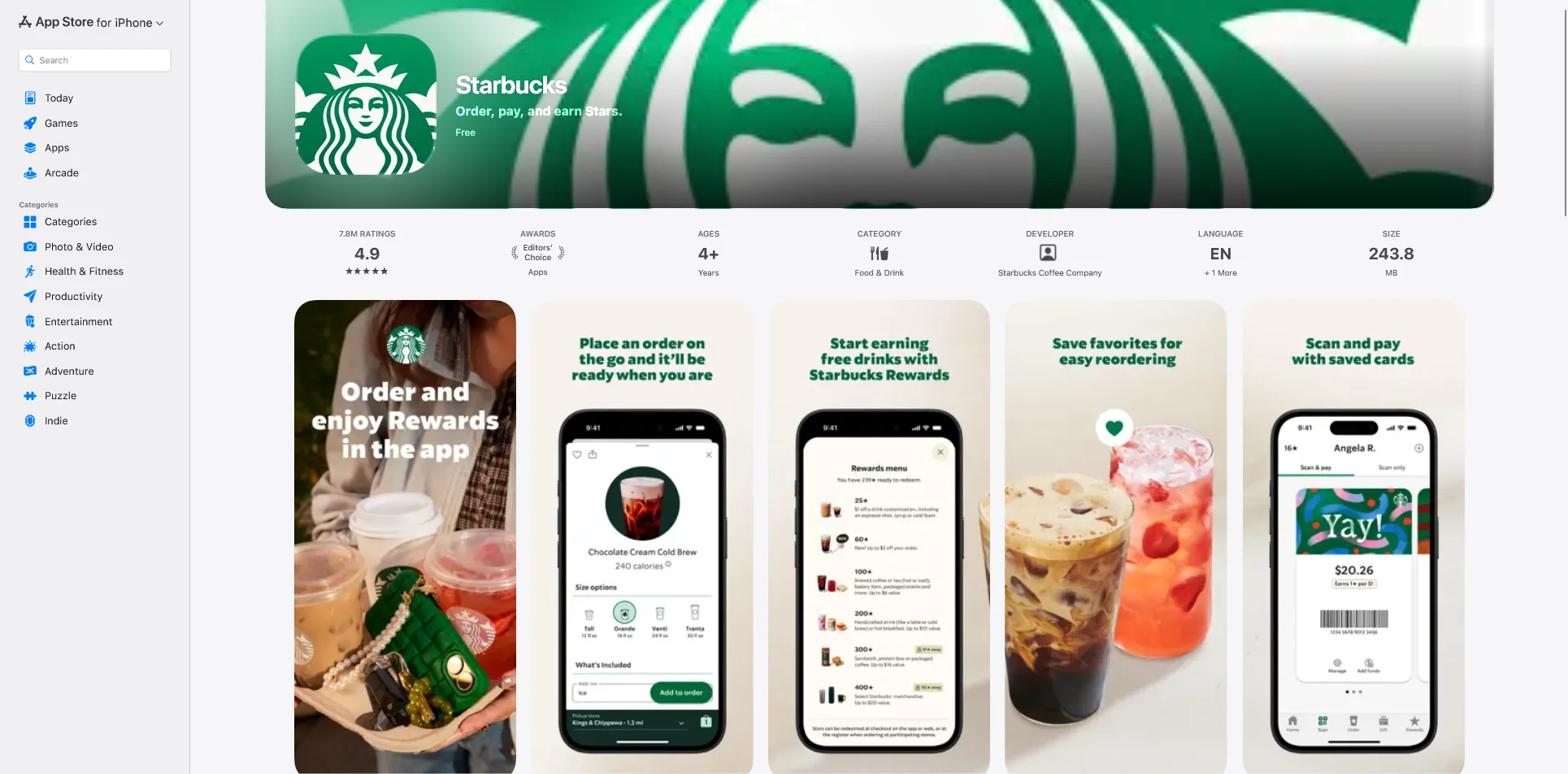
Starbucks' app has 31.2 million active US users, and is so popular that it’s actually the second most popular mobile payment service in the US (after Apple Pay).
31% of US company-operated store transactions come through the app. It combines mobile ordering (order ahead, skip the line), a Stars-based loyalty program, in-app payments via stored-value card, and personalized recommendations. Mobile ordering alone accounts for roughly 20% of total Starbucks revenue.
The lesson: Combine loyalty, convenience, and payments into one smooth experience. The "Stars" currency creates habit loops that drive daily engagement. While Starbucks is technically a restaurant brand, its recurring purchase model mirrors how CPG replenishment works.
Nespresso: The Replenishment Model
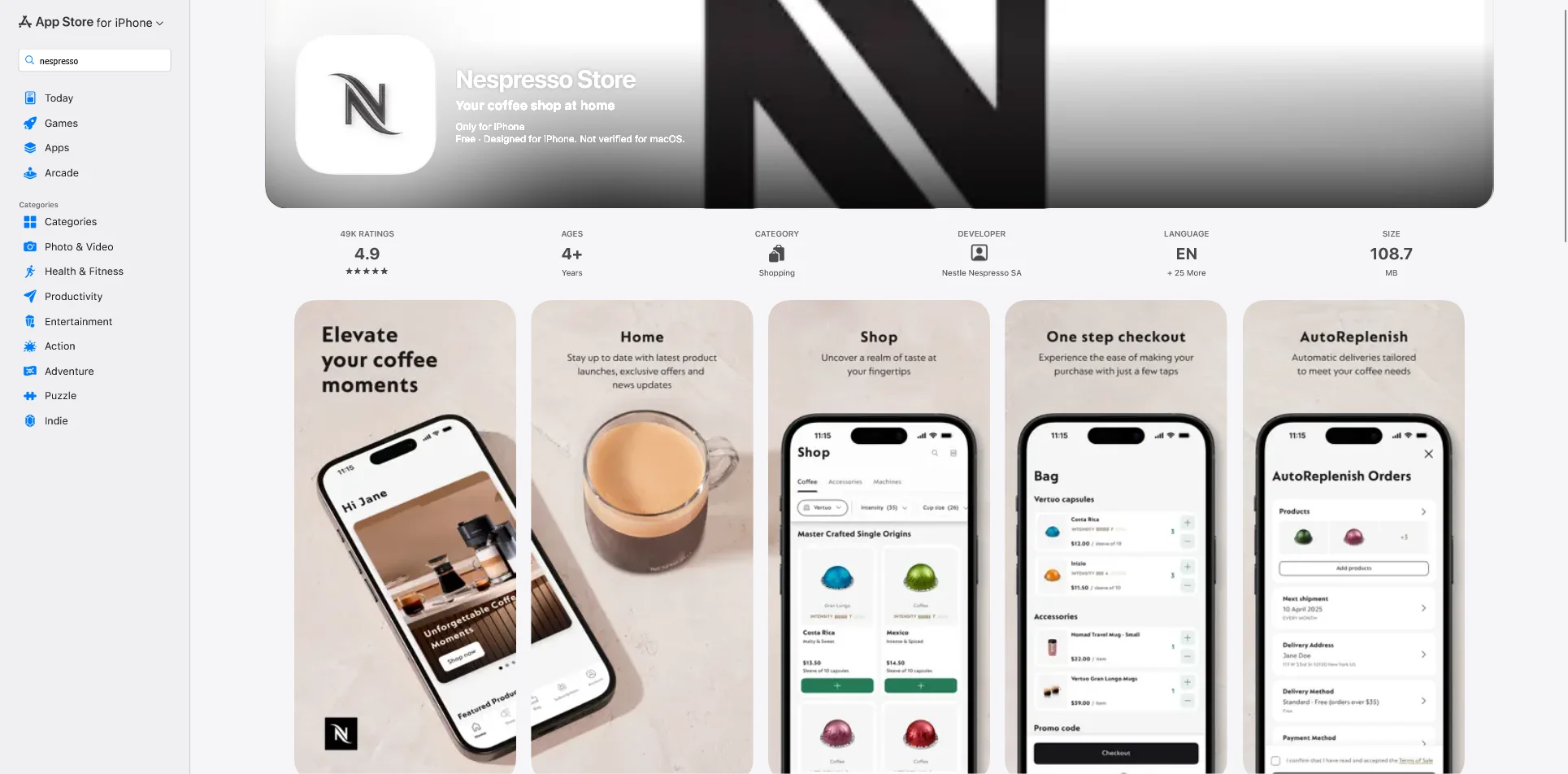
Nespresso's app is the best example of a consumable product owning the replenishment cycle through mobile. The app offers one-tap capsule reordering, AutoReplenish for automatic recurring orders, coffee discovery with taste profiles, and machine connectivity that tracks capsule usage and sends descaling reminders.
The lesson: For any consumable product, the app should make reordering the easiest possible action. Nespresso's machine connectivity creates a closed loop where the app knows when you need more capsules. Even without IoT hardware, you can approximate this with purchase history and average consumption timing.
McDonald's: Deals-Driven Mobile Ordering at Mass Scale
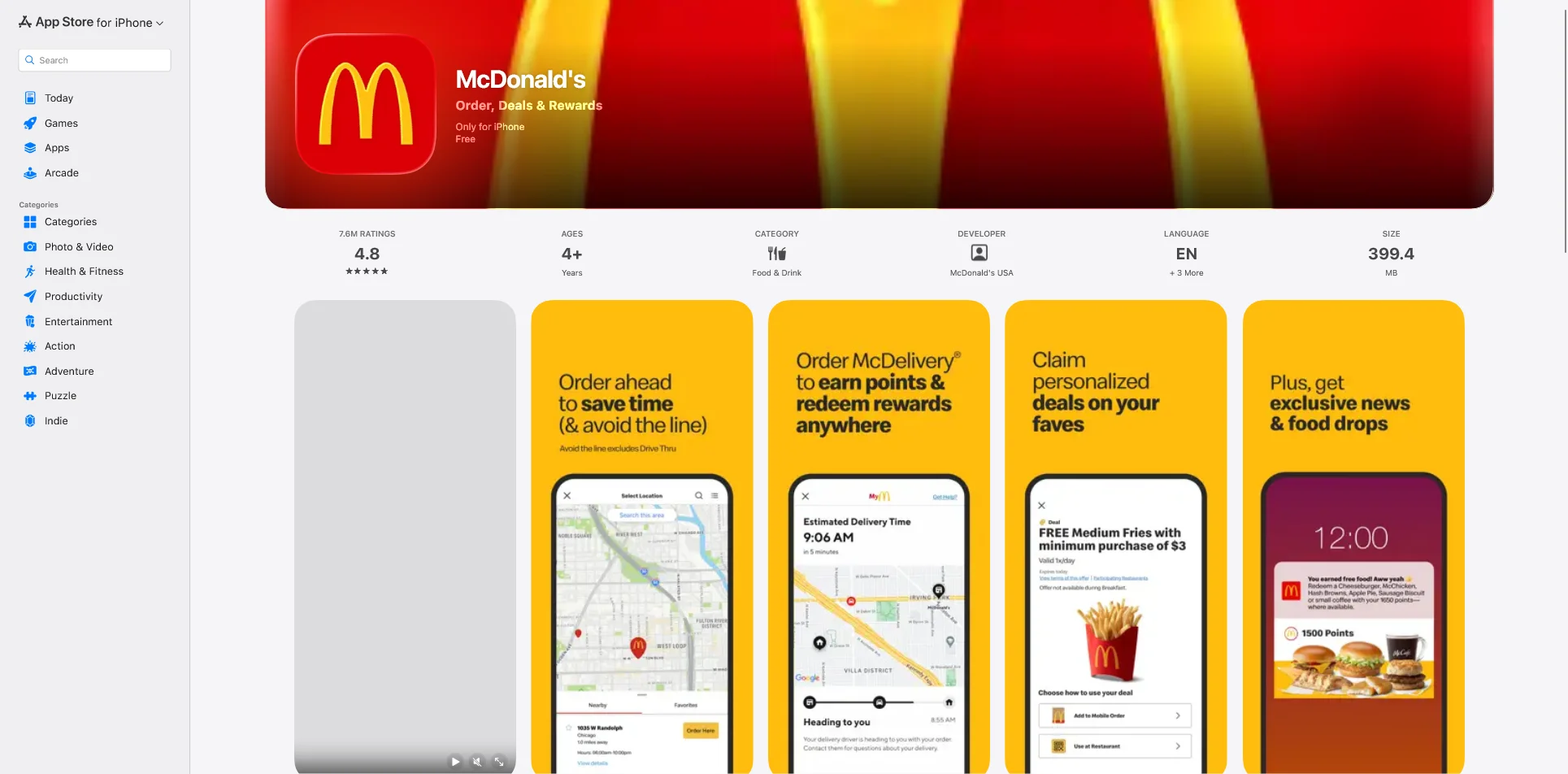
The McDonald's app bundles MyMcDonald's Rewards, mobile order and pickup, and app-exclusive deals. Deals are the hook that drive downloads (the "check the app before you visit" habit), while loyalty points and push-notified offers keep customers coming back. It's one of the most-used food apps in the country, and the primary digital channel between the brand and a huge chunk of its customers.
The lesson: For F&B brands with broad appeal and frequent repeat purchases, app-exclusive deals are the strongest acquisition hook for installs. Give customers a compelling reason to download (a discount, early access, bonus loyalty points), then let rewards and push notifications handle the retention.
Chipotle: Digital Ordering as a Growth Engine
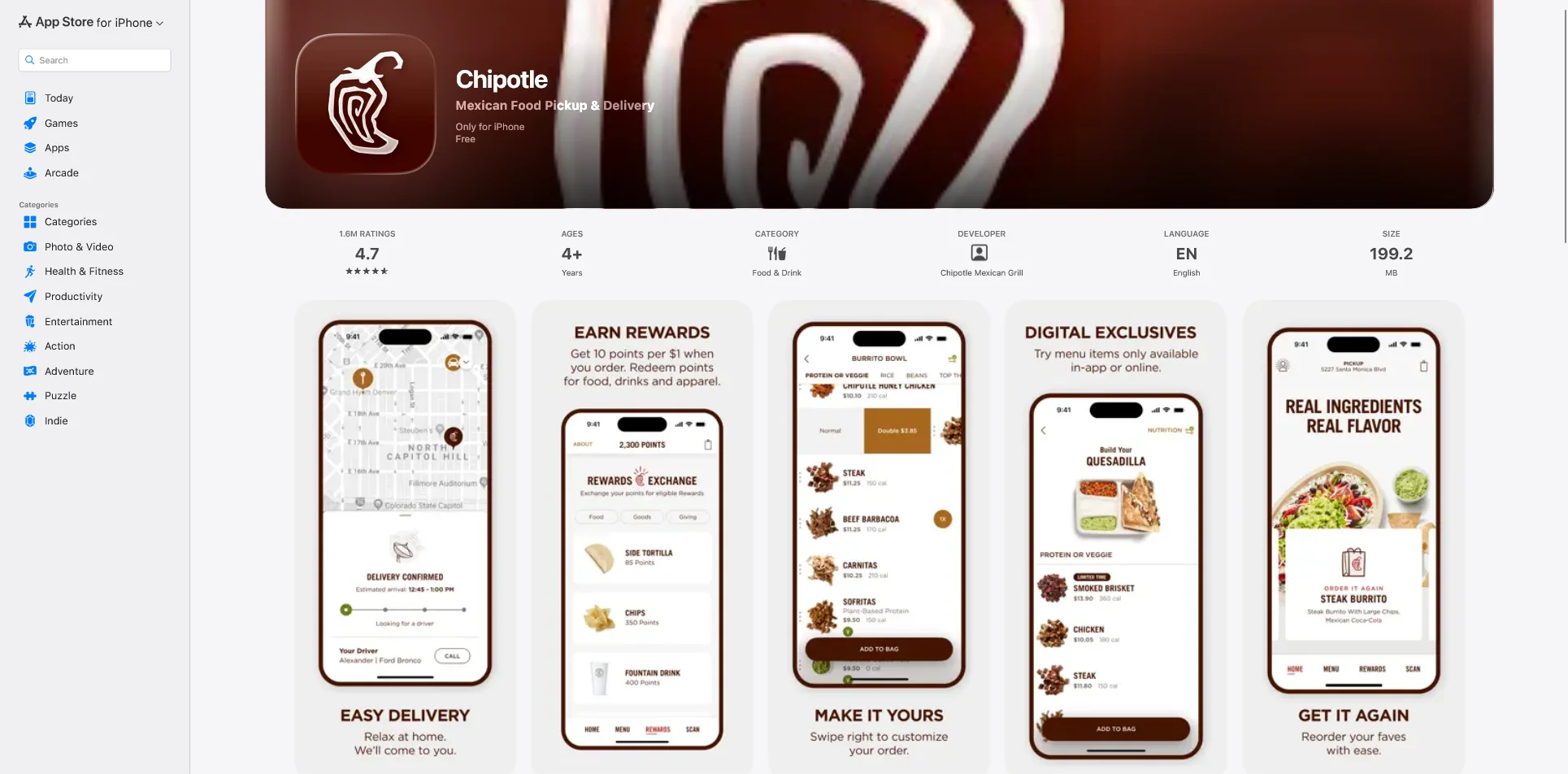
The Chipotle app has been a major driver of the brand's post-2018 turnaround. Chipotle Rewards, launched in 2019, grew to tens of millions of members in a few years. Digital orders now account for a meaningful share of total sales, and physical store designs (dedicated mobile pickup shelves, Chipotlane drive-thrus) have been reworked to treat app-based ordering as a primary channel, not a bolt-on.
The lesson: An app isn't only a convenience feature. Done well, it can redefine how customers buy from you. When digital ordering becomes the easiest path to your product, it shifts from an optional channel to a primary revenue driver that reshapes the rest of your operation.
HelloFresh: Content as Retention
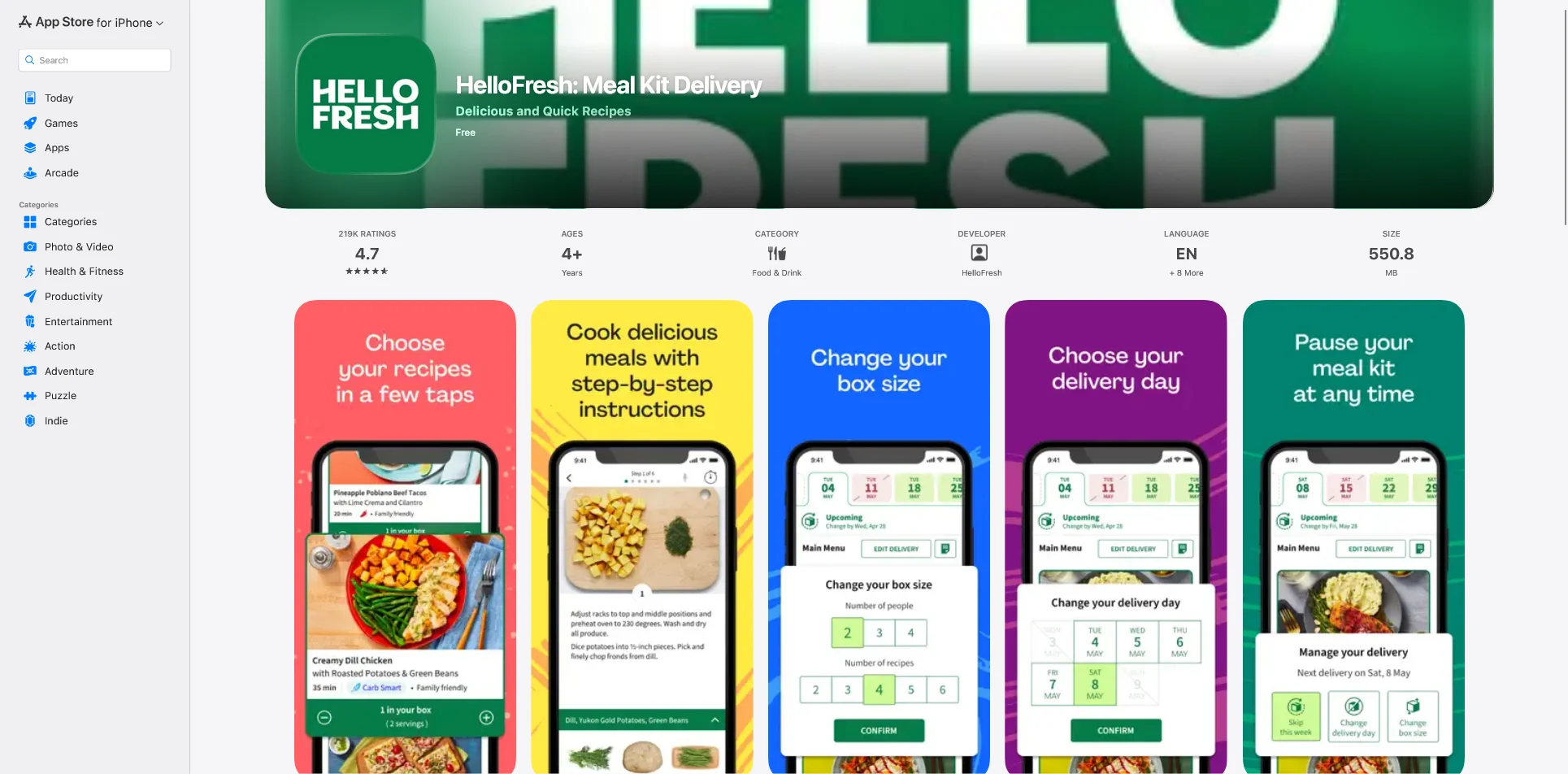
HelloFresh's app is more than a subscription management tool. It's a meal planning and cooking platform: weekly meal selection from thousands of recipes, dozens of diet filters, step-by-step cooking guides with timers, and voice-activated instructions for hands-free cooking.
The lesson: For F&B brands, content (recipes, pairing guides, nutritional info) isn't supplementary. It's a retention mechanism. The app that helps customers use your product becomes the app they open daily.
Country Life Natural Foods: The Case for Mid-Market F&B Apps
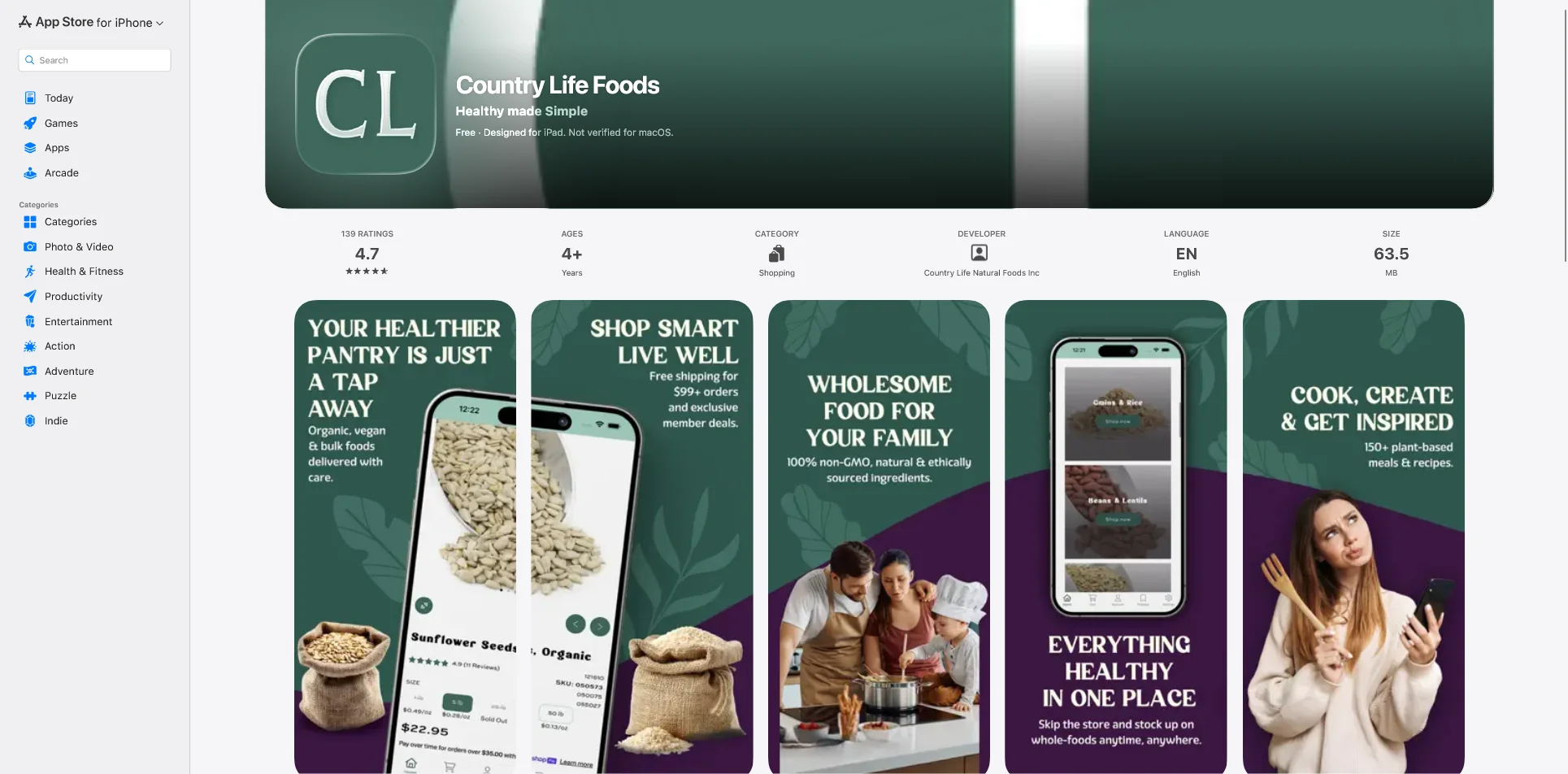
Natural and organic food retailer Country Life Natural Foods launched their app with MobiLoud and saw 15x revenue per user from the app compared to mobile web. App users convert at 2.4x the rate, spend 20% more per order, and visit 5x more frequently. They hit 1,000+ active users in under 2.5 weeks, with less than 10 staff hours of effort to launch.
"Having an app just helps with social proof and validation. The app makes us look more serious, more real."
-- Isaac, Director of Sales, Country Life Natural Foods
The lesson: You don't need Starbucks' budget or Nespresso's IoT integration to see meaningful results. For F&B brands with steady repeat traffic and a loyal customer base, an app that makes reordering easy and gives you a direct push channel can dramatically lift LTV on a short timeline.
How a Mobile App Fits in Your F&B Brand's Growth Strategy
If you're looking to build a mobile app, you're doing it to hold on to a higher share of your best customers, and get more lifetime value from each one you bring in.
Acquisition is one thing. F&B brands are paying more every year to acquire new customers. The only way to make the math work is to compound value from the customers you already have.
Mobile apps are one of the most effective ways to do this. Data shows apps drive up to 7x higher LTV, and retention-driven F&B brands can easily see even stronger results.
We see ecommerce brands with successful apps drive around 20-35% of their total online revenue through the app. That means for a brand doing $5M+ in annual revenue, the app could realistically contribute a million plus per year.
The Retention Play
The more you're spending on acquisition, the more pivotal it is to keep customers around.
It's getting harder to do that with other retention channels. Email visibility is declining. Retargeting is getting more expensive. Social algorithms keep changing.
An app is an always-on presence on the customer's home screen. It comes with push notifications that reach them directly, at any time. It keeps your customers closer, maintains constant awareness, and makes your brand a habit - which is what cements long-term retention.
For F&B specifically, that habit is reinforced by the product itself. Your customer runs out. Your app reminds them. One tap reorders. The cycle compounds.
The 80/20 Rule
For the majority of businesses, a small share of customers contributes the bulk of the profit.
That's absolutely true in F&B. Your most engaged customers, the ones buying coffee every month or a meal kit every week, drive disproportionate LTV compared to occasional buyers.
Think of your app as a way to grow this segment. It removes friction from the buying process and increases engagement, incentivizing your highest-intent customers to spend more. And it helps bring more customers into your inner circle, expanding the share of high-value buyers who power your overall growth.
How an App Complements Your Existing Channels
Don't think of an app as a replacement for your website, email marketing, or social presence.
It sits alongside them, and complements what you've already built.
- Your website handles discovery, SEO traffic, and first-time visitors
- Email and SMS nurture leads and drive re-engagement
- Social media builds brand awareness and community
- Your app serves your most loyal customers with the fastest shopping experience, highest engagement, and fewest steps to checkout
The brands seeing the best results leverage their other channels to drive app installs. Smart banners on your mobile site. A prompt after checkout. A loyalty incentive for downloading. The app download is a key inflection point; once a customer is in the app, engagement metrics typically jump significantly.
How to Build a Mobile App for Your F&B Brand
Now for the practical part - and the biggest objection for most brands. Wanting a mobile app is one thing, but how do you actually build it?
The misconception is that you need to hire a team of developers, at a cost of six figures plus, to build and maintain your app.
Not anymore. It's realistic for just about any F&B brand to have their own mobile app today.
MobiLoud: Turn Your F&B Brand's Site into a Native App
While there are a few ways to do this, MobiLoud is the best way for most F&B brands to launch their own mobile app.
MobiLoud turns your existing website into native iOS and Android apps. Everything you've built on your website (your checkout, subscription management, loyalty program, recipes, product pages) works in the app automatically, and the app and website stay fully synced.
This means there's minimal work required to launch and maintain your app. And your user experience stays consistent across platforms.
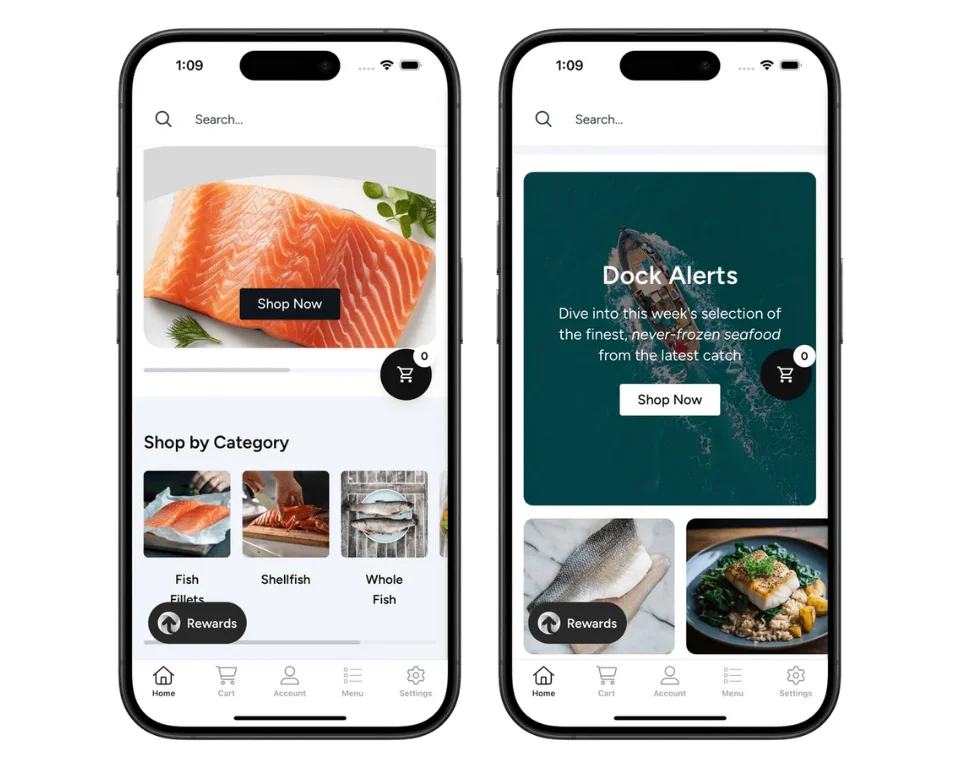
Starting from $1,499 per month, the cost is a fraction of the $100K+ typically required for a custom app, and a drop in the bucket compared to the revenue your app could generate.
F&B Brands Seeing Results with MobiLoud
Country Life Natural Foods is the clearest case study for a mid-market F&B brand. They saw 15x revenue per user from the app vs mobile web, 2.4x conversion rate, and 20% higher AOV. They hit 1,000+ active users in under 2.5 weeks.
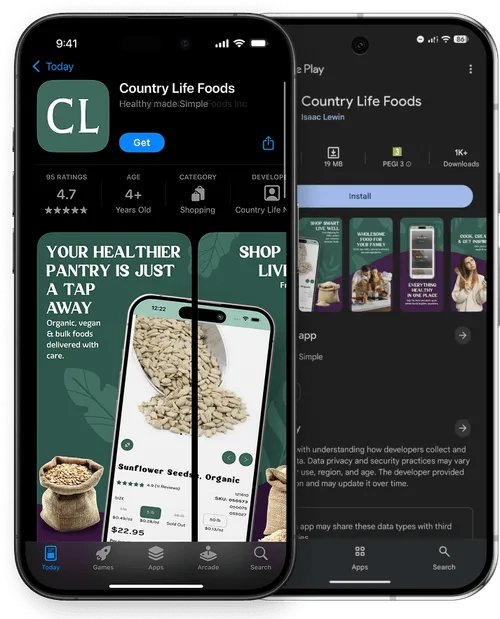
Aside from the actual sales that come through the app, it’s a powerful channel for its ability to drive more customers to key inflection points for long-term retention.
"Once we get that third, fourth purchase, it's done. They're in for life."
-- Isaac, Director of Sales, Country Life Natural Foods
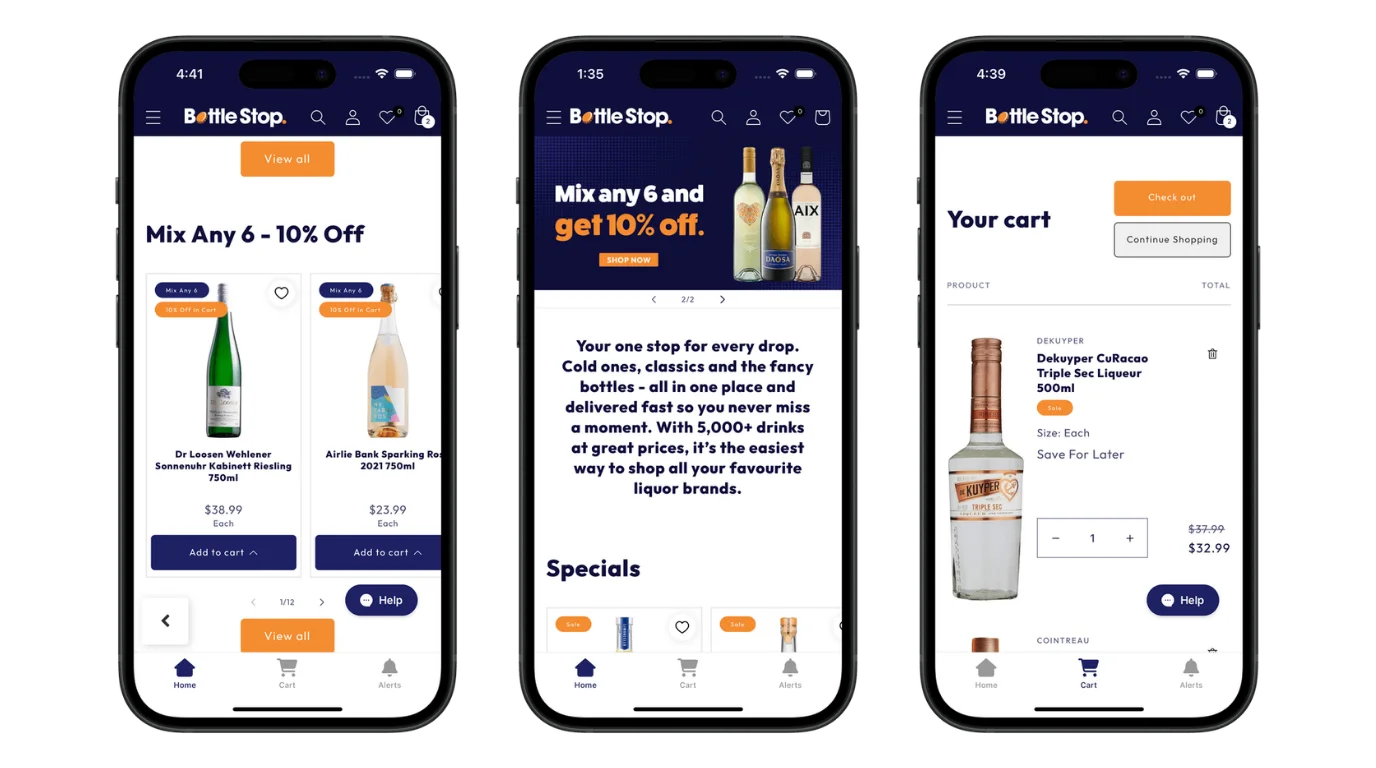
Bottle Stop, an Australian online alcohol retailer, originally launched a custom app to drive more repeat business.
The decision to have an app was the right one, but their previous app came with too much overhead and complexity, cutting into already-thin margins.
After building a new app with MobiLoud, they massively simplified the operational lift from the app, while it continued to drive stronger results, with 5x higher customer LTV through the app.
“We're seeing that the customers who do use the app are more engaged, they're spending more time on site, they're spending more per transaction, they're spending more overall. The app is paying for itself.”
-- Damien Smith, CTO, Bottle Stop
For F&B brands where repeat purchases are the business model, the app doesn't need to be complex. It doesn’t need to do a whole lot of things that your website doesn’t do.
It needs to make reordering easy, keep your brand visible on the home screen, and give you access to push notifications to bring customers back.
See more examples of ecommerce brands having success with MobiLoud and mobile apps.
Your F&B Brand Deserves a Mobile App
F&B has arguably the strongest app economics in ecommerce. High repeat purchase rates, natural subscription fit, and products that run out on a predictable schedule.
A mobile app turns those fundamentals into a repeat revenue powerhouse.
If you’ve already done the hard part of building a successful F&B brand, with customers who want to come back and buy again, the next step is to make it easier for them - and launch an app.
Luckily, you don’t need the budget of a Starbucks or Nespresso to do so. With MobiLoud, you can go live easily, for an affordable cost, with very little operational lift.
The process is simple:
- Book a free strategy call. We'll walk you through a free app preview, answer your questions, and break down the business case for your mobile app.
- We build the app. MobiLoud handles everything: setup, design, configuration, testing, and app store submission.
- Go live. In 6-8 weeks, your app launches on iOS and Android. MobiLoud handles all ongoing technical maintenance.
Get a free app preview to see what your app could look like, learn more about the process, and get the ball rolling.