Headless Commerce with Magento / Adobe Commerce: A Practical Guide

Headless Magento decouples your storefront from your commerce backend, giving your team complete control over the customer experience and the freedom to build with any frontend technology. It's the architecture behind the fastest, most customized Adobe Commerce stores. It can provide a way to manage content for mobile apps too - but in most cases, MobiLoud is a more effective way to launch and maintain apps for headless sites.
Headless Magento decouples your storefront from your commerce backend, giving your team complete control over the customer experience and the freedom to build with any frontend technology. It's the architecture behind the fastest, most customized Adobe Commerce stores. It can provide a way to manage content for mobile apps too - but in most cases, MobiLoud is a more effective way to launch and maintain apps for headless sites.
The most ambitious Magento stores don't run on Luma. They run on custom React storefronts, Alokai-powered frontends, or Next.js applications that consume Magento's GraphQL API.
The backend handles commerce: products, inventory, pricing, orders, customer accounts.
The frontend handles everything customers see, built by developers who aren't constrained by Magento's theme system.
That's headless commerce on Magento. And for brands that have outgrown their platform's native templating, it's a meaningful architectural shift.
This guide how headless Magento actually works, the tools the ecosystem has built around it, when it makes sense (and when it doesn't), and the one channel most headless brands still haven't addressed: native mobile apps.
What Headless Magento Commerce Actually Means
In a traditional Magento setup, the frontend and backend are tightly coupled.
Luma (or a Luma child theme) renders your storefront using Magento's own template system (.phtml files, layout XML, RequireJS). The backend and frontend are part of the same application.
Headless separates them.
- Your Magento backend becomes an API-first commerce engine, exposing product data, catalog structure, pricing, cart, checkout, and customer data through a GraphQL API.
- Your frontend is a completely separate application, built with whatever technology your team chooses, that consumes those APIs to build the storefront.
.webp)
The two layers are loosely coupled. They communicate, but neither depends on the other's architecture.
You can rebuild the frontend without touching the commerce backend. You can upgrade the backend without redeploying the frontend.
Why Teams Go Headless on Magento
Not all stores need a headless setup. A small brand with a simple website and a few SKUs will be fine with a standard Magento website.
But for some, headless offers a way to go much further than the average, static website.
Performance
Luma's traditional rendering is slow. The RequireJS module loader, Knockout.js UI components, and heavy CSS compilation create a front-end asset bundle that consistently struggles with Core Web Vitals.
A custom React or Next.js frontend can deliver sub-second LCP scores that Luma can't match without extreme optimization.
Developer experience
Magento's native frontend stack (PHTML templates, layout XML, custom JavaScript module loading) has a steep learning curve and feels dated to developers used to modern frameworks. Headless lets your team work in React, Vue, or whatever frontend stack they already know.
True customization
Magento's theme system allows significant customization, but ultimately within constraints.
A headless frontend has no constraints: any layout, any interaction, any integration at the component level.
Omnichannel flexibility
A headless backend serves any frontend. Web, mobile, kiosks, voice interfaces, progressive web apps, native apps: they all consume the same API. You build your commerce capabilities once and deliver them anywhere.
ACCS readiness
Adobe Commerce as a Cloud Service (ACCS), Adobe's newest cloud offering launched in 2025, requires a headless architecture. Storefronts run on Edge Delivery Services. Customizations happen through APIs and webhooks, not PHP code modifications. Brands planning to move to ACCS will need to decouple their frontend.
The Headless Magento Ecosystem
If you want to build a custom, bespoke web store, with a headless architecture, Magento is one of the best platforms to build it on.
Several mature tools exist for building headless Magento frontends:
Alokai (formerly Vue Storefront)
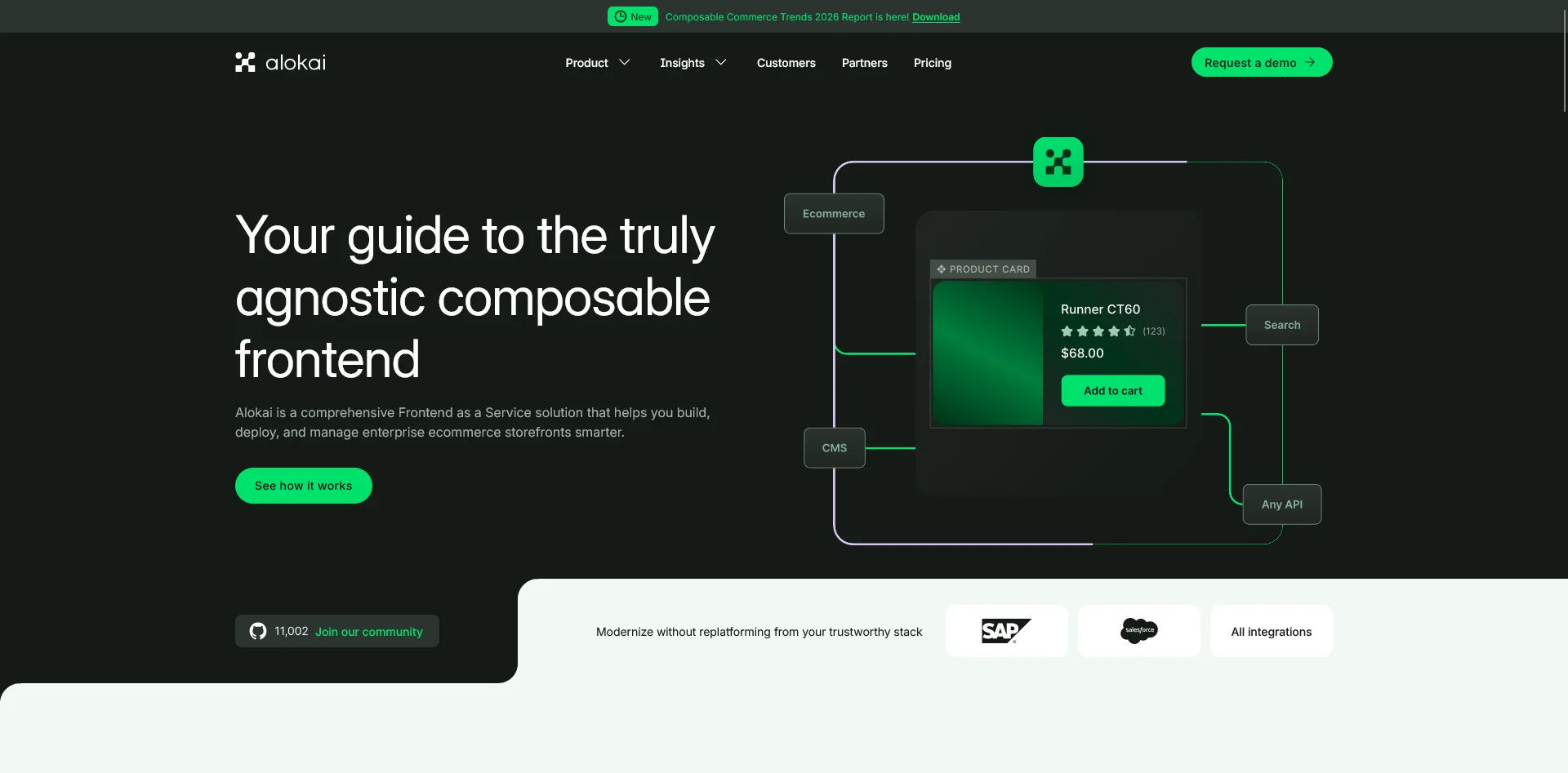
Alokai is the most widely adopted headless frontend framework built specifically for Magento. The open-source edition uses Vue.js and Nuxt; the enterprise edition is built on React. It connects to Magento via GraphQL and provides a pre-built component library, integrations with common third-party services, and a developer experience designed around headless ecommerce patterns.
For teams that don't want to build every component from scratch, Alokai significantly reduces the time-to-market for a headless Magento store. The tradeoff is that you're adopting their component architecture and conventions, which can create constraints of their own.
GraphCommerce
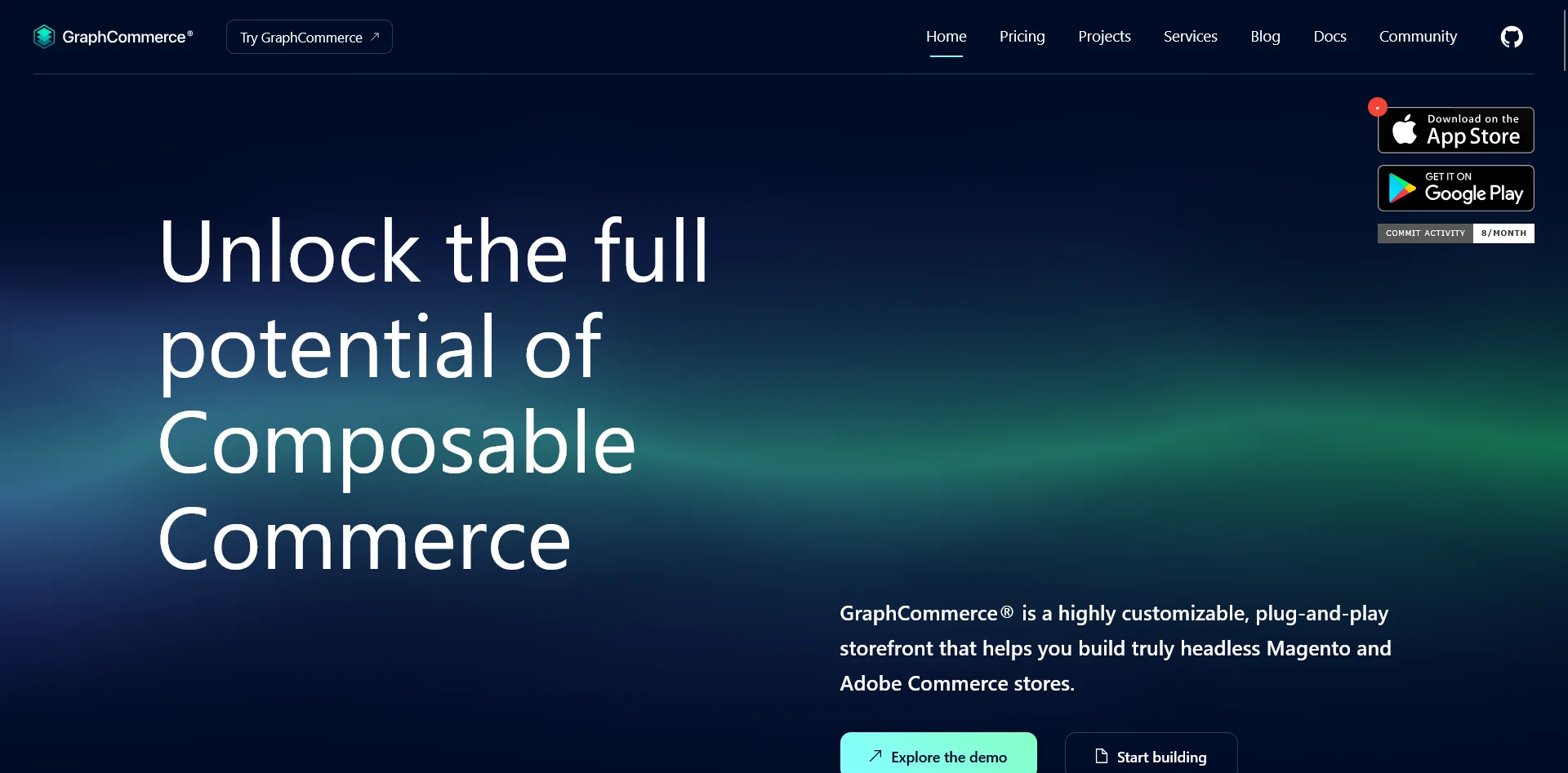
GraphCommerce is an open-source React and Next.js storefront framework built on Magento's GraphQL API. It's fully TypeScript, uses the App Router architecture, and generates optimized static pages.
There’s a smaller community than Alokai, but it’s strong for teams that prefer working in pure React/Next.js.
Custom builds
Many enterprise Magento brands build entirely custom headless storefronts: Next.js or Nuxt.js applications that consume Magento's GraphQL directly, with custom components, custom integrations, and no dependency on a third-party framework.
This gives maximum control and zero constraints, at the cost of maximum build time and ongoing maintenance.
Edge Delivery Services (Adobe's path)
Adobe's own headless direction for ACCS is Edge Delivery Services, focused on document-based authoring and web performance. It's part of Adobe's future product roadmap, not a fit for most existing Magento merchants.
If you're planning a long-term migration to ACCS, it's worth understanding. For merchants on Magento Open Source or the current Adobe Commerce, it's not a practical headless option today.
A note on Hyvä
Hyvä Themes is often mentioned alongside headless discussions but is architecturally distinct. Hyvä replaces Magento's Luma frontend with Alpine.js and Tailwind CSS while keeping server-side rendering on the Magento application itself.
It's dramatically faster than Luma (50%+ of Hyvä stores pass Core Web Vitals vs ~19% for Luma) and uses a familiar PHP template system.
It's not a headless architecture. However, it achieves many of the same things you go headless to accomplish. You get the performance benefits without the full decoupling.
For a lot of teams, Hyvä is the right answer and headless is overkill.
When Headless Magento Makes Sense
Headless is genuinely powerful. It's also a significant architectural commitment that doesn't suit every team or every stage of growth.
It makes sense when:
- Your team has strong frontend engineering capability (React, Vue, Next.js) and you want them working in familiar tooling
- You've hit real limits with Luma or Hyvä's customization ceiling for a specific requirement
- You're building a genuinely omnichannel experience across multiple surfaces
- You're preparing for a migration to ACCS and want to decouple the frontend now
- You need a very specific, custom mobile web experience that no existing frontend framework delivers
It probably isn't the right call when:
- Your team is small and the headless maintenance overhead would be a burden
- Hyvä would address your performance and customization needs without the added complexity
- You're primarily looking for a faster website (Hyvä delivers that with less risk)
- Your customization requirements can be met within Magento's extension ecosystem
The performance and flexibility gains from going headless are real, but they come with real costs.
It adds a separate frontend codebase, a separate deployment pipeline, and dependencies on a new technology stack. That needs to be something you’re comfortable maintaining for the foreseeable future.
The Mobile App Question for Headless Magento Brands
The thought is that, now you’ve decoupled your back and frontend, it’s easy to use the same GraphQL endpoints your web frontend uses to power a mobile app.
It’s correct, to an extent. Headless is designed to let you deploy on multiple channels from the same backend. That can include a web storefront and native iOS and Android apps.
But the question is whether this is an effective use of time and resources for a Magento store.
You’ve got a mobile-optimized website, with everything dialed in for speed and conversions.
The APIs are there for you to launch a mobile app, but not the UI. You’ll need to build a completely new app frontend, from the ground up, likely replicating what you already built for the web.
In all likelihood, you won’t have the talent in your team to build this. Your devs likely don’t have the necessary experience with React Native, Flutter, Swift, Kotlin or other mobile app development frameworks. That means bringing new developers in, or contracting an agency to build it for you.
And that means a significant cost. Likely $150K+ for the first version and potentially another $100K annually to manage it. Not to mention the operational tax of introducing more complexity to your tech infrastructure.
Again - all to more or less rebuild what already exists.
The Best Way to Extend Your Headless Magento Store into a Native App
The reason most headless brands don't have a native app isn't that they don't want one. It's that the cost and complexity of the traditional path is hard to justify. (This applies across headless platforms, not just Magento - see Headless Commerce and Mobile Apps for the broader picture.)
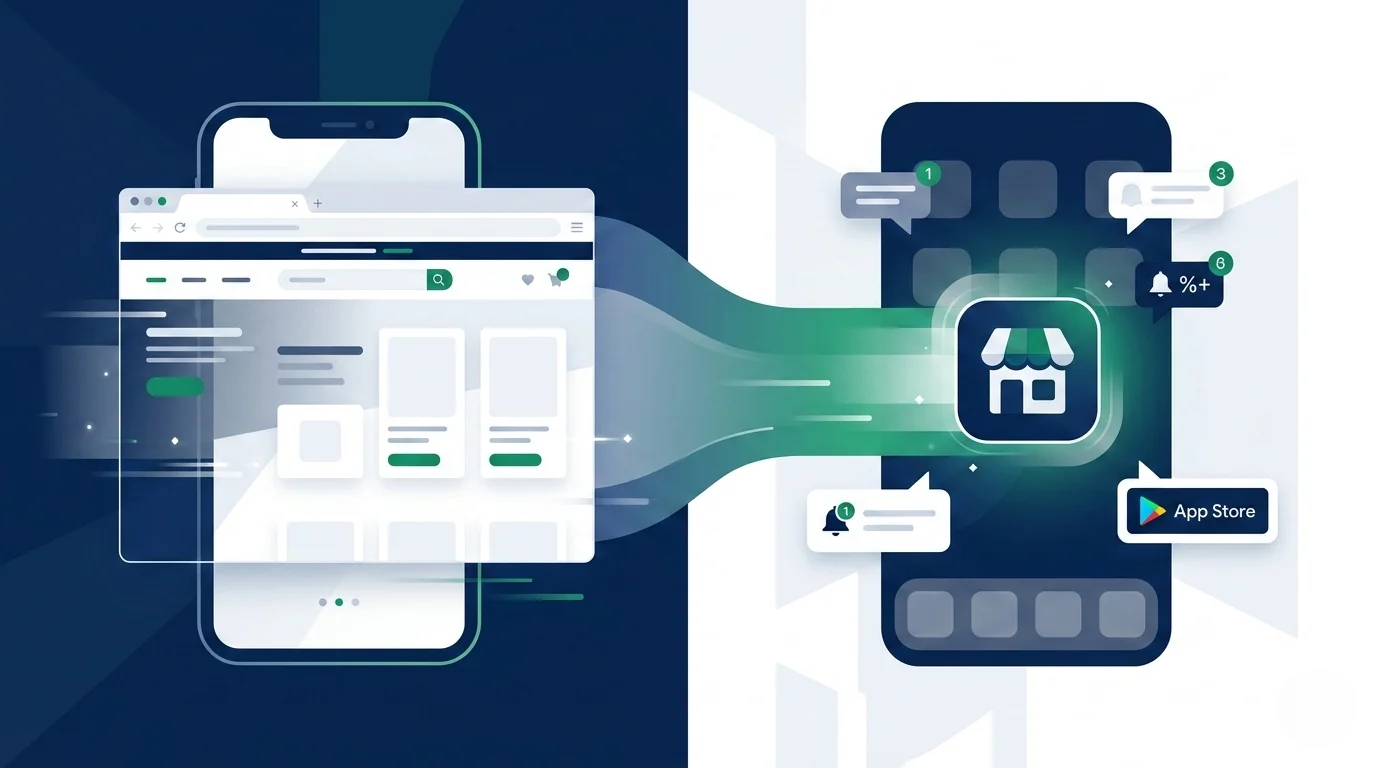
MobiLoud takes a different approach. Instead of consuming your Magento GraphQL API and rebuilding the storefront as native components, MobiLoud takes the headless storefront you've already built and extends it to a native iOS and Android app.
Your Alokai frontend, your custom Next.js storefront, your GraphCommerce implementation: the app renders that, with native capabilities added on top.
It’s essentially your web store, with push notifications, App Store and Google Play listings, native navigation, deep linking, and a home screen icon that puts your store next to Amazon and Instagram on your customers' phones.
Carrying over your frontend investment
The most important practical benefit of MobiLoud’s approach is that you’re not starting from scratch.
A custom headless storefront represents significant engineering investment. The component library, the performance optimization, the custom integrations, the design work. You’ve almost certainly spent an awkwardly large amount of time and money getting this right.
MobiLoud extends that investment rather than replacing it.
Other mobile app solutions for Magento mean rebuilding this, or bypassing all your work and shipping a weak substitute for what your web storefront does.
MobiLoud ensures all the improvements you’ve made have just the same impact for your app users as for web visitors.
No second codebase to maintain
Outside of the cost and complexity to launch a mobile app, the other practical concern for headless teams is the long-term operational overhead.
Adding a mobile app means adding another surface to maintain. Every frontend change needs to be replicated or verified in the app.
When you’re updating your catalogue, store structure, publishing new collections, new promotions, updating your home page, this is now 2x the work - because you have two separate storefronts.
Some of this is mitigated by going headless, but not all.
There are also App store updates, OS compatibility, mobile-specific bug fixes to take care of.
With MobiLoud, you effectively only have one storefront to manage. You update and maintain your website, and your app follows, automatically.
Unless you have specific reasons for needing your app to have a unique, differentiated experience to your website, there’s just not much benefit to rebuilding this as a separate channel.
Why Your Mobile Commerce Strategy Is Not Complete Without a Mobile App
There are some readers asking: why do we need a mobile app at all? Isn’t our mobile website good enough?
Answer: your mobile website is good enough. There’s nothing wrong with it - a mobile app just extends your revenue potential, particularly with your highest-value customers.
Your brand on the customer’s home screen
When a customer installs your app, your icon sits on their home screen alongside Amazon, Instagram, and whatever else they use daily.
That level of awareness and availability is not something you can buy with SEO or ads. It's earned. And the customers who put you there have already told you something important: they think about your brand outside of an active shopping session.
Native push notifications
Push notifications are the most powerful marketing channel you’re probably not using right now. They’re a fast, direct line to your best customers’ lock screen, with almost guaranteed visibility, and no per-send cost.
You’re not getting throttled by mobile carriers or having your messages sent to a secondary inbox. You’re getting right in front of your customers, wherever they are, on the device they look at hundreds of times per day.
A mobile app is the only way to send true, native push notifications. You can send push notifications from a website, but it’s not the same thing.
Turning your Magento store into a mobile app unlocks this channel for real.
Stronger repeat purchase behavior
App users are your most engaged buyers. And it’s not just the app congregating these shoppers in one place - it makes them more engaged, more loyal buyers at the same time.
Tadashi Shoji, a luxury fashion brand on Magento, gets 10x higher revenue per user, 3.8x session frequency and 2x average session duration in their mobile app. John Varvatos gets 4x higher purchase rate, 12x more sessions per app user and 3.6x longer average session duration in their app.
The app amplifies these customers’ existing intent, and builds them into power buyers who make a meaningful difference to your unit economics.
A new level of brand authority
An app in the App Store and Google Play signals a level of brand maturity that most ecommerce businesses never reach.
It’s a trust signal. A social proof driver. It communicates permanence, authority.
While these signals shouldn’t be the main reason to launch an app (the main reason should be revenue: and mobile apps can easily drive enough revenue to make financial sense), the impact for your brand’s imagine should not be missed.
"Having an app just helps with social proof and validation. The app makes us look more serious, more real."
- Isaac, Director of Sales and Business Development, Country Life Natural Foods
Final Thoughts: Building an Efficient and Powerful Headless Magento Setup
Headless Magento is a significant architectural decision, and the right one for brands that have genuinely outgrown Luma's constraints. The ecosystem around it (Alokai, GraphCommerce, Hyvä, ACCS) has matured enough that the tradeoffs are well understood and the tooling is proven.
The gap most headless teams leave open is a mobile app. You can have a world-class web storefront, but without a native app, your mobile commerce strategy is not complete.
MobiLoud is by far the most effective way to turn your high-performing headless storefront into a mobile app, without adding all the complexity of new native app builds to worry about.
Get in touch and book a free strategy call and we’ll show you what it could look like, and the kind of results you can expect from your app.
FAQs

Convert your website into a mobile app