
Your Magento store doesn't run on Magento alone. It likely runs on dozens of third-party tools:
- Firecheckout
- Algolia's search
- Yotpo's reviews
- Smile.io's loyalty program
- Adyen's payment processing
…and another 15-30 extensions that make your store work the way it does.
It stands to reason that if you’re launching a mobile app for your Magento site, you’ll want to know whether all these extensions carry over.
If not, you could end up with a mobile app that’s just a shadow of your website, giving customers little reason to actually use it.
The truth is, your extensions aren’t guaranteed to work in your mobile app. At least, not with the majority of Magento mobile app solutions.
There is one that guarantees everything carries over, though: MobiLoud.
This article will break down everything you need to know about the website to app transition, what happens to your extensions, and how to ensure you launch a mobile app that brings all the tools from your site.
How Magento Mobile App Builders Handle Your Extensions
The majority of Magento extensions are built specifically for the web. Integrating them in a native app typically brings problems. You’re forced to work with APIs, and tools don’t always have comprehensive APIs that let you replicate all their functionality.
It depends how you build your app, though. In fact, that makes all the difference.
API-driven builders
Most Magento mobile app builders connect to your Magento backend through the REST or GraphQL API. They pull data (products, customers, orders, cart contents) and render it in a separate native interface built from pre-designed templates.
This works well for catalog browsing and basic cart operations. The Magento API handles that data cleanly.
The problem is everything the API doesn't expose. When you install a front-end extension like Amasty One Step Checkout, it modifies how your checkout page looks and behaves. It adds custom fields, rearranges steps, injects discount code validation, and changes the checkout flow.
None of that is in the Magento API. The API exposes checkout data (cart items, shipping methods, payment methods). It doesn't expose the custom UI your extension built on top of it.
So an API-driven builder creates its own checkout. Your extension's logic stays on your website, invisible to the app.
This pattern repeats across every category: search overlays, review widgets, loyalty dashboards, payment UIs, shipping calculators.
Website-powered apps
MobiLoud takes a different approach to most other mobile app solutions. Instead of connecting to your API and rebuilding the interface, it extends your actual Magento storefront into native iOS and Android apps.
The app displays the same content and features your customers see on mobile web, with native capabilities added on top (push notifications, App Store presence, native navigation, deep linking).
Because the app renders your storefront, every front-end extension works automatically. If it's visible on your mobile website, it's in the app. No integration, no rebuilding, no per-extension cost.
What Happens to Your Extensions in a Mobile App: Category by Category
Not every kind of extension works exactly the same. Mobile app builders usually have some integrations built for popular apps; and some will be able to build custom integrations for the tools you use on your site.
There are some extensions that are easier to work with, some that are harder.
Let’s run through a few categories now.
Checkout extensions
Popular checkout extensions: Amasty One Step Checkout, Mageworx One Page Checkout Suite, Firecheckout, IWD Dominate Checkout, Mageplaza One Step Checkout.
These extensions overhaul the default Magento multi-step checkout. They collapse steps, add inline validation, inject custom fields (gift messages, delivery instructions, tax ID), and rearrange the layout.
How it Works In an API-driven app: The app builds its own checkout flow using data from the Magento API. Your checkout extension's UI and logic don't transfer. Custom fields, step consolidation, and inline validation need to be rebuilt through custom development.
With MobiLoud: Your checkout page renders as-is. Amasty's one-step layout, your custom fields, your validation logic, your discount code handling: it all works because the app shows the same checkout your website shows.
Payment gateways
Popular payment integrations: Adyen, Stripe, Checkout.com, Klarna, Afterpay/Clearpay, Amazon Pay, Braintree, Mollie, PayPal.
This is how your customers pay. It’s central to how your business works, and how you convert customers at checkout.
In an API-driven app: Each app builder is different, but many only support default Magento payment methods. Adding additional gateways and payment methods may be possible, but likely requires custom development.
With MobiLoud: Your payment page loads exactly as it does on your website. Adyen's hosted payment fields, Klarna's installment widget, Amazon Pay's button: they all render because they're part of your storefront.
Search and filtering
Popular search and filter extensions: Algolia, Klevu, Amasty Elastic Search, Mirasvit Search Autocomplete, Adobe Live Search.
These extensions replace Magento's default search with fast autocomplete overlays, faceted filtering, product recommendations in search results, and "did you mean" corrections. The UI is entirely front-end rendered.
In an API-driven app: The app can send search queries to the Magento API and get results back. But the rich autocomplete dropdown, the instant filtering, the visual product cards in results, that's all custom front-end code from your search extension. The API returns data; the app builds its own (simpler) search interface.
With MobiLoud: Algolia's instant search overlay, Klevu's smart filtering, Mirasvit's autocomplete: they all render as-is. Your customers get the same search experience in the app that they get on your website.
Reviews and UGC
Popular reviews/UGC extensions: Yotpo, Judge.me, Stamped.io, Bazaarvoice, Magefan, Amasty Advanced Reviews.
These inject front-end components: star ratings, photo galleries, Q&A sections, review submission forms, user-generated content widgets.
In an API-driven app: The app can pull review data through the API (star rating, review text). But the rich display, photo galleries, Q&A threads, "helpful" voting, reviewer badges, visual layouts: those are front-end components that don't transfer. The app shows a basic review list.
With MobiLoud: Yotpo's full review widget, Judge.me's photo gallery, the Q&A section: they render as part of your product pages. No feature gap.
Loyalty and rewards
Popular loyalty & rewards extensions: Amasty Reward Points, Smile.io, Aheadworks Points & Rewards, Mageplaza Reward Points, Mageworx Loyalty Program.
These display point balances on the customer dashboard, show earning rules on product pages, inject redemption options at checkout, and render tier progress indicators.
In an API-driven app: Point balances might be accessible via API (if the extension exposes them). But the earning rules display, the redemption widget at checkout, the tier progress bar, the "you'll earn X points" message on product pages: these are front-end components. Rebuilding them requires custom development for each extension.
With MobiLoud: Your loyalty program renders exactly as it does on your website. Point balances, earning rules, redemption at checkout: all visible because the app shows your actual storefront.
B2B modules
Common B2B features: Shared catalogs, negotiable quotes, company accounts, requisition lists, approval workflows, customer-specific pricing.
Magento's B2B functionality has limited API exposure. Shared catalogs and company account hierarchies are partially available through REST, but the front-end interfaces for quote negotiation, requisition list management, and approval workflows are largely storefront-rendered.
In an API-driven app: B2B features are among the hardest to replicate. Most Magento app builders don't support B2B at all, or offer it only as a premium add-on with significant custom development.
With MobiLoud: If your B2B storefront works on mobile web, it works in the app. Requisition lists, approval workflows, customer-specific pricing tiers: all carried over.
Marketing and personalization
Popular marketing & personalization tools: Nosto product recommendations, Klaviyo signup forms and popups, urgency timers, upsell/cross-sell widgets, exit-intent popups, spin-to-win overlays.
In an API-driven app: These are almost entirely front-end rendered. The API doesn't expose popups, recommendation carousels, or countdown timers. They simply don't exist in the app.
With MobiLoud: Front-end marketing tools render as they do on your website. Nosto recommendations on product pages, Klaviyo forms, cross-sell widgets in cart: all present.
The Bottom Line: With MobiLoud, everything that renders on your web storefront will work in your app as well. There’s no question of “will this extension carry over”, because everything does - out of the box.
The Hidden Cost of "Supported" Extensions
API-driven app builders will support a few extensions out of the box. For other extensions, they may offer custom integrations to get these working in your app as well.
This adds a significant amount to the cost of your project. All of a sudden, an app you thought was going to cost $149 is now several thousand and counting.
And for a typical mid-market Magento store running a custom checkout extension, 2-3 payment gateways, a third-party search tool, a reviews platform, and a loyalty program, you could be looking at 5-6 separate integration projects before your app matches your website's functionality.
At $2,000-$5,000+ per integration (based on typical Magento custom development rates), plus ongoing maintenance when extensions update, the cumulative cost approaches custom app development territory, which defeats the purpose of using an app builder in the first place.
With MobiLoud, the cost is much more stable. Anything that works on your site should work the same way in your app, keeping the cost (starting at $1,499/mo) the same, whether you're running 5 extensions or 25.
We can do custom SDK integrations as well, on our Enterprise plan - but for most of the things that work on your site, there's no need. They should already work.
Integrations Don’t Guarantee Full Extension Functionality
And let’s say your extensions are supported; either through custom development or pre-built integrations.
This doesn’t always mean the extension will work exactly the same way in your app as it does on your website.
The functionality may be watered down somewhat. There could be bugs in the integration. And the integration itself requires maintenance, whenever there’s an update to the extension, or to Magento, or to the app builder’s platform.
It just introduces more complexity, more potential points of failure. The more integrations you’re running, the more potential spaghetti code in your mobile app’s backend.
Example of a Magento Mobile App Done Right
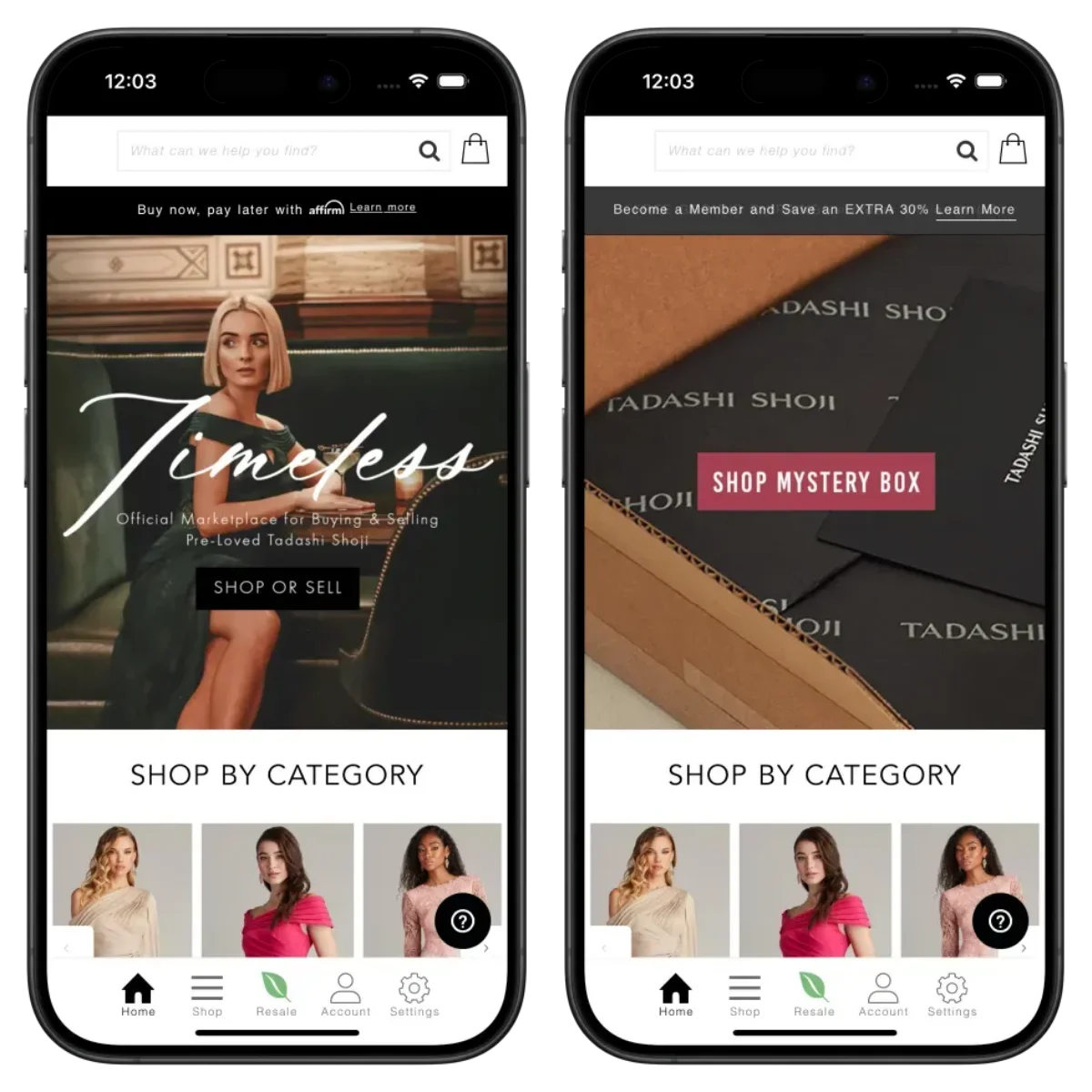
Luxury fashion brand Tadashi Shoji runs on Magento with a heavily customized storefront. When they launched their mobile app with MobiLoud, their lead developer didn't need to rebuild or reintegrate any of their existing extensions:
"I could continue developing the way I am used to. It was completely frictionless for me."
-- David Chamberlin, Lead Developer at Tadashi Shoji
The app now generates 18% of total online revenue, with app users converting at 8.3x the rate of mobile web visitors. Their checkout, their payment processing, their product pages, their entire extension stack: all carried over without additional development.
Launch a Magento Mobile App with All Your Extensions Intact
API-driven builders are a reasonable choice for Magento stores with a straightforward catalog, standard checkout, and default payment methods.
If you want a fully custom native UI and you're willing to accept a simpler app that doesn't replicate your full website experience, these tools can be a solid choice.
For stores with significant customization (custom checkout, third-party search, loyalty programs, B2B features, multiple payment gateways), the extension compatibility gap becomes a dealbreaker. Each integration adds cost, development time, and ongoing maintenance. The app falls behind the website, and it stays behind.
MobiLoud eliminates the gap entirely. Your storefront is the app, so your extensions are the app. Book a free strategy call to see a preview with your actual store and your actual extensions.