How to Convert an Ecommerce Website into a Mobile App (Step-by-Step)

Your ecommerce website already does 90% of what your mobile app should do. Converting it means building a native app framework around your existing site, adding push notifications, native navigation, and letting customers download it to their phones. You can do that with a custom hybrid build, take a shortcut by creating a PWA, or convert everything from your site into a real, full-featured app with MobiLoud.
Your ecommerce website already does 90% of what your mobile app should do. Converting it means building a native app framework around your existing site, adding push notifications, native navigation, and letting customers download it to their phones. You can do that with a custom hybrid build, take a shortcut by creating a PWA, or convert everything from your site into a real, full-featured app with MobiLoud.
We've built over 2,000 ecommerce mobile apps at MobiLoud over the past decade. We've worked with brands on Shopify, Magento, BigCommerce, Salesforce Commerce Cloud, and fully custom platforms. We've seen what works, what doesn't, and where brands waste time and money.
This is everything we know about converting an ecommerce website into a mobile app. Not a fluffy, high-level overview. Just a clear, honest explanation of what this actually involves, to help real ecommerce operators understand what it takes to launch an app.
What Does "Converting" Your Site into an App Actually Mean?
There’s a distinction between converting your site into an app and building a new app from scratch which a lot of people don’t fully grasp.
Most resources or tools that talk about converting your site into an app really mean rebuilding it.
You use a no-code tool to build a new UI, new homepage, new product pages, and pull in data from Shopify.
Or you build something new in React Native/Flutter/Capacitor/Swift, create APIs, connect them to your store’s backend.
None of this is converting what you already have. It’s building a new storefront.
That’s important, because it means more work to launch, difficulty achieving parity with your website (especially with no-code tools, which work from templates and pre-built blocks), and much more maintenance work after you launch.
Can You Convert Your Ecommerce Site into an App?
Yes. And it's far more common than most people realize.
The majority of successful apps, including some of the biggest in the world, blend native code with web content. They’re conversions, not custom apps.
Multiple studies have found that 83-90% of Android apps contain web-based components in their code. Among apps with 100,000+ users, more than half use web content as part of their architecture.
Amazon, Instagram, and Gmail all mix native and web elements. Shopify published a detailed engineering post describing web-based views as "a critical part of Shopify's mobile strategy."
These companies have massive engineering teams. They could build everything natively. They choose to reuse what they’d already built instead.
Why Converting Your Site Is Better Than Rebuilding It
Think about what your ecommerce website actually is.
It’s a mobile-friendly product catalog, conversion-optimized, everything dialed in for small screens and convenience.
That is 90% of what your mobile app needs to be.
App users aren’t looking for something brand new. They just want to be able to launch your app from their home screen, browse and buy with fewer distractions, get push notifications for order updates, promos, product launches, etc.
That’s the 10% that makes it an app; not a different UI, not some kind of flashy feature you can’t build on the web.
And when you convert, instead of rebuild, you:
- Save a significant amount of time/money on the initial build
- Save even more on maintenance and updates over the lifetime of your app
- Manage just one platform - your website - because whatever you build for the web syncs to the app automatically
- Launch risk-free - because you know you’re building from what already works, not taking a shot in the dark with a new UX
It’s about extending, not starting over. For the majority of ecommerce brands, this is the better approach.
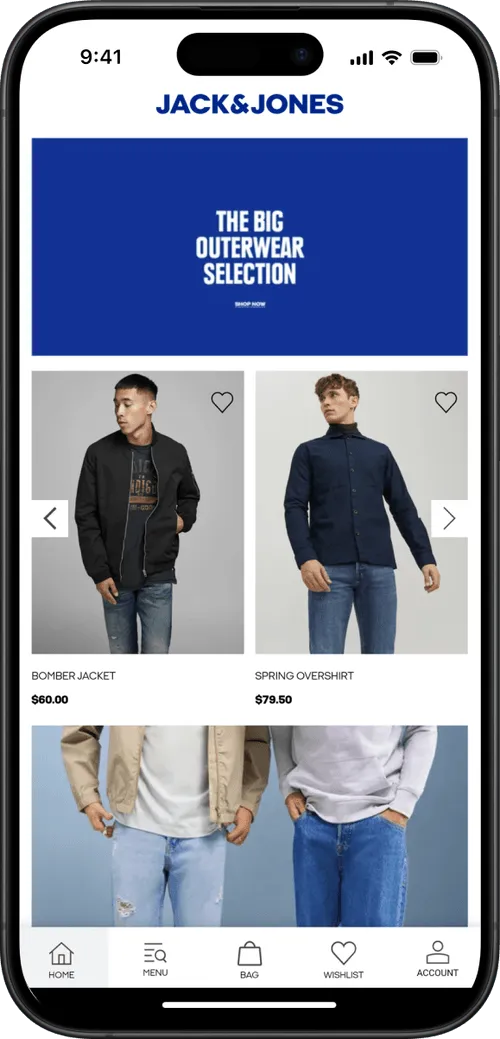
"There is no real business case for building an app from scratch for $1M+ when our mobile website is already good enough!"
-- Thomas Moberg, Product Owner, Bestseller (Jack & Jones, Only, Vero Moda)
Three Ways to Convert an Ecommerce Site Into an App
If we're being precise about what "converting a website into an app" means, there are really three approaches.
Let’s break them down, so you can start to form a picture of what makes sense for your brand.
Progressive Web App (PWA)
This is the lightest version of conversion. A Progressive Web App still runs inside the browser, but it gives an “app-like experience”.
You add modern browser APIs to your website so it can be installed to a user's home screen, cache content for faster loading, and (on Android) send push notifications.
The upside is simplicity. There's nothing to submit to an app store, no separate build, and no ongoing maintenance beyond your website. The improved user experience applies to all your website visitors, too - not just those who download your app.
The downside: it’s not a real app experience.
Your options for sending push notifications are limited, few people actually add your PWA to their home screen, and you can’t get in the App Store.
That’s not to say turning your site into a PWA is a bad thing. The opposite: you should absolutely do this.
But it’s not a substitute for a real mobile app.
Custom-developed hybrid app
This is what brands like Amazon and Shopify do.
You hire developers to build a native app framework that loads your web content inside it. This could be Ionic/Cordova, or perhaps a React Native build or Swift with webviews.
It’s a real app, in every sense of the word. You can customize the UX extensively. It’s fast, it’s mobile-native.
The downside: it costs a lot - even if you’re not building a fully custom app, you’re still looking at a big price tag, and you’ll need a dedicated mobile app team to maintain it.
That’s why it makes sense for Amazon, but not for most ecommerce brands.
MobiLoud
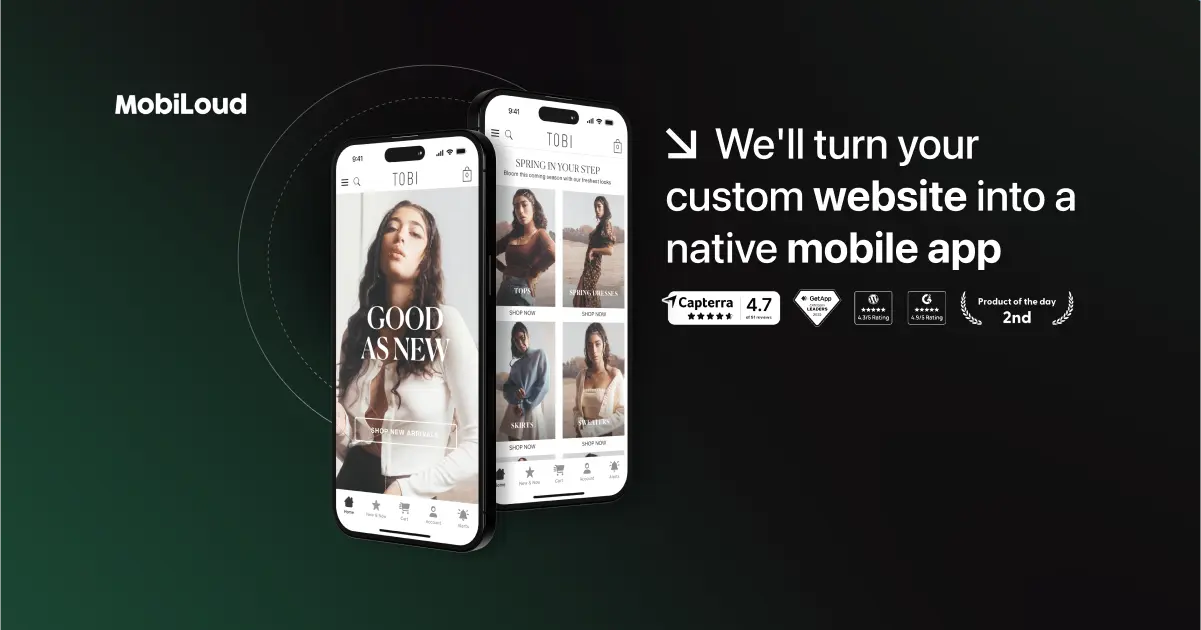
MobiLoud directly converts your ecommerce store into a mobile app.
It gives you more or less the same end result as custom hybrid development (a native app framework built around your website, with push notifications, deep linking, native navigation, and app store presence).
But it’s much more cost-effective, and requires much less from your team.
For a predictable monthly cost (with no revenue share, no hidden costs), you get a team who builds, submits, and maintains the app for you. You don’t need developers, you don’t need to manage the app, and everything you build for the web automatically carries over to your mobile app.
MobiLoud is the leading service in the ecommerce website to app category, with 2,000+ apps launched across every major ecommerce platform.
It’s a risk-free, low-overhead, high-upside way to go live with your own mobile app; whether you’re a major global brand or a lean DTC team.
Want to see what’s possible? Get a free consultation and we’ll break down how you can go live with your own mobile app in ~30 days.
What a Mobile App Gives You That Your Website Can't
You already know the general pitch: apps are better for engagement and retention. But it's worth understanding the specific mechanics, because they explain why apps consistently outperform mobile websites for ecommerce.
Home Screen Real Estate
When someone downloads your app, your brand icon sits on their phone alongside Instagram, Amazon, and their banking app.
That's not a small thing. Over 90% of smartphone time is spent in apps, and less than 6% in browsers.
Your website, no matter how good it is, lives behind a browser. Your customers have to remember to visit it, or you have to pay to bring them back (ads, email, SMS). An app lives on the device. It's visible every time they unlock their phone. That ambient presence drives repeat visits that no other channel can match.
Push Notifications
This is the single biggest reason ecommerce brands launch apps, and it deserves more than a bullet point.
Push notifications land directly on your customer's lock screen, instantly, at zero cost per message. They’re virtually guaranteed to be seen; they don’t disappear in the promotions folder or spam.
The use cases for ecommerce brands are immediate and high-impact.
- Abandoned cart reminders that get seen instantly.
- Back-in-stock alerts that reach customers while the intent is still fresh.
- Flash sale announcements that hit every opted-in user simultaneously.
- Order and shipping updates that keep customers engaged through fulfillment.
And unlike SMS (which costs $0.01-0.05 per message and requires carrier compliance), push is free.
Some of our customers have recovered over $200,000 in a single month from abandoned cart push notifications alone. At zero per-message cost, the economics are hard to ignore.
The Psychology of the Download
This one is underrated. When a customer downloads your app, they've made a small but meaningful commitment to your brand. They chose to give you space on their device.
That's a signal of intent and loyalty that you don't get from a website visit.
App users behave differently from mobile web visitors. They convert at roughly 3x the rate of mobile web visitors in ecommerce. They browse more products per session. They spend more per order. And they come back more frequently, typically delivering 3-7x higher lifetime value over time.
Some of that is selection bias (your most loyal customers are the ones who download the app). But some of it is the app itself creating a better, faster, more frictionless experience that reinforces the buying habit.
App Store Presence
Being listed in the App Store and Google Play gives your brand credibility and discoverability that a website alone can't provide.
Whether it’s the social proof boost of the “Available on the App Store” badges on your website, your app store listings showing up when someone searches for your brand in Google, or the ability to show up in App Store searches, there’s only upside here.
The Rebuild Trap
Apps can be a major revenue channel. Many ecommerce brands we’ve worked with get between 20-35% of their total revenue through their mobile apps.
Some do so on a relatively minor share of their overall customers - like Pharmazone, who gets 63% of their online revenue from less than 15% of their customers, or Junior Couture, who made 50% of their BFCM revenue in 2025 from just 5% of their customers.
It’s absolutely a channel that any ecommerce brand with a mobile-first customer base and high repeat purchase potential should explore.
But the biggest mistake is going for a rebuild, not a conversion.
This changes the risk dynamics greatly.
- You’re building something new (not extending what already works), so there’s no guarantee it’s going to resonate.
- You may not be able to convert everything from your website into the app, leaving open the possibility your website ends up being better than your app (which basically kills any chance of your app being successful).
- It takes longer; the market might move before you launch.
- The app needs to be managed separately from your website; adding overhead, operational complexity, and slowing you down.
And, of course - it costs a lot more.
“If we had unlimited time and money, we would probably go for a custom native app, but that is half a million to a million a year to maintain.”
-- David Cost, VP of Ecommerce, Rainbow Shops
Your app needs to move the needle in a much bigger way to justify the investment. It could do that, certainly. But it’s harder to be sure.
And what we see most often from brands who built custom before they came to us, is the work needed to maintain an app parallel to their website was too much.
You’re maintaining another storefront. That’s not a small amount of work, even if it doesn’t seem like much.
Things start out ok, until the app starts to fall behind the website. Eventually, the team stops maintaining the app, and it falls into disrepair.
When you convert, instead of rebuild, the app stays up to date automatically. Just another reason why this is the best way to build an ecommerce app.
Converting Your Ecommerce Site Into an App: Step-By-Step
If you've read this far and think converting your website into an app is the right approach, here's what the process looks like with MobiLoud.
MobiLoud is a fully managed service. You're not configuring an app yourself in a dashboard. The MobiLoud team handles the build, the testing, the app store submission, and the ongoing maintenance.
Your team stays focused on running your business, maintaining and iterating on your website, like you already do. You get a team that takes care of everything to do with the app for you.
Here’s how it works:
- Strategy call. Get on a call with us. Our team will answer your questions, break down the process, and assess your website to make sure converting your site into a mobile app is the right move. No commitment. Book a free 30-minute call here.
- Build, QA, and submission. MobiLoud builds the production app, runs QA testing across devices and OS versions, writes your app store listing, generates screenshots, and handles the entire Apple and Google submission process. If reviewers request changes, we take care of it. The whole process takes about 4 weeks from kickoff to live in the app stores.
- Launch and growth. Once your app is live, we manage any app-specific maintenance, so you can keep your focus on your website. We also help out with app promotion and strategy post-launch, to help you make your app a success.
What you get
- Native iOS and Android apps listed in the App Store and Google Play
- Full parity with your website: every feature, every integration, every page
- Unlimited push notifications integrated with OneSignal and Klaviyo, at no per-message cost
- Automatic sync: update your website and the app updates too
- Ongoing maintenance, OS updates, and support
- Works with any ecommerce platform: Shopify, WooCommerce, BigCommerce, Magento, Salesforce Commerce Cloud, and custom builds
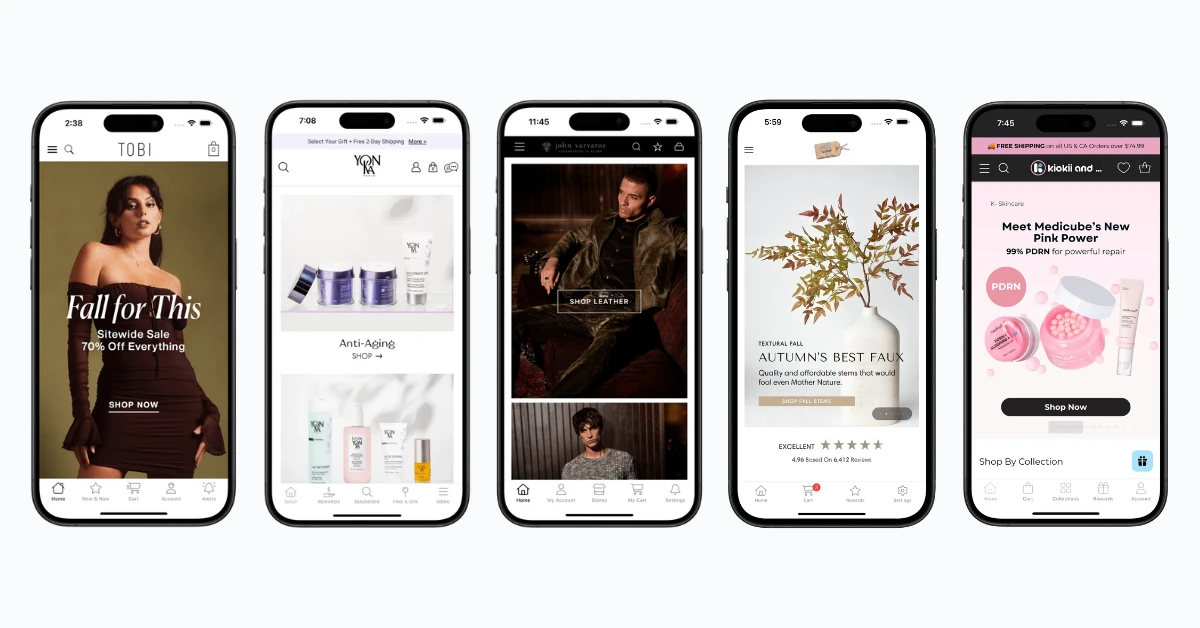
What brands say
"Our website is already well-optimized so using MobiLoud to transform our site into an app was a no-brainer. No crazy costs, no integration headaches, and we were launched in a month."
-- Ahmed Yousef, Director of Ecommerce, Pharmazone
"We tried six companies and I feel like you guys have the best combination of service, functionality, and price."
-- Kenneth Chan, Founder & CEO, TOBI
"MobiLoud keeps this whole thing simple and streamlined. No more juggling two different platforms, no more wasted time on maintenance."
-- Eric Lowe, Director of Ecommerce, XCVI Fashion
Read more case studies from our customers here.
When MobiLoud isn't the right fit
If your mobile website needs significant work, it's worth fixing that first. Don’t use a mobile app as a way to deal with a broken mobile web experience. You’ll get far more people land on your mobile website than download your app, so this is where you should put your focus first.
If you need the app to be a fundamentally different product from your website (not just a mobile-optimized version, but a different experience entirely), converting your site into the app may not be ideal.
You might want to look into custom development, or a DIY mobile app builder instead, which comes with its own tradeoffs, but allows greater app-specific customization.
And if you need device-specific features that don't exist on the web (AR, NFC, complex offline workflows), a custom native build is really the only option.
Getting Started
Want to see how your website would look as an app? Want to hear how other brands like yours have successfully launched their apps by converting their existing website?
We’ll share all of that with you, and answer any questions, on a free 30-minute strategy call.
We've launched 2,000+ apps for brands like yours, and we'll give you an honest assessment of whether this is the right move.
FAQs

Convert your website into a mobile app