TCPA, SMS Compliance, and the Case for Push Notifications in Ecommerce

SMS marketing still works, but the regulatory walls are closing in. TCPA class actions doubled in early 2025, per-message costs keep climbing, and a single compliance slip can cost $500 to $1,500 per text. Push notifications deliver the same direct-to-device messaging with none of the legal exposure, and they're free to send.
SMS marketing still works, but the regulatory walls are closing in. TCPA class actions doubled in early 2025, per-message costs keep climbing, and a single compliance slip can cost $500 to $1,500 per text. Push notifications deliver the same direct-to-device messaging with none of the legal exposure, and they're free to send.
If you run an ecommerce brand and SMS is a meaningful part of your marketing mix, you know the rules are getting tighter.
What you might not know is how much tighter, how fast things are moving, and what your options actually look like when SMS stops being the easy win it used to be.
This isn't a "kill your SMS program" article. SMS has earned its place in your marketing stack. Open rates near 98%, click-through rates in the 21-35% range, and a direct line to your customer's most personal device. The channel works.
But working well and being sustainable are two different things.
The Telephone Consumer Protection Act (TCPA) has been around since 1991, and it's never been enforced as aggressively as it is right now. Combine that with rising per-message costs and stricter carrier requirements, and the math on SMS starts to look different than it did two years ago.
Here's what's actually changing, what it means for your brand, and where push notifications fit into the picture.
Get smarter about ecommerce, retention and CX. The Retention Edge is a free weekly newsletter for operators who want to drive real, sustainable growth. Read it free at retentionedge.co ->
What the TCPA Actually Requires (And What Changed Recently)
The TCPA was originally written to stop robocalls. Over the past decade, it's expanded to cover text messages, and the enforcement machinery has caught up.
Here's what you need to know as an ecommerce brand:
The basics that haven't changed:
- You need "prior express written consent" before sending marketing texts
- Consumers must be able to opt out at any time
- Each unsolicited text can result in $500 to $1,500 in statutory damages per message
- There's no cap on total damages, which is why class actions regularly reach millions
What changed in 2025:
The FCC's revocation of consent rules took effect on April 11, 2025. Under these rules:
- Consumers can revoke consent through "any reasonable means" (not just replying STOP)
- Businesses must honor revocation requests within 10 business days
- This applies to both marketing and informational messages
The FCC also codified that Do Not Call Registry protections apply to text messages, closing a loophole some businesses had relied on.
There was also the saga of the "one-to-one consent" rule.
The FCC proposed requiring seller-specific consent for each individual company contacting a consumer, which would have made lead-sharing and multi-brand consent forms essentially worthless.
The 11th Circuit ultimately vacated that rule in August 2025, finding the FCC had overstepped its authority. But the fact that it got that far tells you which direction regulators are heading.
--
Keep in mind we are not legal experts, and none of this is legal advice. To be sure of complete and accurate information, make sure you check in with a legal professional.
--
The Enforcement Numbers Are Hard to Ignore
In Q1 2024, there were 239 TCPA class actions filed. In Q1 2025, that number hit 507, a 112% year-over-year increase.
Through September 2025, over 2,128 TCPA lawsuits were filed, a 57.9% increase over the same period in 2024.
Nearly 80% of all TCPA lawsuits are now class actions. For context, only about 5% of other consumer protection cases are filed as class actions. Plaintiff firms are expanding operations specifically to increase TCPA filing capacity.
Recent settlements from retail and ecommerce brands:
- DSW / Designer Brands: $4.43 million settlement (approved August 2025)
- Zales Jewelers: $7.5 million settlement (September 2025)
- Albertsons: $5.95 million settlement for telemarketing calls and texts without consent
- &Pizza: $750,000 settlement for texting customers who had already opted out
The &Pizza case is worth pausing on. That wasn't some massive brand-wide violation. It was a company that kept sending marketing texts after people said stop. A mistake any growing ecommerce brand could make with a poorly configured SMS tool or a messy subscriber list.
The Cost Problem Beyond Compliance
Even if you stay perfectly compliant, SMS is getting more expensive.
A standard US SMS message runs $0.01 to $0.05 per send, depending on your platform and message type. MMS (messages with images) costs more, typically around $0.04 per message.
That doesn't sound like much until you do the math at scale.
A brand sending 100,000 messages a month is looking at $1,000 to $5,000 in message fees alone.
Add platform subscription fees, carrier surcharges ($0.003 to $0.01 per message), number registration fees, and the cost of dedicated compliance staff or legal review, and SMS becomes one of the more expensive channels in your stack.
Carrier fees have been steadily increasing. The major carriers (AT&T, T-Mobile, Verizon) introduced surcharges for commercial messaging that didn't exist a few years ago.
And then there's the hidden cost: the internal resources you spend managing compliance. Maintaining consent records, processing opt-outs within 10 business days, auditing your subscriber lists, training your marketing team on the rules, and retaining legal counsel to review campaigns.
None of that shows up in your per-message cost, but it's real.
10DLC
10DLC (10-Digit Long Code) is the registration system US carriers now require for any business sending text messages from a standard phone number.
Before 10DLC, you could get a number and start texting. Now you need to:
- Register your brand
- Submit each messaging campaign for approval
- Wait for vetting
Registration fees run $4 to $15 depending on the carrier, with some requiring annual renewal. Your throughput (how many messages you can send per second) is tied to a "trust score" the carriers assign based on your brand size and registration details.
Lower trust scores mean stricter rate limits, which can be a real problem during flash sales or time-sensitive campaigns. If you skip registration entirely, your messages get silently filtered or blocked.
It's one more layer of cost and operational overhead that didn't exist a few years ago.
Where Push Notifications Fit In
Push notifications and SMS do fundamentally the same thing: put a message on your customer's phone screen in real time.
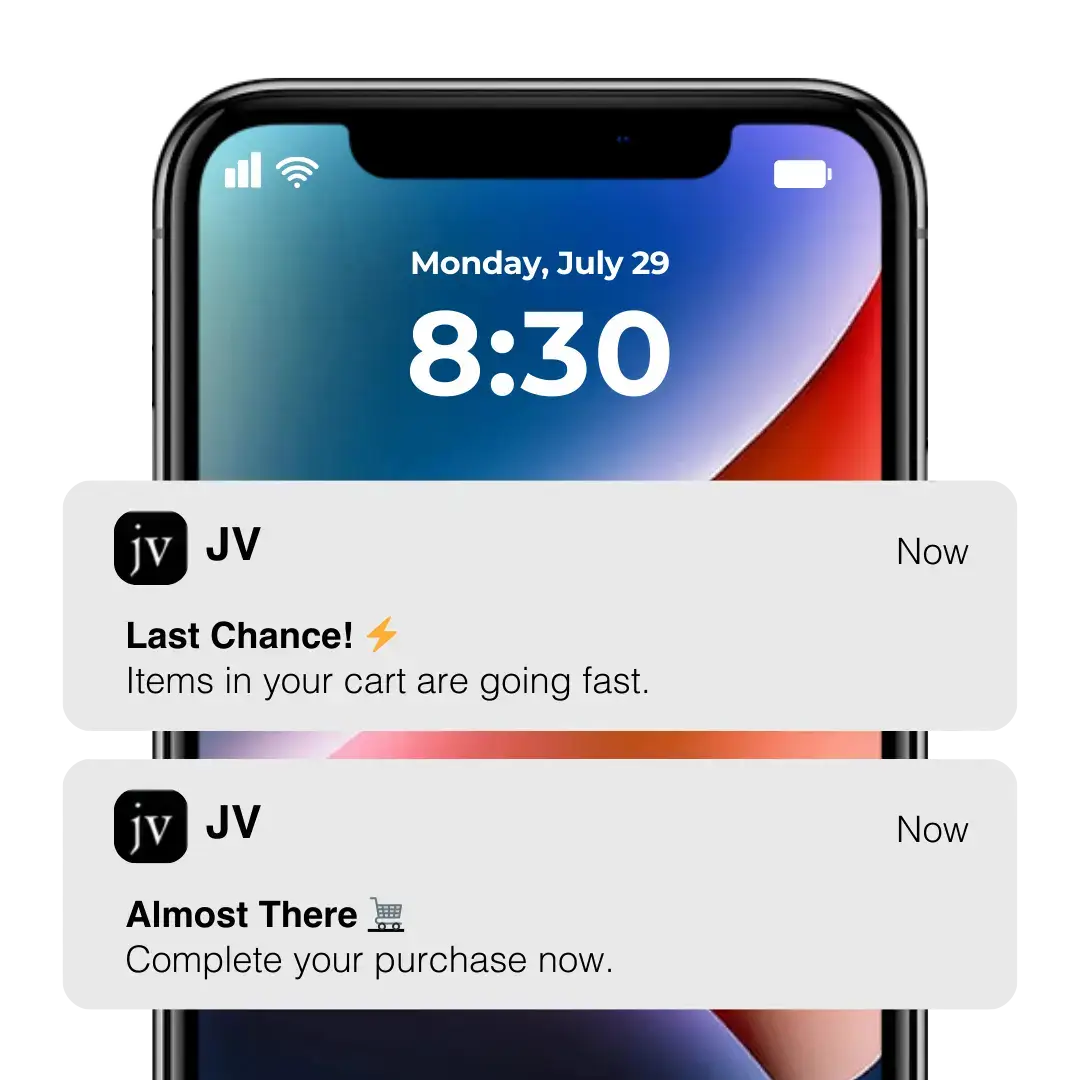
The difference is in how they get there and what rules apply.
Here are some of the advantages of push notifications:
No regulatory exposure
Push notifications aren't covered by the TCPA. There's no statutory damage risk, no class action liability, no FCC oversight.
Users opt in through their device's native permission system (the standard iOS or Android prompt), and they opt out by toggling a switch in their phone's settings.
The entire consent model is managed by Apple and Google at the operating system level. It’s significantly safer - not going to end up with a $7.5 million lawsuit.
No per-message cost
Once you have the infrastructure in place, push notifications are free to send.
There are no carrier fees, no per-message charges, no surcharges. Whether you send 1,000 or 1,000,000 notifications, the marginal cost is zero.
Comparable reach and engagement (with caveats)
SMS generally has higher reported open rates and click-through rates. Those numbers are real and worth respecting. But they're also somewhat misleading - especially regarding push.
Push notifications land right on the lock screen, essentially “opened” already. Many studies regard a push “open” as a long-tap that shows the full message (longer messages have a little bit cut off). Some regard an open as tapping on the notification and opening the app.
That’s a lot different than opening an SMS.
You could argue that push notifications have a 100% open rate, since they’re almost guaranteed to be seen on the lock screen.
The Honest Comparison: SMS vs Push Notifications
The right comparison isn't push vs SMS in isolation. It's the total cost of each channel, including compliance overhead, legal risk, and per-message fees, relative to the revenue it generates.
Here’s the birds-eye view of how SMS and push notifications stack up against each other.
Where SMS still wins:
- Higher raw engagement metrics (open rate, CTR)
- Wider reach: doesn’t require app install
- More established channel with more mature tooling (Klaviyo, Postscript, Attentive all have deep ecommerce integrations)
Where push notifications win:
- Zero regulatory risk under TCPA
- Zero per-message cost
- Deep linking directly into native app content (product pages, carts, account screens)
- Rich media support (images, action buttons, custom sounds) without MMS surcharges
- No carrier approval, registration, or number provisioning required
- Consent model is built into the operating system. There's nothing to manage on your end.
Where it's genuinely close:
- Abandoned cart recovery (both channels perform well here)
- Flash sale and limited-time offer announcements
- Loyalty and rewards program engagement
- Re-engagement campaigns for lapsed customers
The Shift That's Already Happening
Here’s what we’re seeing from successful brands. They’re not abandoning SMS - but reducing their dependence on it and building push notification capabilities in parallel.
The logic is straightforward. If you're spending $3,000 to $5,000 a month on SMS message fees, plus platform costs, plus internal compliance overhead, and one bad list hygiene day could trigger a seven-figure lawsuit, the risk-adjusted cost of that channel is higher than it looks on a spreadsheet.
Meanwhile, push notifications through a native app cost nothing per message, carry no legal risk, and convert at rates that make them worth the investment in the app itself.
This is especially true for brands that already have (or are building) a mobile app. If your customers are installing your app, you have a direct line to them that doesn't route through carriers, doesn't require consent management infrastructure, and doesn't put you in the crosshairs of an industry that filed over 2,000 lawsuits in nine months.
Should You Abandon SMS?
None of this means you should shut down your SMS program tomorrow.
And push notifications are not a direct replacement for SMS either, because you can’t reach every person on your SMS list with a push notification (only those who have your app installed).
But you should be adding push notifications to the mix. For the people you can reach, they’re more reliable, more cost-effective, and arguably more powerful on a message for message basis.
Here’s a quick breakdown of how to assess your SMS strategy - how to make sure you’re safe from lawsuits, and how to start branching out into new channels like push.
- Short term: Audit your SMS compliance. Make sure your opt-out processing meets the new 10-business-day requirement. Review your consent records. If you're using shared consent forms or lead-gen partners, understand exactly what consent you actually have.
- Medium term: If you have a mobile app, invest in your push notification strategy. Segment your audience, build automated flows (abandoned cart, browse abandonment, back-in-stock), and start measuring push performance alongside SMS. You'll likely find that push drives meaningful revenue at a fraction of the cost.
- Long term: Consider what it would take to shift your most expensive SMS campaigns to push. High-frequency campaigns (daily deals, flash sales, loyalty updates) are the best candidates. You won’t be able to shift all of these messages to push; but you can potentially replace SMS with push just for customers who have your app.
For brands that don't have a mobile app yet, this is one more reason to consider it. The direct messaging channel alone can justify the investment, especially when you factor in the compliance costs and legal risk you're avoiding.
Getting Started with Push Notifications
If you're running an ecommerce store and you want to add native push notifications to your marketing mix, you need a mobile app.
Not a PWA (which can only send web push notifications - which are far less effective than native push), but a real native app on iOS and Android.
MobiLoud builds native apps from your existing ecommerce website. Your site, your checkout, your integrations, all delivered as a native app with full push notification support.
No rebuilding your store from scratch, no managing a separate codebase, no sacrificing the features your customers already use.
Here's what that process looks like:
- Book a strategy call. Share your website URL with us, discuss your goals, and we'll assess whether an app is a good fit for you.
- Get a custom app preview. Our team builds a personalized preview so you can see exactly how your store looks and feels as a native app.
- Launch in 30 days. We handle everything. Your app goes live on the App Store and Google Play while you focus on running your business.
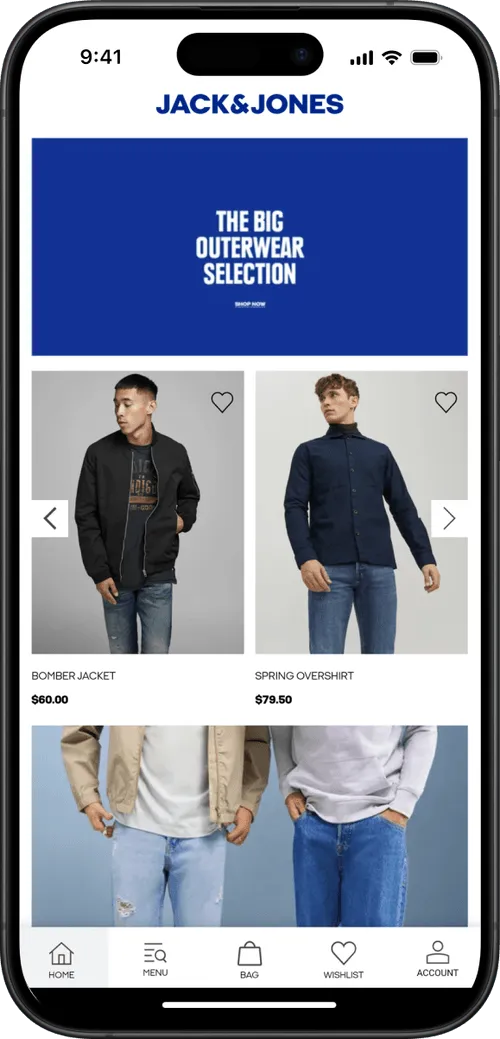
We've built over 2,000 apps over the last 10+ years, including apps for global ecommerce brands like John Varvatos and Jack & Jones.
If you're curious whether a native app (and the push notification channel that comes with it) makes sense for your store, book a free strategy call now to discuss it, get your questions answered, and start making push a part of your marketing stack.
FAQs

Convert your website into a mobile app