Klaviyo vs Mailchimp: Which Email Marketing Platform is Right for Your Ecommerce Brand?

Klaviyo and Mailchimp are two leading email marketing platforms, but they serve different needs. Klaviyo is purpose-built for ecommerce with advanced segmentation, predictive analytics, and deep platform integrations. Mailchimp offers a broader, more beginner-friendly marketing toolkit suitable for a wider range of businesses. Both platforms integrate seamlessly with website to app services like Mobiloud, allowing brands to combine email with push notifications and SMS for a complete retention strategy.
Klaviyo and Mailchimp are two leading email marketing platforms, but they serve different needs. Klaviyo is purpose-built for ecommerce with advanced segmentation, predictive analytics, and deep platform integrations. Mailchimp offers a broader, more beginner-friendly marketing toolkit suitable for a wider range of businesses. Both platforms integrate seamlessly with website to app services like Mobiloud, allowing brands to combine email with push notifications and SMS for a complete retention strategy.
Email marketing delivers an average ROI of $36-42 for every $1 spent, making it one of the most effective channels for ecommerce brands. But choosing the right platform makes a massive difference in how much value you actually extract from that channel.
If you're evaluating Klaviyo and Mailchimp, you're looking at two platforms that take fundamentally different approaches to email marketing.
Klaviyo was built specifically for ecommerce and thrives on customer data and behavioral triggers.
Mailchimp started as a general email tool and expanded into a full marketing suite.
The right choice depends on your business model, technical comfort, and how deeply you want to personalize your customer communication.
This guide breaks down how Klaviyo and Mailchimp compare across features, pricing, automation, and ease of use - so you can make an informed decision based on what actually matters for your store.
Choosing Your Email Core: Klaviyo or Mailchimp
Klaviyo is built to turn ecommerce data into targeted revenue-generating flows, while Mailchimp focuses on being an accessible, general-purpose email and marketing tool.
Here is how they compare for online stores:
Klaviyo: Built for Ecommerce
Klaviyo is an email and SMS platform designed specifically for online retailers, with deep integrations into major ecommerce platforms like Shopify, WooCommerce, BigCommerce, and Magento.
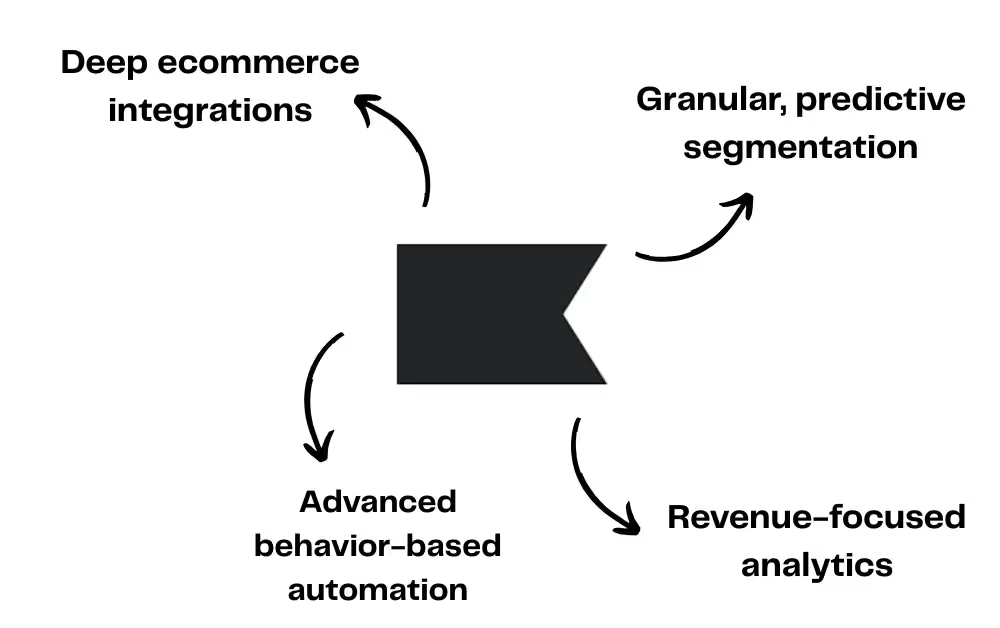
Advanced Ecommerce Features
Klaviyo pulls real-time customer data and lets you build precise segments:
- Browsing behavior, purchase history, cart activity, and product views synced automatically
- Precise targeting like "VIP customers with lifetime value over $500 who haven't ordered in 60 days"
- Dynamic product recommendations within emails based on individual customer behavior
- Real-time data updates for always-accurate segmentation
Turn Klaviyo from “just email” into a full push + app engine. Use this Klaviyo push notifications guide to plug email, SMS, and app push into one system
Sophisticated Automation and Segmentation
Automated emails achieve 42.1% open rates compared to 25.2% for one-off campaigns. Klaviyo's flows let you trigger emails based on almost any customer action - not just abandoned carts, but specific browsing patterns and engagement signals.
Also, apps that run automated abandoned cart flows recover up to 17% more carts than relying on email and SMS alone, and Klaviyo lets you support this with multi-step email flows that adapt to cart value, customer segment, and behavior using predictive analytics like expected next order date and predicted lifetime value.
Pricing and Learning Curve
Klaviyo's pricing scales with your contact count:
- Free plan: up to 250 contacts with access to all email features
- 500 contacts: $20/month
- 15,000 contacts: ~$350/month
- SMS billed separately based on usage
The trade-off is a steeper learning curve. Klaviyo rewards data-savvy marketers but can feel overwhelming if you're new to advanced segmentation and automation.
Mailchimp: User-Friendly Marketing Platform
Mailchimp started as an email tool and evolved into an all-in-one marketing platform designed to be accessible for beginners.

Broader Marketing Tools
Mailchimp provides multiple marketing tools in one interface:
- Landing page builders and website creation tools
- Social media ad management
- Audience insights and analytics
- Email marketing and automation
For small businesses juggling multiple channels, that breadth is valuable. The trade-off is less depth on any single channel compared to specialist tools like Klaviyo.
Automation and Features
Mailchimp offers automation through pre-built workflows for welcome series, abandoned cart reminders, and post-purchase follow-ups.
These work fine for basic needs, but lack Klaviyo's real-time, dynamic segmentation and conditional logic. Many advanced automation features are locked behind higher-tier plans.
Pricing and Accessibility
Mailchimp's pricing tiers:
- Free: up to 500 contacts, 1,000 monthly sends
- Essentials: $13/month for 500 contacts
- Standard: $20/month with more automation and dynamic content
- Premium: $299/month for 10,000 contacts
Mailchimp's pricing can add up with duplicate contacts, since it charges per list rather than per unique subscriber.
For beginners, Mailchimp's interface is easier to navigate with an intuitive drag-and-drop editor.
Head-to-Head Comparison
Automation Capabilities
Klaviyo wins on automation depth. Its flows are real-time, behavior-driven, and endlessly customizable.
You can build complex conditional splits based on customer actions, predictions, and attributes.
Mailchimp's automation is solid for basic needs but less dynamic. Pre-built templates make it easy to get started, but you'll hit limits quickly if you want to personalize at scale.
Segmentation and Personalization
Klaviyo's segmentation is granular and updates in real time. You can layer multiple conditions and use predictive data to target the right customers at the right moment.
Mailchimp offers tags and basic segmentation, but it's not as flexible or precise. For ecommerce brands that depend on hyper-relevant messaging, that gap matters.
Analytics and Reporting
Klaviyo focuses on revenue attribution and customer lifetime value.
You can see exactly which emails drive sales and how different segments perform over time.
Mailchimp provides standard reporting - opens, clicks, unsubscribes - but doesn't tie as directly to revenue. For context, the average customer retention rate in ecommerce is around 38%, so understanding which campaigns improve retention and repeat purchase behavior is critical.
According to our 2025 Ecommerce Mobile App Benchmark Report, app customers have 2.8-5x higher lifetime value than web-only customers, making retention tracking essential for maximizing long-term revenue.
Integrations
Both platforms integrate with major ecommerce platforms, but Klaviyo's integrations are built to sync deeper customer data in real time.
Mailchimp has a larger catalog of integrations overall (300+), covering CRMs, social platforms, and general business tools.
If you need broad compatibility across non-ecommerce tools, Mailchimp has the edge.
Ease of Use
Mailchimp is easier to learn. Its interface is clean, and the workflow is straightforward. If you want to launch a campaign in 15 minutes without reading documentation, Mailchimp delivers.
Klaviyo requires more upfront investment.
You'll need to understand how segments work, how to structure flows, and how to interpret analytics. But once you're comfortable, that complexity translates into much more control.
Get the real 2025 numbers on platforms, design, and deliverability. See the full breakdown of how much email marketing actually costs
Which Should You Choose?
Choose Klaviyo If:
- You run an ecommerce business and need deep platform integration.
- Advanced segmentation and behavioral triggers matter to your strategy.
- You want predictive analytics and revenue attribution built in.
- You're willing to invest time learning a more powerful tool.
- Email and SMS are core revenue drivers for your brand.
Choose Mailchimp If:
- You're a small business, startup, or creator needing an all-in-one platform.
- Ease of use and fast setup are top priorities.
- You need marketing tools beyond just email (landing pages, ads, social).
- Budget is tight and you want a low-cost entry point.
- Your business model isn't primarily ecommerce.
Your Email Stack + Your App, Working as One
Here’s the thing: whichever platform you choose, Klaviyo and Mailchimp both work seamlessly with mobile apps.
With MobiLoud, your existing ecommerce site becomes native iOS and Android apps, so your email stack, automations, segments, and customer data all work exactly as they do on the web.
No rebuilding, no migrations, no starting from scratch.

Email, SMS, and push notifications together form a dependable, revenue-driving retention stack: email for depth, SMS for urgency, and push for instant, high-visibility engagement.
The real advantage is ownership. Your app lives on your customers’ home screens, giving you direct access instead of renting attention in crowded inboxes.
All the work you’ve already done on product pages, navigation, CRO, and integrations comes straight into the app, with push notifications and app-exclusive offers layered on top.
Build a proper owned-channel engine, not just an ESP setup. Read how email, SMS, and push notifications work together to drive DTC growth
Final Thoughts
Klaviyo and Mailchimp are both strong platforms, but they're built for different goals.
Klaviyo is the better choice for ecommerce brands that want to maximize customer lifetime value through data-driven email and SMS marketing.
Mailchimp is a versatile, beginner-friendly option for businesses that need a broader marketing toolkit without the complexity.
If email and retention are central to your growth strategy, Klaviyo's depth pays off. If you're just getting started or need simplicity across multiple channels, Mailchimp gets you moving faster.
And if you're serious about retention and owned channels, don't stop at email.
Mobile apps deliver measurable ROI by turning one-time buyers into repeat customers who keep coming back.
Your app works with whatever email platform you choose - Klaviyo, Mailchimp, or anything else your site already uses.
MobiLoud converts your existing website into native iOS and Android apps without rebuilding or changing your stack. Everything syncs automatically, and you get push notifications, app-exclusive offers, and a permanent presence on your customers' devices.
Ready to add a mobile app to your retention strategy? Request a free preview to see how your store would look as an app.
FAQs

Convert your website into a mobile app