12 Best Push Notification Services in 2026 (Web + Mobile)

The right push notification service depends on your channels, audience size, and tech stack. OneSignal is the most versatile option for teams that need both web and mobile push. Klaviyo is the strongest choice for ecommerce brands already using it for email and SMS. For web push specifically, PushEngage offers the most complete feature set at an accessible price point.
The right push notification service depends on your channels, audience size, and tech stack. OneSignal is the most versatile option for teams that need both web and mobile push. Klaviyo is the strongest choice for ecommerce brands already using it for email and SMS. For web push specifically, PushEngage offers the most complete feature set at an accessible price point.
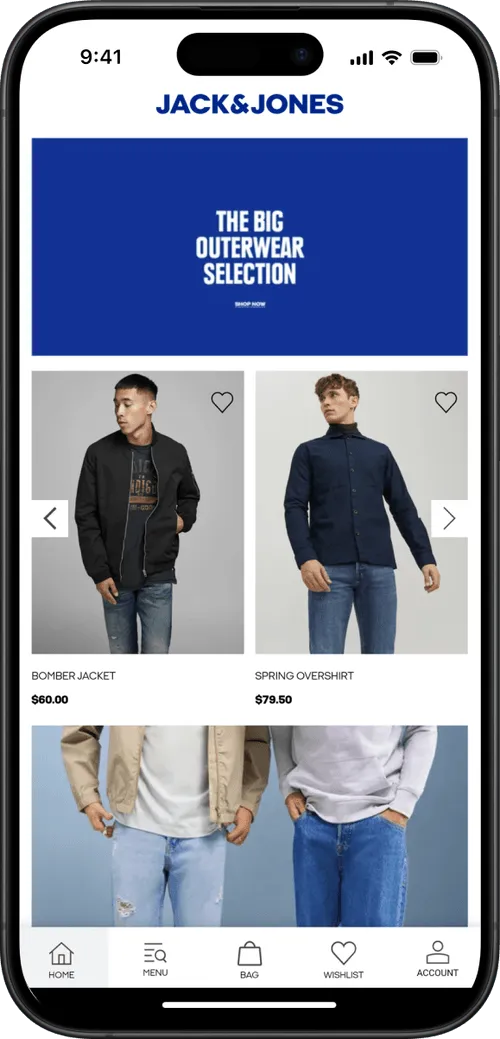
Push notifications are one of the most powerful and efficient way to contact your customers today; whether you're running an ecommerce store, an online publisher, or a mobile app.
Push notification services take care of all the technical legwork related to setting up and delivering your push notifications.
This guide covers 12 push notification services across the full spectrum: dedicated push platforms, omnichannel marketing suites, enterprise engagement tools, and developer infrastructure. We've noted which channels each tool supports, and included user feedback from G2, Capterra, and the Shopify App Store so you can compare options without visiting a dozen websites.
Whether you're a Shopify brand sending your first abandoned cart notification or an enterprise team orchestrating millions of messages a day, you'll find a tool here that fits.
What to Look for in a Push Notification Service
Push notifications are one of the highest-ROI channels in digital marketing. They outperform email on click-through rates and reach customers on the one device they always carry. But the landscape of the best push notification services has shifted significantly in the past few years. What used to be a simple "web push vs. app push" decision now involves omnichannel orchestration, behavioral automation, predictive analytics, and AI-powered delivery timing.
This guide covers 12 push notification services across the full spectrum: dedicated push platforms, omnichannel marketing suites, enterprise engagement tools, and developer infrastructure. Some handle web push only. Others cover mobile app push, email, SMS, and in-app messaging from a single dashboard. We've noted which channels each tool supports so you can match the right service to your stack.
Whether you're a Shopify brand sending your first abandoned cart notification or an enterprise team orchestrating millions of messages a day, you'll find a tool here that fits.
How We Evaluated These Tools
We evaluated each platform on five criteria:
- Channel support (web push, mobile push, or both)
- Pricing transparency
- Ease of integration
- Segmentation and automation capabilities
- Track record at scale
We reviewed pricing pages, tested documentation, and gathered feedback from G2, Capterra, and Shopify App Store reviews.
The 12 Best Push Notification Services
There are a lot of tools out there that make it easy to send push notifications. We've broken done the top options below. Here's a quick summary of the best push notification services:
Now let's get into the list.
1. OneSignal: Best for Multi-Platform Push Notifications
OneSignal is the most widely adopted push notification platform, powering over 200,000 apps and delivering 1.3 trillion messages per year. It supports mobile push (iOS, Android), web push, email, SMS, and in-app messaging from a single dashboard.
The platform is built developer-first. SDKs are available for every major framework, and the REST API is well-documented. Setup is straightforward for technical teams, and the free tier is generous enough for most early-stage projects: unlimited mobile push, 10,000 web push subscribers, and 10,000 email sends per month.
For marketing teams, OneSignal offers automated journeys with branching logic, intelligent delivery timing (which sends notifications when each user is most likely to engage), and segmentation based on behavior, tags, and device properties.
The Growth plan starts at $19/month, but scales by usage at $0.012 per monthly active user for mobile push. At 100,000 MAU, that works out to roughly $1,200/month. Costs can grow quickly for high-traffic apps, so it's worth modeling your expected volume before committing. Notable customers include Zynga, Whole Foods, DHL, and Royal Caribbean.
What users say: "It helps me add push alerts to the mobile apps I build for clients. This saves me weeks of coding because the notification engine is already built and ready to use." (Source: G2)
2. Klaviyo: Best for Ecommerce Omnichannel Campaigns
Klaviyo is an email and SMS-first marketing platform that expanded into mobile push notifications for ecommerce brands. If you already use Klaviyo for email and SMS (and many ecommerce teams do, with 193,000+ paying customers), adding push to your existing flows requires no additional tool. Push notifications are included on all paid plans at no extra per-message cost.
The key differentiator is Klaviyo's ecommerce data layer. Your push notifications can be triggered by purchase behavior, predicted churn risk, expected next order date, and lifetime value segments. A post-purchase flow, for example, can send email on day one, SMS on day three, and a push notification on day seven, all orchestrated from the same automation builder. For a deeper look at how this works, see our guide to Klaviyo push notifications for ecommerce.
One important caveat: Klaviyo's push notifications are mobile app push only. There is no web push support. Your customers need to have your native mobile app installed to receive push notifications through Klaviyo. If your brand doesn't have a mobile app yet, Klaviyo's push channel won't be accessible to you (though we cover options for that later in this guide).
Pricing scales by active profiles, starting at $20/month for 500 profiles. At 50,000 profiles, expect roughly $720/month.
What users say: "What I like best about Klaviyo is the segmentation and automation possibilities. We can create different flows based on customer actions, behavior, and lifecycle stage, so communication becomes much more relevant." (Source: G2)
3. PushEngage: Best for Web Push Notifications
PushEngage is a dedicated web push notification platform with strong ecommerce features. If you need browser-based push notifications without building a mobile app, PushEngage is the most feature-complete option in this category.
The platform excels at ecommerce-specific automations. Cart abandonment recovery, browse abandonment triggers, price drop alerts, and back-in-stock notifications are all built in. These automations fire based on visitor behavior on your website, no app installation required. SuperJeweler reported 8% higher conversions using PushEngage, and Wicked Weasel attributes $2,000-$4,000 in weekly revenue to their push campaigns.
Pricing is straightforward. The Business plan starts at $8/month (billed annually) for up to 10,000 subscribers. The Growth plan at $24/month unlocks advanced features like browse abandonment and dynamic segmentation. All plans include unlimited notifications.
PushEngage focuses exclusively on web push. That means it works through browsers (Chrome, Firefox, Safari on macOS, and Edge) and doesn't require visitors to download anything. The tradeoff is that web push on iOS is limited to Safari 16.4+, so iPhone reach can be inconsistent.
PushEngage holds a 4.6/5 rating on G2 across 53 reviews.
What users say: "PushEngage has helped us achieve open rates that are 400% higher than our email campaigns. The segmentation capabilities let us send highly relevant notifications to specific audience segments." (Source: PushEngage case studies, Saleduck)
4. Braze: Best for Enterprise Mobile Engagement
Braze is a full lifecycle engagement platform built for large-scale consumer brands. If your team has a dedicated marketing ops function and a customer base in the hundreds of thousands (or millions), Braze is the tool that can orchestrate push alongside every other channel in a single system.
The platform's Canvas builder is its centerpiece: a visual workflow tool where you can map multi-step, multi-channel journeys that branch based on real-time user behavior. BrazeAI layers on predictive analytics (identifying users likely to churn) and generative content (personalizing copy at scale). The data infrastructure processes events in real time, so your push notifications can respond to what a customer did seconds ago, not hours ago.
Pizza Hut saw a 21% revenue lift from personalized campaigns on Braze. Other notable customers include Canva, Burger King, HBO Max, JetBlue, and Delivery Hero. Braze was named a Leader in the 2025 Gartner Magic Quadrant for Multichannel Marketing Hubs.
Braze doesn't publish pricing. Third-party estimates place the entry point around $60,000-$100,000 per year, with enterprise deployments running $250,000+. Implementation typically takes several months. This is a platform for teams with budget and technical resources to match.
What users say: "The ability to segment users across multiple channels and easily build complex journeys in Canvas is unmatched. It's incredibly flexible once you get past the learning curve." (Source: G2)
5. Airship: Best for Enterprise Push and Mobile Wallets
Airship is the pioneer of mobile push notifications, having launched the first commercial push notification service in 2009. Its standout feature is mobile wallet support: dynamic passes for Apple Wallet and Google Wallet that update in real time after delivery. If your business needs loyalty cards, coupons, boarding passes, or tickets that live on customers' phones and refresh automatically, Airship is the only platform on this list with a mature mobile wallet product.
The platform serves enterprise brands with complex mobile engagement needs. Ulta Beauty saw 2.8x higher conversions from personalized in-app experiences built on Airship. Ace Hardware reported 13% conversions from abandoned cart push segments. Airlines like Alaska Airlines and Hawaiian Airlines use Airship for mobile wallet boarding passes.
Airship supports push, in-app messaging, SMS, email, web notifications, and was one of the first platforms to support Apple Live Activities on launch day.
Pricing starts around $25,000/year for the Essentials tier (up to 500,000 MAU). Enterprise plans are custom-quoted. The entry cost prices out most SMBs, and the analytics dashboard has been flagged by G2 reviewers as unintuitive. But for enterprise teams with the budget and the need for mobile wallets, Airship occupies a unique niche.
What users say: "It's the main tool I use almost daily, working with various teams to send out many push notifications, inbox, and in-app messages." (Source: G2)
6. PushOwl: Best for Shopify Stores
PushOwl (now part of Brevo) is a web push notification tool built specifically for Shopify stores. If you're on Shopify and want to add browser-based push notifications without the complexity of a full marketing automation platform, PushOwl is the most straightforward path.
The platform focuses on what Shopify merchants care about most: recovering lost revenue. Abandoned cart push automations, back-in-stock alerts, and price drop notifications are all available (cart recovery starts on the $19/month Plus plan). Proozy, a Shopify Plus store, reported 299x ROI and recovered 778 carts in four months using PushOwl. Headphone Zone recovered 1,300+ carts in eight months.
Since Brevo acquired PushOwl, the platform now bundles email and SMS alongside web push. The free tier includes 500 web pushes and 500 emails per month, enough for a small store to test the channel before committing. The Power plan at $79/month unlocks browse abandonment, advanced segmentation, and smart delivery timing.
PushOwl is Shopify-only. There's no support for WooCommerce, BigCommerce, Magento, or custom platforms. The jump from $19 to $79 locks important features behind the higher tier. PushOwl holds a 4.8/5 rating on the Shopify App Store with over 1,800 reviews.
What users say: "Incredibly helpful in making sure our Shopify sync was set up correctly and that our contacts migrated smoothly." (Source: Shopify App Store review, CTA Manufacturing)
7. Pushwoosh: Best for High-Speed Push Delivery
Pushwoosh is built for speed. The platform delivers over 300,000 push notifications per second, making it a strong fit for use cases where timing matters: breaking news, flash sales, sports scores, and time-sensitive alerts. If your notifications need to arrive now (not "within the next few minutes"), Pushwoosh's delivery infrastructure is purpose-built for that.
Every plan, including the free tier, gets full access to every feature. There's no gating behind premium tiers. The only variable is audience size: the free plan supports 1,000 MAU with unlimited push messages, and the paid Omnichannel tier charges $13 per 1,000 MAU.
Pushwoosh supports an unusually wide set of messaging channels: push, email, SMS, WhatsApp, Telegram, LINE, and Kakao Talk. It serves 80,000 customers including McDonald's, FIBA, and GB News. Telepizza drove 300-450 orders per geo-push campaign, and Bantoa achieved a 91.9% click-through rate on their push campaigns.
The tradeoff: Pushwoosh's analytics don't include cohort analysis, predictive modeling, or revenue attribution, features standard in Braze or CleverTap. Some users on G2 note that the UI can be confusing, and support relies on tickets rather than live channels.
What users say: "Exceptional delivery speed of push notifications, which directly translates into significantly higher CTRs." (Source: G2)
8. CleverTap: Best for Data-Driven Mobile Engagement
CleverTap combines deep behavioral analytics with omnichannel messaging in a single platform. While most push notification services focus on the "send" side, CleverTap's strength is the "understand" side: funnel analysis, cohort tracking, RFM segmentation, and predictive models that identify which users to message and when.
The platform's AI layer (CleverAI) includes IntelliNODE, which automatically tests and optimizes different journey paths. CleverTap claims a 35% conversion lift from IntelliNODE's automated path optimization. The data infrastructure processes approximately 100 billion events per month.
CleverTap serves 2,000+ brands across 100+ countries, including Domino's, Decathlon, Levi's, Puma, and TD Bank. It was named a Leader in the 2026 Gartner Magic Quadrant for Personalization Engines, and holds a 4.6/5 rating on G2 across 638 reviews.
The Essentials plan starts at $75/month for up to 5,000 MAU. Advanced and Cutting Edge tiers are custom-quoted, with third-party estimates placing them at $500-$2,000+/month for growing apps. AI-powered features like IntelliNODE and predictive segmentation are gated to the highest tier. The learning curve is steep, and some reviewers note slow performance with large datasets.
What users say: "CleverTap offers a lot of the same features of marketing automation platforms like Braze for a much more affordable price." (Source: Capterra)
9. Firebase Cloud Messaging (FCM): Best for Developers Building Custom Push Infrastructure
Firebase Cloud Messaging is Google's free push notification delivery infrastructure. It's not a marketing tool: there's no campaign builder, no segmentation UI, and no behavioral triggers out of the box. It's the delivery pipe that many other tools on this list (including OneSignal) use under the hood.
FCM is the right choice for development teams that want full control over their push infrastructure without paying per message. You build the segmentation, scheduling, and analytics on your side; FCM handles the delivery across iOS (via APNs), Android, and web browsers. There are no subscriber caps, no per-message fees, and no usage limits.
The platform supports two message types: notification messages (which FCM displays automatically) and data messages (which your app handles programmatically). Topic-based messaging lets you send to groups of users subscribed to a specific topic, and multicast supports up to 500 devices per API call.
FCM is the de facto standard for Android apps via Google Play Services and powers push delivery for billions of devices worldwide. The Notifications Composer provides a lightweight UI for testing and one-off sends, and integration with Firebase Analytics and A/B Testing adds some experimentation capability.
The tradeoff is clear: FCM gives you maximum control and zero cost, but everything beyond raw delivery, including campaign management, audience segmentation, and analytics dashboards, requires your own development resources.
What users say: "The Real-time Database and Firestore make implementing features like live chat or notification systems effortless." (Source: G2)
10. Customer.io: Best for Behavior-Triggered Messaging
Customer.io is a messaging platform where automation is driven by real user behavior, not static lists. If your push notification strategy depends on what users actually do inside your product (feature adoption, onboarding milestones, subscription status), Customer.io's event-driven architecture makes those workflows straightforward to build.
The visual workflow builder lets you combine push notifications, email, SMS, in-app messages, and webhooks in a single automation. A typical flow might send an email when a user signs up, a push notification when they haven't completed onboarding after three days, and an in-app message when they return. Every step branches based on real-time events and attributes.
Customer.io serves 9,000+ brands including Notion, Kraft Heinz, and Schneider Electric. It offers a startup program with 12 months free for companies under $10 million in revenue. G2 rating is 4.4/5 across 732 reviews.
Pricing starts at $100/month for 5,000 profiles on the Essentials plan. The Premium plan (starting at $1,000/month) adds HIPAA compliance, dedicated hardware, and a 90-day onboarding program. The learning curve is steep; this is a developer-friendly platform, not a plug-and-play tool for marketers without technical support.
What users say: "It allows us to build very precise user journeys based on real product activity, not static lists, and this level of personalization has significantly improved our onboarding completion and retention rates." (Source: G2)
11. Webpushr: Best for Budget-Friendly Web Push
Webpushr offers the most generous free tier in the web push space: 10,000 subscribers with every feature unlocked, no credit card required, and no time limit. If you're testing web push notifications for the first time or operating on a tight budget, Webpushr removes the financial barrier entirely.
Like PushEngage, Webpushr focuses exclusively on web push notifications. The platform covers the fundamentals well: segmentation, automation, rich notifications with images and action buttons, and RSS-to-push for automatic alerts when you publish new content. WordPress and Shopify plugins provide one-click setup for those platforms.
Pricing beyond the free tier scales by subscriber count. The Individual plan at $29/month supports up to 50,000 subscribers. The Startup plan at $49/month covers 100,000. All features remain unlocked regardless of plan; you're only paying for audience size.
Webpushr serves 20,000+ websites and over 400 million subscribers globally. The WordPress plugin holds a 4.7/5 rating across 61 reviews.
The limitations match the price: web push only (no mobile app push, no email, no SMS), no behavioral triggers or event-driven workflows, and no journey logic or predictive segmentation. If you need cross-channel orchestration, Webpushr isn't the right fit. But for straightforward, affordable web push, it delivers.
What users say: "Works first time and good free support." (Source: WordPress.org)
12. iZooto: Best for Publishers and Media Sites
iZooto is the only push notification platform on this list built specifically for publishers and media companies. Its standout feature is push notification monetization: iZooto can serve native ads through your push notifications, turning your subscriber base into a revenue stream. Publishers like Philnews report up to 15% of total revenue coming from iZooto push notification ads.
The platform serves 15,000+ publishers and delivers over 200 billion notifications per month. Editorial teams can segment audiences by location, reading interests, and engagement patterns, then send breaking news alerts or content recommendations to the right segments.
The Monetize plan is free forever with unlimited subscribers. The catch: iZooto serves its own native ads in your push notifications and shares the revenue. If you'd rather control the ad experience (or skip ads entirely), the Rise plan starts at $85/month for up to 30,000 subscribers. The Grow plan at $250/month adds advanced segmentation and targeting.
Notable customers include Times, Network 18, Khaleej Times, and Summit Media. News sites report up to 22% traffic boosts from push notification campaigns. iZooto holds a 4.5/5 rating on G2 across 95 reviews.
iZooto is purpose-built for editorial workflows, not ecommerce or SaaS. If you're running an online store, most of its features won't map to your needs.
What users say: "Being able to push breaking news and headlines to targeted audience based on location, interests. It's also simple to use with an intuitive interface that even our editorial teams can start using with little re-training." (Source: G2)
Web Push vs Native App Push Notifications
Before choosing a tool, it's worth understanding the two types of push notifications and how they differ. The distinction shapes which tools you'll evaluate and what results you can expect.
Web push notifications
Web push notifications are sent through a browser (Chrome, Firefox, Safari, Edge). Visitors opt in on your website, and you can send notifications even when they're not on your site, as long as the browser is running. There's no app download required.
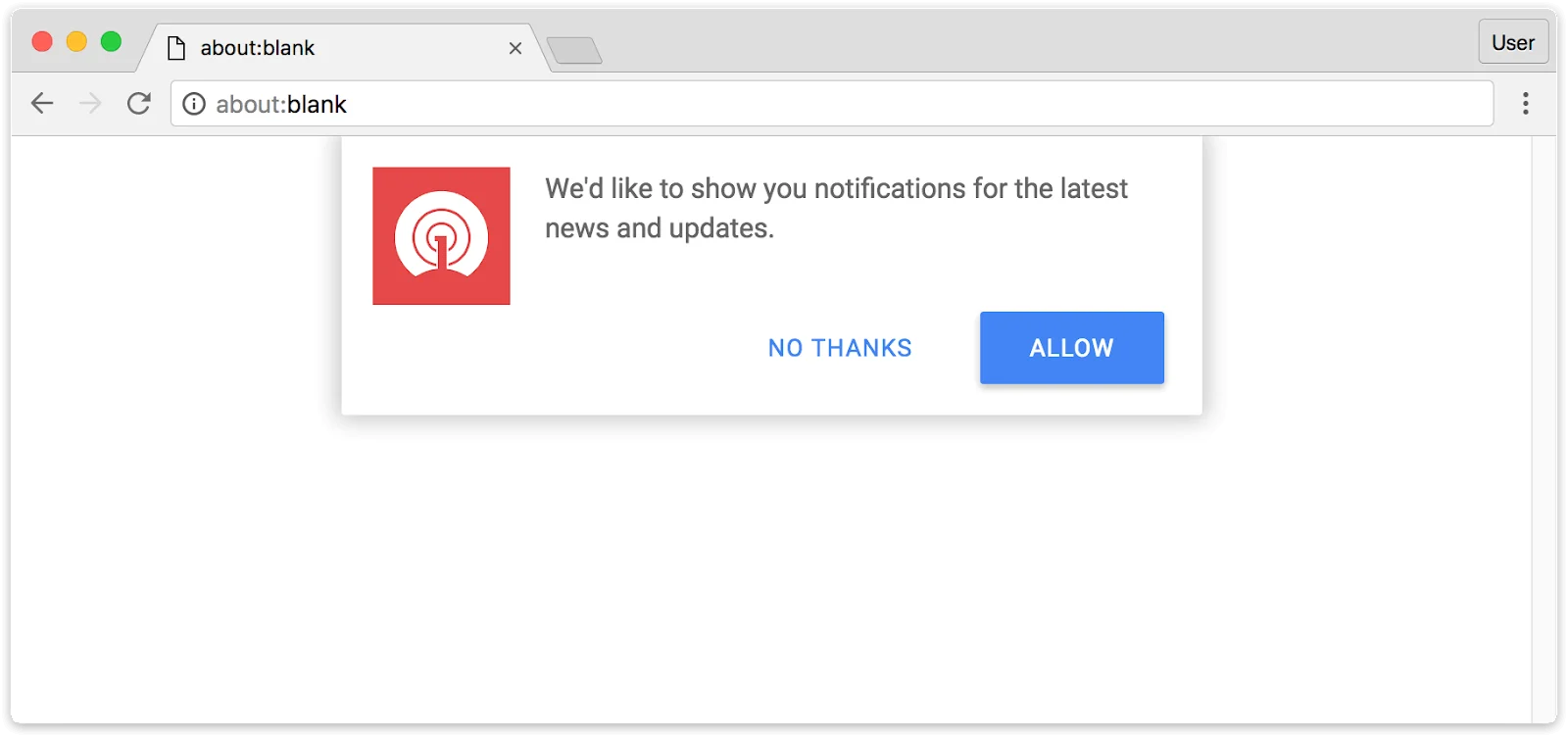
Web push is accessible and low-friction. Tools like PushEngage, Webpushr, and iZooto focus on this channel. The barrier to entry is minimal: add a script to your site, and you can start collecting subscribers within minutes.
The limitations are real, though. Web push delivery rates sit around 33% because notifications only arrive when the browser is open. Rich media support is constrained, and iOS support for web push only arrived with Safari 16.4 in 2023. Even now, web push on iPhone requires users to actively add your site to their home screen first.
Native app push notifications
Native app push notifications are delivered through a mobile app installed on the user's phone. They appear on the lock screen, in the notification center, and can include rich media, deep links, action buttons, and badge counts. Delivery reliability is 95%+, regardless of whether the app is actively open.
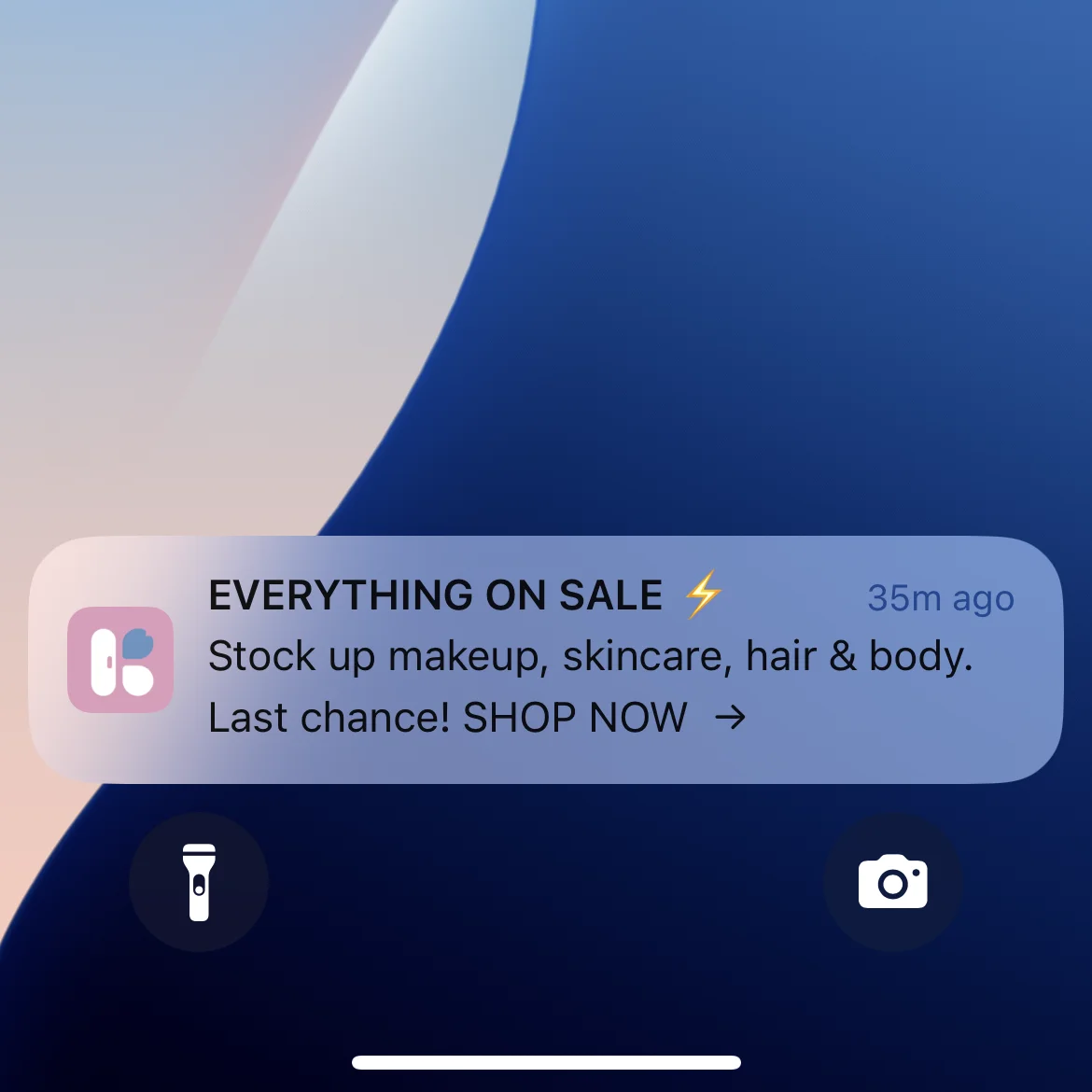
The real advantage of native push is audience quality. Someone who installed your app is a self-selected, high-intent customer. When a notification about a flash sale or price drop lands on their lock screen, right next to messages from Amazon, Instagram, and their banking app, they're far more likely to act on it. AWG Mode, a fashion retailer, saw 3x higher push notification CTR compared to email after launching their mobile app.
Unlocking Native Push (How to Launch Your Own Mobile App)
Native push requires a mobile app on the App Store or Google Play.
You might think that’s a big barrier of entry for native push notifications, and a reason to focus on web push instead. But the benefits of native push notifications are worth it - and, with the right solution, well worth the expense of launching a mobile app.
This is where services like MobiLoud come in. MobiLoud turns your existing website into a native mobile app, complete with push notifications, powered by a native integration with OneSignal or Klaviyo.
You keep your existing tech stack, and your app stays in sync with your website automatically. It’s by far the eaiest way to unlock the full power of native push.
"That's the most important feature for me, push notifications. Instead of sending an email, waiting for the customer to open, or an SMS, here you see the message right away, and it's more customer-friendly I think."
-- Raphael Faccarello, Head of Ecommerce, Yon-Ka Paris
How to Choose the Best Push Notification Service
With 12 tools on this list spanning different categories, here's how to narrow down your options.
Web or native?
Do you need web push, mobile app push, or both? If you don't have a native app, tools like PushEngage, PushOwl, Webpushr, and iZooto handle web push. If you have an app (or plan to launch one), OneSignal, Klaviyo, Braze, Airship, and CleverTap offer native push with deeper engagement features.
Match to your stack
If you're already using Klaviyo for email and SMS, adding push through Klaviyo is the path of least resistance. If you're on Shopify and want something simple, PushOwl installs in minutes. If you have developers who want full control, FCM is free and infinitely customizable.
Consider scale and budget
Free tiers from OneSignal, PushEngage, PushOwl, Pushwoosh, and Webpushr are generous enough for early testing. Mid-market brands typically spend $20-$250/month. Enterprise platforms like Braze and Airship start at $25,000+/year and require dedicated implementation resources.
Evaluate automation depth
Simple campaign sends are table stakes. The differentiator is automation: cart abandonment flows, behavioral triggers, predictive send timing, and cross-channel journey orchestration. Assess how much of your push strategy can run without manual intervention.
Which Push Notification Service Is Right for You?
If you're an ecommerce brand already using Klaviyo for email and SMS: Klaviyo. Push notifications are included at no additional cost, and your push campaigns can tap into the same segments, flows, and predictive analytics you already use. You'll need a native mobile app to use Klaviyo's push channel.
If you need both web and mobile push on a single platform: OneSignal. It's the most versatile multi-platform option with a generous free tier, and it's used by over 200,000 apps worldwide.
If you want web push notifications without building an app: PushEngage for ecommerce (cart recovery, browse abandonment) or Webpushr for maximum value on a tight budget.
If you're a Shopify store and need web push with minimal setup: PushOwl. Built natively for Shopify, with abandoned cart recovery and one-click opt-in.
If you're an enterprise with a dedicated marketing ops team: Braze for cross-channel journey orchestration, or Airship if mobile wallets are part of your strategy.
If speed of delivery is critical (news, sports, flash sales): Pushwoosh. Over 300,000 pushes per second, with zero feature gating on any plan.
If you need deep behavioral analytics alongside messaging: CleverTap. Combines marketing automation with product analytics in one platform.
If you're a developer building custom notification infrastructure: Firebase Cloud Messaging. Free, scalable, and fully programmable.
If you want to unlock native push for your existing ecommerce store: Pair a push service like OneSignal or Klaviyo with a solution like MobiLoud to extend your website into a native app with push built in. No separate app codebase required.
Frequently Asked Questions
What is the best push notification service?
It depends on your use case. OneSignal is the most widely adopted multi-platform option. Klaviyo is the strongest choice for ecommerce brands that want push integrated with email and SMS. PushEngage leads for web push specifically. For enterprise, Braze and Airship are the market leaders.
What is the difference between web push and mobile push notifications?
Web push notifications are delivered through browsers and don't require an app. They work on desktop and mobile browsers (with limited iOS support). Mobile (native) push notifications are delivered through a mobile app and appear on the lock screen. Native push offers higher delivery reliability (95%+ vs ~33%), richer notification formats, and reaches a self-selected, high-intent audience.
How much do push notification services cost?
Pricing ranges from free to enterprise-level. OneSignal, PushEngage, PushOwl, Pushwoosh, and Webpushr all offer free tiers. Mid-market tools run $8-$250/month depending on features and subscriber count. Enterprise platforms like Braze and Airship typically start at $25,000-$60,000+ per year. For a detailed breakdown, see our push notification cost guide.
Are push notifications better than email?
Push notifications and email serve different roles. Push typically delivers higher click-through rates and is better for time-sensitive messages (flash sales, order updates, breaking news). Email is better for longer content, nurture sequences, and communications that users want to reference later. Most brands see the best results using both channels together.
Can I send push notifications without an app?
Yes. Web push notification services like PushEngage, Webpushr, and iZooto let you send browser-based push notifications without a mobile app. Visitors opt in through their browser. The tradeoff is lower delivery reliability (~33% vs 95%+ for native push) and constrained functionality on iOS compared to native app push.
What is a good push notification click-through rate?
Industry benchmarks for push notification CTR vary by channel and industry. Web push typically sees 2-5% CTR. Native app push averages 5-15%, with well-segmented campaigns reaching 20%+ in some verticals. Personalized, behavior-triggered notifications consistently outperform broadcast sends.
Do push notifications work on iPhone?
Native app push notifications work on all iPhones. Web push notifications on iPhone require iOS 16.4+ and Safari, and users must first add your site to their home screen. This constraint is one reason many ecommerce brands invest in a native app for their push strategy.
How do push notifications help ecommerce stores?
Push notifications drive repeat purchases, higher AOV, and stronger customer lifetime value. Common ecommerce use cases include abandoned cart recovery, back-in-stock alerts, price drop notifications, flash sale announcements, and order status updates. The channel is particularly effective for retention, reaching customers who've already bought from you and bringing them back.
Final Thoughts
The push notification landscape in 2026 spans everything from free, developer-focused infrastructure (FCM) to enterprise engagement platforms processing billions of events per day (Braze, CleverTap). The right choice depends on your channels, your audience size, and how deeply push integrates with the rest of your marketing stack.
For most ecommerce brands, the decision comes down to web push vs. native push. Web push (PushEngage, PushOwl, Webpushr) is the fastest way to start, with no app required. Native push (through OneSignal, Klaviyo, or enterprise tools) delivers higher engagement, but requires a mobile app.
If you're already using Klaviyo or OneSignal and want to unlock native push for your ecommerce store, MobiLoud can help you extend your website into a native app with push notifications built in. No separate codebase, no months of development.
Book a free strategy call to see how it works.
FAQs

Convert your website into a mobile app