
You're on Magento or Adobe Commerce, you've decided you want a mobile app, to boost retention and build a direct line to your best customers.
That’s step one. Step two is figuring out how you’re going to build it.
There are thousands of app builders and software tools and development agencies out there. The issue is you need one that works with your ecommerce platform - because your mobile app and website need to be in sync, not two disconnected storefronts.
“What is the best Magento mobile app builder” is also a difficult question to answer in one sentence, because there’s massive variety in the type of brands using Magento. It’s impossible to settle on one vendor that every Magento or Adobe Commerce should look to first.
We’ll clear up as much as we can in this article. We’ll break down what building a mobile app takes for a brand on Magento, what the Magento mobile app builder market looks like as a whole, and then give you a list of tools and services to choose from.
Let’s go.
The Mobile App Reality for Magento Brands
The archetypical Magento store is not just one kind of brand.
You’ve got SMBs and small boutique stores. You’ve got legacy ecommerce stores that haven’t moved to Shopify yet. And you’ve got a huge number of high-end, global brands as well - including Nike, Land Rover, and Liverpool FC.
Even “Magento” doesn’t have the same meaning for every store. It can mean Magento 2/Open Source, or it can mean (as is the case for the big named brands above) Adobe Commerce - what some people still refer to as Magento out of habit.
As there are many different types of Magento stores, the tools and services for Magento brands are also wildly different - including those built to help you launch a mobile app.
The Different Types of Mobile App Solutions for Magento & Adobe Commerce
As you’ll see below, when we list the tools, not all “mobile app builders” work and look the same.
Some are managed platforms, providing a mix of tech and service, made for higher-end brands on Magento.
Some are marketplace extensions you buy, download, install and manage yourself. Some are drag-and-drop app builders.
There are also development agencies that work with Magento brands, which can build you a custom mobile app that connects with your store.
Each approach has an ideal type of customer. Chances are, a quick look at how each tool works (and the price) will immediately give you an idea of whether it’s a good fit for your brand, or not.
Custom Mobile App Development is an Option (But Not THE Option)
There’s always the choice to build a custom mobile app, too.
It’s an option - just not an ideal one, in our opinion.
It just costs too much, and introduces too much ongoing complexity for your team to keep the app running.
That’s what most ecommerce brands don’t realize when they launch a custom mobile app. It’s not a one-off project, where you sprint to get your app live and then it’s done. It’s a plant that needs continuous watering as long as you expect it to stay alive.
If that’s something your team can handle, great. If you don’t want to have a full-time team dedicated to managing the app, an app builder is a better option.
The Best Magento Mobile App Builders: At a Glance
Short answer: MobiLoud is the best fit if you want a native app built and managed for you on your existing Magento or Adobe Commerce stack, including customized, B2B, Hyvä, or headless stores, with full feature parity and no second storefront to maintain.
MobiLoud is for mid-market and enterprise brands; it’s likely too much for a small, boutique store. If you’re looking for a simple app on a budget, a one-time marketplace extension like Mobikul or MageMob is the smarter starting point.
Here’s a table summing up the app builders we’re going to cover:
| Tool | Tier | Starting Price | Best For |
|---|---|---|---|
| MobiLoud | Managed service | From $1,499/mo + setup | Customized, B2B, or headless Magento brands wanting it managed |
| JMango360 | Managed platform | Subscription (quote-based) | B2B and multi-storeview Magento brands |
| Mobikul (Webkul) | Marketplace extension | $299 one-time | Stock stores wanting a native app and source-code access |
| MageMob (AppJetty) | Marketplace extension | From $299 one-time | Budget-conscious, relatively stock stores |
| MageComp | Marketplace extension | $29/mo or $299-$599 one-time | Stores wanting the lowest monthly entry to test an app |
| Knowband | Marketplace extension | ~$199.99 one-time | A white-label native app at a low one-time price |
| Meetanshi | Marketplace extension | From ~$89 one-time | The most price-sensitive, stock-catalog stores |
| Brainvire | Custom dev agency | Custom project quote | Enterprise brands wanting a bespoke build from a large Adobe partner |
| Dinarys | Custom dev agency | Custom project quote | Brands wanting a genuine native build from a certified partner |
Pricing taken from each vendor's own site, current as of June 2026. Custom and project-based prices are quoted directly.
9 Adobe Commerce/Magento Mobile App Builders Worth Your Time
Now let’s jump into nine app builders that fit the bill, in a variety of ways, for Magento brands. We’ve covered high-end managed app solutions, to drag-and-drop app builders and marketplace extensions, and finally custom development agencies, for brands who want to go the custom dev route.
1. MobiLoud: Custom App Service for Ecommerce Brands
Best for: Mid-market and enterprise Magento or Adobe Commerce brands, especially customized, B2B, Hyvä, or headless stores, that want a native app built and managed for them on their existing stack.
Key features:
- Native iOS and Android apps powered by your existing storefront
- Full website and app parity (every extension, integration, and custom flow carries over)
- Fully managed build, launch, and maintenance
- Native push notifications and deep linking
- Support across Magento Open Source, Adobe Commerce, Cloud, Hyvä, Mage-OS, and headless builds.
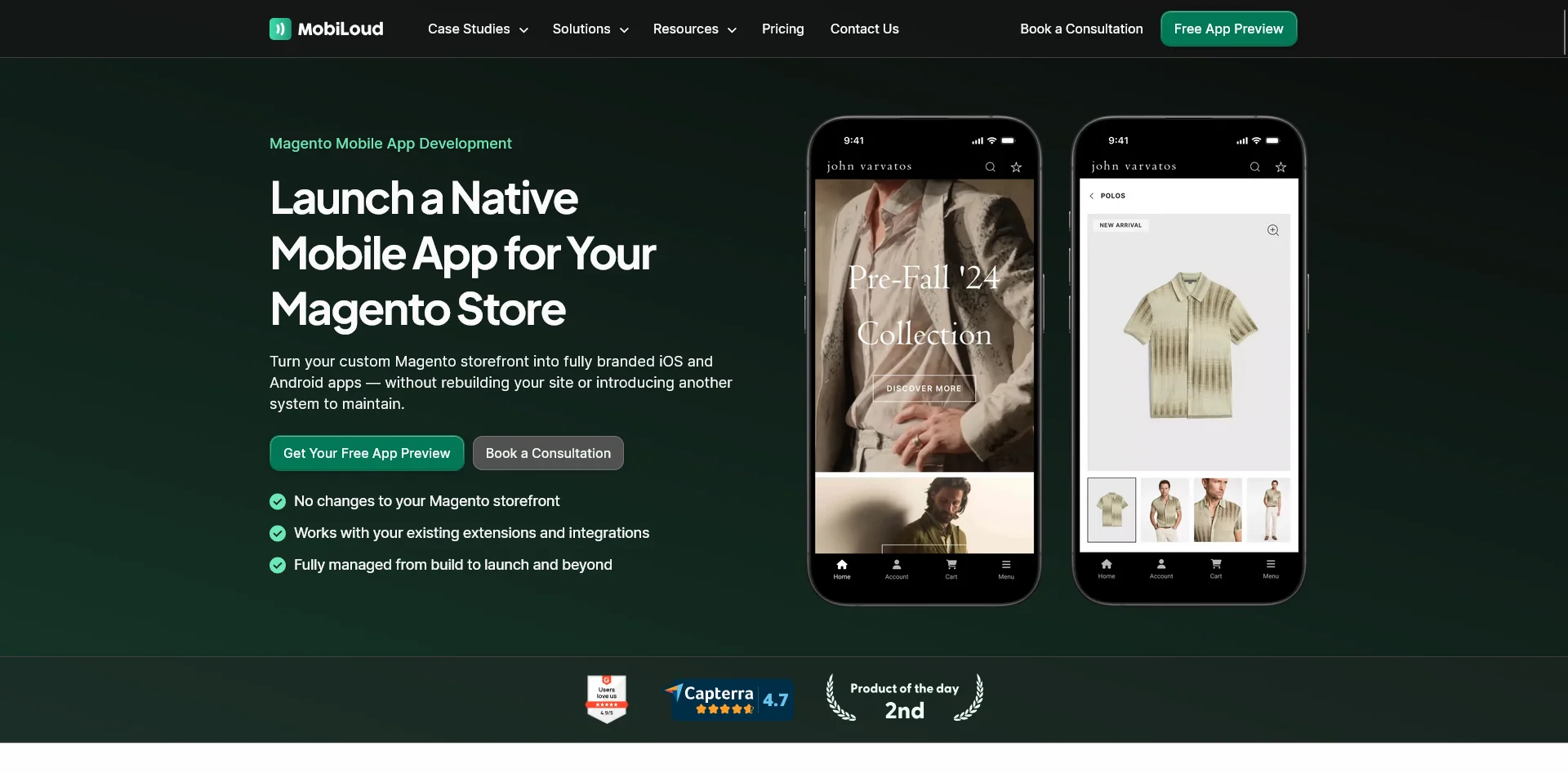
MobiLoud is a fully managed service that turns your existing Magento or Adobe Commerce website into native iOS and Android apps.
It lets you build a custom app that runs off your existing tech stack. You manage both website and app from the same codebase, while shipping a custom experience to each.
MobiLoud’s team handles all the technical maintenance for the app, as well as app store submission and routine OS updates. They also work with you on your app growth strategy - it’s a partnership model, not just a project where you get handed an app and told to figure it out.
MobiLoud works with any Magento or Adobe Commerce store, no matter how custom. Custom checkouts, B2B setups, multi-region storefronts, Hyvä themes, headless stores - all of it can be carried over to your app.
Magento brands using MobiLoud to power their apps include luxury fashion brand Tadashi Shoji, and automotive parts brand GSF Car Parts, both of whom were able to carry over and extend custom web experiences into clean, high-converting mobile apps.
"I could continue developing the way I am used to. It was completely frictionless for me. I really have to applaud MobiLoud for being so compatible so that we were able to do that."
- David Chamberlin, Lead Developer, Tadashi Shoji
MobiLoud’s services start at $1,499 per month, plus a one-time setup fee. It’s not for small businesses or for brands who want a cheap app, but it’s the best way for serious brands to get a full-featured, high-quality mobile app without the tax of custom development.
2. JMango360: No-Code Mobile App Builder with Managed Service
Best for: B2B and hybrid B2B/B2C Magento brands with gated catalogs, customer-tier pricing, or repeat-order workflows, and European brands running multiple country storefronts.
Key features:
- Native B2B features (user groups, prices behind login, account-tier catalogs)
- Barcode-scanner reorder workflows
- Native multi-storeview
- Native checkout via Braintree or Stripe
- Push notifications, deep linking, and in-app messaging.
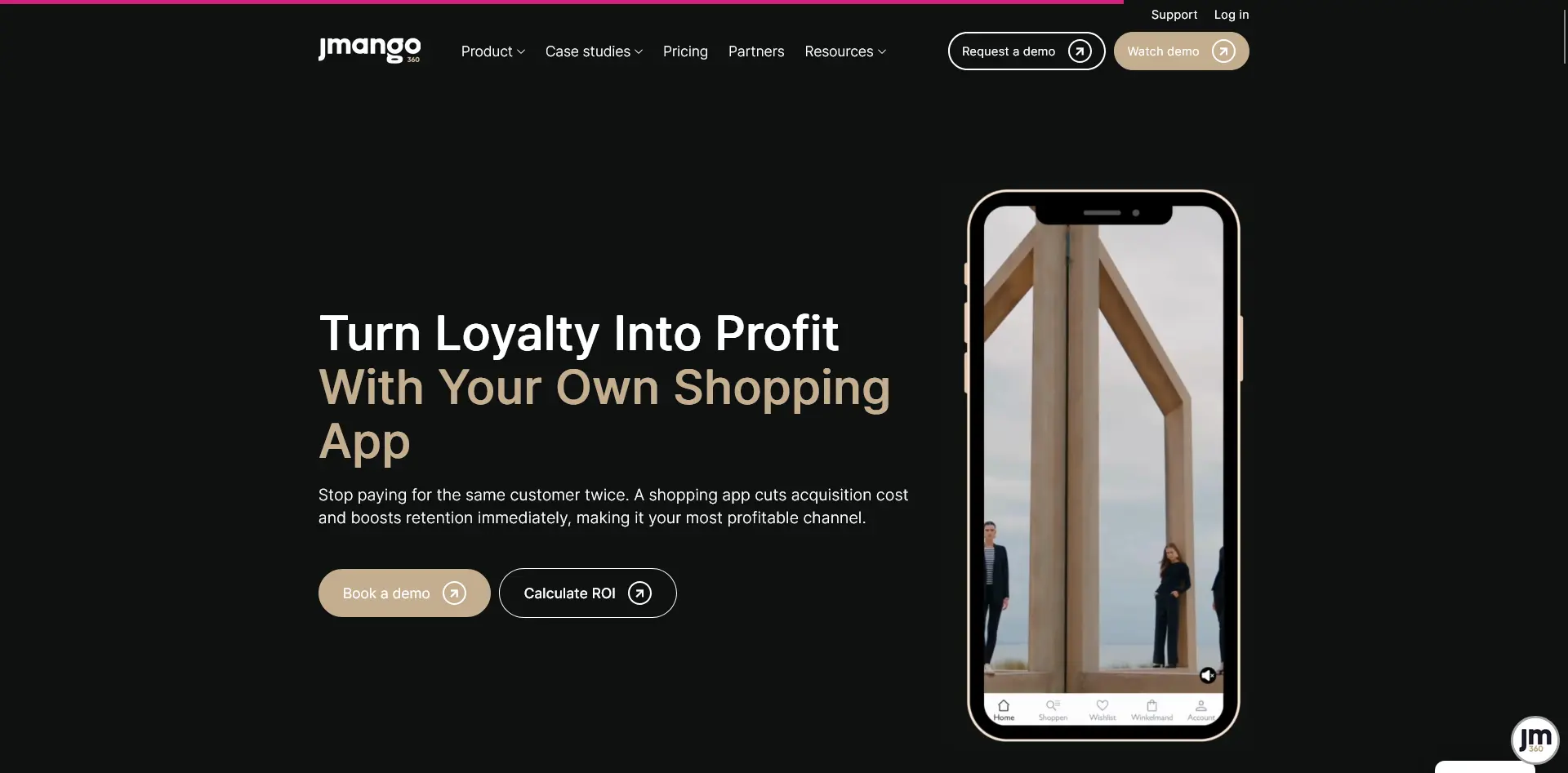
JMango360 is a Netherlands-based managed app platform that combines multi-platform support with a genuine B2B feature set. It supports Adobe Commerce and Magento alongside Shopify, BigCommerce, and WooCommerce.
They’ll help you build a native iOS and Android front end that connects to your Magento backend through an API integration that keeps product and order data in sync, managed via JMango360's own dashboard.
Their positioning veers towards mid-market and enterprise; with custom, quote-based pricing and a full-service partnership, including custom development for features that their platform doesn't natively support.
They’re a decent choice for brands who want a custom mobile app with a mix of no-code and service blended together.
3. Mobikul by Webkul: One-Time Purchase Flutter App Template
Best for: Stock or lightly customized Magento stores that want a Flutter-native app, with the option to own and customize the source code.
Key features:
- Flutter-native iOS and Android apps
- Purchasable source code
- AI and ML-powered search (image, object, and text detection)
- AR product visualization and an AR size calculator on iOS
- Offline mode
- Live delivery-partner tracking
Mobikul is built by Webkul, one of the most active extension vendors in the broader ecommerce ecosystem. It's a native Magento 2 mobile app extension built with Flutter, driven by your store through Magento's GraphQL API.
It’s essentially a mobile app template. You buy it, install it, and then use it to create your own mobile app.
In the basic option, you’ll keep managing the app via the extension, but it also comes with the option to own the source code for your app, which makes it something viable if you have someone in-house who can build on top of that code when needed.
Pricing starts at a $299 one-time license, with source code and additional Adobe Commerce editions available as paid add-ons.
4. MageMob by AppJetty: Drag-and-Drop App Builder Extension
Best for: Budget-conscious Magento merchants on a relatively stock setup, with the in-house resources to handle the install and ongoing app-store submissions.
Key features:
- Drag-and-drop home-screen layout builder
- Offline data-sync mode
- One-page checkout
- Abandoned cart notifications
- Push notifications via Firebase
- Multi-currency and multi-language with RTL support
- Social logins
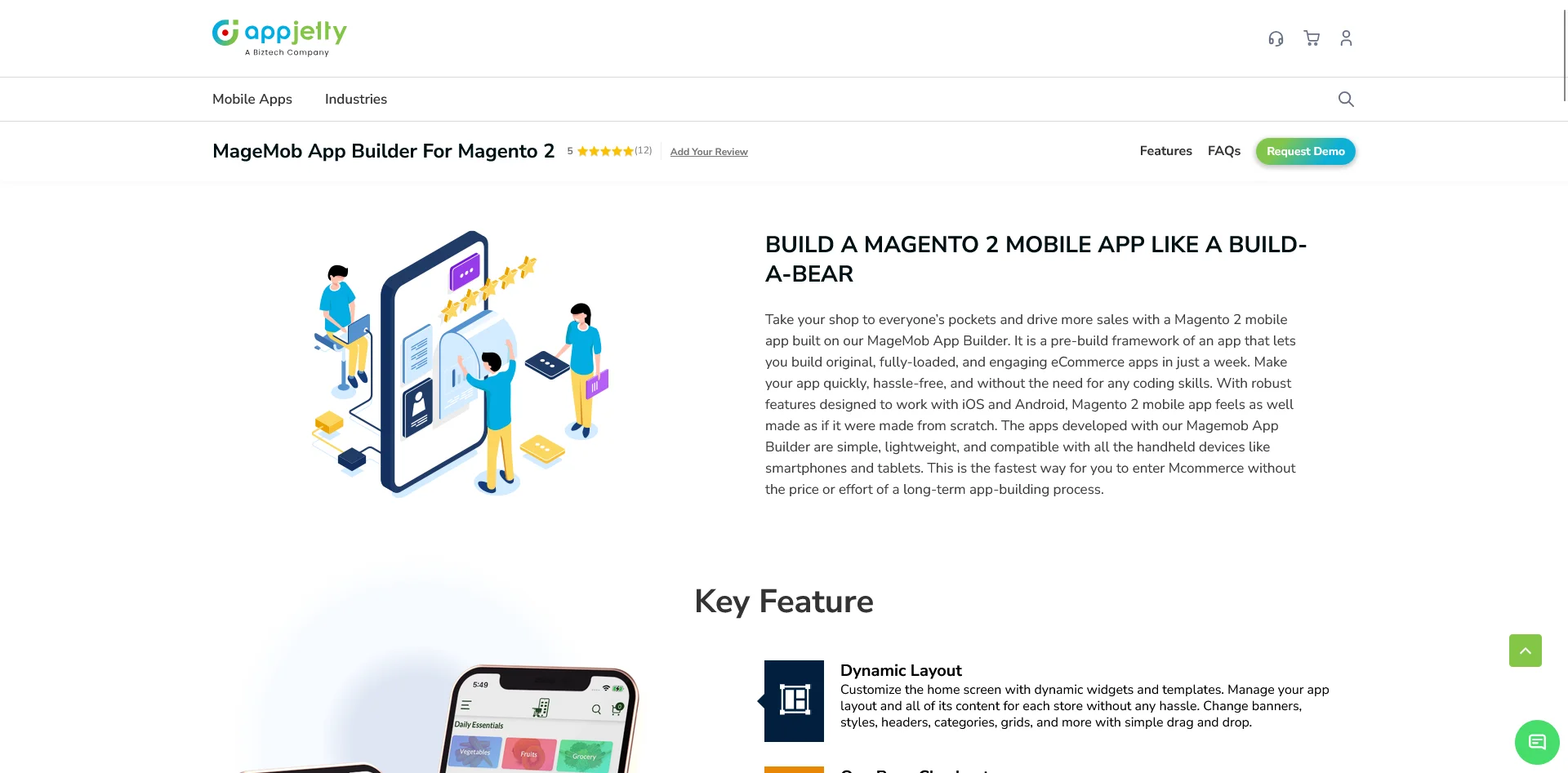
MageMob is an Adobe Commerce Marketplace extension from AppJetty, the product line of Biztech, which has spent more than 16 years in the Magento ecosystem. It's a DIY extension: you install it on your Magento server, configure the home screen and theme through the admin, and AppJetty handles the iOS and Android build and submission.
The feature set is narrower than the managed platforms and focused on what a stock store needs: product browsing, search, cart, one-page checkout, push, and account management, with a drag-and-drop builder for the home screen.
It's actively maintained, with a late-2025 release supporting current Magento versions. Named customers on AppJetty's listing include Golden Cala, with over 10,000 installs, and Café Punta del Cielo.
Pricing is a one-time license starting around $299 through the Adobe Commerce Marketplace, with add-ons for additional platforms and a white-label option (worth noting, since without it the app publishes under AppJetty's developer account rather than your own).
5. MageComp Mobile App Builder: No-Code App Builder with a Low Monthly Option
Best for: Stores that want the lowest possible monthly entry point to test a Magento app, with the option to buy source code later.
Key features:
- No-code app builder
- Tiered pricing (monthly or one-time)
- Brand slider and tailored homepage
- Voice search and social login
- Push notifications
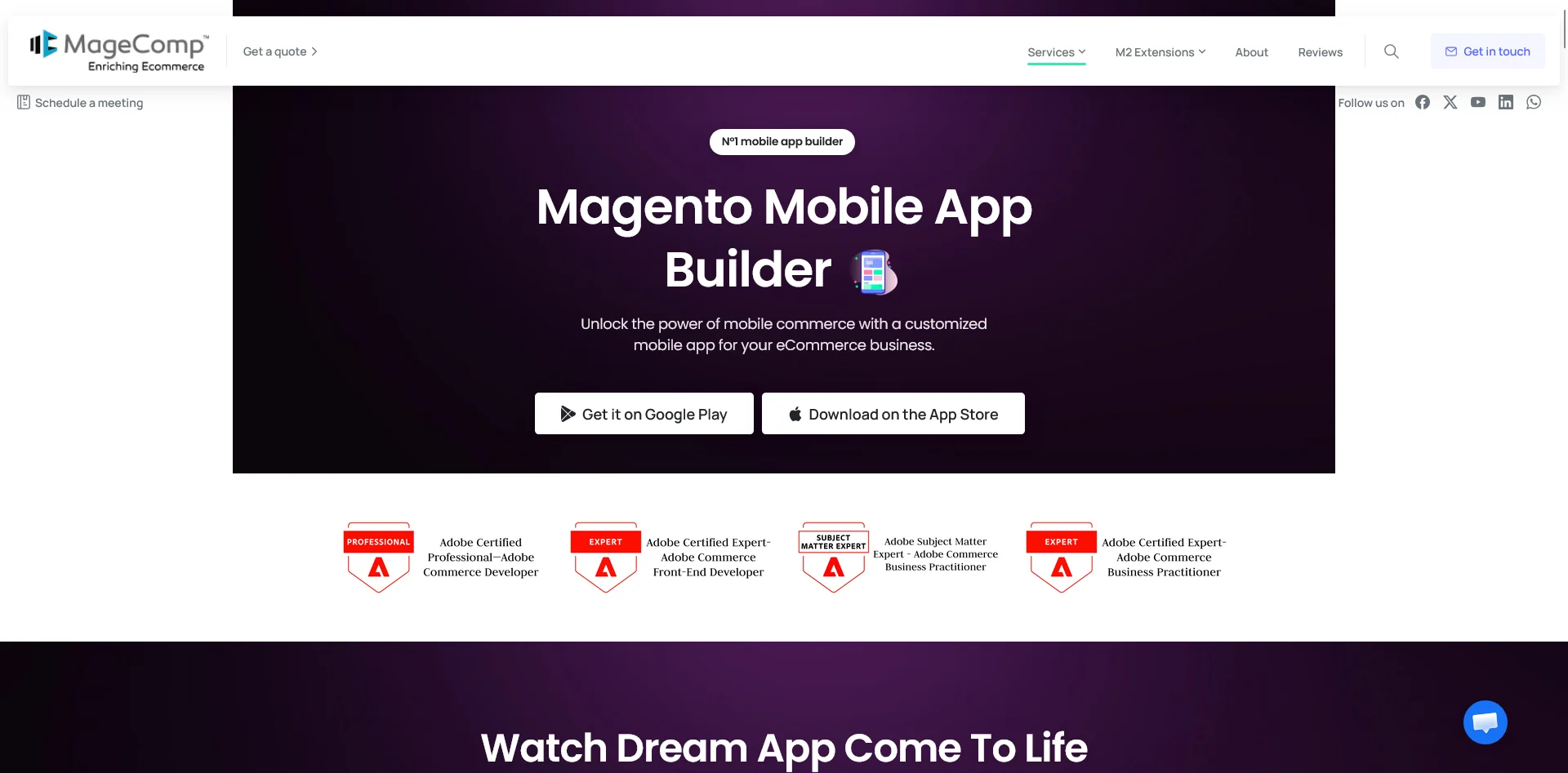
MageComp offers one of the more flexible pricing structures in this tier, built by a certified Adobe Commerce development shop. It converts your Magento store into native iOS and Android apps through an extension plus a ready-made app.
What stands out is the pricing model rather than any single feature. You can start at $29 a month (with the app published under MageComp's store account), or buy outright: a Basic one-time license around $299, or a Pro license around $599 that includes the source code.
That low monthly entry is unusual in this set and makes it a low-risk way to test whether an app is worth it before committing to a larger build.
MageComp leads on price rather than named customer logos, so the clearest way to size it up is the tiered pricing and a trial. For a store testing the waters, the appeal is the low entry point and the option to scale up to source-code access later.
6. Knowband Mobile App Builder: White-Label Native App Extension
Best for: Budget merchants who want a white-label native app at a low one-time price and are comfortable with a DIY drag-and-drop setup.
Key features:
- No-code native Android and iOS apps via a Magento 2 extension
- Real-time sync
- OTP and fingerprint login
- WhatsApp chat
- Gamified spin-and-win popup and video banners
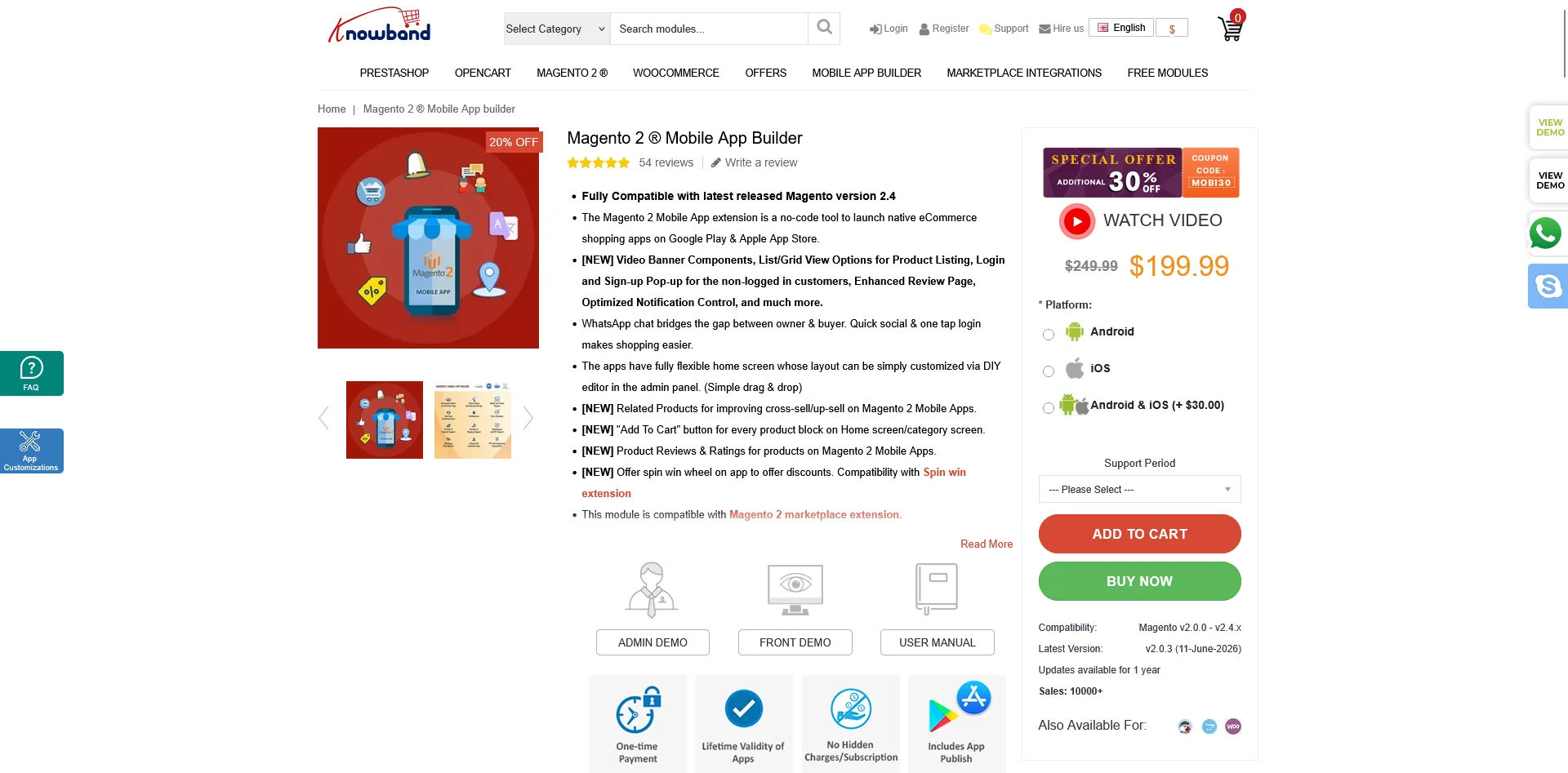
Knowband builds a white-label native app from a Magento 2 extension, with a drag-and-drop home-screen editor and real-time sync. It's actively maintained, with a 2026 release supporting current Magento versions, and Knowband sells comparable builders for PrestaShop, OpenCart, and WooCommerce.
The feature set is broad for the price, including OTP and fingerprint login, WhatsApp chat, and a gamified spin-and-win popup that most tools at this tier don't bundle in. The model is DIY: install, configure, and Knowband handles the build.
Knowband's store shows a high rating across several dozen reviews, though it doesn't publish specific brand customers. Pricing is a one-time license around $199.99, with the second platform and extended support available as add-ons.
7. Meetanshi Mobile App Builder: Low-Cost App Builder with a Lifetime License
Best for: The most price-sensitive merchants who want a lifetime license at the lowest entry cost, on a relatively stock catalog.
Key features:
- Extension that connects your store to pre-built native iOS and Android apps
- Real-time sync
- Multi-currency out of the box
- Optional source code
- Lifetime license with a year of free updates
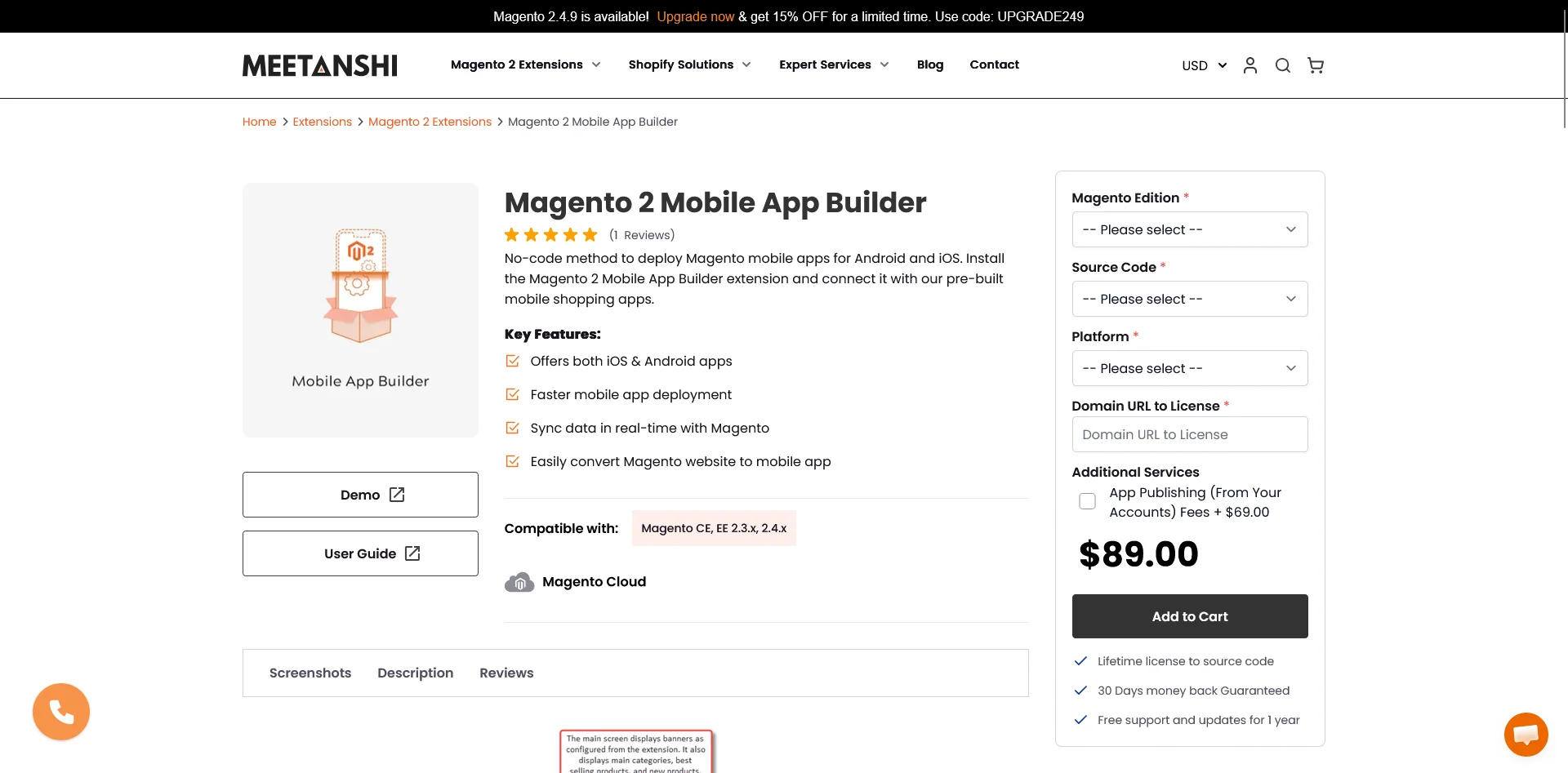
Meetanshi is a Magento and Shopify agency whose app builder works by connecting your store, through an extension, to its pre-built native apps. It's the lowest entry price in this roundup.
The pitch is straightforward: a lifetime license (rather than a recurring fee) at a low starting cost, with multi-currency support included and source code available as an add-on. That makes it one of the cheapest ways to get a native Magento app off the ground for a stock catalog.
Meetanshi keeps things lean and price-led, and doesn't surface named brand customers, so the license terms and a trial are the best way to judge fit.
Pricing starts around $89 for the base license, with Adobe Commerce editions, source code, the second platform, and app publishing each available as add-ons.
8. Brainvire: Enterprise Adobe Commerce Development Agency
Best for: Enterprise brands that want a large Adobe Commerce partner to deliver a complex build, with a custom mobile app as one workstream.
Key features:
- Full-service Adobe Commerce development and custom mobile app development
- 150-plus certified developers
- Enterprise client roster across retail and B2B
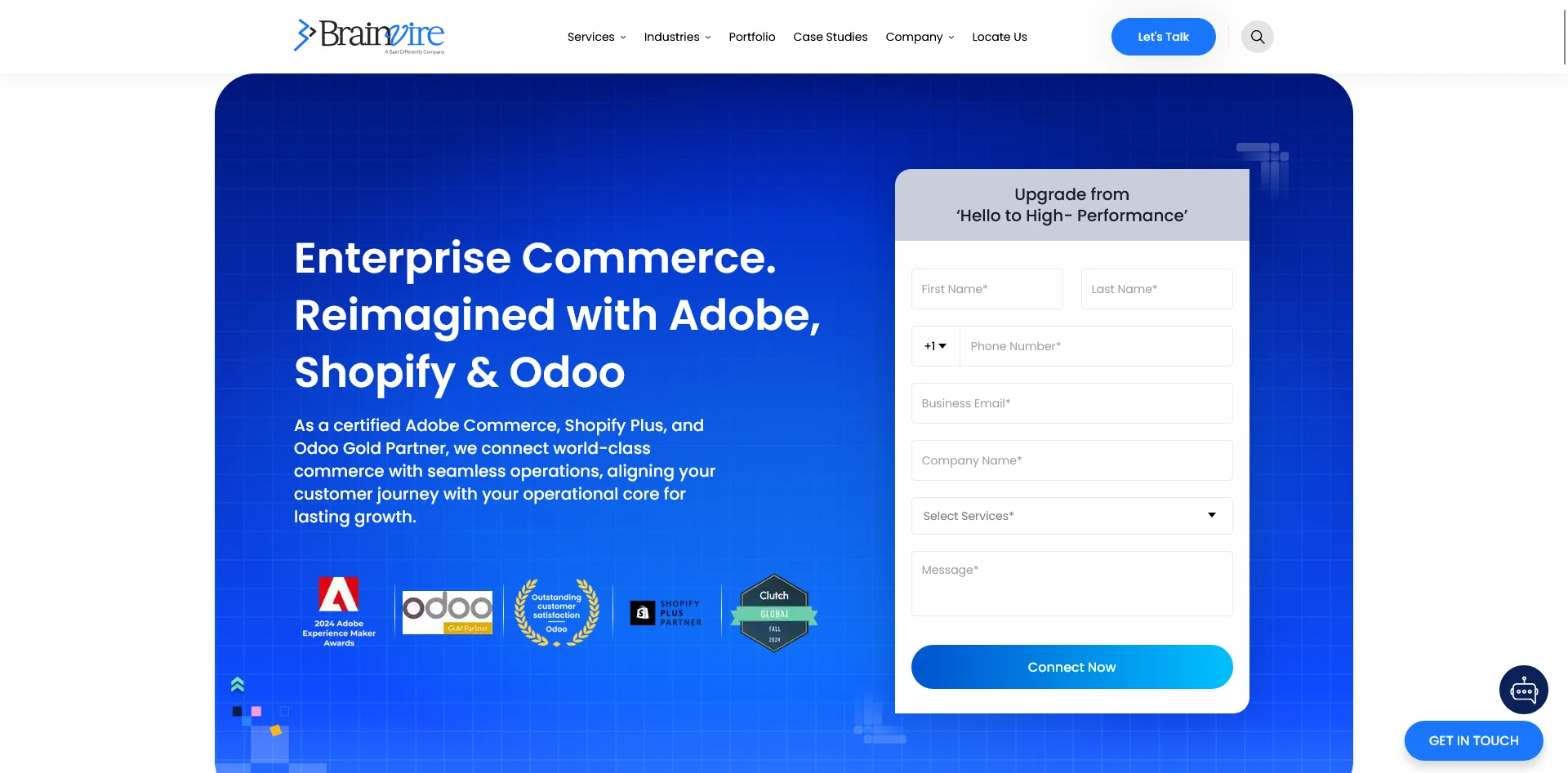
Brainvire is a large global development firm that states it's an Adobe Gold Solution Partner and Adobe Commerce Specialized, with an enterprise client base that includes names like Fossil and Rev-A-Shelf.
For a brand that wants a single heavyweight partner handling an Adobe Commerce implementation with a mobile app as part of the scope, it's a credible fit.
Their strongest verifiable mobile app case study is a B2B sales-rep ordering app (a Clutch-reviewed project integrating Magento with an ERP backend) rather than a consumer-facing storefront app, so their proven strength leans toward complex, integration-heavy B2B apps.
Pricing is project-based and quoted directly, and as a custom build from a partner of this size, it sits at the higher end of the cost and timeline range.
9. Dinarys: Certified Native App Development Agency
Best for: Brands that want a genuine native build (Kotlin and Swift) from a certified mid-size Adobe partner.
Key features:
- Native Android (Kotlin) and iOS (Swift) development
- Adobe Solution Partner status
- A dedicated Magento mobile app practice
Dinarys is a certified Adobe Solution Partner with a genuine native app practice, building separate Kotlin and Swift apps rather than templated ones. Its named work includes a retail app for an electronics and appliance chain, which is a real consumer-storefront example rather than only internal tooling.
It's a smaller, more focused shop than the largest Adobe partners, which fits brands that want a certified native build without the overhead (or price tag) of a top-tier agency.
Pricing is project-based and quoted directly. For a brand that specifically wants a native, from-scratch build from a certified partner without going to the largest (and priciest) agencies, it's worth a conversation.
Our Honest Opinion on Magento Mobile Apps
We’re MobiLoud - so we have a stake in this.
But here’s our take, shaped from the thousands of customers we’ve had exploratory calls with over the years.
Realistically, an ecommerce brand doesn’t need a custom-developed, React Native/Flutter/Swift app. It’s not just unnecessary, they’re usually worse off for it.
The custom development option essentially means rebuilding a lot of what already exists in a new codebase, which requires new developers to build and maintain.
All the mobile-friendly elements of your site (product pages, collections, checkout) are already doing the job an app is supposed to do (if your site doesn’t work well on mobile - this is what you should fix first).
With MobiLoud, you use your existing site as the foundation for your app; instead of rebuilding everything from scratch.

You can add custom features and experiences on top of that. But it’s all built on top of one store, one single source of truth.
For stores looking for a “custom” mobile app, this is by far a more efficient way to get to the same thing you would with a custom React Native app.
This is our advice for mid-market brands and above. If you’re with a smaller brand, and the prospect of a service that costs $1K+ per month for an app seems excessive, you’ll be better off trying the Magento mobile app extensions, to see if any fit your idea of what you want from your app.
How GSF Car Parts Got a Custom Magento App Without the Custom App Cost
GSF Car Parts is one of the UK's largest auto-parts distributors, with more than 200 stores, both B2B and B2C customers, and around 140,000 SKUs.
They run a headless front end on Adobe Commerce Cloud, and a number of complex features on their site. A custom “from scratch” build was quoted at around £500,000 (just upfront; not taking into account the total cost of ownership long-term).
They instead launched their app with MobiLoud. They were live in under three months, for a fraction of the cost of what a custom native app would have taken, and even less of the complexity.
Their example is the perfect case study for why even enterprise brands don’t need the hassle that comes with juggling a separate app build, and why a managed app solution like MobiLoud is superior.
"The way that it functions and works, it seems like a bespoke build that you don't have to worry about updating."
- Chris Barella, Digital Director, GSF Car Parts
Final Thoughts on How to Build Your Magento Mobile App
Any established store, with decent repeat purchase potential, and a customer base that shops on mobile, should have a mobile app.
It’s a powerful retention channel and brand asset. Traditionally, the blocker for launching your own app has been the cost and complexity of custom development. But not today, with these great Magento mobile app builders.
The list above covers a range of options, to fit all types of brand, from small boutiques to global enterprise brands.
If you’re ready to build a mobile app for your Magento store, check out the options above, read back through this article twice, and pick the one that looks like the best fit for what you’re trying to do.