Why MobiLoud is the Best Mobile App Solution for Unified Commerce Brands

The unified commerce philosophy requires that all your channels are linked together, unified on the customer side, as well as in your backend. This gets complicated with mobile apps, as you need to juggle multiple surfaces, with multiple codebases, doubling your workload and dragging your team down. MobiLoud is different: a mobile app solution that's unified by default, giving you a straightforward way to maintain a native app linked with every other element of your business.
The unified commerce philosophy requires that all your channels are linked together, unified on the customer side, as well as in your backend. This gets complicated with mobile apps, as you need to juggle multiple surfaces, with multiple codebases, doubling your workload and dragging your team down. MobiLoud is different: a mobile app solution that's unified by default, giving you a straightforward way to maintain a native app linked with every other element of your business.
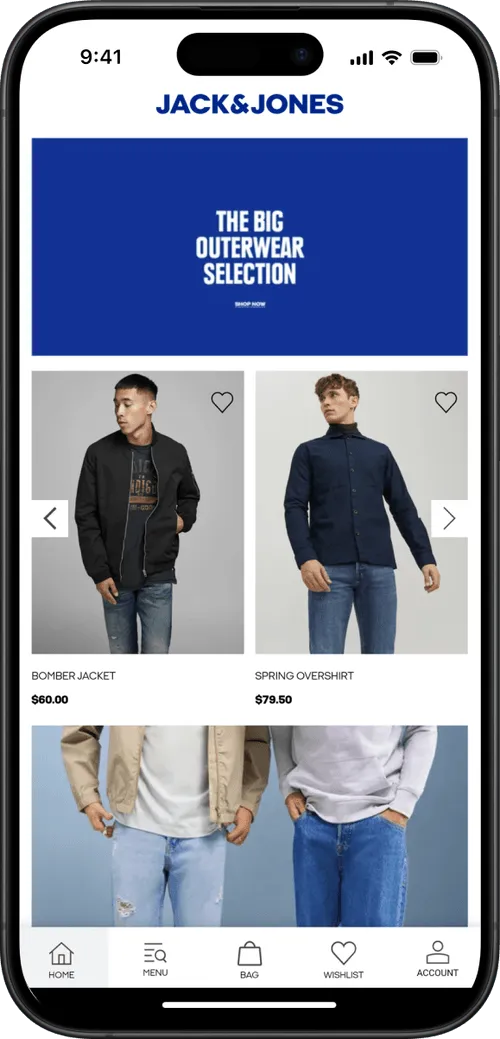
Unified commerce means running every customer-facing channel from one source of truth: same inventory, same customer record, same business rules for promotions, search, personalization, and fulfillment across web, mobile, in-store, and the rest.
On the web, you've already built that. Your ERP, OMS, personalization, loyalty, fulfillment - all of it runs from a single source of truth, fully synced with your retail side as well.
Adding an app to the picture adds another layer of difficulty. It’s a new channel, a new codebase, a new thing that needs to be managed and kept in line with your other surfaces.
Serious brands today need an app. And MobiLoud is the perfect way to launch one, fully aligned with the unified commerce philosophy.
Read on to learn more.
What Is Unified Commerce?
Unified commerce is the operational model where every customer-facing channel (web, mobile app, in-store, marketplaces, call center) runs from a single source of truth for inventory, customer data, orders, content, promotions, search, personalization, and fulfillment.
It's one layer past omnichannel. Omnichannel connects channels; unified commerce collapses them onto one stack.
- A customer who adds an item to their cart on the web sees that item in their cart on the app.
- A customer who earns loyalty points in store sees the correct balance everywhere the next morning.
- A customer eligible for store pickup on the web sees the same option on the app, with the same inventory tied to the same warehouses.
Unified commerce comes with a large catalog of tech integrations. ERP and OMS for inventory and orders. PIM for product data. CRM for customer profiles. Search and discovery engines like Algolia, Klevu, or Bloomreach. Personalization engines like Nosto or Dynamic Yield. Loyalty and subscription platforms. Cross-channel fulfillment logic for BOPIS, BORIS, and ship-from-store. Customer service tools.
Each one runs across your business, and has to stay in sync across surfaces for the unified commerce model to hold up.
The platforms enterprise teams use to build unified commerce each take their own approach to the same idea. commercetools is the most explicit about it: composable, API-first, headless by default. Salesforce Commerce Cloud and Adobe Commerce extend the model through their broader product clouds. Shopify Plus and BigCommerce Enterprise have rebuilt around it, while SAP Commerce Cloud anchors the B2B and industrial version.
For all the infrastructure these platforms have built for unified commerce, the mobile app question is still a significant pain point.
Where a Mobile App Fits in Your Unified Commerce Stack
A mobile app is a key surface for your brand, one that’s optimized for your best, most loyal customers.
It’s just another channel that needs to be unified, on the front end (user experience) and back end (operational system and tech stack).
The app has to link up with the same systems and workflow other channels do. Same inventory as the web. Same customer record. Same loyalty balance. Same promotions. Same personalization. Same store-pickup logic. One source of truth, same business rules, every surface in sync.
- A shopper adds a sweater to their cart on the web at lunch, opens the app at home that evening, and the sweater is still there at the same price.
- A loyalty member earns points at a checkout counter in one store, opens the app the next morning, and their balance reads correctly.
- A buyer configuring a complex bundle on the web sees the same configuration logic and the same available inventory in the app.
Everything needs to align across platforms. Your app is no different.
The Problem with Mobile Apps and Unified Commerce
Building a custom native app that fits into a unified commerce stack is doable. Plenty of enterprise brands have done it.
But it comes with a lot of work - a surprising amount, as most brands who try this find out.
Here are the main challenges:
Rebuilding Every Web Feature in Native Code
A native app, whether that's two codebases in Swift and Kotlin or a single React Native or Flutter codebase, has to build a fresh integration for all your web features and integrations in native code.
Search, personalization, loyalty, subscriptions, BOPIS routing, B2B pricing logic, customer-specific catalogs, custom checkout, multi-region rules. Each one is bespoke native work, built on top of the web implementation that already exists.
Keeping Two Codebases in Sync
Once the app is live, the biggest challenge begins: keeping everything in sync.
It’s a parallel system to manage, one that needs to be integrated and synced with your website, but is often managed separately.
This brings a huge amount of work. New features or changes to your website need to be replicated in the app. You have double the work, slower release cycles, and the risk of major tech debt if you miss an update.
What this costs your team isn't visible on a budget line. It's engineering capacity. Your mobile developers spend their time patching the second codebase to keep up with the first, not shipping new product. Your web roadmap waits on app-team availability. The people who should be building the next experience are keeping the existing one in sync.
Two Surfaces, Twice the Risk
Two codebases mean two release cycles, two integration test surfaces, and two places for a promo rule, a tax setting, or a fulfillment policy to go wrong.
When you build a new feature on your website, you need to consider if it will work in the app. You need to review to make sure that it didn’t break anything in the app.
Even something as simple as a promo code or a new loyalty tier or a payment method added to checkout becomes a potential point of failure.
How MobiLoud Keeps Your Mobile App Unified by Default
MobiLoud lets you build a custom mobile app using the same tech stack you use on the web.
You manage everything from one place. The backend is exactly the same, which means every integration, from BOPIS to loyalty features, are inherently unified.
You can ship a custom app experience, which shows something different to your site. But on the technical level, it’s the same system powering everything.
It’s literally what unified commerce is all about.
MobiLoud’s team handles all the app maintenance for you, while your web team manages the content. It’s a far more streamlined - and unified - way to run your mobile app channel.
"We don't have to worry about the app. MobiLoud handles everything on the backend, and our website updates are automatically reflected."
- Nick Barbarise, Director of IT, John Varvatos
What Unified Commerce Looks Like with MobiLoud
Here are a few concrete examples, showing how MobiLoud keeps your operations and customer experience unified across multiple channels.
Adding a New Feature to the Site
Your web team ships a new feature - that could be a new search facet, a new product type, a new payment method, a new B2B pricing band, a new content module, or a new personalization rule.
In most apps, you need to build a custom implementation for the native app, with a new release cycle, an App Store review, and intense coordination required between your web and app teams.
On MobiLoud, the feature works in the app the moment it's live on the web. If there are some custom tweaks needed for the app side, MobiLoud’s team handles it for you. The process is faster, and significantly easier.
Changing a Promo Rule, Personalization Vendor, or Tax Setting
Changes to existing logic are the most common kind of unified commerce work: a promo rule update, a swap from one personalization vendor to another, a tax configuration change for a new region, a checkout customization, a routing rule adjustment for cross-channel fulfillment. Most of the engineering hours your team spends on unified commerce in a given quarter go on changes like these, not on greenfield builds.
In most apps, every one of these is two changes: the web update and the native re-implementation. This is all duplicate work, dragging your workflow down, and creating drift between channels when you inevitably forget to repeat an update in the app.
With MobiLoud, your app and website have a shared source of truth, so each of these changes happen once (unless they’re specifically separate in web and app). You’ve eliminated the duplicate work.
Cross-Channel Fulfillment (BOPIS, BORIS, Ship-From-Store)
Cross-channel fulfillment is one of the clearest expressions of unified commerce. A customer buys online and picks up in store, returns the item to a different store, and has the next purchase shipped from a third location.
All of it depends on a single source of truth for inventory and a single set of business rules for fulfillment routing.
The OMS rules your website uses to surface store-pickup availability, manage inventory by location, route fulfillment, and calculate shipping are the rules the app uses. There's no second OMS integration to maintain. Your BOPIS flow on the web is the BOPIS flow in the app, because the underlying logic is the same.
Loyalty Tiers, Promotions, and Customer-Specific Pricing
Loyalty is the integration most teams worry about when extending unified commerce to mobile. A customer buys a product in store, redeems points on the web that evening, and opens the app the next morning. The balance has to be right on all three surfaces, on the same schedule, against the same rules.
The loyalty integration your website carries (Yotpo, LoyaltyLion, Smile, Stamped, or whichever platform you're using) works in the app the same way it does on the web. There's no second integration to keep in sync. Tier changes reach the app the moment they're live on the web.
The same logic applies to customer-specific pricing. B2B catalogs, VIP tiers, gated drops, tier-restricted catalogs, customer-specific net terms: the rules your website applies are the rules the app applies. One pricing engine, two surfaces.
Final Thoughts
Unified commerce requires one source of truth across every customer-facing channel. This tends to mean a giant headache when launching a mobile app: setting your team up for a whole lot of painstaking work coordinating and making sure everything is consistent across channels.
That happens to be the best feature of what we do at MobiLoud. With our approach, your app and website are unified by default. They share the same source of truth, link up with the same backend systems, and update in sync.
It’s just a better way to run a mobile app.
If you’re interested in what we can do for your unified commerce brand, get in touch. Book a free app preview and we’ll walk through what your app could look like, how it works with your existing web setup (whether that’s on Shopify Plus, Salesforce Commerce Cloud, BigCommerce, commercetools, or any other platform), and how we’ll help you launch the perfect mobile app, fully managed for you.
FAQs

Convert your website into a mobile app