Top Ecommerce Platforms Powering Enterprise Brands in 2026

Enterprise commerce runs on a different stack than the SMB market. Five platforms dominate the Gartner Leaders tier: Salesforce Commerce Cloud (Adidas, Puma, L'Oréal), SAP Commerce Cloud (Bosch, 3M, Levi's), Adobe Commerce (HanesBrands, AkzoNobel, Krispy Kreme), Shopify Plus (Heinz, Mattel, Gymshark), and commercetools (Audi, Ulta Beauty, NBCUniversal), while composable challengers VTEX and Spryker hold meaningful niches in LATAM commerce and B2B respectively.
Enterprise commerce runs on a different stack than the SMB market. Five platforms dominate the Gartner Leaders tier: Salesforce Commerce Cloud (Adidas, Puma, L'Oréal), SAP Commerce Cloud (Bosch, 3M, Levi's), Adobe Commerce (HanesBrands, AkzoNobel, Krispy Kreme), Shopify Plus (Heinz, Mattel, Gymshark), and commercetools (Audi, Ulta Beauty, NBCUniversal), while composable challengers VTEX and Spryker hold meaningful niches in LATAM commerce and B2B respectively.
The platforms running Adidas, Heinz, and L'Oréal’s online stores are not the platforms running your favorite Shopify boutique or streetwear brand.
The enterprise commerce stack lives in its own world. It's a world where Shopify isn’t the obvious leader, where Salesforce and SAP still quietly power more of the world's largest retailers than most observers realize, and where the top 10 retailers on the planet often run no commercial platform at all.
Here's what powers enterprise commerce in 2026:
- Salesforce Commerce Cloud runs much of global apparel, footwear, and beauty (Adidas, Puma, Lululemon, L'Oréal, Cole Haan, Columbia, Lacoste).
- SAP Commerce Cloud runs the industrial and B2B end of the spectrum (Bosch, Siemens, 3M, General Electric, Levi Strauss, Nikon, Johnson & Johnson).
- Adobe Commerce runs customization-heavy retailers and franchise operators (HanesBrands, Alshaya Group, Mitsubishi Motors, AkzoNobel, Krispy Kreme).
- Shopify Plus runs the modern direct-to-consumer wave (Allbirds, Gymshark, SKIMS, Kylie Cosmetics) and a growing list of legacy CPG brands (Heinz, Mattel, Bombas).
- commercetools, VTEX, and Spryker are the composable and headless challengers (Audi, Ulta Beauty, Whirlpool, Carrefour, Hilti, Aldi).
- The very top of the market (Amazon, Walmart US, Apple, Target) runs custom infrastructure, not commercial platforms.
That summary covers most of the enterprise commerce landscape today. The rest of this article walks platform by platform: what each one is, what kind of brand it tends to attract, and what the verified customer list looks like.
The Biggest Enterprise Ecommerce Platforms At A Glance
The data below on enterprise commerce share, and the most notable enterprise brand examples, comes from two primary sources: BuiltWith's Top 10,000 most-trafficked sites, which filters out the millions of SMB stores that distort the broader market, and the 2025 Gartner Magic Quadrant for Digital Commerce, the industry's standard ranking of enterprise platforms by capability and execution.
We used that to put together the following list of the top ecommerce platforms used by enterprise companies today:
A note on the BuiltWith data. BuiltWith captures technology it can detect from a storefront's HTML, so it systematically undercounts headless backends like Salesforce Commerce Cloud, SAP, and commercetools that sit behind custom or third-party frontends. Their real enterprise footprint, measured by Fortune 500 customer count and Gartner placement, is much larger than raw BuiltWith share suggests.
The opposite is also true: a frontend CMS like Amplience shows up at 11.1% of the Top 10K, but it's not a commerce backend at all. It sits on top of one.
With that caveat in mind, let’s dive deeper into each platform, breaking down what it is, and the notable brands running their digital operations on each one.
Salesforce Commerce Cloud (Now Agentforce Commerce)
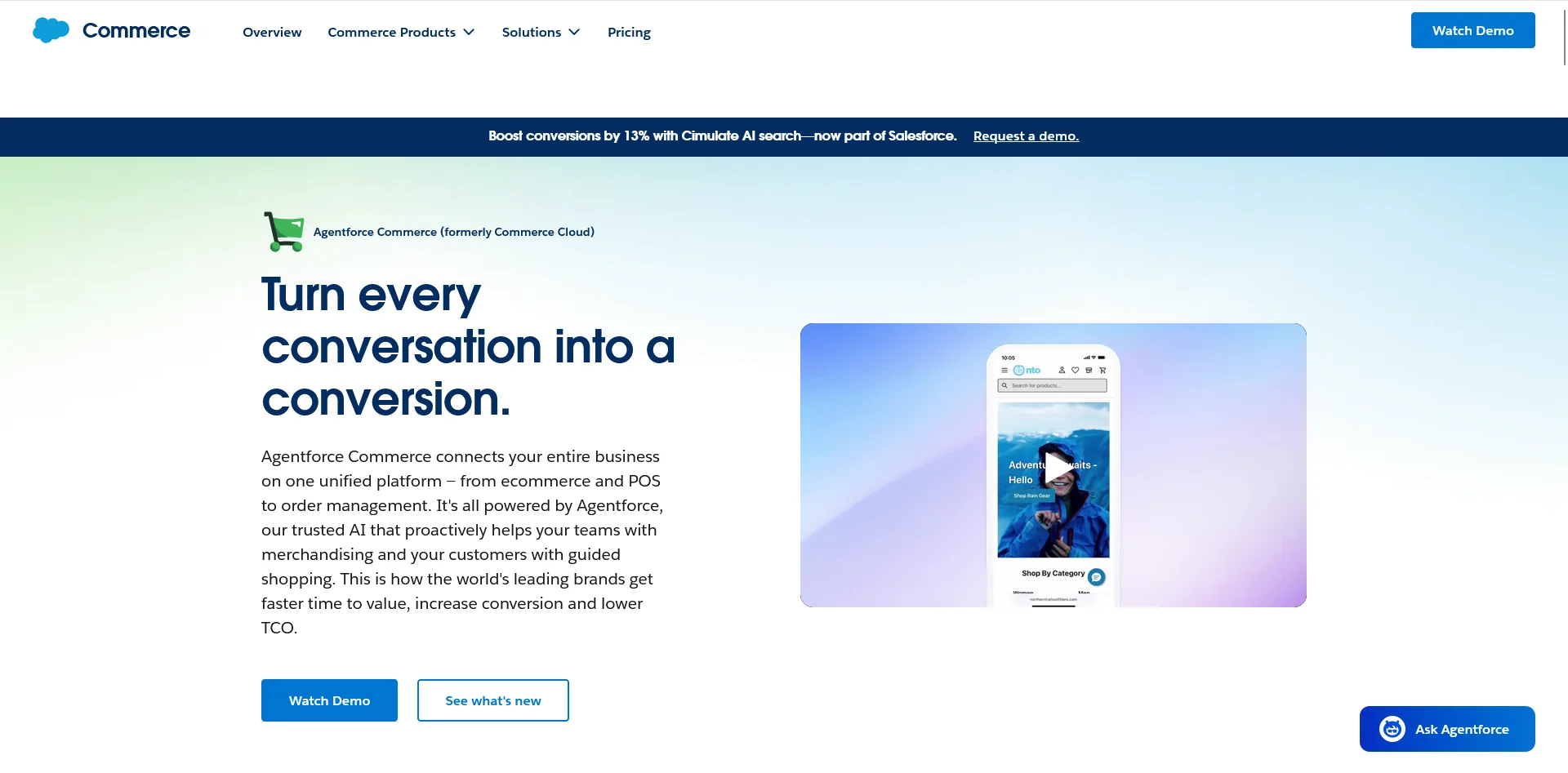
Salesforce Commerce Cloud is the platform that defines enterprise B2C commerce in 2026. It began life as Demandware in 2004, was acquired by Salesforce in 2016 for $2.8 billion, and now sits at the center of Salesforce's broader CRM and commerce stack.
The 2025 Gartner Magic Quadrant marked Salesforce's 10th consecutive year as a Leader in digital commerce, tied with SAP for the longest tenure in the category.
The customer list is the giveaway. According to Salesforce's own 2016 launch announcement, early Commerce Cloud customers included Cole Haan, Puma, and Suitsupply. Adidas has been a Demandware customer since 2011 and now sits on the full Salesforce stack.
Puma has a published Salesforce case study documenting its global replatform. L'Oréal, Lululemon, Columbia Sportswear, and Lacoste are all widely documented Commerce Cloud customers across multiple industry analyses.
There’s a consistent pattern: global apparel, footwear, and beauty brands with sophisticated omnichannel requirements default to SFCC.
What makes Commerce Cloud the default for that segment, as much as the commerce engine itself, is the surrounding Salesforce ecosystem.
If a brand already runs Sales Cloud, Service Cloud, and Marketing Cloud, Commerce Cloud is the only platform that shares the customer data model by default. For a global apparel brand managing tens of millions of profiles across dozens of countries, that integration is worth a lot.
Further reading: Mobile App Development for Salesforce Commerce Cloud Brands
SAP Commerce Cloud
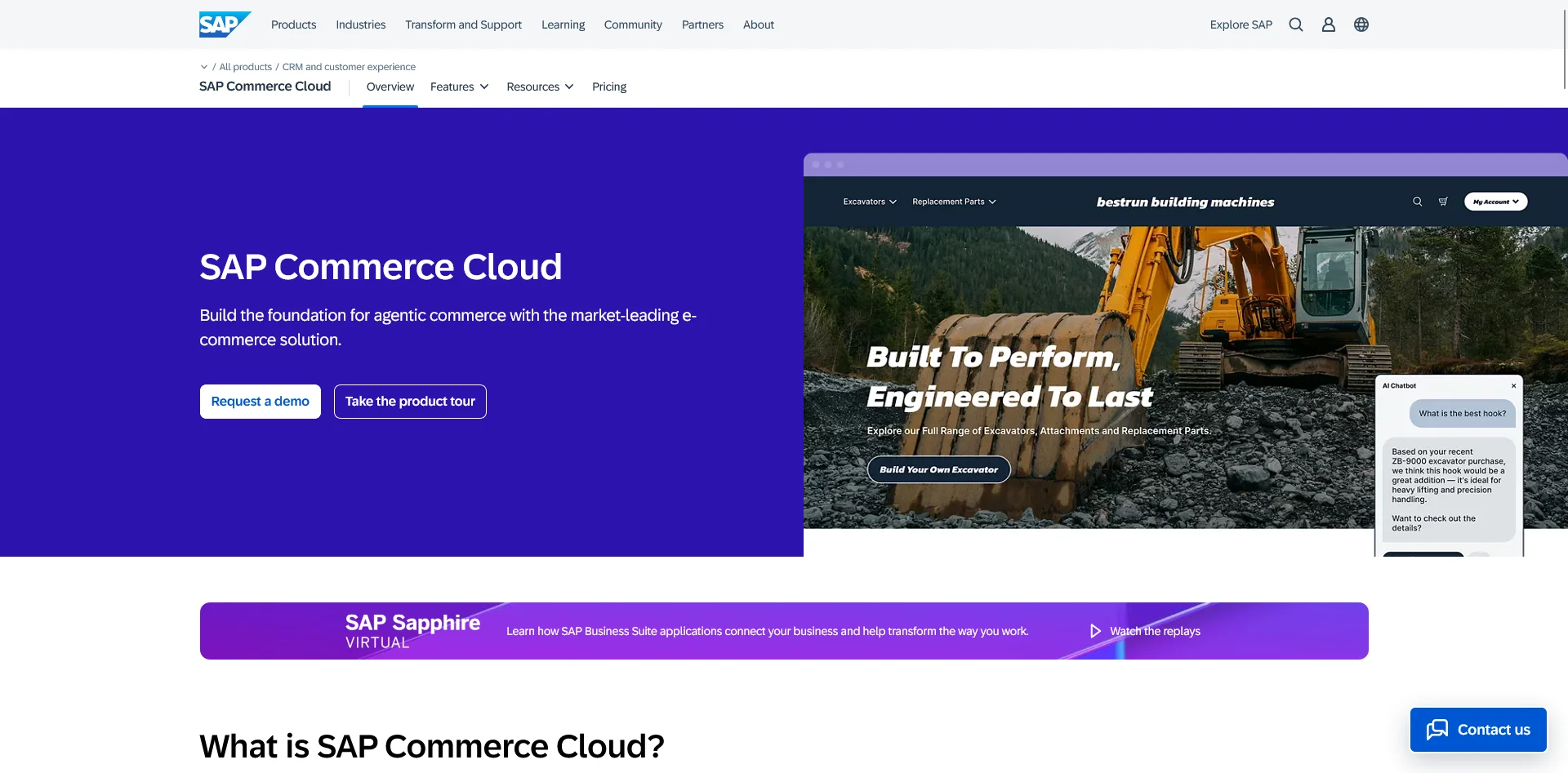
SAP Commerce Cloud is the platform you've heard the least about and seen the most in real life. It originated as Hybris, a German commerce platform acquired by SAP in 2013 for $1.5 billion. It has now been a Gartner Leader for 11 consecutive years, the only vendor positioned in the quadrant every year since the category began in 2014.
The customer list reflects its industrial center of gravity. According to the Wikipedia entry on Hybris, confirmed customers across the platform's history have included General Electric, ABB, 3M, Levi Strauss, Nikon, Johnson & Johnson, Procter & Gamble, Thomson Reuters, and West Marine.
AppsRunTheWorld's vendor database adds Reliance and Tata (India's two largest conglomerates), Qantas Airways, Henkel, Amway, Haier, and Nestlé. Bosch and Siemens are widely cited SAP Commerce customers in industry analyses.
The center of gravity here is industrial manufacturing, B2B distribution, and large multinationals with deep SAP investments in their back office. When the same vendor runs commerce, inventory, billing, and financial consolidation, the brittle middleware layer between commerce and the rest of the business disappears.
For a manufacturer with hundreds of regional pricing books, complex tax requirements, and SKUs running into the millions, that single data model is hard to give up.
Adobe Commerce (Magento)
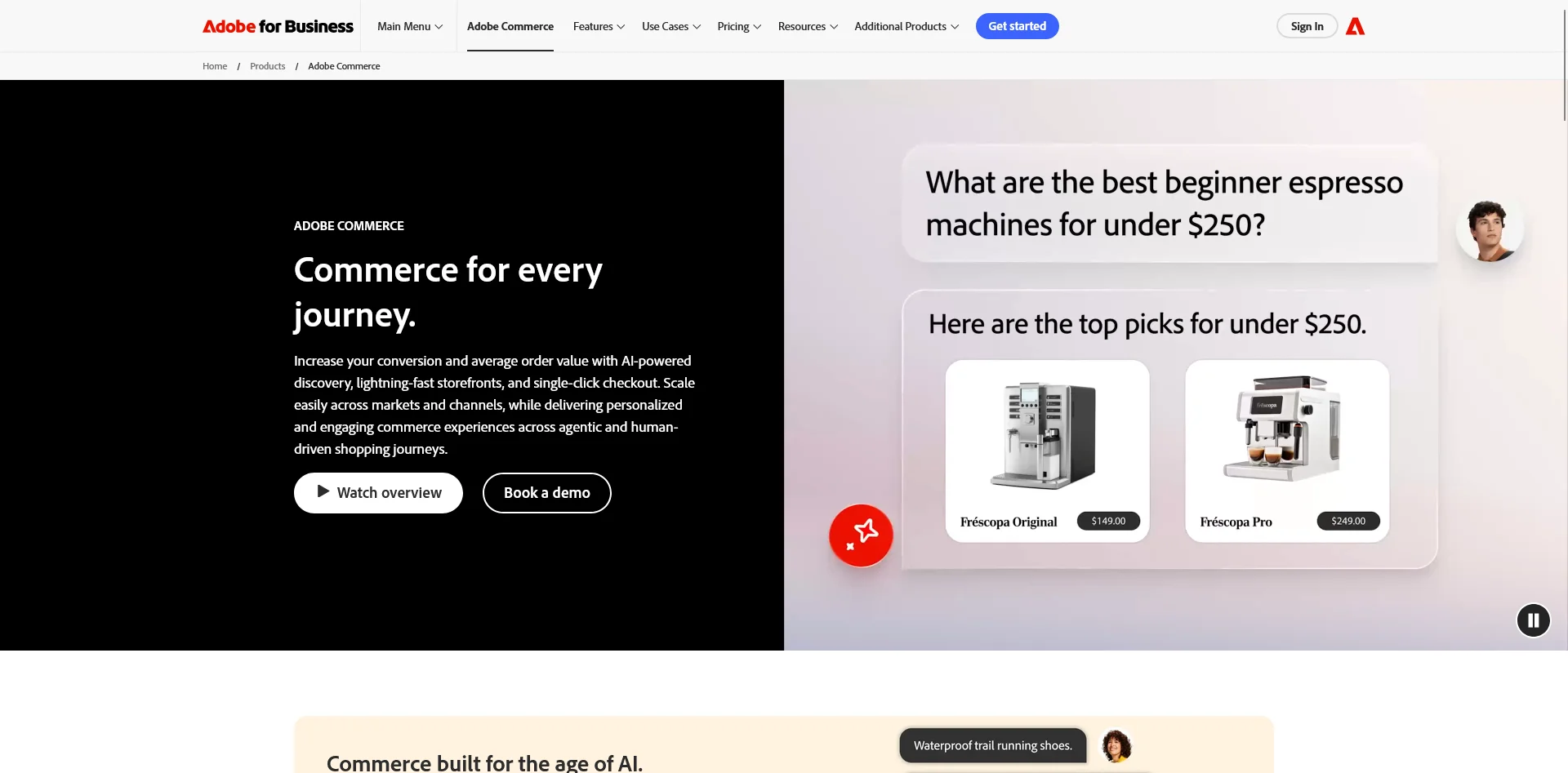
Adobe Commerce is the most flexible platform in the enterprise tier. It started as Magento, an open-source commerce platform launched in 2008. Adobe acquired it in 2018 for $1.68 billion and folded it into Adobe Experience Cloud.
The platform is a 2025 Gartner Leader and one of the most-deployed commerce platforms across the BuiltWith Top 10K.
The customer base, verified through Adobe's own published case studies, tells a different story than Salesforce's.
- HanesBrands runs Adobe Commerce for its Australasia operation and credits the platform with a 41% lift from behavioral data personalization.
- Alshaya Group, the 130-year-old Middle Eastern franchise operator behind regional Starbucks, Pottery Barn, and Victoria's Secret stores, runs its digital retail transformation on Adobe Commerce.
- Mitsubishi Motors uses it to manage product configurations and accessories online. AkzoNobel manages thousands of branded websites on the platform.
- Krispy Kreme runs its Australia and New Zealand ecommerce on Adobe Commerce.
- ASUS chose it for B2B.
- OTTO, the German retailer, uses Adobe Commerce as part of its broader Adobe stack.
The reason Adobe Commerce attracts that crowd is customization. The platform exposes its codebase in a way that Salesforce and SAP don't, which means agencies can build deeply distinctive storefronts.
It also offers genuine multi-store administration, which suits multi-brand retail conglomerates that want one back office running ten storefronts. Adobe's broader Experience Cloud integrations are stronger than anyone else's at content-and-commerce.
Related: Mobile App Development for Adobe Commerce & Magento Brands
Shopify Plus
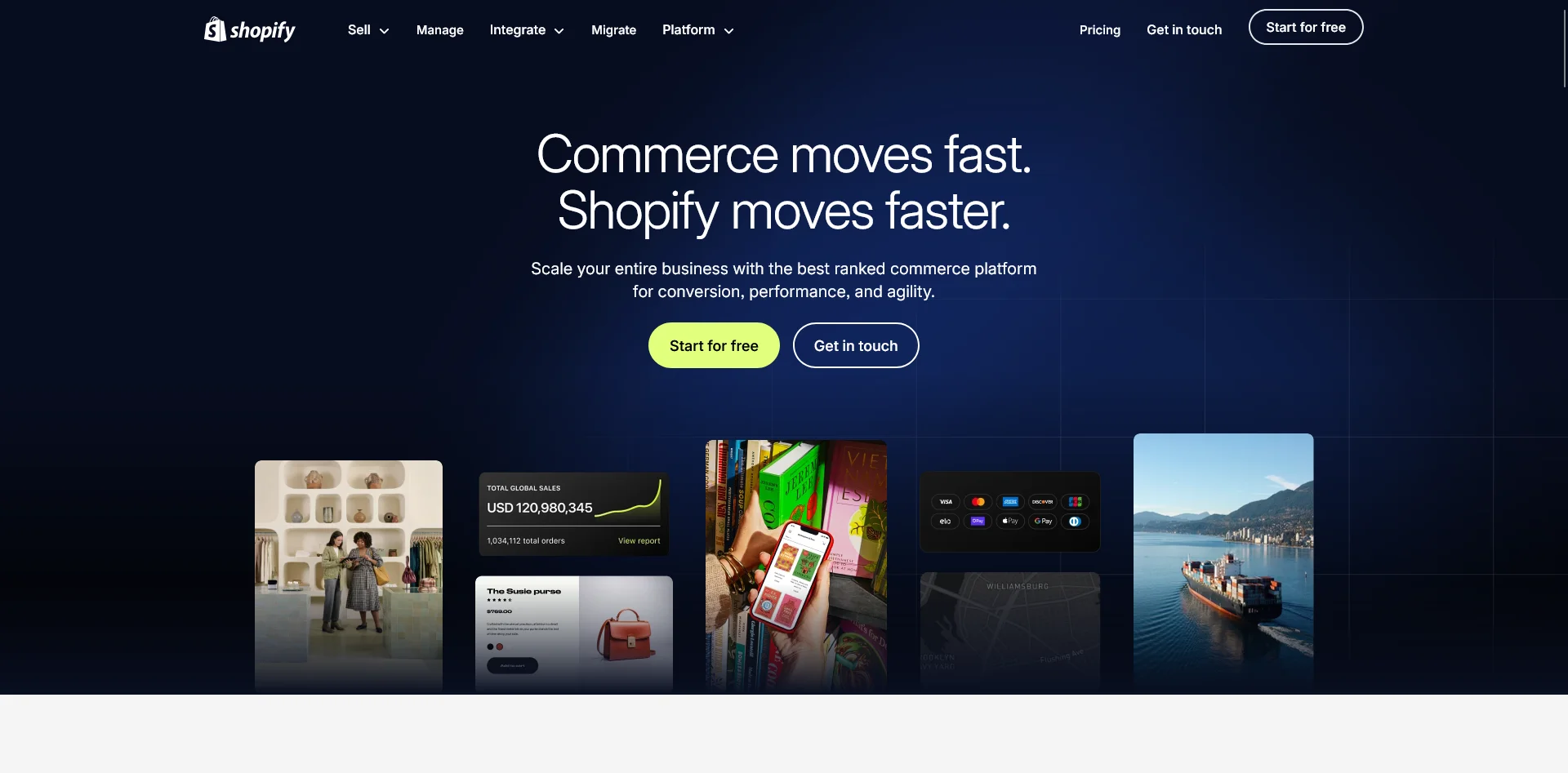
Shopify Plus is the most interesting story in enterprise commerce right now. The 2025 Gartner Magic Quadrant put Shopify in the Leaders quadrant, and according to Kasama Digital's analysis of the report, Shopify and Salesforce are now "neck and neck" at the top of the chart.
That's a remarkable position for a platform that didn't exist as a serious enterprise option a decade ago.
The Shopify Plus customer list has shifted substantially in the past five years. The modern direct-to-consumer side is still the core. Gymshark is the canonical example: it grew from a UK fitness brand to a £128 million DTC operation on Shopify Plus, and its migration from Adobe Commerce is one of the most-cited replatforms in the industry.
Allbirds, SKIMS, Kylie Cosmetics, Fashion Nova, MVMT, Bombas, and Rebecca Minkoff all run on Shopify Plus as well.
The legacy side has expanded faster.
- Heinz migrated to Shopify Plus during the pandemic.
- Mattel runs Barbie, Hot Wheels, and Mattel Creations on it.
- Spanx, BBC merchandise, and Staples Canada have all replatformed onto Shopify Plus from older systems.
The brands moving onto the platform now are no longer the boutique DTC stories of 2018. They're CPG giants and Fortune 500 sub-brands.
What makes the platform work at this tier is speed. Shopify Plus implementations launch in weeks rather than quarters. The merchant admin is genuinely friendly, which matters for brands that want their ecommerce team (not their engineering team) launching the next campaign, and the Hydrogen framework gives engineering teams a clean path to custom frontends when they want one.
Further reading: The Complete Guide to Shopify Plus Mobile App Development
commercetools

commercetools is the platform that defined the composable commerce movement. Founded in Berlin in 2012, hosted on Google Cloud, and now a Gartner Leader for the 6th consecutive year.
It's the platform brands choose when their competitive advantage is the frontend experience and they want a backend that gets out of the way.
The customer list, drawn from commercetools' own published case studies, reflects that positioning.
- Audi runs commercetools for parts of its commerce stack.
- Bang & Olufsen unified its global brands on the platform.
- NBCUniversal built its shoppable-TV marketplace on commercetools with Mirakl.
- Ulta Beauty committed its entire business to a headless and MACH architecture on commercetools.
- Kmart Australia migrated to microservices on the platform.
- Woolworths used commercetools to launch its on-demand grocery service MILKRUN.
- Interflora UK, Zoro.com, Tekton, PetSmart, and Wild Fork Foods are all named customers.
The architecture is what makes commercetools interesting. There's no built-in storefront. The platform exposes a clean set of REST and GraphQL APIs, and the customer's team builds the frontend, the merchant admin, and the orchestration on top.
That sounds like a lot of work because it is. The trade-off is total flexibility: the same backend serves web, mobile app, in-store kiosks, voice, and social commerce, each updating on its own schedule.
VTEX
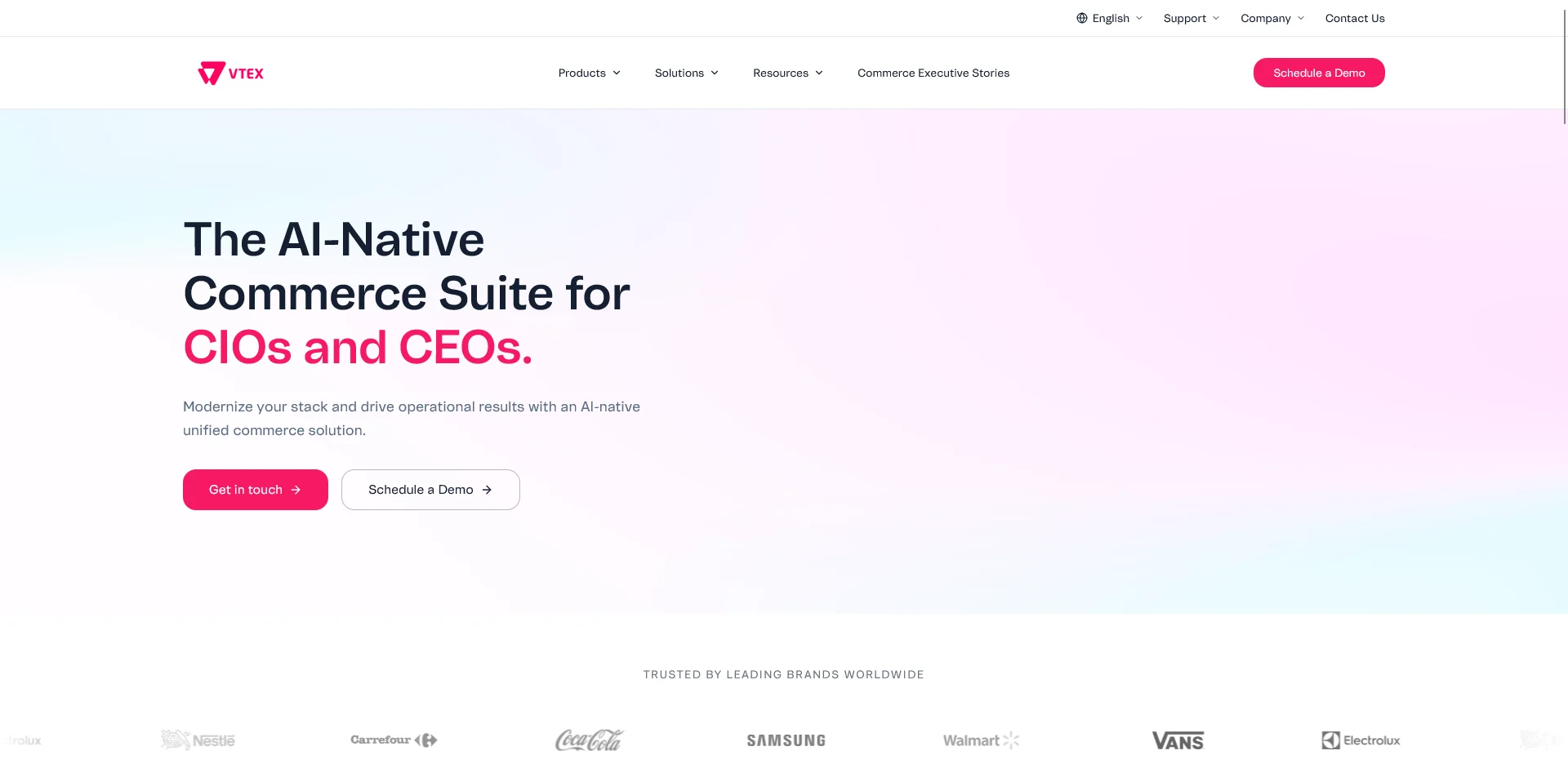
VTEX is the LATAM enterprise leader with a growing global footprint. Founded in Brazil in 1999 and now operating across 44 countries with around 2,200 customers and 3,100 online stores, the platform has built its position on a headless API-first architecture and deep native support for the regulatory and payment complexity of emerging markets.
The customer list is global but anchored in LATAM. According to VTEX's own press disclosures and the INSEAD case study on the company, VTEX runs Whirlpool (across 15 countries), Sony, Carrefour, Walmart Argentina, Coca-Cola Andina, AB InBev, Stanley Black & Decker, Motorola, Nestlé, Colgate, Mondelez, Electrolux, Unilever (regional), Panasonic, and Xiaomi (Peru).
In beauty, the platform powers Natura, Avon, and The Body Shop, all now under Natura & Co. Magalu, Brazil's largest non-Amazon retailer, runs its marketplace on VTEX.
The strongest pitch here is for multinationals that need a single backend across very different regional commerce environments.
Brazil's tax code is famously complex. Argentina's payment systems are unlike anywhere else. VTEX handles both natively. A US-built platform like Salesforce or Adobe handles neither without expensive middleware.
Spryker
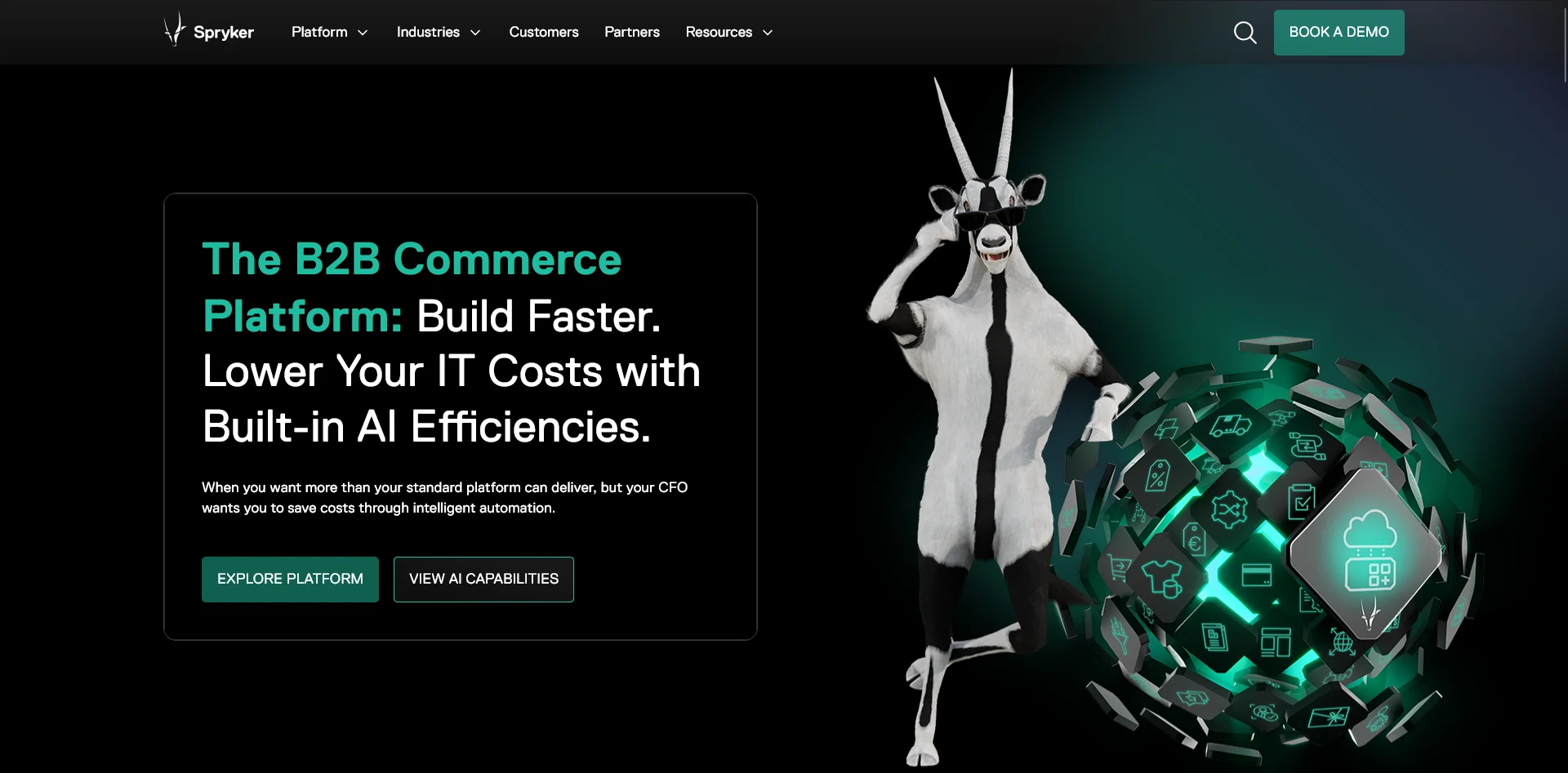
Spryker is the B2B specialist of the group. Founded in Germany, it’s headless and API-first like commercetools, but explicitly designed for the complexity of business-to-business commerce: hierarchical buyer accounts, negotiated contracts, master agreements, multi-step approval workflows, and dealer-network management.
The customer list is heavy on industrial and B2B. According to Spryker's published partner materials, the platform is "trusted by brands such as Aldi, Siemens, Hilti, and Ricoh."
Toyota is also publicly named as a Spryker customer (typically interpreted as Toyota Material Handling, given the platform's commerce positioning).
The brand-name density is lower than the consumer-focused platforms because the buyer is procurement, not retail.
Oracle NetSuite SuiteCommerce, BigCommerce, and Elastic Path
Three more platforms occupy smaller but meaningful slices of the enterprise market.
Oracle NetSuite SuiteCommerce is the storefront layer on top of NetSuite ERP. Oracle acquired NetSuite in 2016 for $9.3 billion. It's not a Gartner Leader, but it's deeply embedded in mid-enterprise B2B.
The customer base is less consumer-visible than the others: thousands of mid-market manufacturers, wholesale distributors, professional services firms, and resellers running NetSuite as their core operating system extend naturally into commerce here.
BigCommerce sits in the Visionaries quadrant. It started as a mid-market alternative to Shopify, has invested heavily in moving upmarket, and now occupies a real but smaller slice of the enterprise segment, particularly strong in multi-store retail and mid-enterprise B2B.
Elastic Path is the smaller composable-commerce specialist, headquartered in Vancouver and founded in 2000. Its highest-profile published customer is T-Mobile, whose Cerberus initiative case study is featured prominently on the Elastic Path site.
It plays in the same conceptual space as commercetools but positions itself as more aggressively modular.
Custom And In-House Platforms
At the very top of the enterprise market, brands aren’t building on top of any commercial platform. As you can imagine, for businesses doing billions in annual turnover, these brands build custom.
- Amazon runs entirely custom infrastructure and licenses pieces of it out as AWS Commerce services.
- Walmart US runs substantially custom, including the technology it inherited from its 2016 Jet.com acquisition.
- Target, Costco, and Best Buy run custom or heavily customized legacy systems.
- Alibaba and JD.com run custom marketplaces.
- Apple runs the Apple Online Store as a fully proprietary system. eBay is custom by definition.
- Inditex (Zara) and H&M run substantially custom systems, often layered on top of selected enterprise components.
For these companies, it just makes more sense to build your own platform, where you control every part of the code and aren’t reliant on a third-party vendor or software.
What's Changing in Enterprise Ecommerce
How does the current state of enterprise ecommerce reflect ongoing trends or changes in the industry?
First, composable commerce has moved from aspirational to mainstream at enterprise.
commercetools, VTEX, and Spryker now have the enterprise customer count and Gartner credibility to be taken seriously by buyers. The question is no longer whether to go composable, but which existing platform will let you do it without re-platforming.
Salesforce, SAP, and Adobe have all responded with headless deployment options of their own.
Second, Shopify is genuinely competing at the top. The 2025 Gartner Magic Quadrant put it neck and neck with Salesforce, and the customer wins are now CPG giants and Fortune 500 sub-brands, not just modern DTC startups.
The Fortune 500 industrial segment still defaults to Salesforce, SAP, and Adobe. The Fortune 500 consumer brand DTC arm increasingly defaults to Shopify Plus.
Third, custom is still winning at the very top, and that isn't changing. Amazon, Walmart, Apple, and the largest pure-play retailers continue to build their own platforms.
The economics that drive that choice (commerce as competitive surface area, not operational expense) only become more favorable as those businesses grow.
Fourth, the gap between platforms is narrower than the marketing implies. Every Gartner Leader now supports headless. Every Leader supports B2B. Every Leader supports multi-region, multi-currency, and complex catalogs.
The functional differences that drove most platform decisions in 2018 are now second-order.
Where MobiLoud Fits In
Every business running on one of the platforms above is operating at the scale where having a dedicated mobile app is a necessity.
MobiLoud is a service built specifically for these brands. MobiLoud builds native iOS and Android apps for enterprise ecommerce brands, powered by their existing tech stack.
Unlike most mobile app vendors, MobiLoud works with any ecommerce platform: Shopify Plus, Adobe Commerce, BigCommerce Enterprise, Salesforce Commerce Cloud, headless setups, custom builds, and even niche platforms.
MobiLoud allows these brands to launch a mobile app that’s fully synchronized with their website by default, and requires significantly fewer resources to maintain, compared to a custom app built from scratch.
Brands like Tadashi Shoji (Adobe Commerce) and John Varvatos (Salesforce Commerce Cloud) launched their apps with MobiLoud, without standing up a mobile team or commissioning a custom dev project. They now have a high-ROI retention channel, driving significant revenue with minimal overhead.
The Short Version
If there's one thing to take from this article, it's that the enterprise commerce market is not the SMB commerce market with bigger logos. It's a separate ecosystem with its own logic.
- Salesforce Commerce Cloud, SAP Commerce Cloud, and Adobe Commerce remain the heavyweight Gartner Leaders running much of the world's largest consumer and industrial brands.
- Shopify Plus has broken into that tier and now competes directly with the legacy platforms, particularly for large modern DTC brands and CPG sub-brands.
- commercetools, VTEX, and Spryker are the composable challengers, each anchored in a different segment of the market.
- NetSuite SuiteCommerce, BigCommerce, and Elastic Path occupy real but smaller niches.
- And the very top of the market (Amazon, Walmart, Apple) runs nothing anyone else can buy.
These are all heavyweight platforms, powering heavyweight brands, from Adidas to Puma to Heinz.
FAQs

Convert your website into a mobile app