
Two-thirds of large-scale tech programs don't deliver on time, within budget, or within scope.
That's rarely because the vendor was incompetent. More often, it's a mismatch: the vendor's strengths didn't align with the buyer's actual needs, or the evaluation process focused on features and demos instead of fit.
78% of enterprise buyers shortlist just three vendors after self-guided research. That means the criteria you use to filter matters more than any sales pitch. If you’re going to look at just three vendors, it’s important that you’ve narrowed down to companies that align with your priorities.
We’ve helped over 2,000 businesses launch mobile apps over the last 10 years. That means we’ve been part of countless sales calls and consultations, and we’ve heard every concern, objection, every non-negotiable handed down from the board of directors or the CEO. So we know what’s important when it comes to looking for an app vendor.
This guide walks through what enterprise ecommerce teams should evaluate before shortlisting, what questions to ask, and what to look for along the way.
Start with Your Requirements, Not Vendor Demos
The mistake is booking a round of demo calls, without actually being clear on your requirements and specifications.
Before you look at a single vendor, get clear on what you actually need. Most evaluation processes go sideways because the requirements are vague, and every vendor can claim to meet vague requirements.
Map your existing stack
What commerce platform are you on? Salesforce Commerce Cloud, SAP, Adobe Commerce, Shopify Plus, something else?
What integrations are non-negotiable: your ERP, OMS, PIM, loyalty platform, payment gateway, POS system?
The vendor needs to work with what you have; you shouldn’t be adapting your tech stack to fit their capabilities.
Be honest about your team's capacity
Can your team staff an ongoing mobile app project with dedicated developers, QA, and product management? Or do you need a vendor that handles everything?
This is the single most important question, and the answer determines which type of vendor you should even be evaluating.
Your team is already managing website updates, promotions, inventory, and analytics. Adding app management to that workload is a harder sell than most vendors acknowledge.
As Kenneth Chan, Founder and CEO of Tobi, put it: “When you develop an app you can't just have one person. When we built the app in 2014, the maintenance became very heavy. You also have to maintain a good user experience. To keep a platform like this in-house I feel like you’d probably need around six people.”
Set your timeline and budget constraints
The app development process typically takes a long time (as long as 9-12 months, depending on how complex your project is).
Some approaches can get you live faster. But it’s best to do the research into whether this is possible before getting onto a sales call - because there will always be some vendors who say “yes” to everything you need, whether it can be done or not.
If you need to be in the App Store before the holiday season, that narrows your options significantly.
Same thing with budget. Be clear on how much you’re ready to spend on the app from the start.
Define your success metrics
What does "working" look like for your organization? Conversion lift? Retention improvement? Push notification reach? Reduced customer acquisition cost?
Define this before vendor conversations, not after. Vague goals lead to vague evaluations and, eventually, to projects that nobody can call a success or a failure.
The Five Evaluation Criteria That Actually Matter
Enterprise procurement teams typically weight their RFP evaluations across five core categories. Here's what to look for in each.
Technical Fit (Weight: 30-35%)
This is where most evaluations go wrong. A vendor's feature list tells you what they built. Technical fit tells you whether it works with what you already have.
- Integration architecture. Does the solution work with your existing commerce platform and tech stack, or does it require building and maintaining a separate codebase? Will it work with all the third-party tools your business uses?
- Update workflow. When your team updates the website, a promotion, a product page, a banner, does the app reflect those changes automatically? Or does every change require a separate deployment? This is the difference between a tool your team can live with and one that doubles their workload.
- Performance standards. Ask for specific benchmarks: load times, crash rates, App Store compliance track record. Every vendor will say their app is "fast." Ask for numbers.
- Scalability. Can the solution handle your traffic during peak periods (Black Friday, flash sales, seasonal spikes) without degradation? Ask what happens when traffic doubles.
Total Cost of Ownership (Weight: 25-40%)
The biggest mistake when looking for a mobile app solution is looking at the upfront costs, and assuming that’s all you’re going to pay.
Don't compare sticker prices. Compare 3-year TCO.
The gap between quoted price and actual cost is where enterprise app projects quietly hemorrhage money. (For a deeper breakdown, see our full guide to mobile app total cost of ownership.) App maintenance typically runs 15-20% of the original development cost annually.
You’re looking at maintenance costs, scope creep, sometimes your own team’s labor as well.
By year three, cumulative maintenance costs can exceed the initial build investment.
Your TCO calculation should include:
- Development costs (initial build or setup)
- Infrastructure (hosting, CDN, monitoring)
- Ongoing maintenance (bug fixes, OS updates, App Store compliance changes)
- App Store fees ($99/year Apple, $25 one-time Google, plus any additional fees like in-app purchase fees)
- QA and testing (regression testing across devices and OS versions)
- Team time (how many hours per week does your team spend managing the app?)
- Compliance updates (Apple and Google regularly change requirements, forcing vendors and teams to adapt)
Ask every vendor for a 3-year TCO projection that includes all of these. If they can't provide one, that tells you something.
As a benchmark: custom enterprise app builds typically cost $350K-$500K+ upfront with $100K+ in annual maintenance. Managed services offer more predictable monthly pricing with maintenance included.
Delivery Capability (Weight: 20-25%)
A vendor's ability to deliver on schedule matters as much as what they deliver.
- Track record. How many apps have they launched for businesses at your scale? On your commerce platform? Ask for specifics, not aggregate numbers.
- Implementation timeline. Get a contractual timeline, not an aspirational one. "Typically 4-6 weeks" is marketing. "We'll be live in the App Store by [date], per our agreement" is a commitment.
- Post-launch support model. What happens after launch? Do you get a dedicated account manager or a support ticket queue? Do they offer SLAs? Who handles App Store submissions, OS updates, and compliance changes? You need a named point of contact, not self-service documentation.
- App Store management. Apple and Google regularly update their requirements, review guidelines, and APIs. Ask who is responsible for keeping your app compliant. If the answer is "your team," factor that into your resource planning and TCO.
References and Proof (Weight: 10-15%)
Case studies are the most influential content type for enterprise B2B buyers, with 84% actively seeking them during vendor evaluation. But not all references are equal.
- Ask for businesses your size. A case study from a $5M DTC brand doesn't tell a $200M retailer much. Ask for references from businesses with similar revenue, similar traffic volume, and similar stack complexity.
- Request reference calls. Testimonials on a website are curated. A phone call with a current customer at your scale is the highest-trust action a vendor can offer. If they won't arrange one, ask why.
- Check their existing client apps. Download a few from the App Store. Read the reviews. Look at the ratings. Check when the app was last updated. An app that hasn't been updated in months tells you something about post-launch support.
- Look for specific metrics. "Our clients love us" is not proof. Conversion lift, session time, push notification engagement rates, revenue per user compared to mobile web, these are proof.
Questions to Ask a Vendor
Your buying committee includes stakeholders with different priorities. Here are the questions each one should be asking.
For your CTO and IT team
- "How does your solution integrate with [your commerce platform]? What's the architecture?"
- "What happens to our existing third-party integrations (search, reviews, loyalty, analytics)?"
- "When we update our website, does the app update automatically, or is it a separate process?"
- "What's your approach to app performance monitoring and crash reporting?"
- "How do you handle Apple and Google OS updates and policy changes?"
For your CFO and finance team
- "What's the full 3-year TCO, including maintenance, updates, and compliance?"
- "Are there usage-based fees that could scale unexpectedly with traffic or transactions?"
- "What are the contract terms? Is there a minimum commitment?"
- "What happens to our investment if we decide to switch vendors?"
For your ecommerce and marketing team
- "How much ongoing work does this create for our team on a weekly basis?"
- "Do we need to manage a separate content pipeline, or does the app mirror our website?"
- "How are push notifications managed? Can our existing marketing team handle it?"
- "What analytics and reporting are available natively?"
For legal and procurement
- "What are the contract exit terms and switching costs?"
- "How portable is our data if we leave?"
- "What are your SLA terms, uptime guarantees, and penalties for breach?"
- "Do you carry cybersecurity insurance?"
For IT security
- "How do you handle PCI DSS compliance for payment flows?"
- "Where is user data stored, and how is it encrypted at rest and in transit?"
- "Can you share your most recent penetration testing report?"
Signs a Vendor Might Not Be the Right Fit
None of these are automatic disqualifiers. A vendor might be excellent at what they do but simply not aligned with what your team needs. Here are the patterns worth paying attention to.
Pricing isn't clear upfront
Enterprise teams need budget predictability. If a vendor can't share a clear pricing model early in the conversation, it's harder to build an accurate business case internally.
Their reference customers don't look like you
A vendor with great case studies from small DTC brands may be genuinely strong in that segment. But if your team is running a complex tech stack with enterprise-grade integrations, you want to see proof they've delivered at that level of complexity.
Integration details come after the contract
The strongest vendors can walk you through how their solution works with your specific commerce platform before you commit. If that conversation is deferred to "onboarding," it introduces uncertainty.
The app requires a separate codebase or content pipeline
This is a fit question more than a quality question. Some vendors build apps that require your team to manage separate content, navigation, or creative alongside your website. That model works well for some organizations. But if your team is already stretched, it's worth understanding the operational commitment before you sign.
"Every time you try to do something that doesn't take the website and now has a separate code base, you run into issues. All of a sudden, something that works perfectly well on your website now doesn't function in the app."
-- David Cost, VP of Ecommerce, Rainbow Shops
OS and compliance updates aren't clearly owned
Apple and Google regularly update their requirements. It's worth clarifying who is responsible for keeping your app compliant, your team or the vendor, so there are no surprises down the line.
Vendor Evaluation Scorecard
Use this as a quick reference when comparing vendors side by side.
| Criteria | Weight | Ask the Vendor |
|---|---|---|
| Technical Fit | 30-35% | How does your solution work with our platform? Do website updates sync to the app automatically? |
| TCO | 25-40% | What's the full 3-year cost, including maintenance, compliance, and team time? |
| Delivery Capability | 20-25% | What's your contractual timeline? Who handles App Store compliance post-launch? |
| References & Proof | 10-15% | Can we speak with a customer on our platform, at our scale? |
Finding the Right Fit
The goal of this evaluation process isn't to find the "best" vendor in the abstract. It's to find the one that fits your specific situation: your commerce platform, your integration requirements, your team's capacity, and your timeline.
Start by defining what you need. Use the five evaluation criteria to compare vendors on what actually matters for your organization. Ask the questions that surface real alignment, not just feature parity. And pay attention to how vendors respond to those questions; the conversation itself tells you a lot about what the partnership will look like.
The right vendor is one that can prove, with reference customers who look like you, that they can deliver what you need, support you after launch, and grow with you over time.
How MobiLoud Works
MobiLoud is a fully managed service that turns your existing ecommerce website into native iOS and Android apps.
We typically work with mid-market and enterprise ecommerce brands, particularly those with custom ecommerce stacks that other vendors can’t support.
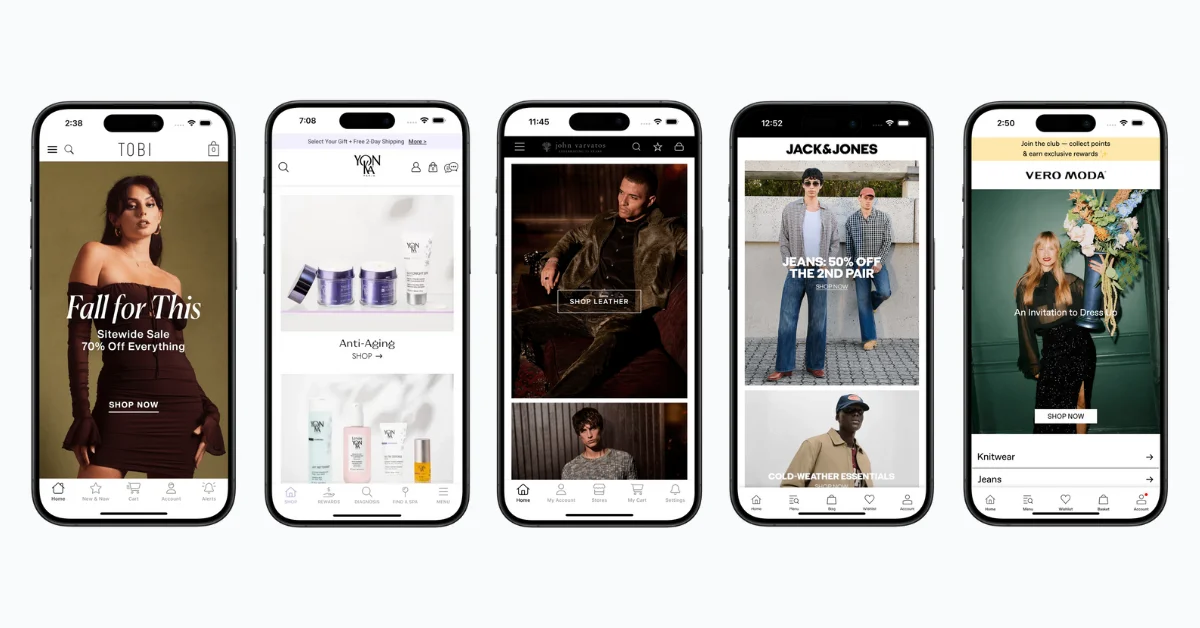
Our approach is different to many others. Instead of building you a new app that needs to be managed separately from your website, we directly convert your existing site into an app.
This means:
- Your website powers the app. Your product pages, checkout flow, promotions, loyalty program, and every third-party integration you already use carry over to the app automatically. When you update your website, the app reflects those changes in real time. There's no separate codebase, no duplicate content pipeline, and no additional workload for your team.
- We handle everything. MobiLoud's team builds your app, submits it to the App Store and Google Play, and manages ongoing maintenance, OS updates, and compliance changes. Your team doesn't need mobile development experience.
- Native app features, without the native app project. Your app gets push notifications, a home screen icon, native navigation, and full App Store presence. Customers get the fast, familiar experience they expect from an app, powered by the website you've already built.
- Predictable pricing. A flat monthly fee with maintenance and updates included. No usage-based fees that scale unexpectedly, no hidden costs, no surprise invoices.
- Live in weeks, not months. Most brands go from first conversation to App Store in about 6-8 weeks.
MobiLoud works with Shopify Plus, Salesforce Commerce Cloud, Adobe Commerce, Shopware, WooCommerce, BigCommerce, and custom platforms.
We've built over 2,000 apps for brands including Tadashi Shoji, John Varvatos, buybuyBaby, PetShop.co.uk, and Jack & Jones.
If you're evaluating vendors and want to see how MobiLoud would work with your specific stack, you’re in the right place.
Check out our homepage for a closer look at what we do and who we help, as well as our Case Studies and App Examples.
If you’re ready to talk to us about whether MobiLoud is the right fit for your project, get in touch and Book a Free Consultation. We’ll explain whether our approach is the best way for you to go live with your mobile app.