
If you run a non-Shopify ecommerce store, you’re often made to feel like an outsider.
Everything you read online is pitched towards Shopify these days. That includes Shopify-specific mobile app builders like Tapcart (as well as the throngs of similar apps in the Shopify App Store).
If you’re not on Shopify - maybe you're on Magento, or a custom platform, or even a relatively straightforward WooCommerce store - you’re often told the only way to get a mobile app is to commit to a custom build from scratch; something that will cost you six figures and six to twelve months of your time, just for version 1.
There’s a better way, though, no matter how custom or niche your ecommerce platform is. Keep reading and we’ll explain it all.
Most of Ecommerce Is Not on Shopify
The "Shopify is everywhere" reflex doesn't hold up against the actual platform numbers.
Shopify is the largest single ecommerce platform in the United States, with roughly 30% of US platform share, and about 10% of the global market by share of websites (Statista, Chargeflow, 2025-2026).
That’s big, but not a monopoly. The other 70-90%, depending on which lens you take, runs on a long list of platforms that look very different from each other.
WooCommerce alone covers an estimated 4.7 million active stores, somewhere between 18% and 21% of global ecommerce websites.
Add the Magento and Adobe Commerce ecosystem (with Hyvä now powering 6,400+ live stores after going open source in November 2025), Shopware, BigCommerce, and the long tail of custom and headless stacks running on commercetools, MedusaJS, Salesforce Commerce Cloud, VTEX, and bespoke builds.
Together, these platforms power the majority of the ecommerce world (increasing at the higher end of the market).
What Kind of Stores Run on Non-Shopify Platforms?
Non-Shopify ecommerce isn't a single archetype. It splits into a handful of clear patterns, each with its own reasons for being where it is.
| Archetype | Platforms | Example brands |
|---|---|---|
| B2B distributors and manufacturers | Adobe Commerce, BigCommerce, Shopware, Salesforce B2B Commerce, SAP, ERP-integrated custom | REDARC (Adobe), Bio-Rad (BigCommerce), Prime-Line (BigCommerce) |
| Enterprise and legacy stacks | Adobe Commerce (Magento), Salesforce Commerce Cloud, Shopware | HanesBrands, Catbird, Coca-Cola En Tu Hogar (Adobe) PUMA, YETI, Sonos, Fisher & Paykel (SFCC) STABILO, ARMEDANGELS, MissPompadour (Shopware) |
| Audience-first publishers | WooCommerce | All Blacks rugby team shop, Tiny Wood Stove |
| Custom and headless stacks | commercetools, MedusaJS, BigCommerce Catalyst, custom builds | L.L.Bean, PetSmart, Breville, FREITAG (commercetools), Tekla Fabrics (MedusaJS) |
B2B Distributors and Manufacturers
Complex B2B is where Shopify Plus has historically struggled, and where Adobe Commerce, BigCommerce, Shopware, Salesforce B2B Commerce, SAP, and ERP-integrated custom builds have entrenched themselves.
These aren't catalogs with company logins bolted on. They're hierarchies, contracted pricing, sales rep accounts, quote-to-order workflows, and customer-specific catalogs running across thousands of accounts at once.
The brands actually running these stacks tell the story.
- REDARC, an Australian automotive electronics manufacturer, runs both its B2B distributor portal and its DTC channel on Adobe Commerce.
- Bio-Rad, a life-sciences and clinical diagnostics company, runs a headless ecommerce setup on BigCommerce.
- Prime-Line, a US hardware and replacement-parts manufacturer, sells through wholesale and direct on BigCommerce.
Each is a real B2B operation, not a B2C store with a discount tier.
A mobile app on top of any of these has to respect that complexity. Most off-the-shelf app builders simply don't.
Enterprise and Legacy Stacks
Large-scale ecommerce that pre-dates Shopify Plus is where the most non-Shopify stores are. While Shopify has begun to power more enterprise brands, this has traditionally been an area they dominate less.
Adobe Commerce (the platform formerly known as Magento) still powers serious D2C operations:
HanesBrands runs its apparel business on Adobe Commerce; Catbird, a Brooklyn fine-jewelry brand, runs the same stack; Coca-Cola's En Tu Hogar D2C delivery business sits on it as well.
Salesforce Commerce Cloud carries a comparable list of premium and global brands. PUMA, YETI, Sonos, Fisher & Paykel, and Boggi Milano all run their commerce there.
Shopware powers the European DTC and mid-market layer that rarely makes US headlines but matters across DACH and the UK: STABILO (the global writing-instruments manufacturer), ARMEDANGELS (Cologne-based sustainable fashion label), Casey's Furniture (Irish heritage retailer founded in 1921), and MissPompadour (European premium-paint DTC brand).
These merchants spent years and a meaningful budget building the commerce stack they want. They aren't shopping for a re-platform. They want their next channel, the mobile app, to extend what they already run.
Audience-First Publishers and Content-Led Brands
WooCommerce dominates a category Shopify isn't built for: the audience-first brand whose store is downstream of their content.
Publishers, creator businesses, membership communities, niche retailers built on a decade of organic traffic. The moat is the WordPress plugin ecosystem and the content already ranking; standardizing on a SaaS storefront usually destroys more value than it creates.
The pattern shows up in case after case. The official All Blacks rugby team shop runs on WooCommerce. Tiny Wood Stove, a US specialty retailer in a deeply niche category, scaled from a WordPress blog about wood-burning stoves into a multi-million-dollar business on the same plugin stack.
The Woo merchant typically built the audience first and added the cart later, which is the inverse of how Shopify-native businesses are wired.
Custom and Headless Stacks
At the top of the market, you increasingly see brands picking custom or headless commerce: commercetools, MedusaJS, BigCommerce's Catalyst framework, or fully bespoke implementations.
L.L.Bean, a heritage US outdoor retailer, runs its digital business on commercetools. PetSmart, Breville, Pet Valu, and FREITAG (the Swiss upcycled-tarp bag brand built around a circular-economy thesis) are all on commercetools as well.
Tekla Fabrics, the Copenhagen home-textiles brand, runs on MedusaJS. The teams here have engineering depth and want commerce as APIs, not as a hosted theme.
In short: the merchants that aren't on Shopify aren't fringe cases. They're the legacy, the enterprise, the regulated, the content-first, the global, and the technically ambitious. They span most of ecommerce by revenue and a clear majority by store count.
Read more: The Ecommerce Mobile App Buyer's Guide breaks down all there is to know about every single type of mobile app solution for ecom brands, no matter the platform.
Why It's Harder to Build a Mobile App If You're Not on Shopify
Mobile app builders are a game-changer for ecommerce, letting brands launch full-featured mobile apps without having to invest in a fully custom native build.
However, this category is centered squarely around Shopify.
If you search in the Shopify App Store, you'll currently find 98 tools under the category of "mobile app builder".
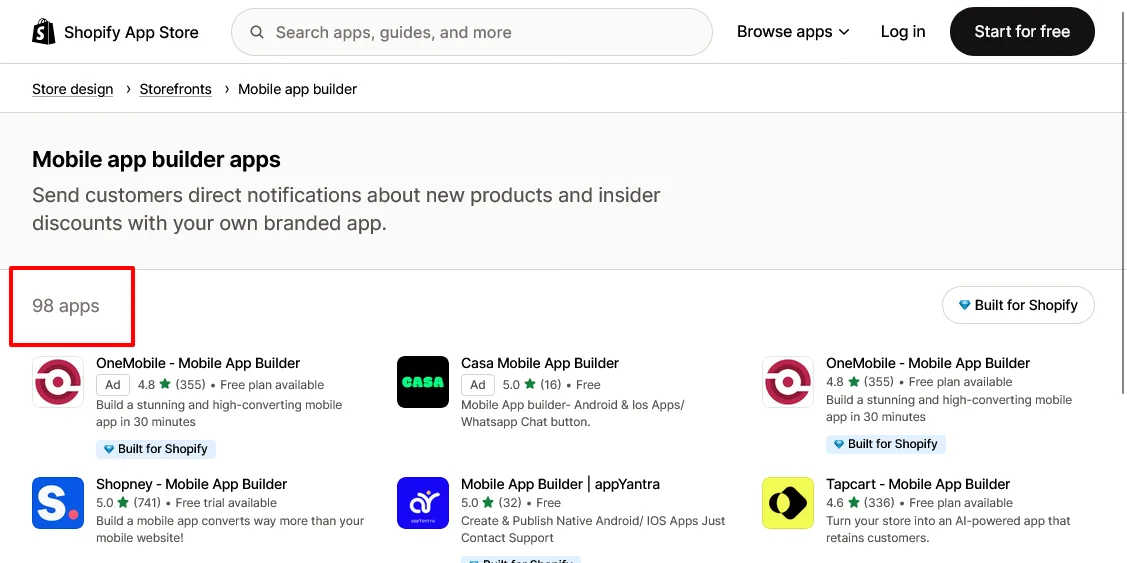
A quick look on Google, in ChatGPT, or in your platform's equivalent to the Shopify App Store (the Salesforce AppExchange, WooCommerce plugin marketplace, the Adobe Commerce marketplace), you'll find drastically fewer choices.
There are two reasons this ecosystem is so much stronger for Shopify.
The first is APIs. Shopify's Storefront API and Admin API are clean, well-documented, and consistent across stores.
There are some limitations that come with the API, but in general, it’s the foundation for all these software tools that let straightforward Shopify stores launch apps quickly and easily.
Off Shopify, the picture is a lot more fragmented.
- WooCommerce APIs vary by plugin stack.
- Magento has REST and GraphQL but they behave differently across customizations.
- Salesforce Commerce Cloud uses OCAPI and SCAPI.
- Shopware has its own.
- BigCommerce ships its own.
- Custom and headless stacks expose whatever the team built.
In short, there's no single API a vendor can build a generic mobile app product on top of. If you were building the “Tapcart for non-Shopify”, it would mean working with so many different APIs, the complexity just would not be worth it.
The second is the kind of brands that run off-Shopify.
These brands are generally running more complex operations (which is why they’re not on Shopify in the first place). B2B, multi-storefront operations, bespoke implementations.
This makes it a lot more difficult to work with a generic mobile app builder SaaS, and the output is unlikely to measure up to the custom work you’ve done on your website.
The result is that you’re usually forced to build a custom app from the ground up to match your custom site - which comes at a huge cost (in both time and money), as well as shackling you to a new, separate codebase, massively increasing overhead complexity.
Why You Still Need a Mobile App (As a Non-Shopify Store)
The smaller number of vendors for non-Shopify stores doesn't change the fact that a mobile app is an important asset for an ecommerce brand today.
An app can deliver significant results, especially for the kind of businesses that run on legacy or enterprise ecommerce platforms.
We’re talking B2B brands, global retailers, and businesses doing 8 and 9 figures in annual revenue (where an app could easily be a $10M+ revenue channel).
So, although it may be difficult, you do need an app. The question is just how to build one, without feeling like you’ve got a whole new storefront to manage.
How MobiLoud Builds Custom Mobile Apps for Any Stack
MobiLoud is a custom development partner that is the ideal midpoint between app builders and custom app development agencies.
We help you build a custom app using your existing web stack. Whether that’s Shopware, BigCommerce, Medusa, or a fully custom site - we’ll ship a native app for you that’s completely synced with your existing website.
You get a full-featured native app, with native push notifications, in-app onboarding flows, app-only experiences and exclusive offers, App Store and Play Store listings under your developer accounts.
Everything a shopper would expect from a native app from a brand of your size.
The big difference is, you’re not rebuilding your store in a brand new codebase. The app is powered by your website, so everything you build for the web carries over to your app, automatically.
This model is platform-agnostic, which is the part that matters here. MobiLoud apps can run on top of:
- WooCommerce stores, including custom plugin stacks
- Magento and Adobe Commerce, including Hyvä-themed and Mage-OS open source builds
- Shopware, including B2B-focused configurations
- BigCommerce, including Catalyst headless setups
- Salesforce Commerce Cloud, including B2C, B2B, and Agentforce-powered storefronts
- MedusaJS and other custom or headless commerce stacks
- Custom builds on bespoke architectures
Since you’re not rebuilding from scratch, you can launch much faster and more affordably than a traditional custom build. And more importantly, you don’t need to maintain a second codebase, which avoids the biggest trap that plagues most native apps.
"A custom app build for our Salesforce Commerce Cloud setup would have been prohibitively expensive. MobiLoud was the only realistic option."
-- Nick Barbarise, Director of IT, John Varvatos
For non-Shopify ecommerce brands, this is the only way to get a real custom mobile app without funding two codebases for the lifetime of the app.
Migration Insurance: Your App Keeps Working If Your Platform Changes
Another thing to keep in mind: if you do happen to join the migration to Shopify, you don’t need to worry about uprooting and breaking your mobile app.
There are no APIs that need reconfiguring. No dealing with a vendor that worked with your old platform, but not your new one.
Since MobiLoud is platform-agnostic, we can power your app if you’re on BigCommerce, commercetools, Shopify, Shopify Plus - no matter where you go.
That’s the ultimate flexibility. Not being tied down to a specific tech stack, that multiplies complexity should you ever plan on moving.
Final Thoughts: Building the Perfect Mobile App, No Matter Your Platform
If you're outside the Shopify ecosystem, the mobile app conversation has been broken for a long time.
The defaults pointed you at custom builds you didn't want, with budgets you didn't have, on timelines that didn't fit your business. The other 80% has been told the only way to a real app is to spend like an enterprise and live with the tax forever after.
That's no longer true. The custom app your brand needs can be built on top of the web stack you already run, in around 6-8 weeks, for a fraction of what a from-scratch build would cost, and it travels with you if you ever move platforms.
Book a free strategy call to scope out the project, get a preview of your site as an app, and figure out if this is the right way to launch your mobile app.