Most growing Shopify stores end up working with an agency at some point. Sometimes it's for a single project: a replatform, a redesign, a paid campaign. More often, the relationship lasts for years and runs alongside the business.
The agency you pick matters more than most decisions of this kind, because the relationship compounds. A good agency gets more valuable over time as they learn your brand, customers, and operations. A mismatched one creates a slow churn of half-finished projects, missed context, and effort spent re-explaining the basics.
This guide is meant to help you find a partner, not just pick a vendor. It walks through when an agency makes sense, what kinds of work they actually do, the types of agencies you'll encounter, what fits what kind of store, and where to look once you know what you're after.
Do You Need a Shopify Agency?
Not all stores need to work with an agency. Plenty of Shopify stores run for years without one. Founders ship most of the early work themselves, lean on freelancers for specific tasks, or hire from the Shopify Experts marketplace when they need help they can scope down to a single project.
That works well in two situations.
First, when the work is contained, like a one-off feature build, a single campaign, or a theme tweak. Second, when the team has the in-house capacity to direct the work and integrate it back into the business.
An agency starts making sense when:
- You need specialized experts, with abilities beyond what your in-house team can produce.
- The work is ongoing, not a one-off. Replatforming, optimization, marketing, or anything that needs sustained attention rather than a fixed deliverable.
- The stakes are high enough that you want a team accountable for the outcome, not only the output. A single freelancer building your checkout is a different risk profile than an agency owning that build with QA, code review, and a project lead.
- You need breadth across disciplines (design, development, marketing, analytics) that no individual freelancer covers and that you don't want to hire and manage internally.
- You want continuity. Freelancers move on, switch focus, or get booked elsewhere. A partnership with an agency is meant to outlast individual projects.
If none of that applies yet, you probably don't need one. If two or three do, you're in the zone where an agency starts paying for itself.
What Shopify Agencies Do
The work Shopify agencies do is broad, but it tends to cluster into a handful of recurring buckets. Most agencies live in one or two of these and partner out for the rest.
Not every agency does every one of these well, and the ones that claim to usually have a clear primary specialty underneath. Knowing what you need matters more than finding an agency with the longest service list.
Build and migrate
Custom theme work, headless builds, replatforming from BigCommerce or Magento, complex integrations with ERPs and 3PLs. This is the heaviest engineering work and usually the most expensive single bucket.
Design and UX
Visual design, mobile-first layouts, navigation and information architecture, brand systems applied across the storefront. Often paired with development, sometimes sold as a standalone discipline.
Growth and marketing
Paid acquisition (Meta, Google, TikTok), SEO and content, email and SMS lifecycle, organic social. Some agencies focus exclusively here and never touch the codebase.
Conversion optimization
Auditing the customer journey, identifying friction, running tests, and improving on-site merchandising. CRO agencies tend to bring the strongest pattern recognition because they've seen the same problems across many stores.
Strategy and roadmap
A smaller bucket, but real. Some agencies operate as fractional growth or ecommerce leadership, helping prioritize where to invest, sequencing work across channels, and translating business goals into a 12-month plan.
The Different Types of Shopify Agencies
Beyond the work itself, agencies differ in shape. There’s no universal definition of what makes an “agency”, exactly what an agency should do, and how they should operate.
The shape is often what determines whether they're the right fit, more than their portfolio.
Full-service vs specialist
Full-service agencies offer most of the buckets above under one roof: design, development, marketing, optimization. They suit brands that want a single partner to own a large surface area and that have the budget to support that scope. The tradeoff is that depth in any one area is rarely uniform; the development team and the paid media team are often in different leagues.
Specialists go narrow on purpose. A CRO-only shop, a Shopify Plus development studio, a Klaviyo-focused lifecycle agency. They're usually deeper in their lane but require you to coordinate across multiple partners. For most growing brands, a small constellation of specialists outperforms a single generalist agency, as long as someone internally can play conductor.
Shopify Plus-focused vs broad
Some agencies work exclusively with Shopify Plus merchants, typically brands doing $10M per year and up. Their processes, pricing, and engagement models are tuned for that scale. They're overkill for early-stage stores and frequently won't take them on.
Other agencies work across the full Shopify spectrum, including newer stores. These tend to be more flexible on scope and pricing but lighter on the kinds of complex builds and integrations larger brands need.
Regional and vertical specialists
Some agencies build a moat around a region (UK, ANZ, France, Mexico) or a vertical (wine, beauty, B2B, fashion). The advantage is that they understand the local market, common integrations, or category-specific buying behavior in a way generalists don't. The tradeoff is a smaller pool, which matters more if you're scaling internationally or operating across categories.
Project shop vs embedded partner
This one is less about how an agency markets itself and more about how they operate.
Project shops scope work, deliver it, hand it off, and move on. Embedded partners function more like an extension of your team. They're in your Slack, they know your roadmap, and they think in quarters or years rather than statements of work.
If you're looking for a long-term partner, the project shop model usually doesn't get you there, even if the individual deliverables are good.
Fitting the Type of Agency to the Right Store
There's no universal best agency, only the best fit for your stage and situation.
- If you’re early-stage DTC, finding product-market fit: A full-service Plus agency is usually too heavy. You're better served by a small specialist or a high-end freelancer for the most acute gap, typically design or paid acquisition. Save the bigger agency relationship for when you have stable revenue and a clearer growth thesis.
- If you’re a scaling Plus brand with a single big gap: The right move is usually a specialist. If conversion is the bottleneck, hire a CRO agency. If the codebase is the bottleneck, hire a Plus development studio. Don't pay for full-service breadth when you only need depth in one discipline.
- If you’re replatforming: A migration specialist or a Plus-focused development agency with a strong migration track record. SEO preservation, data integrity, and minimizing downtime are hard problems that reward experience. Look for agencies that can show you completed migrations, not only open ones.
- If you’re an established brand needing a growth engine: A marketing-led agency or a paid-plus-lifecycle hybrid. At this stage, the codebase is usually fine; the gap is in turning steady traffic into compounding revenue. Agencies with strong CRO and lifecycle chops typically deliver more than pure paid shops.
- If you’re a multi-region, B2B, or operationally complex brand: A Plus-focused full-service agency, or a tightly coordinated pair of specialists. Complexity rewards continuity, and these are the cases where having a single partner who knows your full stack actually pays for itself.
The honest version of this is that most stores cycle through several agencies as they grow.
The first one might handle a redesign. The second might own paid. The third might be a long-term Plus partner who takes over the build.
You might also work with one agency that manages development for your store, another that does paid ads and CRO, and another that runs email marketing.
That's normal. The goal is to make each of those decisions on purpose, not by default.
The Best Shopify Agencies (And Where to Find Them)
Once you know what kind of agency you're after, the search itself is the easier part.
If you're not sure where to find a good agency, here's where to look:
- The Shopify Experts directory is the official starting point. It's filterable by service type, region, and certification level (Shopify Partner, Plus Partner). It's most useful for shortlisting, less useful for evaluating quality, since the bar to be listed is lower than the bar to be a good fit.
- Curated lists. Top-agency lists from operator-focused publications surface names that show up consistently in real conversations rather than paid placements.
- Recommendations. Talk to other brand owners, read newsletters, listen to podcasts, go to conferences, join communities, and get first-hand from successful operators who they’ve worked with and recommend to others.
We've talked to a lot of operators in the Shopify space, who all have hands-on experience with a number of agencies, for a wide range of jobs.
From this experience, here are some agencies that carry solid recommendations and are worth a look.
Netalico
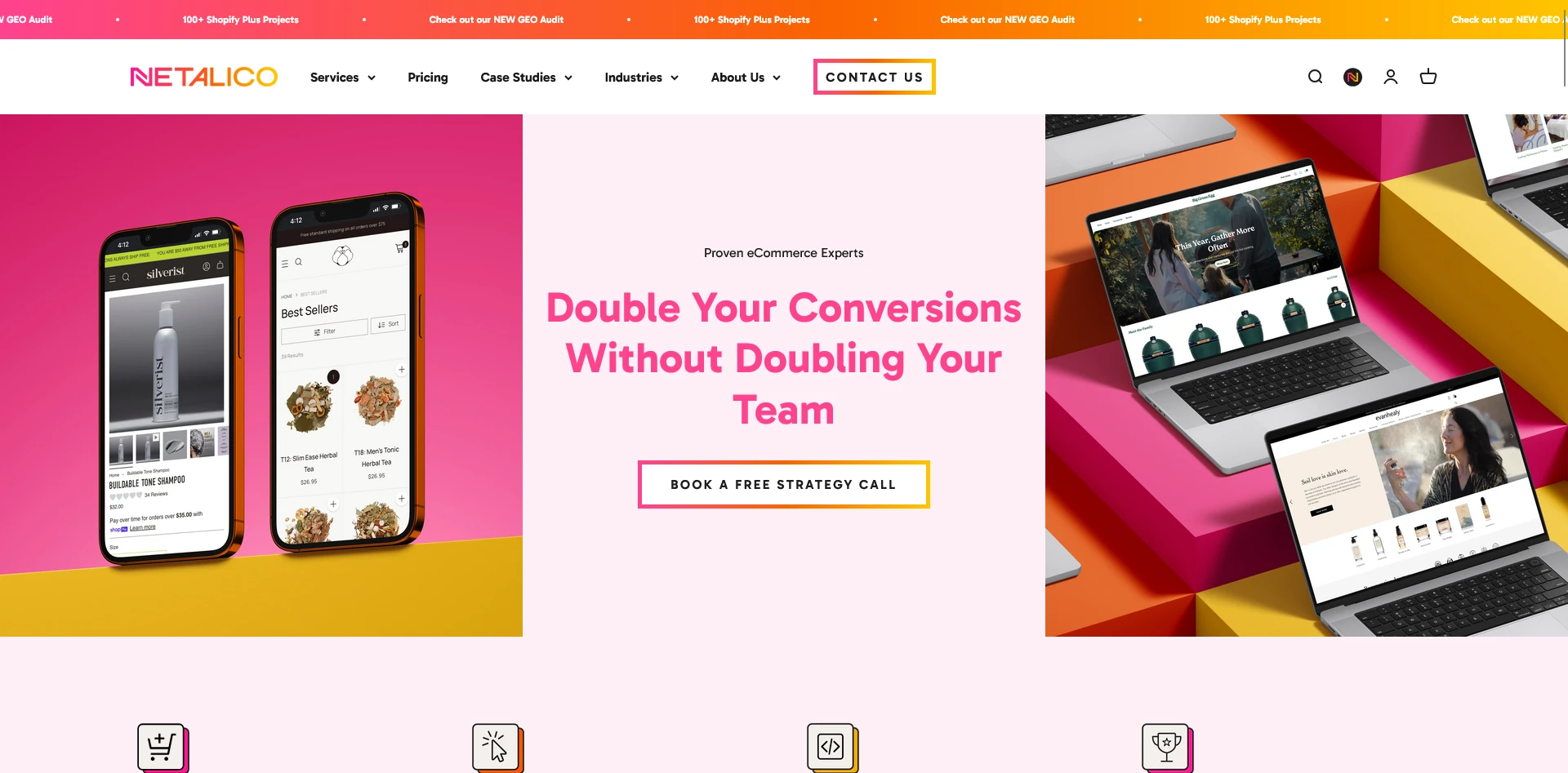
Netalico is a US-based, full-service Shopify Plus agency that has been working with ecommerce brands since 2013. Its strongest area is migrating stores to Shopify Plus from Magento, BigCommerce, or custom builds, and it pairs that with UX and conversion design, custom development, and Klaviyo email and SMS work.
Netalico operates as an embedded partner rather than a project shop, and most of its clients work with it on ongoing monthly retainers. It has run builds for brands like Oatly, Big Green Egg, and Feetures, and it is a sensible choice if you want a single long-term Plus partner to lead a replatform and then stay on to keep improving the store.
Commerce-UI
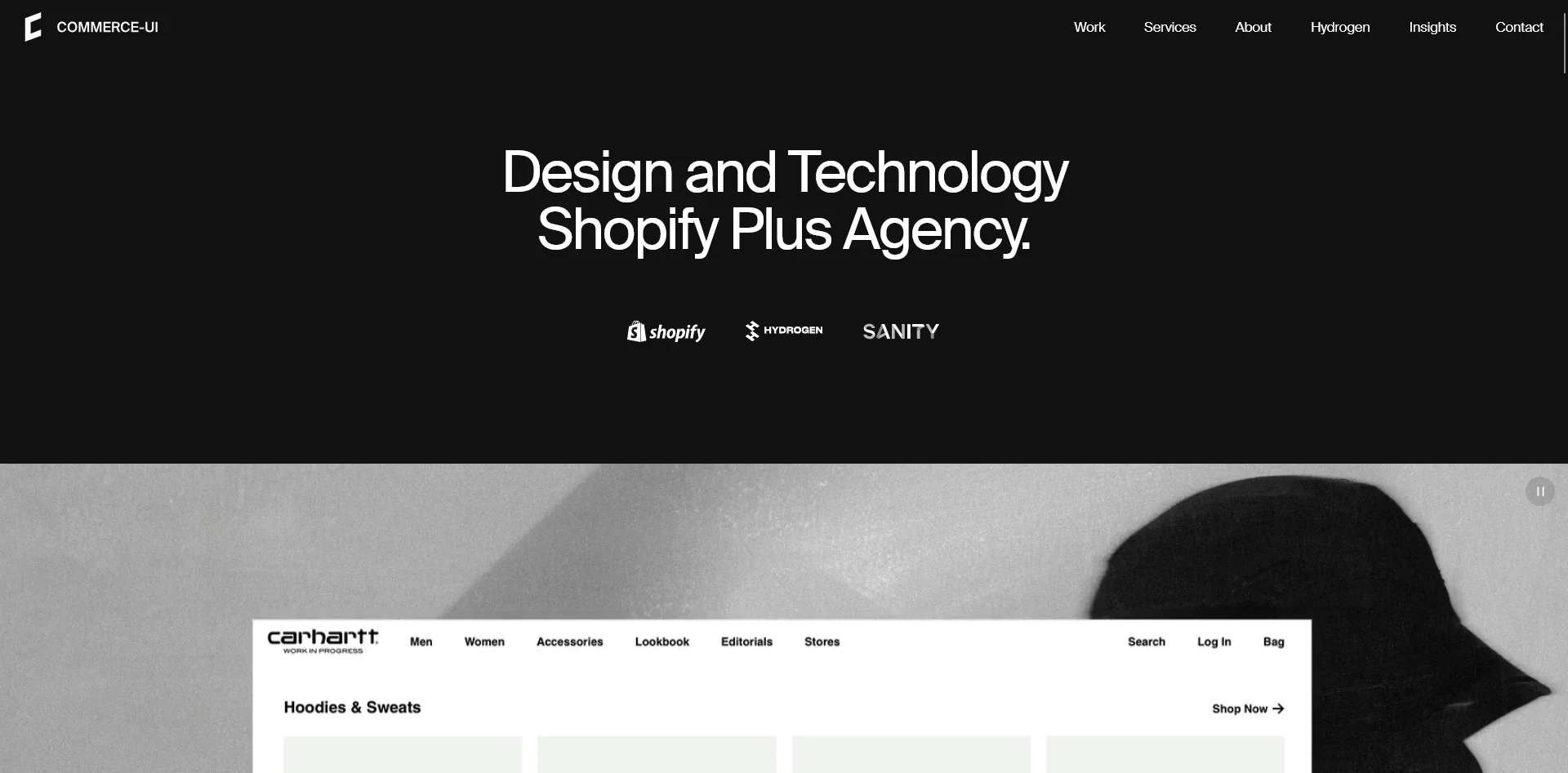
Commerce-UI is a design-led Shopify Plus agency built around a small, senior team and a focus on headless commerce. It specializes in Shopify's Hydrogen stack, Next.js storefronts, and the Sanity CMS, and it has won a Shopify Build Award for Best Hydrogen Storefront.
Their work tends toward premium, design-driven brands, including Carhartt WIP, Pangaia, and the official Lady Gaga store. Commerce-UI is a strong fit for established brands that want a high-craft custom or headless build and care as much about design as they do about engineering.
GetDevDone
GetDevDone is an engineering-heavy development partner with a large team of more than 400 engineers and over two decades of delivery experience. Much of its work is white-label, with other agencies bringing it in to handle front-end, website, ecommerce, and design production behind the scenes, though it also takes on direct clients. Its emphasis is on reliable, on-spec delivery and capacity rather than brand strategy or marketing.
GetDevDone suits brands that need development horsepower and predictable execution, as well as agencies that want to expand their own delivery capacity.
Blend Commerce
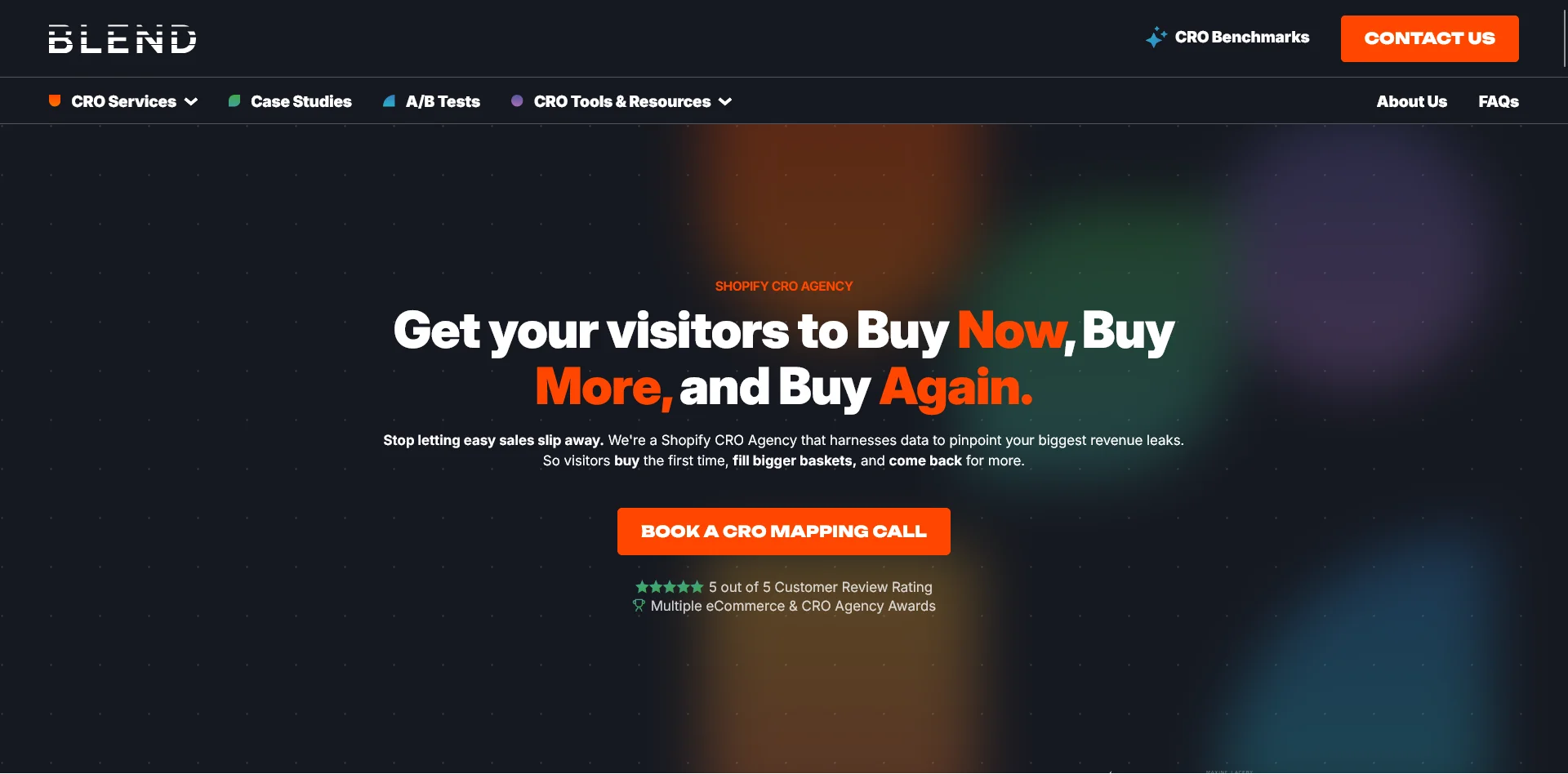
Blend Commerce is a Shopify CRO agency that focuses on Customer Value Optimization, which means improving the full set of levers behind revenue, including conversion rate, average order value, purchase frequency, and retention, rather than conversion rate alone. Its team is fully in-house across strategy, design, development, and QA, and it runs a structured, data-led testing process.
Blend is multi-award winning and has been named CRO Agency of the Year at recent UK and global agency awards. It works best for an established store with steady traffic that wants to turn more of that traffic into revenue without leaning harder on paid ads.
Fourmeta
Fourmeta is a UK-based, full-service Shopify and Shopify Plus agency headquartered in London, with a team of more than 60 specialists and over 100 Shopify launches behind it. It handles design, development (including headless Hydrogen builds), migration, CRO, and marketing under one roof, and it frames its work around measurable revenue growth and long-term collaboration, citing a 93% year-over-year client retention rate.
Its clients include Dan John, Josh Wood Colour, and Crep Protect. Fourmeta is a good fit for brands that want one full-service partner, particularly those based in the UK or Europe.
What Makes a Good Long-Term Partner
The agencies that turn into long-term partners share a few things in common, and most of them aren't about technical skill.
They take time to learn your business before pitching solutions. The first month is heavy on questions and audits, not deliverables. They're willing to disagree with you when they think a brief is pointed in the wrong direction. They communicate when something is going off track instead of waiting until the next status update. They're honest about the limits of their lane and bring in other partners when the work calls for it.
The relationship deepens because the agency keeps building context. They know what you tested last year, why a project got shelved, which campaigns are sacred and which are up for revision. That accumulated knowledge is what makes year three with the right agency more valuable than year one with any new one.
If you're evaluating an agency for a long engagement, less of the conversation should be about their portfolio and more about how they work.
How do they onboard? Who's on the account day to day? How do they handle disagreement, scope creep, or a project that's behind?
Those answers tell you whether you're hiring a vendor or a partner.
Building a Mobile App for Your Shopify Store
If a mobile app is on your roadmap, that's one of the few jobs where most Shopify agencies will refer you out. Native mobile development is a specialist discipline that rarely sits within a general Shopify agency.
MobiLoud is built for that gap. We extend your existing Shopify store into a high-quality iOS and Android app, including your theme, custom functionality, integrations, checkout, and the apps and workflows you already rely on. The result is a native app that mirrors your full site experience, not a stripped-down version of it.
We've launched mobile apps for established Shopify brands including XCVI, Kiokii, MASC, and Yon-Ka Paris, with most going live in 4 to 6 weeks. Pricing starts at $1,499/month, with a one-time setup fee that covers the build and launch of your app.
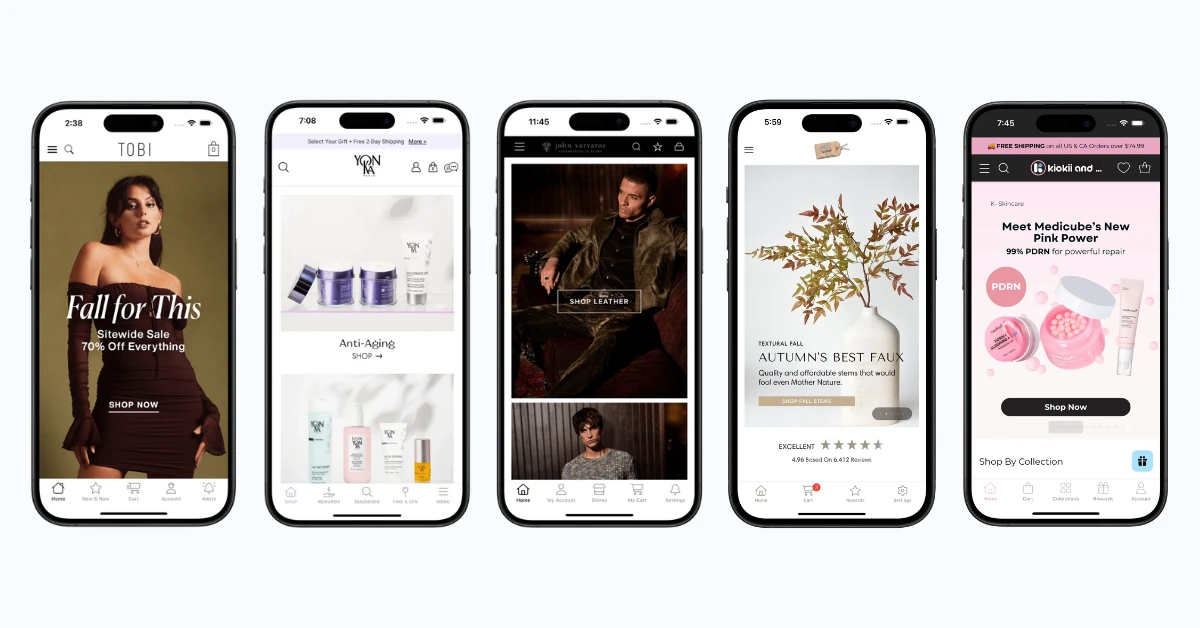
If you want to see what your app could look like, book a free app preview and we'll build a working prototype for you to check out. We’ll present it on a call where you learn all there is to know about the process, how we work, and what a mobile app can do for your store.