How Much Do Push Notifications Cost?

Most push notification services charge $0-$200 per month for small to midsize businesses, based on subscriber count rather than message volume. The major platforms (OneSignal, PushEngage, Klaviyo) include unlimited sends in every plan. At scale, push notifications cost a fraction of what SMS charges per message, making them the most cost-efficient direct messaging channel in ecommerce.
Most push notification services charge $0-$200 per month for small to midsize businesses, based on subscriber count rather than message volume. The major platforms (OneSignal, PushEngage, Klaviyo) include unlimited sends in every plan. At scale, push notifications cost a fraction of what SMS charges per message, making them the most cost-efficient direct messaging channel in ecommerce.
You're searching "how much do push notifications cost" because you're trying to figure out what this will actually run you. Fair question. The answer depends on a few things: how many subscribers you have, which service you use, and whether you're sending web push, mobile push, or both.
This article breaks down the real numbers: what push costs at different scales, how pricing models work, what hidden costs to watch for, and how push compares to email and SMS in real dollar terms at specific sending volumes.
How Push Notification Pricing Works
Push notification services don't all charge the same way. There are three main pricing models, and understanding which one a provider uses will save you from sticker shock.
Per-subscriber (or per-MAU) pricing
This is the most common model. You pay based on how many subscribers or monthly active users (MAUs) you have, not how many messages you send. Most plans include unlimited notifications.
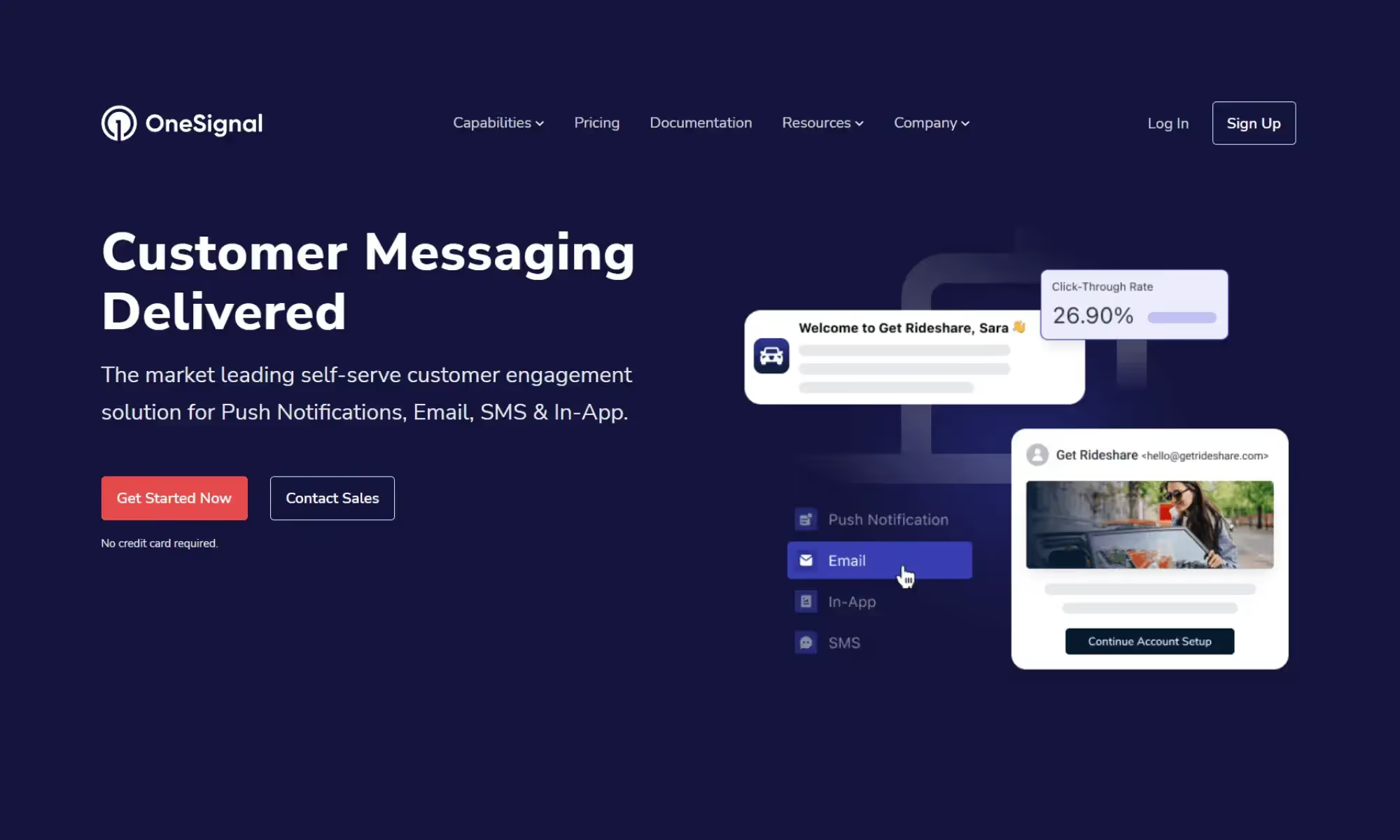
OneSignal uses this model. Their Growth plan charges $0.012 per monthly active user for mobile push. If you have 50,000 MAUs, that's $600/month for mobile push alone, but you can send as many notifications as you want.
PushEngage also uses subscriber-based tiers but packages them differently: their Business plan at $14/month covers up to 50,000 subscribers with unlimited campaigns.
Feature-tier pricing
Some providers charge a flat monthly fee that includes a set number of subscribers, and you upgrade tiers for more features or higher limits.
PushEngage and Airship follow this model. The price jump between tiers is driven as much by advanced features (A/B testing, automation, segmentation) as by subscriber volume.
Infrastructure pricing (pay-per-message)
This is the enterprise model. Amazon SNS charges $0.50 per million mobile push notifications after the first million free each month. Azure Notification Hubs starts with a free tier of 1 million pushes/month and scales from there.
These services are raw delivery infrastructure, not marketing platforms. You handle the segmentation, analytics, and campaign management yourself (or build it).
For most ecommerce brands, per-subscriber or feature-tier pricing is the right fit. Infrastructure pricing only makes sense if you already have an engineering team managing your notification stack.
.avif)
What Does Push Actually Cost?
Here's the short version: push notification costs scale with your audience size, not your send volume.
Every major provider includes unlimited sends. How much you spend depends on how many active users you have in your mobile app.
The table below shows what you can expect to pay based on subscriber count.
The range at each tier is wide, and that's because providers price differently.
The low end reflects subscriber-tier platforms like PushEngage (flat monthly fee covering a subscriber cap, e.g. $14/month for up to 50,000 subscribers). The high end reflects per-MAU platforms like OneSignal (base fee plus $0.012 per monthly active user on their Growth plan). Both include unlimited sends.
A few reference points to make this concrete:
- OneSignal free plan: Unlimited mobile push sends, no subscriber cap. Limited to basic features (fewer segments, 30-day reporting, simple journeys). Genuinely useful for small brands, not just a trial.
- PushEngage Business ($14/mo): Up to 50,000 subscribers with unlimited campaigns, rich notifications, and audience targeting. Jumps to $29/month (100K subs) and $60/month (250K subs) at higher tiers.
- OneSignal Growth ($19/mo + $0.012/MAU): Cross-channel messaging (push, email, in-app), advanced journeys, intelligent delivery. Cost scales linearly with your audience: 10K MAUs runs about $139/month, 50K runs about $619/month.
- Klaviyo: Mobile push bundled into existing email/SMS plans at no extra per-send cost. If you're already on Klaviyo, push is effectively included.
- Enterprise (Airship, Braze, OneSignal Enterprise): Custom pricing, typically $10,000+/year. Includes dedicated support, SLAs, advanced personalization, and custom integrations.
The important pattern: your push notification bill is a fixed monthly cost based on audience size. Whether you send 2 campaigns a week or 20, the cost doesn't change. This is the fundamental pricing difference between push and channels like SMS, where every message adds to the bill.
.webp)
Can You Send Push Notifications for Free?
Yes, but the definition of "free" depends on what you're willing to build yourself.
Truly free: platform free tiers
OneSignal's free plan supports unlimited mobile push sends. PushEngage's free tier covers 200 subscribers with 30 campaigns.
These are functional, not just trials. For a small business sending notifications to a few hundred or few thousand users, they work.
Free delivery, DIY everything else
Firebase Cloud Messaging (FCM) and Apple Push Notification Service (APNs) are free to use. FCM has no message limits and no per-send fees. APNs is the same. These are the underlying delivery pipes that every push notification ultimately flows through.
But FCM and APNs are infrastructure, not products. To use them directly, you need to:
- Build a backend to store and manage device tokens
- Handle token refresh (tokens change periodically, after reinstalls, etc.)
- Build segmentation logic so you're not blasting everyone with the same message
- Create a campaign management interface for your marketing team
- Set up analytics to track delivery, opens, and conversions
- Build automation triggers (abandoned cart, price drop, back-in-stock)
- Handle error cases, retry logic, and delivery receipts
That's weeks or months of engineering work. For a company with a dedicated mobile engineering team, this can make sense at scale. For most ecommerce brands, the cost of building and maintaining this infrastructure far exceeds what a managed service charges.
A note on "free forever" services
Some lesser-known push notification providers advertise free unlimited plans. Be cautious. The common tradeoffs include data monetization (your subscriber data gets sold to third parties), limited GDPR compliance tooling, and minimal support when things break.
If the service is free and the company doesn't charge anyone, figure out what the actual business model is before handing over your customer data.
Extra Costs Associated with Push
The sticker price on a push notification platform's pricing page isn't always the full picture. Here's what can add to your actual spend.
Rich media bandwidth
Sending images in push notifications uses bandwidth. For most ecommerce brands sending product images in notifications, this is negligible. But at serious scale (millions of subscribers, large image attachments), bandwidth costs can add up. One estimate puts the cost of sending a 1 MB image to 3 million devices at roughly $450 in bandwidth alone.
Analytics and segmentation upsells
Most providers gate their best features behind higher tiers. Basic push delivery might be cheap, but behavioral segmentation, A/B testing, conversion tracking, and journey orchestration often live on the professional or enterprise plan. Check what's actually included in the tier you're evaluating, not just the subscriber limit.
Integration and development time
Even managed platforms require integration work. Connecting push to your ecommerce platform, setting up event tracking for abandoned carts and browse behavior, configuring deep links, and testing across devices all take engineering time. Budget for this as a one-time setup cost.
Platform lock-in costs
If you've built automations, segments, and analytics in one provider and need to switch, migration is non-trivial. Subscriber data may or may not be portable. This isn't a monthly line item, but it's a real cost to consider when choosing a provider.
The app itself
Mobile push notifications require a native app (you can send push from a website too, but it's a lot less effective) If you don't have an app yet, the cost of building or launching one is the real upfront investment, not the push notification service fee.
Push vs Email vs SMS: What Does It Actually Cost to Reach Your Audience?
Abstract per-message rates are useful, but what most brands really want to know is: "If I have X subscribers and message them Y times a week, what am I paying?"
Here are three real scenarios, to give you an idea.
Scenario 1: 10,000 subscribers, 2 messages per week
~80,000 messages per month.
At this scale, push and email are in the same ballpark. SMS is 10-30x more expensive because every message carries a per-send cost of $0.015-$0.055 (base rate plus carrier surcharges).
Scenario 2: 50,000 subscribers, 3 messages per week
~650,000 messages per month.
This is where the gap becomes impossible to ignore. Reaching 50K subscribers three times a week via SMS runs $10,000-$36,000 per month. The same reach and frequency via push costs $14-$620. That's a 15x-60x difference, and it widens every time you add another campaign.
Scenario 3: 100,000 subscribers, 3 messages per week
~1,300,000 messages per month.
At 100K subscribers, SMS costs $20,000-$72,500 per month. Push costs $29-$1,220. The math is unambiguous.
What these numbers mean (in practice)
Each channel reaches a different audience.
- SMS reaches anyone with a phone number.
- Email reaches anyone who gave you an address.
- Push reaches your app users only.
You're not choosing one over the other; most ecommerce brands use all three. (We break down the strategic tradeoffs in our push vs email and push vs SMS comparisons.)
But the cost comparison reveals something important: for high-frequency use cases like abandoned cart sequences, flash sale alerts, back-in-stock notifications, and loyalty updates, push is dramatically cheaper at every scale.
Any campaign you can shift from SMS to push, without losing effectiveness, saves real money. According to Omnisend's 2025 data, push generates 15% of attributed ecommerce revenue from just 3% of total message volume, so the per-message efficiency is there too.
---
Email platform costs in the scenarios above are based on typical pricing from Klaviyo, Omnisend, and Mailchimp, where sends are generally included in the subscription. SMS per-send costs use $0.015-$0.055 per message (base rate plus carrier surcharges, based on industry benchmarks from Textline and Mobile Text Alerts).
Are Push Notifications Worth the Cost?
The short answer: for ecommerce, they're one of the highest-ROI channels available.
Here's a simple way to think about the return. According to Omnisend's 2025 ecommerce report, push notifications generate 15% of attributed ecommerce revenue from just 3% of total message volume.
That's the highest revenue-to-send ratio of any direct messaging channel.
The engagement data backs this up:
- Ecommerce push notification CTR averages 3-4%, with behavior-triggered automations (abandoned cart, price drop, back-in-stock) converting at 22.9% (Omnisend 2025)
- Rich push notifications with images see a 56% higher open rate than text-only
- Users receiving push notifications show nearly 3x higher retention than users who receive none (Airship)
A back-of-the-napkin ROI calculation
Say you have 20,000 push notification subscribers and you're paying $200/month for your platform.
You send 8 campaigns per month.
At a 3.5% CTR and 4% conversion rate from those clicks, with a $75 average order value:
- 20,000 subscribers x 8 sends = 160,000 impressions
- 160,000 x 3.5% CTR = 5,600 clicks
- 5,600 x 4% conversion = 224 orders
- 224 orders x $75 AOV = $16,800 in monthly revenue
- Monthly platform cost: $200
Even if your actual numbers are half this, the return more than justifies the cost. And unlike SMS, your per-send cost doesn't increase as you scale up your sends.
The real question for most ecommerce brands isn't whether push notifications are worth it. It's whether they have an app to send them from.
“The power of push notifications is so strong. In a world where people open email less and less each day, everyone is jumping into SMS which is crazy expensive, and people are starting to tune these out too, being able to do push notifications is the reason you do an app.”
-- David Cost, VP of Ecommerce, Rainbow Shops
How to Start Sending Push Notifications
Native push notifications require a mobile app. That's the prerequisite. Web push notifications work through browsers, but opt-in rates are much lower, they don't work on iOS, and they only send when the browser is open.
Long story short, web push and native push are two very different things.
For push to be a real revenue channel, you need a native app on the App Store and Google Play.
If you're an ecommerce brand with an existing website, you don't need to rebuild everything from scratch.
MobiLoud turns your existing website into native iOS and Android apps with full push notification support built in. Your storefront, checkout flow, loyalty program, and third-party integrations all carry over, because the app is powered by the site you've already built.
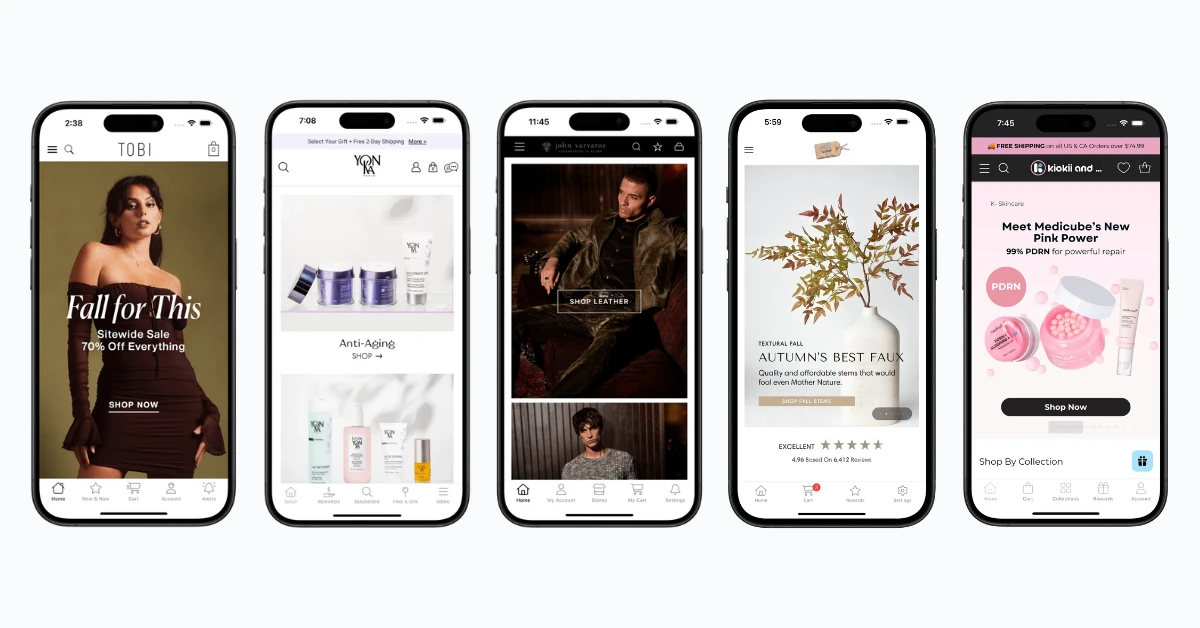
Here's how you can get your brand in the app stores, and start sending powerful push notifications (in as little as 30 days):
- Book a strategy call. Share your website URL and talk through your goals. We'll assess fit and answer your questions. No commitment.
- Get a custom app preview. Our team builds a personalized preview so you can see how your store looks and performs as a native app, before you decide anything.
- Launch on the App Store and Google Play. We handle the build, QA, and submission, as well as maintenance and updates after you launch.
Want to see what your store looks like as a native app? Book a free strategy call to discuss it with our team of experts. We've built over 2,000 apps, and we'll guide you through every step of the process to help you launch with zero stress, and zero risk.
FAQs

Convert your website into a mobile app