When you're comparing mobile app builders for your Shopify store, you may come across the Built for Shopify badge. You might be wondering what this is - and how strong of a signal it is to consider when choosing a tool.
The answer is somewhat nuanced.
Built for Shopify is a legitimate quality standard. It tells you that Shopify has reviewed an app against requirements covering performance, design, integration and merchant experience. That's a good thing.
But when you're choosing a Shopify mobile app builder, this badge only tells you about a small part of the product you're buying.
The Built for Shopify badge doesn't give you any insight into the overall quality of the iOS and Android app your customers will use. It doesn't tell you how closely that app will match your existing store, whether all your integrations will work, whether your custom features will carry over, or how much extra work it will create for your team.
And importantly, it doesn't change the fundamental limitations that come with building a separate, API-driven frontend for your Shopify store.
Let's look at what the badge really means, what it doesn't mean, and how much weight you should give it when choosing a Shopify mobile app builder.
What Does "Built for Shopify" Mean?
Built for Shopify is Shopify's certification program for apps listed in the Shopify App Store.
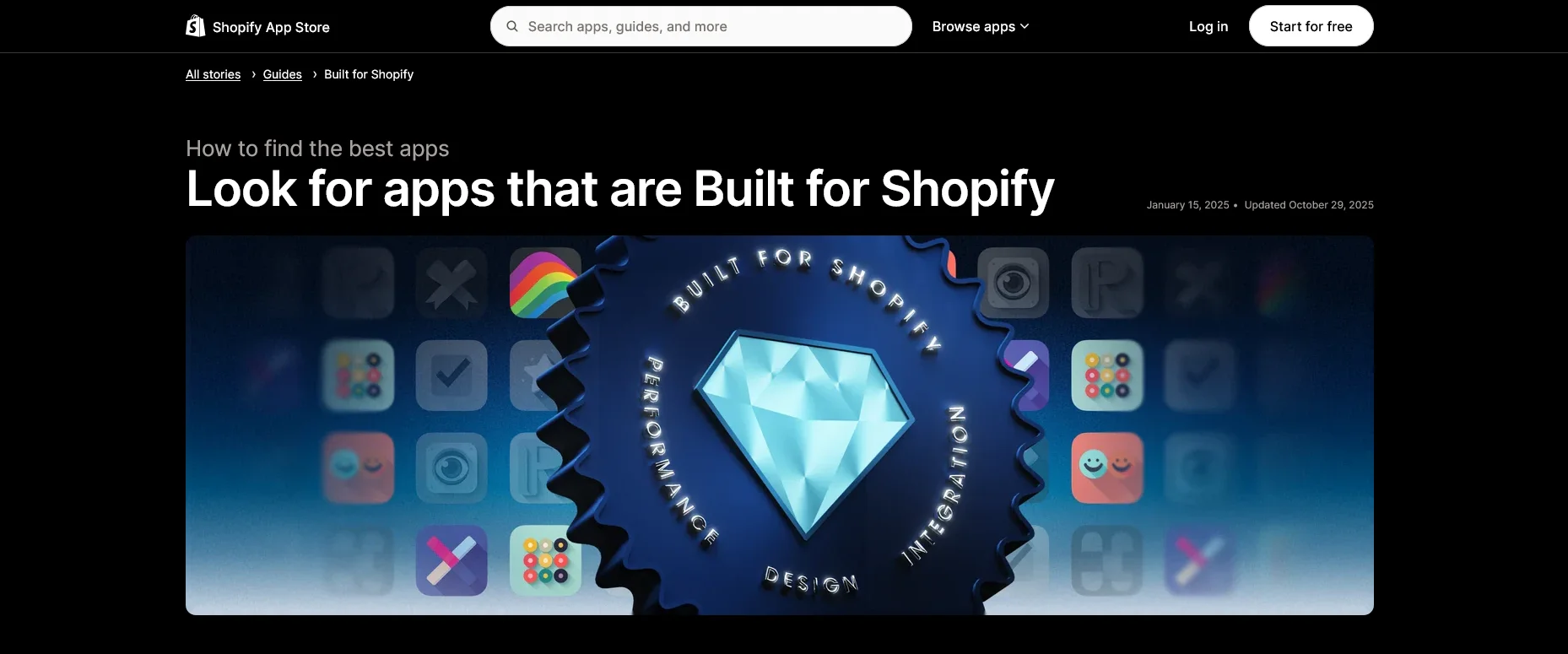
Shopify describes apps carrying the badge as having passed its testing and meeting its highest quality standards.
Shopify's merchant-facing documentation groups these standards into three broad areas: performance, design and integration. Its full developer requirements also include prerequisites around App Store compliance, Partner standing, merchant adoption, reviews and ratings.
The requirements are extensive, and earning the badge is a positive sign.
For example, Built for Shopify apps need to meet standards including:
- Good performance when the app loads within Shopify Admin
- Limited impact on your online store's performance
- Proper integration into Shopify Admin using Shopify's current technology standards
- A clean installation and uninstallation process
- An interface that feels consistent with Shopify
- A minimum level of merchant adoption, reviews and ratings
Shopify also reviews Built for Shopify certifications over time, so an app needs to keep meeting the required standards to retain its status.
There's real value in all of this.
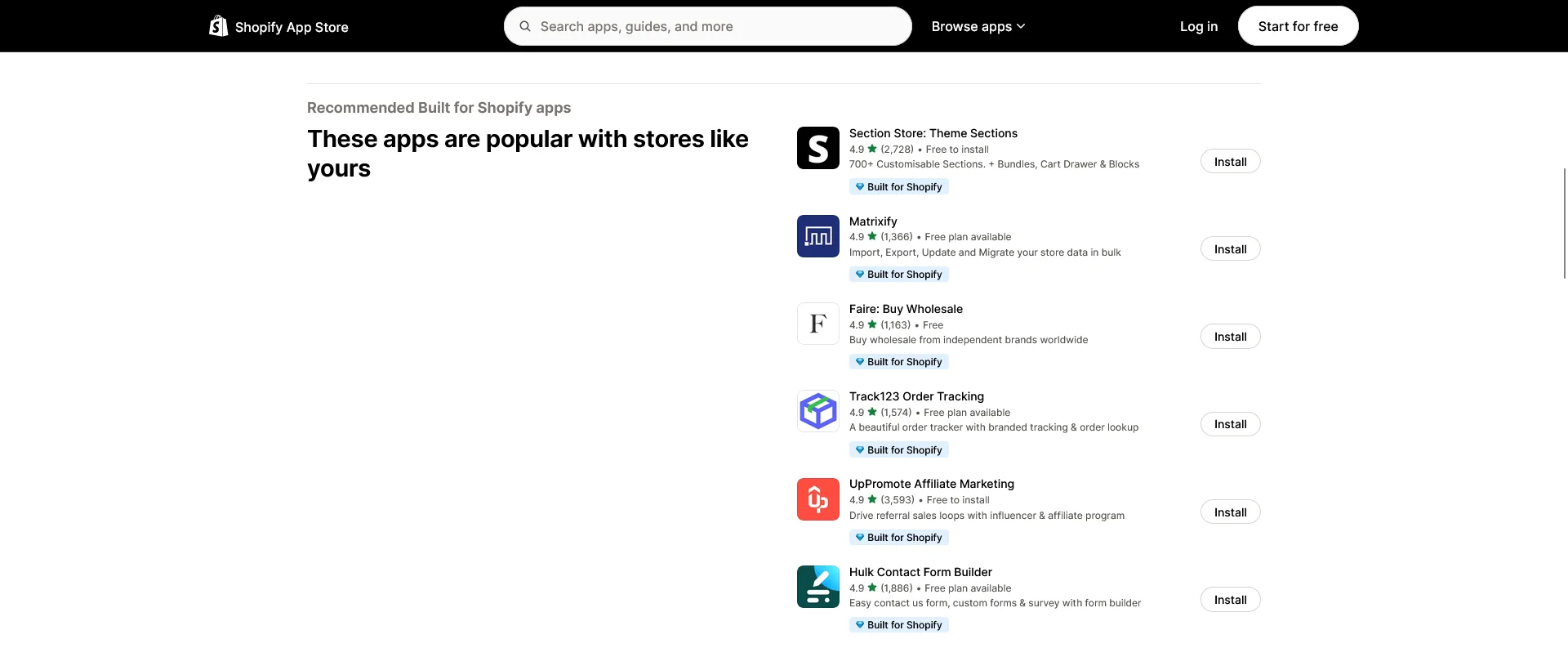
If an app is Built for Shopify, you have additional evidence that the developer follows Shopify's best practices and has put effort into creating a reliable experience for merchants.
The question is how much this tells you about the real job of a Shopify mobile app builder.
What Does Built for Shopify Mean for a Mobile App Builder?
When you install a typical mobile app builder from the Shopify App Store, there are effectively two different products involved.
First, there's the Shopify app you install and use as a merchant. This might give you a dashboard, app editor, configuration options, analytics and other management features.
Then there's the customer-facing mobile app the platform creates for you, which shoppers download from Apple's App Store or Google Play.
Built for Shopify is relevant for the first part.
For example, Shopify's performance requirements measure Web Vitals when the app loads inside Shopify Admin. Its integration requirements focus on making primary functionality available within Shopify Admin and using technologies such as Shopify App Bridge. Its design guidelines focus heavily on making the app feel familiar and consistent for merchants using Shopify.
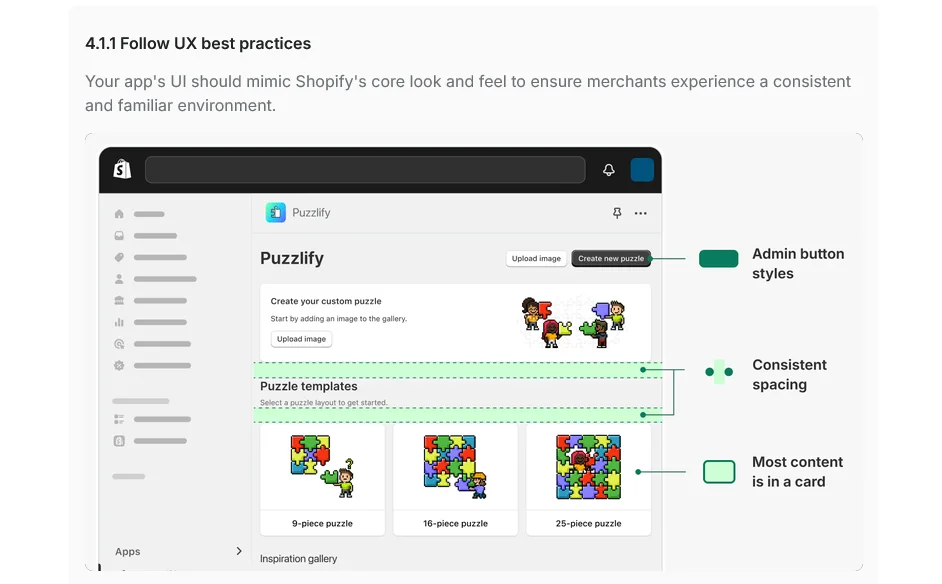
Shopify also assesses the impact the app has on your online store, requiring Built for Shopify apps not to reduce the storefront's Lighthouse performance score by more than ten points.
These are useful standards.
But they refer, in most part, to how the app works in your Shopify Admin, not the functionality of the app itself.
Built for Shopify isn't a certification that your iOS app loads quickly, that the Android shopping experience is great, that every feature from your Shopify store is available, or that your existing tech stack works inside the app.
That's a much bigger question.
What Built for Shopify Doesn't Tell You About Your Mobile App
The Shopify App Store badge is one useful data point when evaluating a mobile app builder.
It just doesn't answer many of the questions that will ultimately determine whether your mobile app succeeds.
Will Your Existing Store Experience Carry Over?
You've probably spent years refining your Shopify store.
Your product pages may have custom sections, merchandising elements, upsells, size guides, product recommendations, bundles, custom collection pages and dozens of smaller improvements designed to help customers buy.
The fact that its Shopify app is Built for Shopify doesn't say anything about how much of this it can carry over from your site to your app, or how easy it’ll be to recreate your web experience inside your app.
Will Your Shopify Apps and Integrations Work?
Your Shopify store probably relies on a lot more than Shopify itself.
You might use separate tools for:
- Subscriptions
- Loyalty and rewards
- Reviews
- Product recommendations
- Upsells and cross-sells
- Bundles
- Search and filtering
- Customer accounts
- Personalization
- Support and live chat
- Localization
- Returns and order management
These tools may be deeply embedded in your customer experience.
A Built for Shopify badge on your mobile app builder doesn't mean these third-party tools will automatically work inside the mobile app. It says nothing about how many integrations it supports, or the level of functionality that the integrations carry over.
Will Your Custom Features Work?
The same applies to anything your developers have built specifically for your store.
Maybe you have custom product logic, a unique configurator, special collection behavior, a custom account experience, bespoke promotional functionality or something completely unique to your business.
Built for Shopify doesn't certify compatibility with any of this.
You still need to find out how the app builder plans to reproduce it.
Will Your Checkout Work the Same Way?
Your Shopify checkout may contain extensions, apps, special discounts, upsells, subscriptions, custom logic or alternative payment methods.
Again, Built for Shopify doesn't guarantee that the journey from your mobile app through checkout will behave exactly as your existing website does.
You need to evaluate the actual mobile app implementation.
Is the Customer-Facing App Any Good?
This is perhaps the most obvious point.
The Shopify badge isn't a substitute for downloading apps built with the platform and using them yourself.
How quickly do they load?
How smooth is navigation?
What are product pages like?
Does search feel good?
How does adding products to the cart work?
Does the app still feel like the brand's existing store?
What happens when you log into your account or start checkout?
These are much better indicators of what your customers will ultimately experience.
Built for Shopify Doesn't Change the Limitations of an API-Driven Mobile App
There's another reason not to put too much weight on the badge.
Most Shopify mobile app builders use Shopify's Storefront API to create the customer-facing app.
Shopify itself describes the Storefront API as the foundation for custom storefronts. It provides access to commerce data and functionality such as products, collections, search, carts and customer information, which developers can use to build a separate frontend for the web or a native mobile app.
Shopify's current mobile storefront documentation makes the architecture especially clear. The Storefront API provides the product data and cart operations, while your native iOS, Android or React Native code provides the interface shoppers interact with.
That's how most traditional mobile app builders work.
They aren't simply putting your existing Shopify website into an app. They're creating another storefront.
The app builder pulls the data it needs from Shopify through APIs and uses that data to populate its own templates and interface.
This approach works perfectly well for the basics.
Products, variants, collections, search and cart functionality can all be retrieved from Shopify and presented inside a mobile app. Shopify's Storefront API is specifically designed to make these types of custom commerce experiences possible.
The challenge is that your website is more than its Shopify data.
It's also your theme.
It's the apps running on your storefront.
It's the custom code your developers have written.
It's the way you've designed your product pages.
It's the third-party scripts, widgets and integrations you've added.
It's all the small optimizations your team has made over time.
When you create a separate frontend, these things don't simply become part of it because the app builder has a good connection to Shopify.
They need to be recreated, separately integrated or otherwise supported inside that frontend.
This is the key thing to understand about Built for Shopify.
A mobile app builder can meet Shopify's standards perfectly while still creating a mobile app that doesn't support important parts of your existing storefront.
There's no contradiction there.
Shopify is certifying one set of things. You're trying to evaluate a much larger product.
Built for Shopify vs Build for High-Quality Shopping Apps
Here’s a clear breakdown of the questions this badge answers, vs what it doesn’t:
| Question | Does Built for Shopify Help Answer It? |
|---|---|
| Does the Shopify app follow Shopify's standards? | Yes |
| Does it integrate properly with Shopify Admin? | Yes |
| Is the merchant-facing app well designed? | Yes |
| Does it avoid significantly slowing down my web storefront? | Yes |
| Is the customer-facing mobile app fast and easy to use? | Not necessarily |
| Will my existing Shopify theme carry over? | No |
| Will all my Shopify apps work inside the mobile app? | No |
| Will my custom features work? | No |
| Will my existing shopping experience carry over exactly? | No |
| How much additional work will my team have to do? | No |
It’s a positive signal, but in reality not a huge factor for a mobile app builder.
What Really Matters When Choosing a Shopify Mobile App Builder?
The most important question is much simpler:
Can this platform give you the mobile app you actually want?
Start by looking at the store you have today.
If there are important parts of your website that drive conversions, retention or customer experience, find out exactly how they'll work inside your mobile app.
If you use Recharge for subscriptions, you want to know this will carry over to your app.
If your loyalty program is central to your brand, find out what the loyalty experience looks like in the app.
Think about any other crucial elements on your store, like heavily customized product pages, custom functionality, or specific Shopify apps or integrations.
Get an idea of whether this will work with your app, or if you’re going to be forced to make compromises.
The Built for Shopify badge doesn’t tell you any of this.
Do You Need a Built for Shopify Mobile App Builder?
If a mobile app builder is Built for Shopify, that’s not a bad thing, but it’s not worth restricting your choice to only app builders with this certification.
But some of the best Shopify mobile app builders, powering DTC’s best ecommerce apps, are not “Built for Shopify”.
This is just one signal, but it’s realistically a small signal, not a major factor for something like a mobile app builder - where the end product is so much, much more from what you see in your Shopify Admin.
A Different Approach to Shopify Mobile Apps
MobiLoud takes a different approach to building mobile apps for Shopify stores.
Instead of creating a completely separate storefront and rebuilding your website through Shopify's Storefront API, MobiLoud uses your existing website as the foundation of your mobile app.
Your existing mobile site provides the core shopping experience, while we add a native layer around it for app-specific functionality and UX.
That means you're starting with the Shopify store you've already built, rather than starting from scratch and trying to recreate your customer experience in another system.
Your existing pages, storefront features and integrations can remain part of the mobile experience, and changes you make to your website carry through without your team having to maintain a completely separate version of the store.
MobiLoud isn’t “Built for Shopify”, because it doesn’t operate as a Shopify Admin App anyway. But that’s the advantage.
You’re not constrained by Shopify’s API, or by a set of templates, or by a limited number of integrations.
Your only constraint is what you can build on the web. Which, today, is virtually limitless.
Final Thoughts
Built for Shopify is a good program.
The badge gives merchants a useful way to identify Shopify apps that meet Shopify's standards for quality, performance, design and integration.
But you need to understand what those standards are measuring.
When you're evaluating a mobile app builder, the Shopify app itself is only one small part of the equation.
Your customers aren't going to care whether the builder you selected had a Built for Shopify badge. They're going to care whether the app is fast, easy to use and gives them the same features and shopping experience they expect from your brand.
So consider Built for Shopify when comparing mobile app builders. Just don't confuse it with a certification of the mobile app you're ultimately going to launch.