The 10 Best Headless Ecommerce Platforms in 2026


The right headless ecommerce platform depends on your scale, team, and what you're trying to build. Shopify Plus is the easiest on-ramp for Shopify merchants. Commercetools is the enterprise-grade headless-first option. BigCommerce splits the difference between flexibility and usability. Adobe Commerce and Salesforce Commerce Cloud serve large enterprises already in those ecosystems. Newer players like Medusa and Saleor offer open-source alternatives. All of them separate the frontend from the backend; the differences are in pricing, complexity, and what you get out of the box.
The right headless ecommerce platform depends on your scale, team, and what you're trying to build. Shopify Plus is the easiest on-ramp for Shopify merchants. Commercetools is the enterprise-grade headless-first option. BigCommerce splits the difference between flexibility and usability. Adobe Commerce and Salesforce Commerce Cloud serve large enterprises already in those ecosystems. Newer players like Medusa and Saleor offer open-source alternatives. All of them separate the frontend from the backend; the differences are in pricing, complexity, and what you get out of the box.
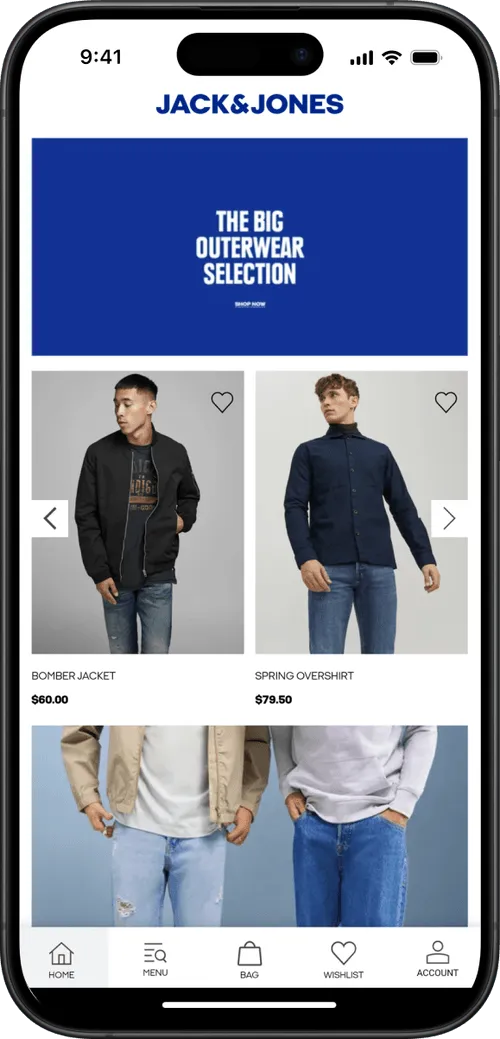
Headless ecommerce platforms provide the backend commerce engine (products, inventory, pricing, checkout, orders) while leaving the frontend entirely up to you.
It’s a modern, and (arguably) more flexible way to build an online store; instead of being locked into a theme or template system, you build whatever storefront you want and connect it to the backend via APIs.
The platforms on this list range from traditional ecommerce platforms that now offer headless capabilities to purpose-built headless-first systems designed around APIs from the ground up.
Some are best for mid-market DTC brands; others are built for enterprise-scale operations with complex requirements.
Read more: The Top Examples of Headless Commerce from Major Brands
Ten Popular Headless Commerce Platforms in 2026
Maybe you’re thinking of going headless. Perhaps you’ve made the decision already, you’re just looking for the right platform.
It makes sense to take your time and do your research - after all, this is the foundation of your digital storefront we’re talking about.
We work with numerous ecommerce brands, of various scales, operating on headless platforms. With that as a starting point, plus extensive research into the landscape, we gathered a list of contenders and assessed each platform on:
- Headless architecture quality: API depth, frontend flexibility, developer experience
- Ease of adoption: How much development work is required to go headless
- Ecosystem: App/integration availability, developer community, third-party support
- Pricing transparency: Whether you can evaluate cost without a sales call
- Scale fit: Which business size and complexity level the platform serves best
You’ll want to do your own research in parallel, of course, but this should give you a good starting point for picking the right platform for your brand.
Now let’s dive deeper.
1. Shopify Plus (Hydrogen/Oxygen)
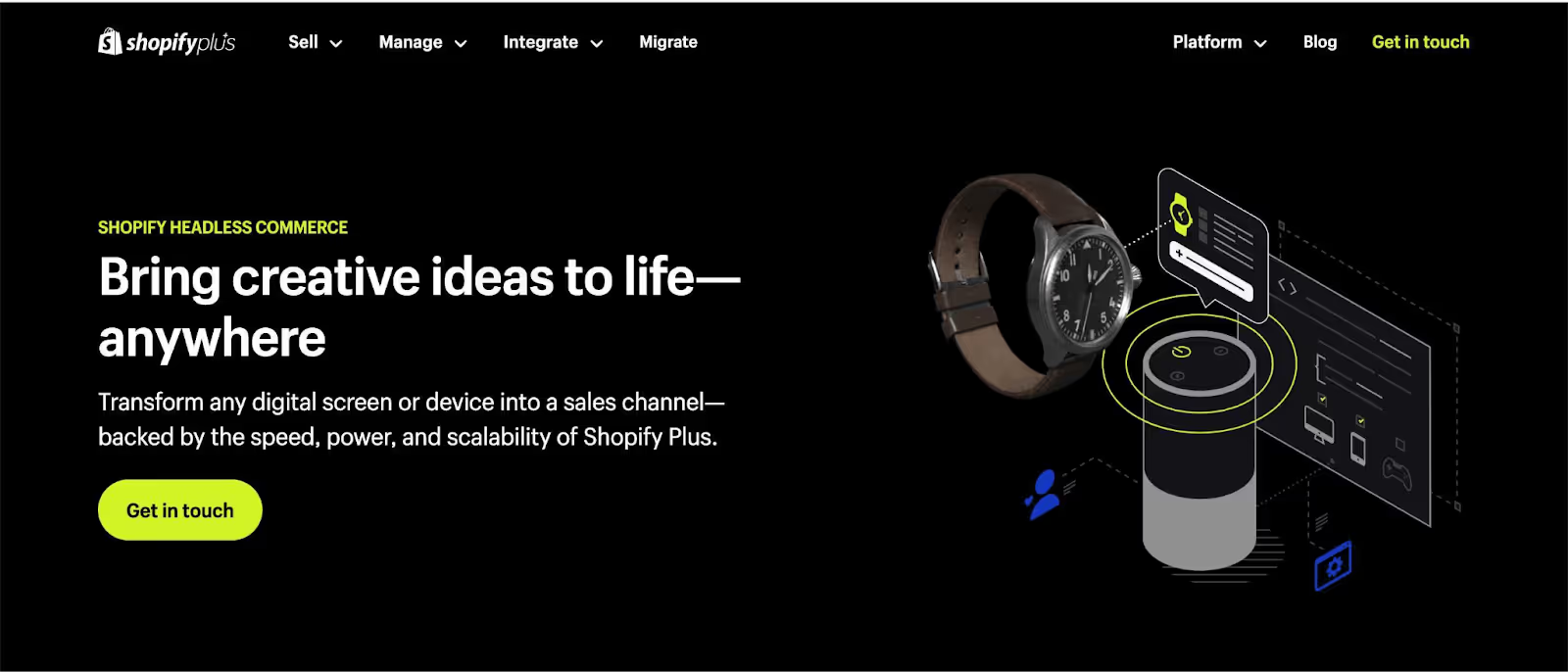
Best for: Shopify merchants who want full frontend control without leaving the Shopify ecosystem
Shopify's headless offering is built around Hydrogen (a React-based storefront framework) and Oxygen (Shopify's global hosting for Hydrogen apps). Shopify Plus itself is not exclusively a headless platform; but it offers the option to go headless.
If you're already on Shopify Plus, going headless doesn't mean migrating to a new platform. It means replacing your Liquid theme with a custom React frontend while keeping Shopify's backend running your commerce operations.
The Storefront API (GraphQL) provides access to products, collections, carts, and customer data. Checkout is managed by Shopify's hosted checkout, which has been expanded through checkout extensibility to allow more customization than before.
The developer ecosystem is Shopify's biggest advantage here. Finding React developers who can work with Hydrogen is easier than finding specialists for most other headless platforms. Shopify's documentation, starter templates, and community support are strong.
For a deeper look at when Hydrogen makes sense (and when it doesn't), see our Shopify headless commerce guide.
Pricing: Shopify Plus starts at $2,300/month. Hydrogen and Oxygen are included at no additional hosting cost.
Key strength: Lowest-friction path to headless for existing Shopify merchants.
2. Commercetools
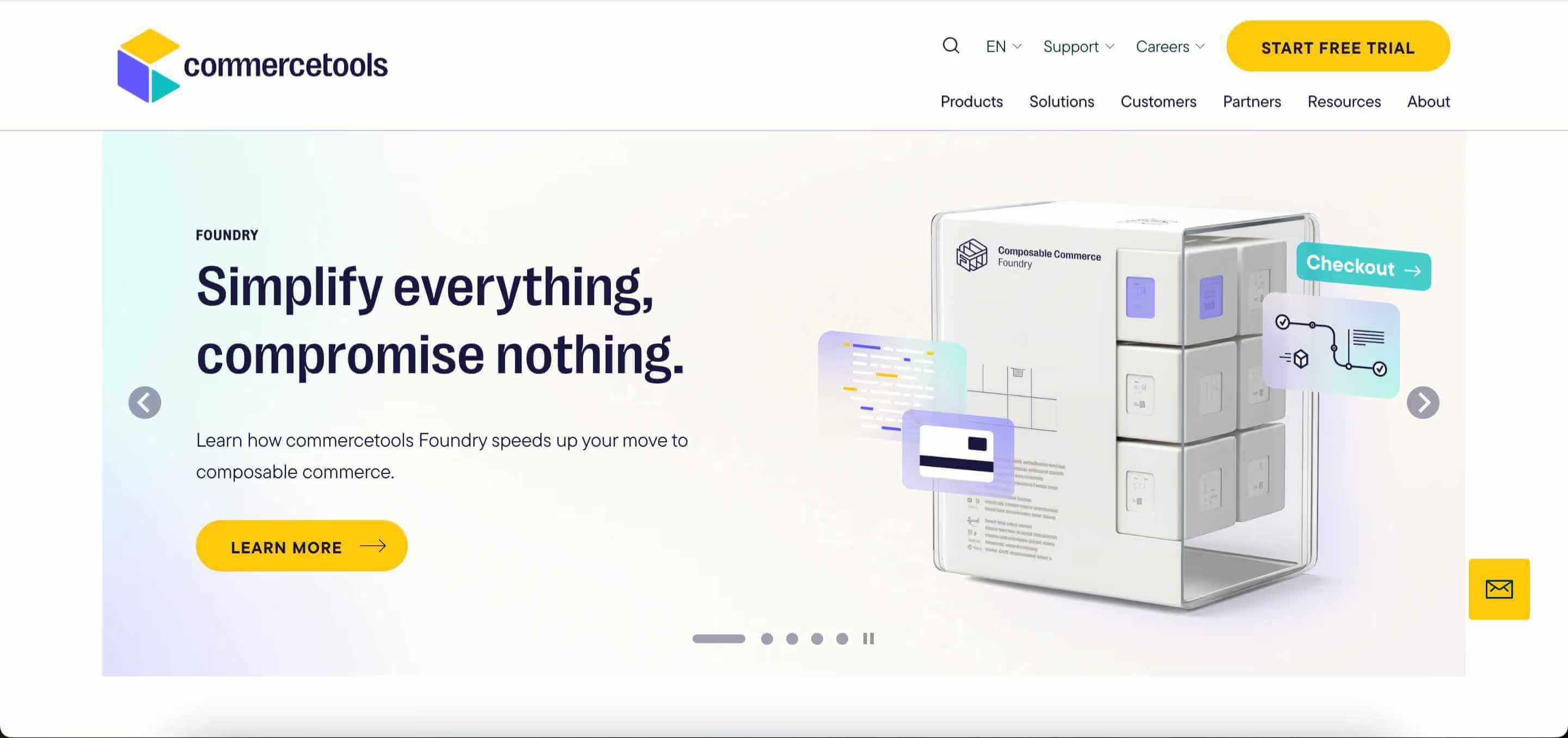
Best for: Enterprise brands building a fully composable commerce stack
Commercetools is headless-first. There's no built-in frontend, no theme editor, no "standard" way to build a storefront. Everything is accessed through APIs, and the platform is designed to be one component in a larger composable architecture.
This makes it extremely flexible but also more complex to implement than platforms like Shopify or BigCommerce. You'll need experienced developers (or a systems integrator) to build the frontend, integrate a CMS, set up search, and configure the rest of the stack.
Where Commercetools shines is backend flexibility. Custom data models, complex pricing logic (multi-currency, B2B tiered pricing, market-specific rules), and multi-tenant architectures are natively supported.
It's a MACH Alliance certified platform built for the kind of complexity that enterprise brands deal with.
The 60-day free trial lets you evaluate the platform before committing to a custom quote.
Pricing: Custom pricing (60-day free trial available).
Key strength: The deepest backend flexibility for enterprise-scale composable architectures.
3. BigCommerce
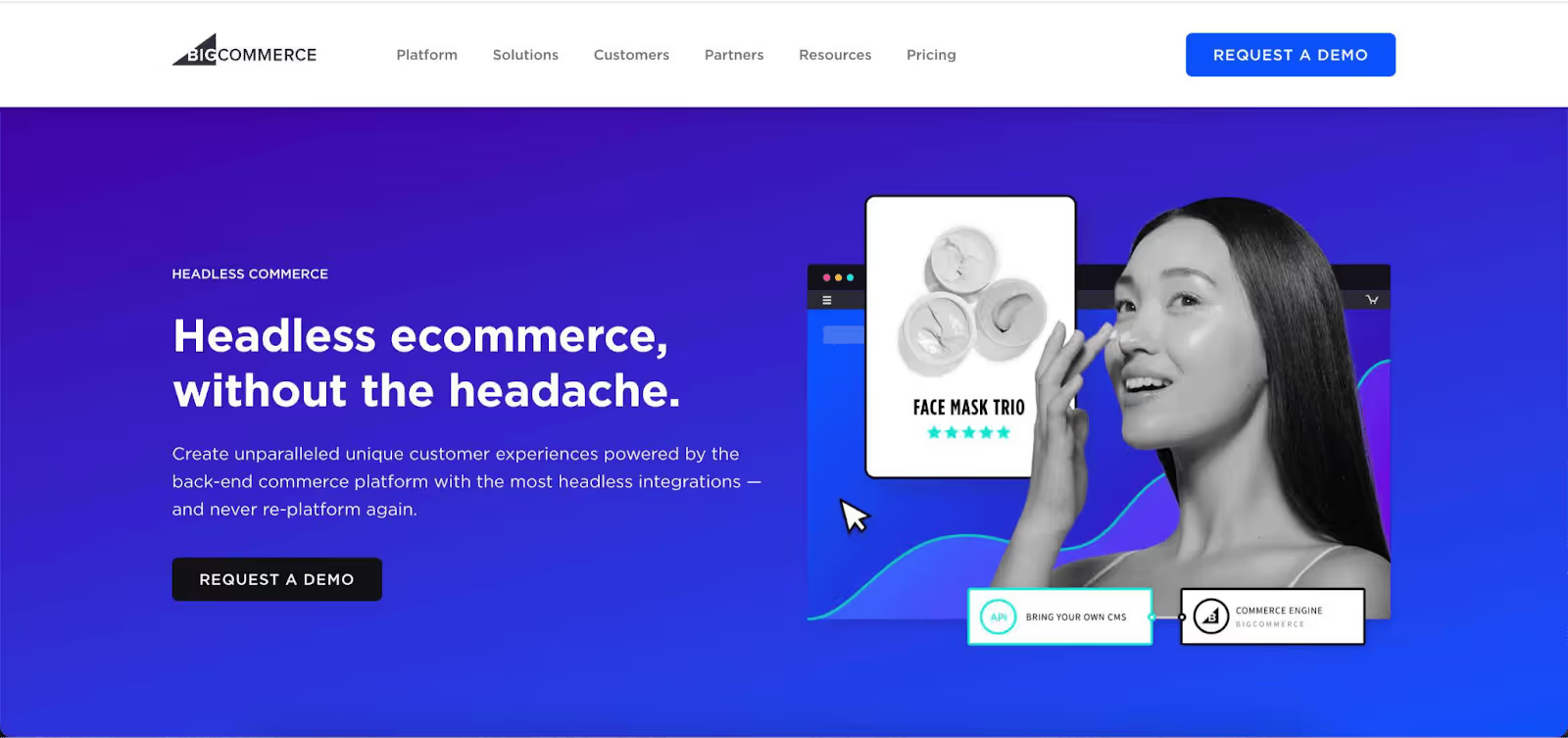
Best for: Mid-market brands that want headless flexibility with more out-of-the-box functionality than a headless-first platform
BigCommerce's headless approach lets you use the platform's backend (products, checkout, orders) with any frontend framework. They support Next.js, Nuxt.js, and Gatsby.js with official starter kits, and integrate with headless CMS platforms like WordPress, Contentful, and Prismic.
The advantage over a pure headless-first platform like Commercetools is that BigCommerce gives you more out of the box:
- A capable product management system
- Built-in checkout
- Native features (multi-storefront, multi-currency, complex catalog support) that would need custom development on a headless-first platform.
The advantage over standard BigCommerce is full frontend control. If your brand has outgrown BigCommerce's built-in themes but doesn't want to migrate off the platform, headless is the middle path.
API support is extensive, covering catalog, cart, checkout, customer, and order management. The developer community is smaller than Shopify's but active, and BigCommerce's support team is well-regarded in reviews.
Pricing: Enterprise plans are custom-quoted. Standard plans with API access start at $29/month, though headless implementations typically require Enterprise.
Key strength: A balanced blend of headless flexibility and built-in commerce features.
4. Adobe Commerce (Magento)
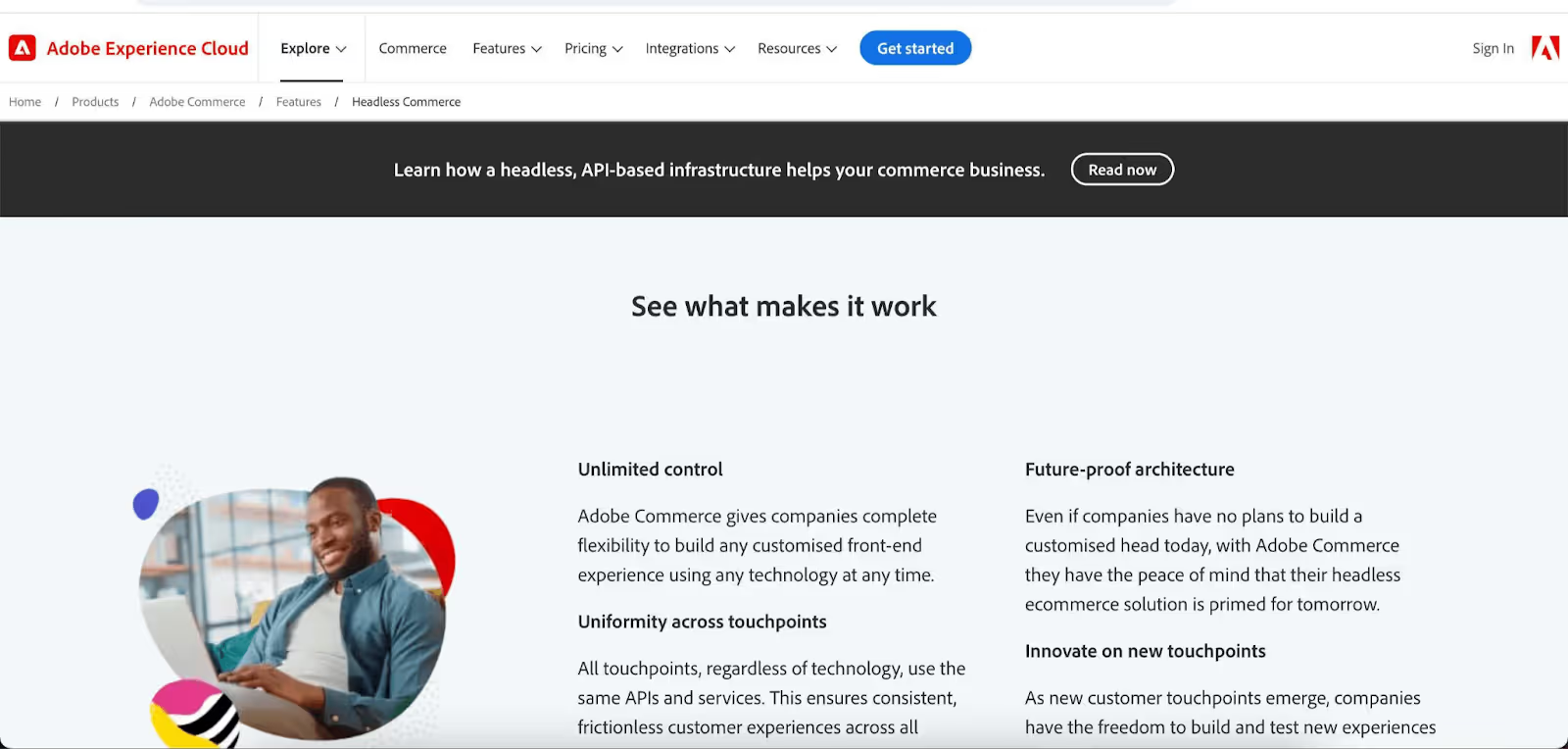
Best for: Large enterprises that need deep customization and are already in the Adobe ecosystem
Adobe Commerce (formerly Magento) has been a major ecommerce platform for over a decade, and its headless capabilities have expanded significantly. The platform offers GraphQL APIs for storefront data, PWA Studio for progressive web app development, and integration with Adobe Experience Manager for enterprise-grade content management.
The customization depth is Adobe Commerce's core strength. With access to the full codebase (especially on the open-source Magento version), developers can modify virtually anything.
This same depth is its challenge: implementations are complex, expensive, and typically require specialized Magento developers or a certified agency.
Adobe Commerce headless makes the most sense for brands already invested in the Adobe ecosystem (Experience Manager, Analytics, Target) where the platform integrations add compounding value.
Pricing: Adobe Commerce Cloud pricing is custom-quoted and typically starts well into six figures annually. The open-source Magento version is free but requires self-hosting and significant development investment.
Key strength: Unmatched customization depth for enterprise brands in the Adobe ecosystem.
5. Salesforce Commerce Cloud
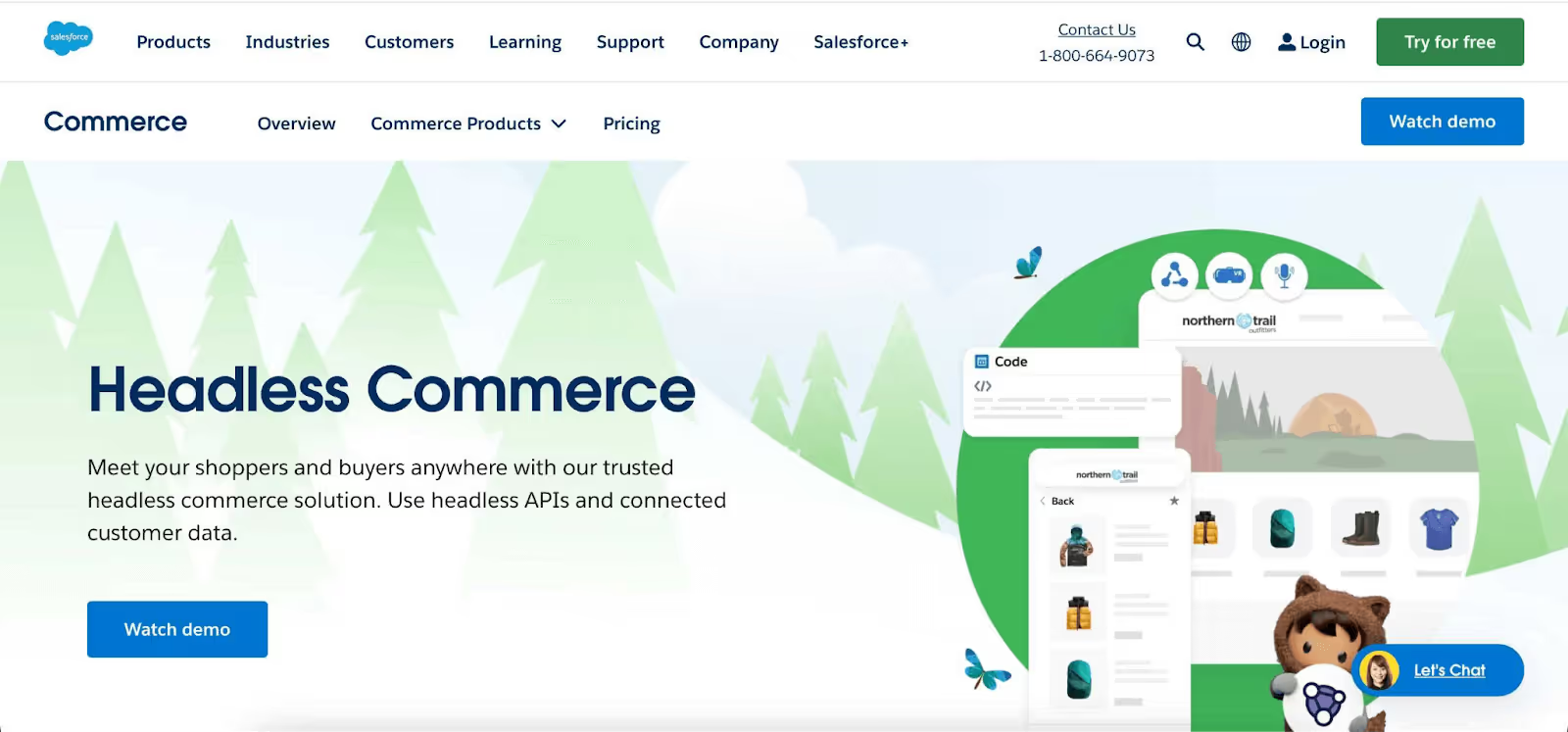
Best for: Enterprise organizations already embedded in the Salesforce ecosystem
Salesforce Commerce Cloud (formerly Demandware for B2C, CloudCraze for B2B) is the natural headless option for businesses running Salesforce CRM, Marketing Cloud, and Service Cloud.
The native integration between commerce and CRM data is its defining advantage: customer purchase history, service interactions, and marketing engagement all inform the commerce experience.
The platform comes with comprehensive APIs and supports flexible frontend framework selection. Commerce Cloud's B2C and B2B capabilities are both strong, making it a fit for brands selling to both consumers and businesses.
The pricing model is revenue-based (a percentage of gross merchandise value), which aligns cost with performance but can become expensive at scale. Implementation typically requires Salesforce-certified partners.
Pricing: Revenue-based pricing (historically ~1-3% of GMV for B2C). Contact for current pricing.
Key strength: Native CRM integration for brands already in the Salesforce ecosystem.
6. Fabric
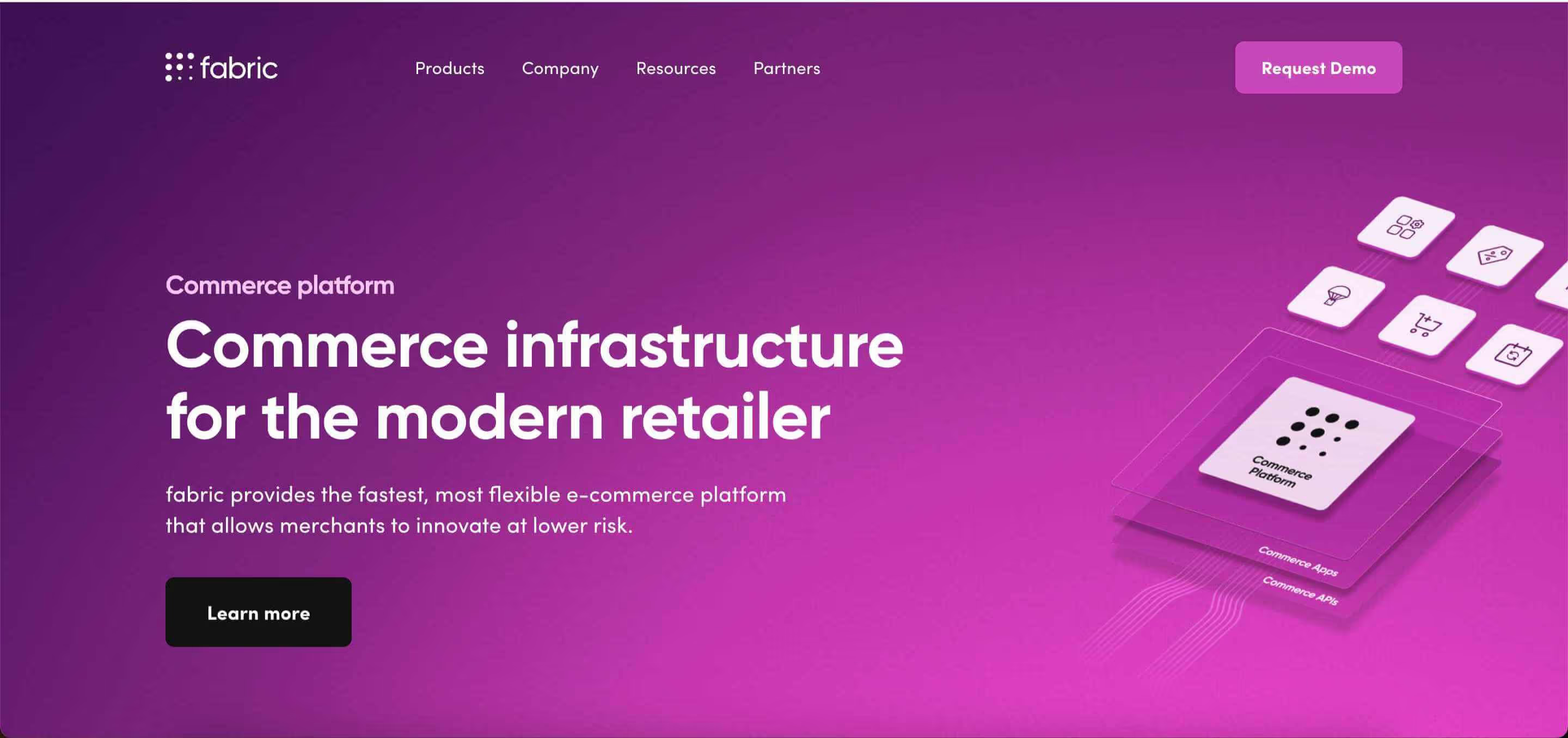
Best for: Brands looking for a modular, API-first commerce platform that covers the full customer journey
Fabric positions itself as a modular commerce platform covering everything from merchandising to fulfillment. Its API-first architecture is designed for both B2B and B2C implementations, with a focus on reducing the development overhead typically associated with headless builds.
The platform includes modules for product information management (PIM), offers and promotions, orders, and inventory, all accessible via APIs. Fabric's pitch is that you get the flexibility of headless with less complexity than assembling a fully composable stack from independent vendors.
It's a newer entrant compared to Shopify or Adobe Commerce, so the ecosystem is smaller. But for brands that want a single vendor covering the commerce backend modularly (without the weight of a legacy platform), Fabric is worth evaluating.
Pricing: Custom pricing (demo required).
Key strength: Modular API-first platform that covers more of the commerce backend than most headless-first options.
7. Spryker
Best for: Enterprise B2B and B2C brands with complex, multi-channel commerce requirements
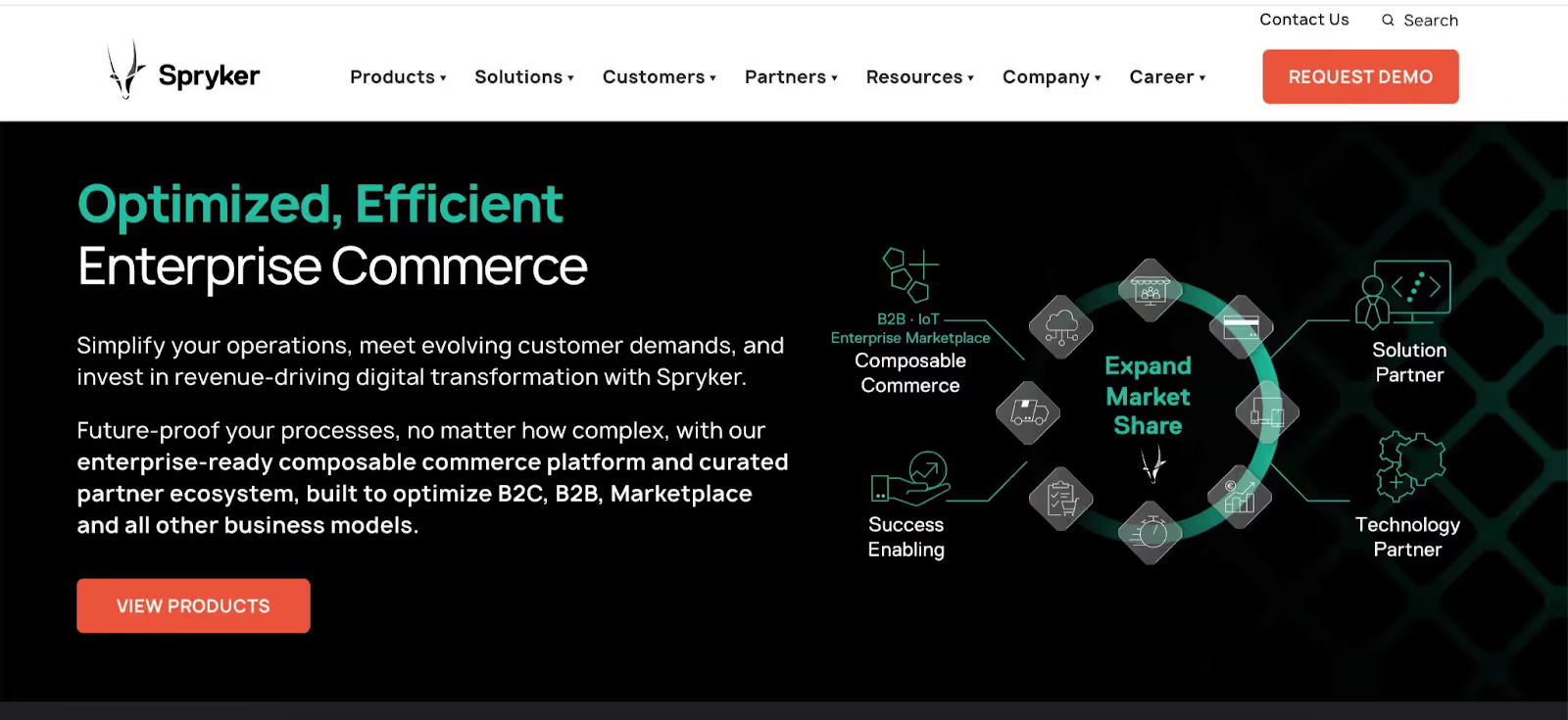
Spryker's fully composable architecture comes with over 900 API endpoints (built on its GLUE API layer), giving developers extensive access to every part of the commerce system.
The platform supports B2B, B2C, and marketplace models, making it one of the more versatile enterprise options.
Spryker is fairly popular in European enterprise markets and is particularly strong for brands with complex B2B workflows (custom pricing, quote management, approval flows) alongside consumer-facing commerce.
The platform requires significant development investment to implement, and the ecosystem is more specialized than Shopify's or BigCommerce's. It's an enterprise tool designed for enterprise teams.
Pricing: Enterprise pricing (contact required).
Key strength: B2B + B2C versatility with deep API coverage for complex enterprise requirements.
8. Medusa
Best for: Developer teams that want a fully open-source, customizable headless commerce engine
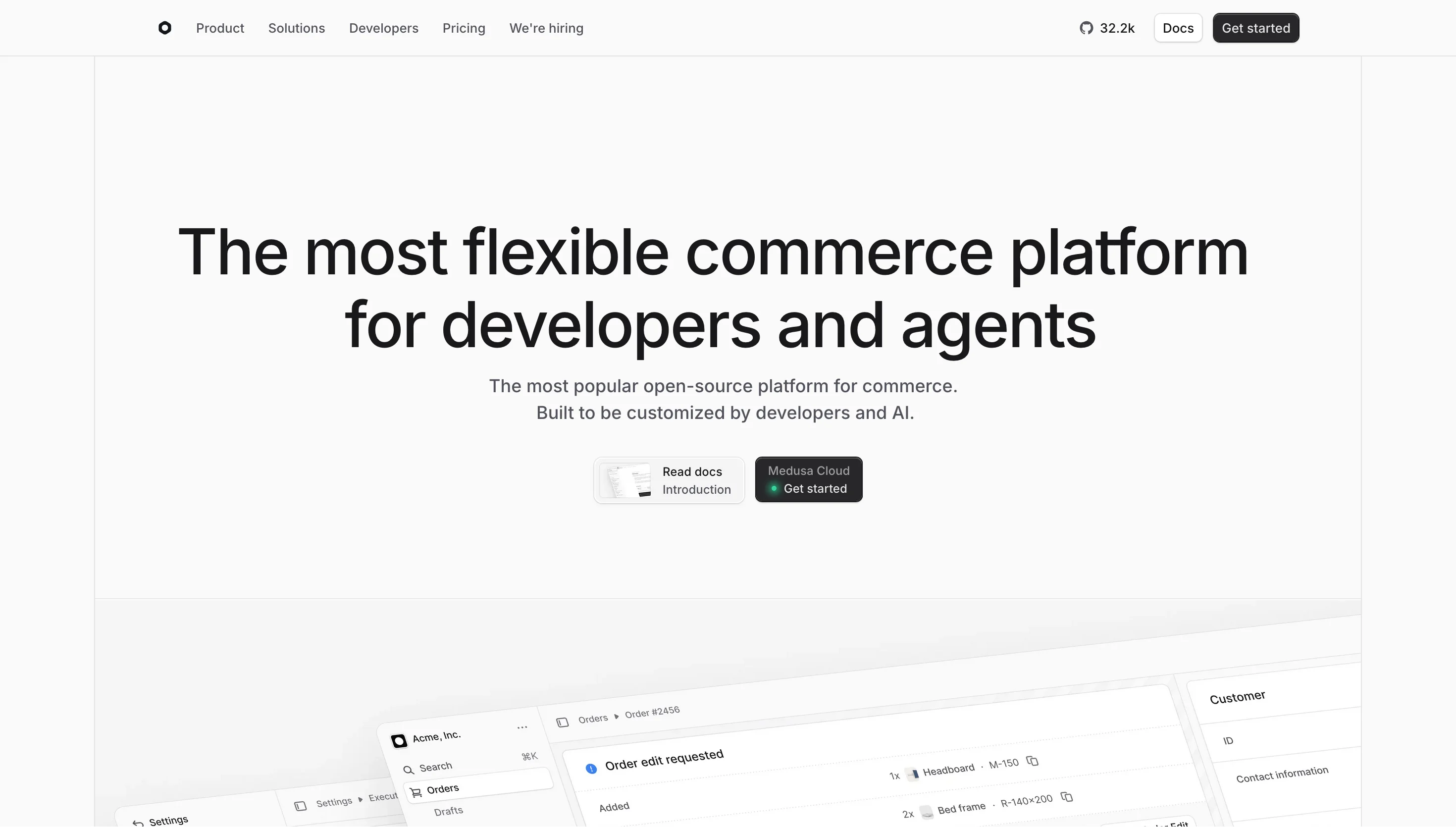
Medusa is an open-source headless commerce platform built on Node.js. It's designed for developers who want full control over every aspect of the commerce backend without vendor lock-in or licensing fees.
The platform provides APIs for products, orders, customers, carts, and payments out of the box, with an extensible plugin architecture for adding functionality. It's particularly appealing for brands with strong in-house development teams that want to own their commerce infrastructure entirely.
The tradeoff is that you're responsible for hosting, scaling, maintenance, and building everything that proprietary platforms include by default. There's no managed checkout, no built-in payment processing, no customer support team to call when something breaks.
Pricing: Free and open-source. Costs are infrastructure and development.
Key strength: Full ownership of the commerce backend with no licensing fees.
9. Saleor
Best for: Brands that want an open-source, GraphQL-native headless commerce platform
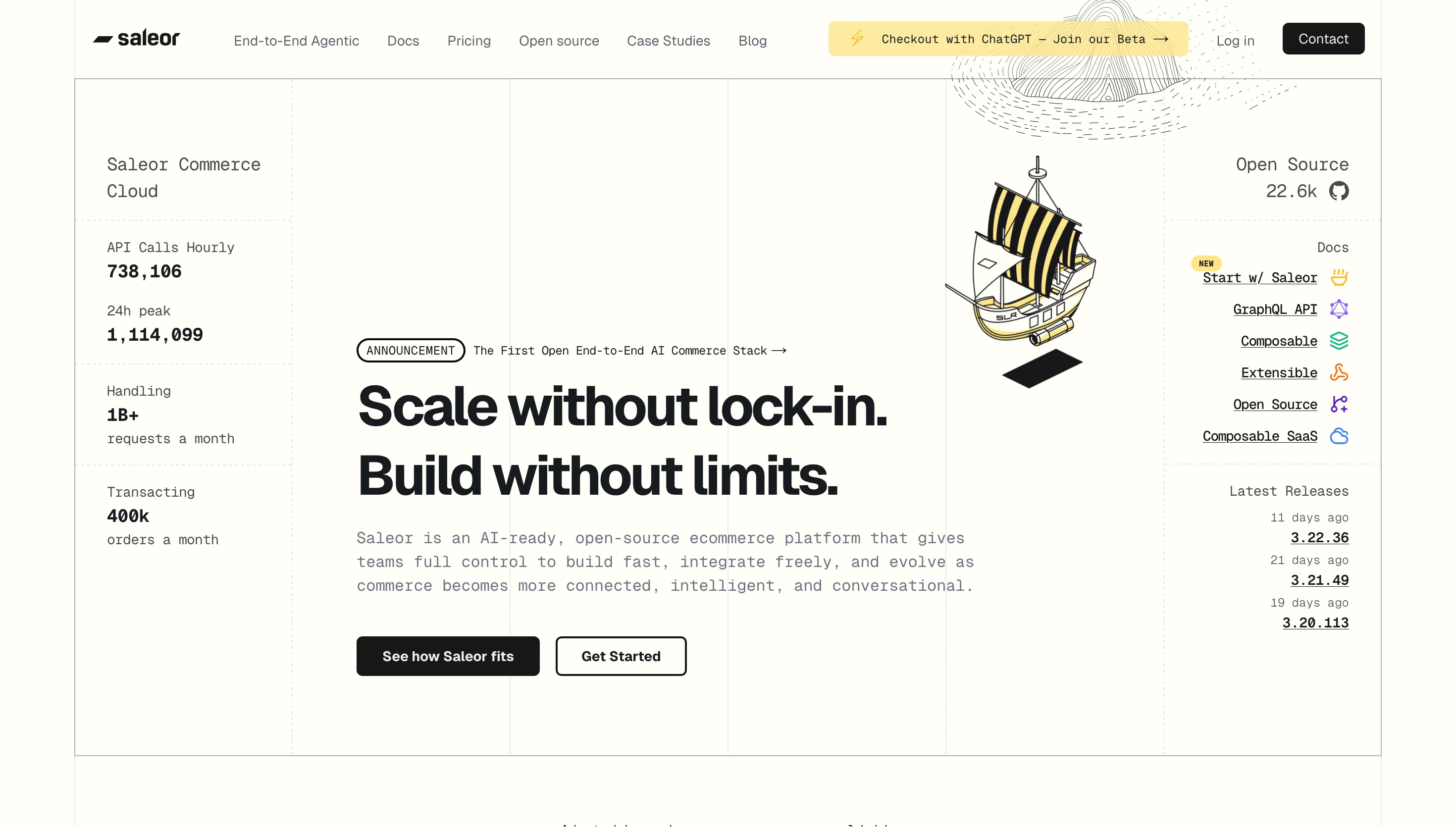
Saleor is another open-source headless option, distinguished by its GraphQL-native architecture. Every interaction with the platform goes through GraphQL (not REST), which aligns well with modern frontend frameworks that use GraphQL natively.
Saleor includes a dashboard for product and order management and offers Saleor Cloud as a managed hosting option for teams that don't want to handle infrastructure themselves. The platform supports multi-channel, multi-warehouse, and multi-currency out of the box.
Like Medusa, Saleor requires a development team to implement. The open-source version is free; the cloud-hosted version is priced based on usage.
Pricing: Open-source version is free. Saleor Cloud pricing is usage-based.
Key strength: GraphQL-native architecture with the option of managed cloud hosting.
10. Centra
Best for: Fashion and luxury brands with multi-market requirements
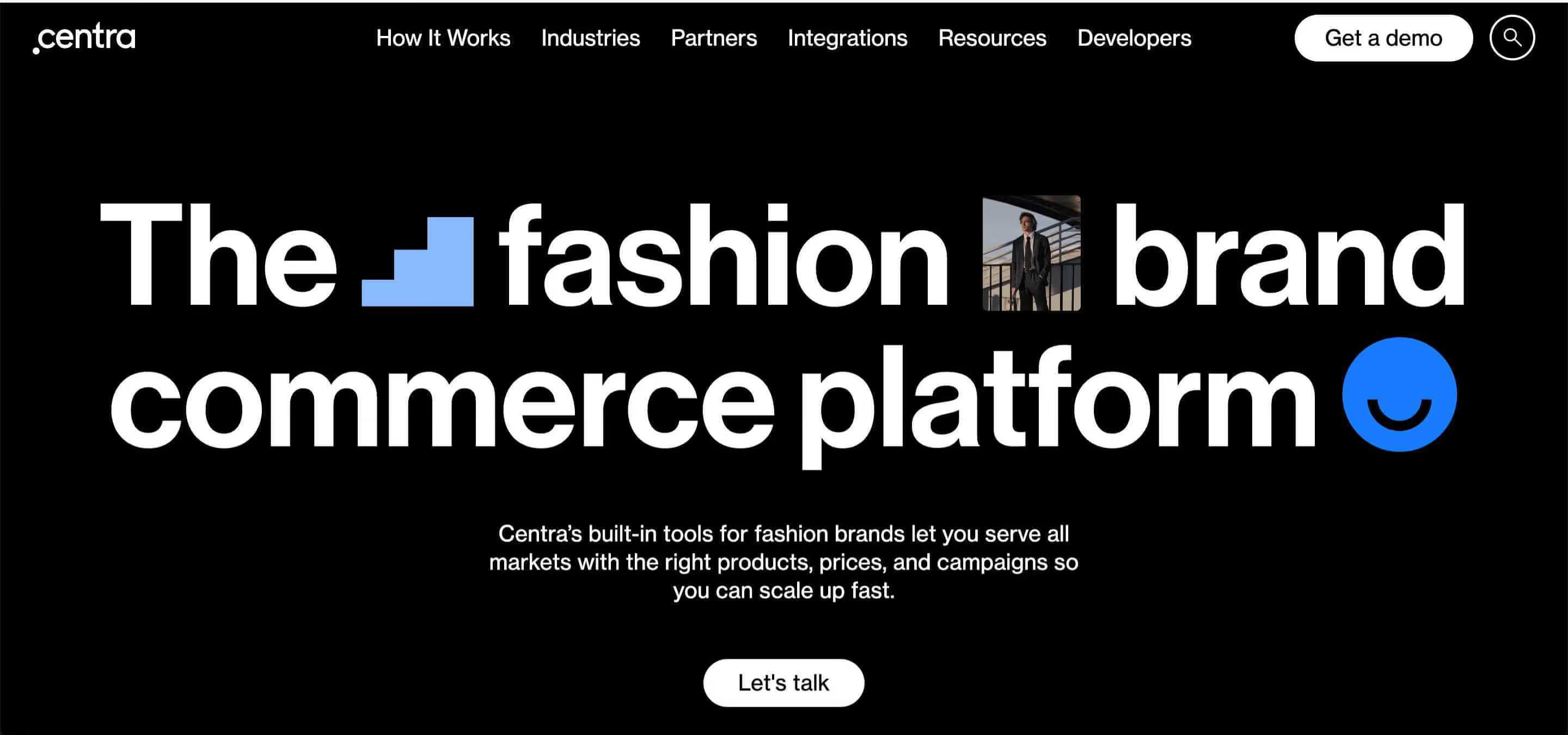
Centra is a headless commerce platform built specifically for fashion and lifestyle brands. Its core strengths are multi-language, multi-currency, and multi-region support without the plugin complexity that most general-purpose platforms require for international selling.
The API-first approach gives developers full frontend flexibility while the backend handles the complexities of international fashion commerce: wholesale (B2B) alongside DTC, complex size/variant matrices, and market-specific pricing.
Pricing: Custom pricing (demo required).
How to Choose the Right Headless Ecommerce Platform
The decision usually comes down to three questions:
Are you already on a platform? If you're on Shopify Plus, going headless with Hydrogen is the simplest path. If you're on BigCommerce, Adobe Commerce, or Salesforce, their headless capabilities keep you in your existing ecosystem. Migrating platforms AND going headless at the same time doubles the project scope.
How complex is your commerce operation? Simple DTC catalog on Shopify? Hydrogen or even a well-optimized standard theme might be enough. Multi-brand, multi-market, B2B+B2C? You're looking at Commercetools, Spryker, or Salesforce Commerce Cloud.
What's your team's technical capacity? Headless-first platforms (Commercetools, Medusa, Saleor) require strong development teams. Platforms with headless options (Shopify, BigCommerce) offer a gentler on-ramp because you can lean on the platform's built-in capabilities while building out the frontend.
---
Ultimately, we can’t tell you what the best headless platform is. It’s down to what offers the best fit for you, business-wise.
But this should give you a good idea of the options, and a solid foundation to zero in on the top contenders to evaluate in more detail.
Headless Site to Mobile Apps
One thing to keep in mind as you search for the right headless commerce platform: how you’re going to extend your storefront to mobile apps.
A common misconception about headless is that it makes it simple to launch both a web storefront and an app.
Technically, yes, it’s easier than with rigid, packaged platforms. But it still requires a lot of custom development (from developers with different skillsets from your web team), and a lot of complexity and moving parts.
Or you can use MobiLoud.
MobiLoud works with any headless platform on this list. It takes the web storefront you've built (regardless of which backend powers it) and delivers it as a native mobile app with push notifications, deep linking, App Store distribution and a home screen icon.
It’s just an easier, more efficient way to build a mobile app for your headless site, compared to building and managing a separate frontend in React Native/Flutter/Swift/Kotlin.
For a detailed look at how mobile apps work with headless architecture, see our guide to headless commerce mobile apps.
Ready to see your headless storefront as a native app? Want to discuss how the platforms you’re looking at fit with apps? Book a free strategy call and talk it over with our mobile app experts.
FAQs

Convert your website into a mobile app