
Video Commerce: The Winning Engagement Strategy For Ecommerce Brands in 2026

Video commerce is one of the best engagement programs an commerce brand can run in 2026. It's a powerful engagement layer for your brand, integrating things like shoppable video, live shopping, UGC, and interactive product video across various stages of your customer journey. The best brands are taking hints from the likes of Instagram and TikTok - driving mobile-first engagement with video, and extending their video commerce strategy further with mobile apps (powered by MobiLoud).
Video commerce is one of the best engagement programs an commerce brand can run in 2026. It's a powerful engagement layer for your brand, integrating things like shoppable video, live shopping, UGC, and interactive product video across various stages of your customer journey. The best brands are taking hints from the likes of Instagram and TikTok - driving mobile-first engagement with video, and extending their video commerce strategy further with mobile apps (powered by MobiLoud).
Static product pages are losing attention. Shoppers who spend hours watching TikTok and YouTube Shorts do not change modes when they land on a store. They want to see the product move, hear someone talk about it, and watch a real person use it before they commit. The text-and-carousel product detail page, which has defined ecommerce for fifteen years, no longer matches how buyers actually evaluate products.
Video commerce is how mid-market and enterprise ecommerce brands are closing that gap. It is not a tactic or a content experiment. It is becoming the default engagement layer for modern ecommerce, the surface where discovery, consideration, and conversion increasingly happen on the same screen.
This article covers what video commerce is, why it is winning right now, the four formats driving real results, how it changes engagement economics, where to deploy it across the customer journey, and how to extend every piece of your video program into a native mobile app. It closes with a practical rollout plan for mid-market teams.
What Video Commerce Is (And What It Isn't)
Video commerce is the practice of using video as the primary conversion surface of a shopping experience, rather than as a supporting asset.
The product is not described next to a video. It’s tagged inside the video, clickable, and purchasable without leaving the frame.
The distinction matters. Uploading a product demo to YouTube is not video commerce. Running a video ad on Meta is not video commerce either. Both use video, but neither turns the video itself into a transactional surface.
Video commerce covers four umbrella formats, each broken down below:
- Shoppable video: pre-recorded video with tagged, clickable products
- Live shopping: real-time hosted events with in-stream chat and checkout
- User-generated video: customer and creator-filmed content embedded in the shopping journey
- Interactive product video: video that adapts to the viewer with branching, variant selection, or personalization
The common thread: the video sits inside the purchase journey. That is what separates video commerce from video marketing.
Marketing drives traffic to a store. Commerce happens inside the video.
Why Video Commerce Is Winning Right Now
Three forces are converging right now.
The first is consumer behavior. Short-form video has trained buyers to evaluate products visually first. The TikTok generation is not a demographic, it’s a shopping behavior now common across every age group with disposable income.
When shoppers land on a text-heavy PDP after watching a 15-second product demo on social, the format mismatch is obvious. They bounce.
The second is engagement data. Brands that have deployed video on PDPs consistently report longer dwell times and higher interaction rates on video-enabled pages.
Shopify, Adobe Commerce, and BigCommerce have all moved native video shopping features into their core platforms in recent releases, which is the clearest signal that the behavior is no longer experimental. For the broader context, statistics show that attention is concentrating on mobile, which aligns perfectly with video as a medium.
The third is the authenticity problem. As generative AI floods the web with synthetic text and images, buyers are increasingly skeptical of static content.
A real person on camera talking about a real product solves this in a way copy cannot. User-generated video and live shopping signal authenticity that AI content struggles to replicate.
Then there’s the platform evidence. TikTok Shop, Amazon Live, and YouTube Shopping have all scaled from novelties into core retail surfaces. When the largest retail platforms in the world invest this heavily in video commerce, mid-market brands need to match the experience buyers have been trained to expect on their own stores.
The Four Video Commerce Formats Driving Real Results
Video commerce comes in several different forms. Each format solves a different part of the engagement problem. Most brands start with one and layer in others as the program matures.
Shoppable Video on Product and Category Pages
Shoppable video is the workhorse. Pre-recorded videos with tagged products sit directly on PDPs, category pages, or homepage feeds. When a shopper sees a product they want, they tap the tag and either add it to cart or view the full product page without leaving the video.
Fashion, beauty, and home goods brands have adopted this format most aggressively. A single product page might feature a hero video, a how-to creator video, and a customer styling video, each tagged and clickable.
The production economics are the main advantage. Shoppable video can be repurposed from social content you already own. You are not filming from scratch, you are tagging what you already have.
Live Shopping Events
Live shopping is the highest-engagement format in video commerce. A host goes live, demos products in real time, answers chat questions, and runs time-bound offers. Viewers buy directly in-stream.
Live builds urgency through scarcity, community through chat, and trust through unscripted presence. The combination produces AOV spikes and conversion rates several multiples higher than static PDPs during the event window.
The best-performing live programs are episodic. Customers know when to tune in, which turns a one-time event into a recurring engagement habit.
User-Generated Video and Creator Content
UGC video converts because it sidesteps the credibility problem of brand-produced content. A customer filming themselves using a product is the closest thing to a live referral: unscripted, unpolished, visibly authentic.
Sourcing is what separates programs that work from programs that don't. The three common models for UGC sourcing are:
- Affiliate-driven: creators post shoppable video to social, earn commission on referrals
- Review-incentivized: customers upload video reviews in exchange for credit or samples
- Partner-creator programs: long-term relationships with a curated roster of creators
Brands that treat UGC as a pipeline, not a one-off campaign, build a library that feeds shoppable video surfaces indefinitely.
Interactive and Personalized Product Video
Interactive video is the emerging category. Viewers interact with the video itself, switching product variants, changing colors, selecting sizes, or branching into specific feature demos.
This format is most valuable for consideration-heavy categories: furniture, electronics, high-AOV apparel, where shoppers need to explore multiple configurations before buying. The production cost is higher than shoppable video, but interactive video pages routinely show stronger time on page of traditional PDPs in the same category.
The tradeoff is practical. The more interactive and personalized the video, the more resource-intensive it is to create.
Interactive video is not where most brands should start. It rewards teams with mature video programs that have already proven ROI on simpler formats.
How Video Commerce Changes the Engagement Economics for Ecom Brands
The case for video commerce is not primarily a conversion-rate argument. It’s an engagement-economics argument.
A video-heavy strategy drives an uplift in certain metrics, which compound over time.
Time on page
Video-enabled PDPs hold attention meaningfully longer than static ones. The longer a shopper engages with a product, the more confidence they build, and confidence is what closes high-consideration purchases.
AOV lift
Tagged products in video naturally cross-sell. A creator styling a dress with a jacket and a bag sells the outfit, not the dress. Live shopping events drive even larger average order value spikes because hosts can bundle on the fly.
Repeat engagement
Episodic live content and a continuously updated video library give customers reasons to come back that static catalogs cannot match. Occasional buyers become regular viewers, and viewers become high-LTV customers.
Recognition and habit
Video-first brands build recognition faster. Customers remember the host, the set, the tone. That familiarity compounds into loyalty in ways text and still images rarely produce.
The CFO-facing framing is this: video commerce is an LTV play, not a conversion play.
Conversion improvements are real but marginal. The meaningful wins come from repeat purchase rate, AOV, and the kind of brand affinity that makes customers choose you when they have options.
Where to Deploy Video Commerce Across Your Whole Customer Journey
The common mistake, when adopting video commerce, is treating it as a PDP feature.
You have your product image carousel, throw a video in there, and call it “video commerce”.
It’s really a customer journey strategy, and the highest-performing programs deploy video at every stage.
Discovery
Shoppable social video on TikTok, Instagram, and YouTube Shorts. The goal is to convert casual viewers into owned-audience shoppers. Link-in-bio and shop tabs are the bridge, but the best programs pull that traffic back to owned surfaces where the next video can touch them.
Consideration
Video-enabled PDPs, category landing pages, and collection hubs. A buyer researching an expensive purchase wants multiple angles, use cases, and reviewer perspectives, all of which video delivers faster than text.
Decision
Live shopping events, product launch livestreams, interactive demos, and comparison videos. Decision-stage buyers need their final objections answered, and live formats answer objections faster than any FAQ page.
Post-purchase
Onboarding videos, how-to content, and unboxing-style tutorials reduce returns and build the foundation for repeat purchases. Post-purchase is the most under-invested video surface for most brands, and the one with the highest ROI on time spent, because it directly protects margin.
Mobile app
Apps are the highest repeat engagement surface for video commerce, and the one most brands leave on the table.
Native video feeds, push-notified live events, and app-only creator content drive repeat visits in ways mobile web cannot match.
Extend Your Video Commerce Program Into a Native App with MobiLoud
A lot of ecommerce brands now are making the smart play to invest heavily in video commerce on their website: shoppable PDPs, live shopping events, creator content, UGC libraries.
The problem is that, when you go to launch a mobile app, integrating unique, video-heavy user experiences makes the job a whole lot more complex.
MobiLoud solves that problem. MobiLoud turns your existing website into a full-featured native mobile app for iOS and Android, and ensures every video commerce feature that works on your store runs natively inside the app.
Shoppable video, live shopping, UGC feeds, interactive product video: everything carries over.
The DIY App Builder Problem
The most common approach for modern ecommerce brands launching a mobile app is to use a DIY mobile app builder (like those in the Shopify App Store).
The problem (especially for sites with custom features and bespoke PDPs) is that these tools build a new storefront, inside of their own templates.
That means features like shoppable videos and UGC feeds often don’t carry over. The tool may have an integration built for popular video commerce tools, but the integration likely won’t enable everything you can do on your site.
This limits the potential of your app, and often results in a user experience that lags behind your website.
The MobiLoud Solution
Instead of making you rebuild your website inside templates, MobiLoud directly converts everything from your website to a native app.
The app is powered by your website, and everything that works on your website works in the app.
You manage the UX of both channels from one place (your website). One codebase, one content pipeline. Update a video on your site, and it appears in the app. There’s no duplicated workflows, separate management backlog, or missing features.
MASC’s Video Commerce Strategy
Men's skincare brand MASC runs on video. Their website is far from standard, with shoppable reel-style videos that makes it feel more like Instagram or TikTok than a static ecommerce site.
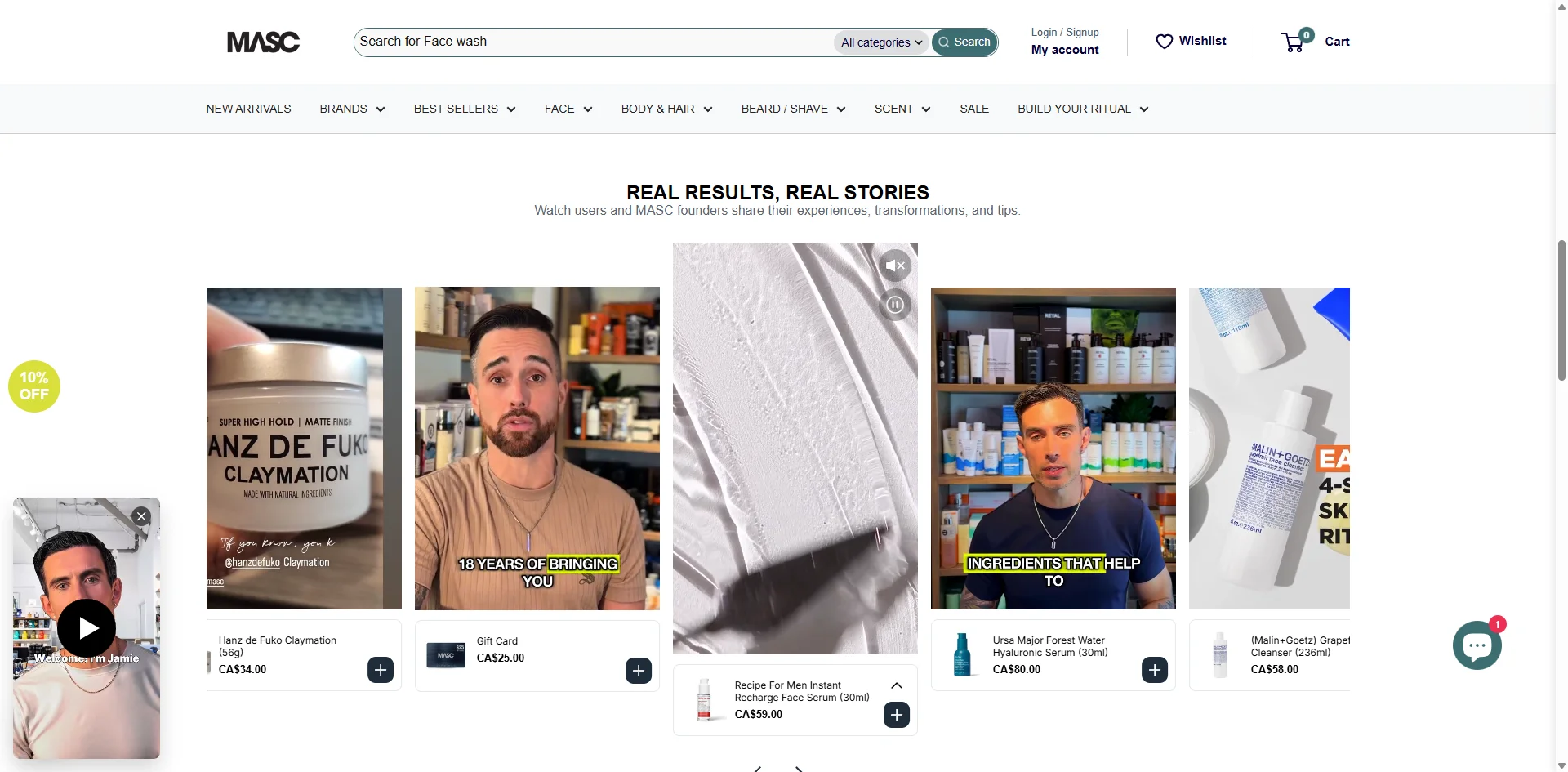
The brand originally had an app built with a DIY app builder, which didn’t carry over all of their video commerce features.
As a result, it lagged behind their website, and didn’t offer the user experience their customers expected.
They switched to MobiLoud, and were finally able to deliver their full UX in the convenient, high-touch surface of a mobile app.
“MobiLoud allowing us to use all the features that we already pay for with other companies is important.”
-- Patrick Levesque, Co-Founder, MASC
Read more about MASC’s mobile app journey.
Why an App Compounds Every Engagement Win
Video commerce is an engagement economics play, and mobile apps dominate the metrics that matter most.
App users open more often, spend longer per session, and respond to push notifications at rates email cannot approach. That means every engagement boost from your video program is amplified inside a native app:
- Longer dwell times become repeat sessions
- AOV lifts become higher reorder frequency
- Live shopping events become recurring tune-in behavior.
Just see the platforms that dominate video commerce: TikTok, Instagram, as well as new players like Whatnot. They’re all mobile-first.
If you want to get the most out of your video commerce strategy, you need to replicate that, on your own channels.
Getting Started: A Practical Video Commerce Rollout for Mid-Market Brands
Four steps separate brands that see results from brands that stall after a pilot.
- Audit where video already lives in your stack. Most mid-market brands are more fragmented than they realize: social video, email video, PDP video, and customer service video, all managed by different teams with no shared asset library. The audit is the unglamorous first step that unlocks everything else.
- Pick one format and one surface for the pilot. Resist the instinct to launch everything at once. The two highest-ROI starting points are shoppable video on PDPs (if you have a creator pipeline) or live shopping events (if you have a team that can host well).
- Build the sourcing pipeline before investing in tooling. Video commerce tools are commoditized. The differentiator is content supply. Brands that stall are usually the ones that bought platforms before they figured out how they would continuously source video.
- Instrument the right metrics. For the first 90 days, track watch time, interaction rate, and repeat visit rate, not just conversion. Engagement metrics tell you whether the program is working months before the revenue shows up.
Final Thoughts
Video commerce is not a passing trend, or a hack. It’s a structural shift in how ecommerce brands will compete for attention over the next five years.
Treat video as the engagement layer of your store, not just a gimmick or a marketing afterthought. Extend that engagement into every surface your customers use, including a native mobile app.
There’s little doubt, by now, that video works. The only question left is how long you wait until you make this a core part of your marketing strategy.
FAQs

Convert your website into a mobile app




