
When you scope a mobile app for an ecommerce brand, the conversation almost always centers on the build cost.
An agency might quote you $100K for a custom React Native project. You might compare that against a DIY or service-driven app builder and the monthly or yearly subscription on their pricing table. You might weigh these two costs against each other, to estimate the ROI potential of your mobile app over time.
You might, on the basis of the quotes you’ve been given, see the “one-time cost” of a custom project as a preferable option to an ongoing subscription that bills every month.
But here’s what you’re missing: the upfront cost of a mobile app is far from the end of the billing picture.
The real cost of owning a mobile app shows up after launch. Maintenance costs, OS updates, new features, fixes, updates to follow design or branding updates on your website.
It’s a job that never ends. And failing to understand the long-term cost of a mobile app is the biggest mistake we see ecommerce companies make.
Read on and learn everything you need to know about the long-term maintenance costs of mobile apps, and how to make sure these costs don’t come back to bite you.
What Mobile App Maintenance Includes
Mobile app maintenance isn't a small bucket of bug fixes. It’s a regular, full-time job.
“We had [an app] in 2014 and found that it was too much to maintain. To keep a platform like this in-house I feel like you’d probably need around six people.”
-- Kenneth Chan, Founder & CEO, Tobi
For an ecommerce app, the ongoing work falls into five buckets:
Platform updates
Apple ships a major iOS release every year, plus several point releases. Google does the same with Android. Each release deprecates APIs, changes permissions, tightens privacy rules, and occasionally breaks behavior your app depended on.
Apps that don't keep up get warnings, then rejections, then get pulled from the App Store. Staying compliant with these rules is non-negotiable.
Third-party SDK or API updates
Every integration your app uses - analytics, push, payment, attribution, reviews - has its own code, and its own SDK or API used to make it work in your app.
Each one publishes updates. Each one occasionally breaks.
If a push provider or an analytics tool updates their API, they’re not going to personally call you and make sure the new version works in your app. That’s on you.
Website parity
Most ecommerce websites aren’t static. They’re constantly moving, getting refreshed.
You add a new reviews widget, a product configurator. You change the hierarchy on your PDPs. You update your homepage, add a new collection.
All this work needs to be replicated in your app, or your app and web experiences quickly drift apart, and end up looking like two different stores.
Bug fixes and regressions
Bugs are inevitable in software.
It could be an edge case that wasn’t caught in testing. It could be a new integration. It could be one of the SDK or API updates mentioned above, which breaks your implementation.
And the important thing about bugs is that one bug is easy to fix. But once you let multiple bugs accumulate, it’ll start to look as if the only way to fix them all is to tear down your code and start again.
Performance and security
You’ll (hopefully) acquire more and more users over time. That can add new problems that didn’t exist when you first launched the app.
Apps that worked fine at 5,000 monthly active users start showing strain at 50,000. You get more crash reports, memory issues surface, and you may need to roll out patches to keep your app functioning well.
What It Costs to Keep Up
The industry rule of thumb for native mobile app maintenance is 15-25% of the original build cost per year.
Realistically, we’ve found this to be a conservative estimate.
Based on this, a $100K app will cost $15,000-$25,000 per year to maintain. A $150K app will cost $22,500-$37,500.
But this typically assumes everything goes well, the only maintenance is routine maintenance, and there are no major feature additions or website parity updates required.
Even if we assume the best, it’s still a recurring cost, like a tool subscription, which you can’t get away from.
Why the Operational Tax Hurts More Than the Maintenance Bill
The 15-25% maintenance cost estimate leaves out one important part.
This cost is the pure dev hours - X hours, billed at $100 per hour (or however much you’re paying your mobile devs).
That’s the visible cost. The hidden cost is the operational tax.
Operational tax is the time your ecommerce team spends managing two different systems. Every meeting where someone says "and what about the app?" Every CRO experiment that wins on the website and doesn't make it into the app. Every homepage refresh that ships on the web in three weeks and lands in the app eight weeks later. Every integration vendor your team chooses based partly on which ones the app supports.
These are the patterns we consistently see and hear from ecommerce teams running a custom-built mobile app:
Decision lag
Once you have two surfaces to think about, every product, marketing, and merchandising decision brings additional questions.
- Should this run only on the web?
- Only in the app? Both? When?
It makes procurement processes longer, and rules out some moves that seem perfect but for the mobile app question.
Feature drift
Let’s say you put the app question to the side. You say, “let’s add the feature; we’ll work it out in the app later.”
Six months after launch, your website has 8-12 new features the app doesn't have. Twelve months in, that gap is 20+ features.
The app starts feeling stale. Customers notice - they switched to the app expecting a better experience and got a thinner one. Now your best customers are upset they’re being served a weaker version of your website.
Talent dependency
Quick, cheap maintenance depends on having the right developers readily available.
You need people who know the code, who can ship fixes without breaking other areas of the app.
If you rely on freelancers, the same people might not be available right away. If you use an agency, there might be a lag time between the bug report and implementation.
If you hire developers in-house, you have HR and all the associated costs of having employees to worry about. And then there’s still the risk that the person who knows everything about the codebase leaves, and no one else knows what does what under the hood.
Opportunity cost
Because of the extra work it takes to keep your app in line with your website, you start making decisions based on what’s easiest, not what’s best for the brand.
You decide not to build a new product configurator tool, because it’s going to take 2x as long to build it for both website and app. You don’t integrate with a new personalization tool because it’s not compatible with your app. You decide against an overdue website redesign, because that means you need to redesign your app as well.
This is the biggest hidden cost, because it’s literally hidden. It doesn’t show up on your expense report. It’s not money lost, it’s value you could have realized, but didn’t, because the operational tax holding you back.
A Year in the Life of a $30M Brand With a Custom Mobile App
Picture a $30M Shopify Plus apparel brand. In early 2025, they scoped a custom React Native app with a specialist mobile agency.
Build cost: $400,000. Build time: 8 months. The agency stayed on for a Year 2 maintenance retainer at $80,000 a year. Launch went well. The app is clean, fast, real native components, in the App Store.
Q1
iOS 19 ships. The agency spends three weeks bringing the app into compliance with two deprecated APIs and a tightened permissions model. The brand's internal team doesn't see the work - the agency is paid for it out of the retainer. So far, so good.
Q2
The brand's CRO team turns on AI-driven product recommendations on the website - a Nosto / Rebuy integration the web team adds in a single sprint.
Category pages, PDPs, and cart all start surfacing personalized "you might also like" modules. The app keeps showing its hand-built static product carousels because the app's recommendation logic was custom-coded at launch, not wired to the recommendation engine.
The agency quotes four weeks to connect it. For those four weeks (and the conversion lift the website is already logging), app users get the old static carousels.
Q3
Marketing wants a homepage refresh for fall. The website ships the new homepage in three weeks. The app version takes another seven weeks because the new homepage uses content blocks the app can't render. The brand ships the fall campaign with two homepages live for two months.
Q4
The reviews widget vendor updates their mobile SDK. The app build that pulls in the new SDK ships with a crash on Android 14. The agency rolls back to the previous version. The crash is fixed three weeks later in a hotfix. The brand's app reviews drop from 4.7 to 4.4 in the meantime.
—-
Across the year, the agency bill stays at $80,000. The internal cost - ecommerce manager time on app coordination, marketing time on dual-launch logistics, support time fielding bug reports - runs another six to ten hours a week across two senior team members.
Conservatively, that's another $40,000-$60,000 in opportunity cost.
The Year 2 cost of operating this app sits somewhere between $120,000 and $140,000, before counting any new feature work. The app, meanwhile, is now behind the website on at least a dozen features.
The team is starting to talk about a "Year 3 modernization,”, which really means rebuilding the app and relaunching it on a new listing, without the negative reviews it’s been accumulating.
Learn more about the cost to build a Shopify mobile app.
How to Scope Total Cost Before You Commit
If you're scoping a mobile app and the only number in front of you is the build cost, you’re missing half of the picture.
You don’t need the upfront cost - you need the Total Cost of Ownership (TCO).
Here are some things you need to take into account:
Year 2-5 maintenance
Apply the 15-25% rule to your build estimate. Multiply by four years. Compare that number to the build cost.
For most custom apps, the four-year maintenance figure is larger than the build by Year 4, meaning the build number you're staring at is less than half of what you'll pay over the life of the app.
Operational hours
Estimate how many hours per week your ecommerce, marketing, and customer experience teams will spend coordinating between web and app. Multiply by loaded hourly cost. Multiply by 50 weeks. That's the operational tax line item, and it's usually larger than people assume.
Drift risk
Ask the vendor or your internal team how feature parity between web and app gets maintained over time. If the answer is "every feature gets built twice," realize that you’re building a second storefront to manage.
How MobiLoud Simplifies Mobile App Maintenance
A large reason MobiLoud exists is the maintenance cost and operational lift of running a mobile app.
The traditional model, running a mobile app as a separate surface, with a separate codebase, is impractical for ecommerce brands, whose focus is typically on marketing and merchandising, not tech.
With MobiLoud, the operational tax doesn’t exist.
MobiLoud ships custom apps that are fully synced with your website. Everything on your site works in the app, and updates instantly when you update it on your site.
If an integration changes their API, if you update your homepage, add a new feature to your PDPs, that reflects instantly in your app, with no additional development needed.
Our team handles all the technical app maintenance and regular updates for you. We are your app team, letting your team’s focus remain on what drives the business forward.
You’ll likely spend a few hours per month on the app - not 40 hours a week. Your maintenance bill is a flat subscription, not a costly retainer or inflated dev hours every time you need a fix or a feature update.
Brands like John Varvatos, BESTSELLER, Tadashi Shoji, and Pharmazone all ship and maintain mobile apps on this approach without dedicated in-house mobile teams. The apps run on the web stacks each brand already uses, and simplifies what it takes for these brands to provide a native mobile app for their best customers.
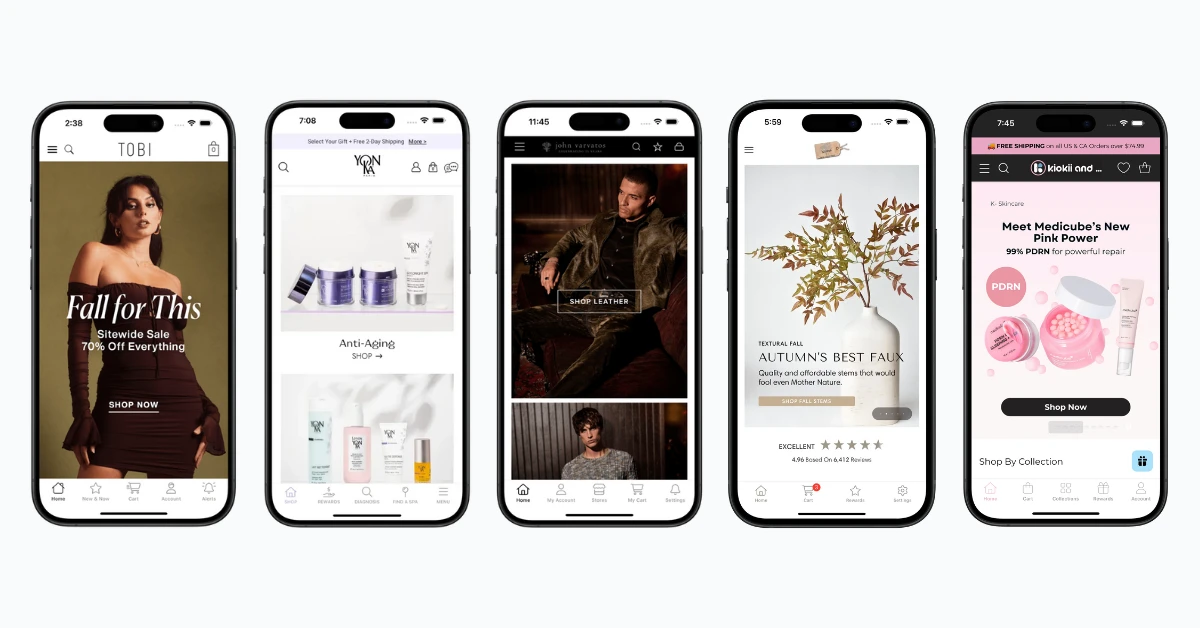
It’s a better way to ship a custom mobile app for an ecommerce brand.
Want to see what’s possible? Get in touch and get a free app preview, and you’ll see what your site could look like as an app, as well as a walkthrough from our app team of how we’ll help you build, launch and maintain the perfect mobile app.