
Mobile apps have been part of everyday life for long enough that the sheer scale can be easy to take for granted.
Nearly 150 billion apps were downloaded from the App Store and Google Play in 2025. We spent 5.3 trillion hours using them. And spending on in-app purchases and paid apps reached $167 billion.
In this article, we've pulled together 57 of the latest and most useful mobile app statistics, covering:
- Smartphone and mobile usage
- App downloads
- App usage and retention
- The Apple App Store and Google Play
- Major app categories and market trends
- Mobile app revenue
These statistics give you everything you need to know about how we use our mobile phones - and in particular, mobile apps.
You'll see how massive the mobile app market is, how much money is flowing around, and how mobile apps have become an indispensable part of life as we know it.
Highlights
There's plenty of data below. First, here are some of the numbers that best sum up the mobile app market in 2026:
- Consumers downloaded nearly 150 billion apps from the App Store and Google Play in 2025. [Sensor Tower]
- People spent 5.3 trillion hours in mobile apps during 2025, equivalent to roughly 3.6 hours per mobile user per day. [Sensor Tower]
- Revenue from in-app purchases and paid apps and games reached $167 billion in 2025, up 10.6% year over year. [Sensor Tower]
- For the first time, consumers spent more on non-gaming apps than games through in-app purchases. [Sensor Tower]
- There were 5.83 billion unique mobile users worldwide in April 2026. [DataReportal]
- Retail apps recorded more than 8.7 billion downloads globally in 2025. [Sensor Tower]
- Generative AI apps reached 3.8 billion downloads and more than $5 billion in in-app purchase revenue in 2025. [Sensor Tower]
The big picture is interesting. App downloads are still growing, but only slowly. The stronger growth is happening in engagement and monetization: people are spending more time and more money inside the apps they already use.
Let's look at the numbers in more detail.
7 Smartphone & Mobile Device Statistics
Before looking specifically at apps, it helps to understand the scale of the devices they're running on.
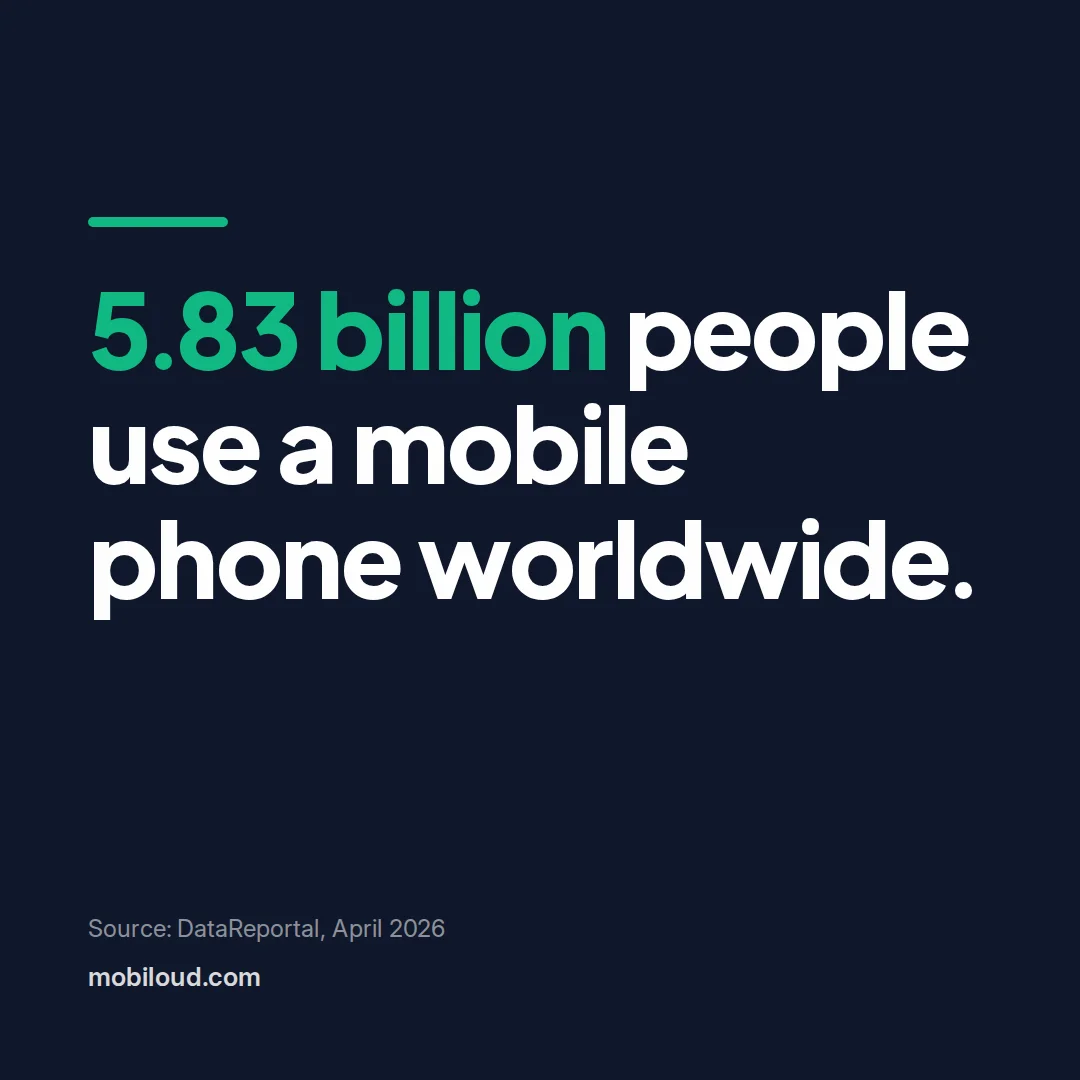
- There were 5.83 billion unique mobile phone users worldwide in April 2026. [DataReportal]
- That means 70.4% of the world's population now uses a mobile phone. [DataReportal]
- The number of unique mobile users increased by 103 million in the previous 12 months. [DataReportal]
- Smartphones account for roughly 89.1% of mobile handsets currently in use. [DataReportal]
- Smartphones make up approximately 85.5% of cellular mobile connections worldwide. [DataReportal]
- 96.2% of internet users use a mobile phone to go online at least some of the time. [DataReportal]
- Mobile phones generate around 51.6% of global web traffic, before even accounting for time spent inside apps. [DataReportal]
Takeaways
Mobile is no longer a secondary way to access the internet. For many people, it's their primary device, billions of people carry their smartphone with them everywhere they go.
Web traffic only captures part of that behavior. A huge amount of mobile activity happens inside apps, rather than the browser.
8 Mobile App Download Statistics
The app market is mature, but that doesn't mean people have stopped downloading apps. Global download volumes are still at record levels.
- Consumers downloaded nearly 150 billion apps and games from the Apple App Store and Google Play in 2025. [Sensor Tower]
- Total downloads increased 0.8% year over year, enough to exceed the previous record set in 2023. [Sensor Tower]
- Generative AI apps reached 3.8 billion downloads in 2025. [Sensor Tower]
- Downloads of generative AI apps grew 148% year over year in 2025. [Sensor Tower]
- Short-form drama apps grew even faster, with downloads increasing 278% year over year. [Sensor Tower]
- Retail apps recorded more than 8.7 billion global downloads in 2025. [Sensor Tower]
- Restaurant and food delivery app downloads increased 14% year over year in 2025. [Sensor Tower]
- Sports betting app downloads grew 24% globally in 2025 as the category expanded into new markets. [Sensor Tower]
Takeaways
The important change isn't that people have stopped downloading apps. They clearly haven't.
But global download growth is flattening as the market matures. More people already have their core set of apps, which means simply getting an install isn't enough. Retention and ongoing engagement matter more than ever.
There are still breakout categories. AI is the obvious example, while newer formats such as short-form drama have also shown how quickly a new app category can take off.
12 Mobile App Usage & Retention Statistics
Downloads tell you how often people try an app. Usage tells you whether the app becomes part of their routine.
And on that front, mobile apps continue to take up an enormous amount of our time.
- Consumers spent 5.3 trillion hours in iOS and Google Play apps in 2025. [Sensor Tower]
- Total time spent in apps increased 3.8% year over year. [Sensor Tower]
- That works out to roughly 3.6 hours per day per mobile user. [Sensor Tower]
- Users spent 48 billion hours in generative AI apps in 2025. [Sensor Tower]
- Time spent in generative AI apps was approximately 3.6 times higher than in 2024, and almost 10 times higher than in 2023. [Sensor Tower]
- Generative AI apps recorded more than one trillion sessions during 2025. [Sensor Tower]
- By Q4 2025, 64% of generative AI users accessed these tools exclusively through mobile apps rather than combining app and web usage. [Sensor Tower]
- Across app categories, a typical app retains around 26% of users after the first day. [Adjust]
- Average retention falls to approximately 13% by day seven. [Adjust]
- By day 30, average app retention is around 7%. [Adjust]
- iOS retention tends to be slightly higher than Android: around 8% versus 6% at day 30. [Adjust]
- Ecommerce app sessions increased 5% year over year in 2025. [Adjust]
Takeaways
Apps can create incredibly strong habits. Collectively, we're spending trillions of hours in them every year.
But there's a big difference between getting downloaded and becoming one of the apps a user keeps coming back to.
A typical app loses most of its new users within the first month. That's why onboarding, speed, usability, notifications and giving people a genuine reason to return matter so much.
For businesses launching an app, tracking the right numbers is crucial.
Downloads are an acquisition metric. Retention is what determines whether the app becomes a valuable channel.
12 App Store Statistics
The Apple App Store and Google Play remain the two dominant distribution channels for mobile apps.
Because app store inventories change constantly, the figures below use 42matters' live August 2026 data where possible, alongside Apple's official 2025 App Store reporting.
- Google Play currently has approximately 2.51 million apps available. [42matters]
- More than 777,000 publishers have released apps on Google Play. [42matters]
- Around 88.4% of Google Play listings are non-gaming apps, with games making up 11.6%. [42matters]
- Approximately 97.1% of Google Play apps are free to download. [42matters]
- An average of roughly 2,900 new apps are released on Google Play each day. [42matters]
- The Apple App Store currently has approximately 2.53 million apps tracked by 42matters. [42matters]
- More than 1.08 million publishers have released apps on the Apple App Store. [42matters]
- Around 90.5% of App Store listings are non-gaming apps, with games making up 9.5%. [42matters]
- Approximately 94.9% of App Store apps are free to download. [42matters]
- Around 3,000 new apps are released on the App Store per day on average. [42matters]
- Apple's App Store averaged almost 893 million visitors per week during 2025. [Apple]
- The App Store averaged approximately 930 million app downloads per week in 2025, not including more than 2 billion weekly redownloads. [Apple]
Takeaways
There are millions of apps competing for attention, and thousands more are being published every day.
At the same time, the app stores have an enormous built-in audience. Apple's own data shows close to 900 million people visiting the App Store each week.
One thing that hasn't changed is the dominance of the free-download model. Around 95% of App Store apps and 97% of Google Play apps are free to install.
That doesn't mean the app economy isn't making money. Quite the opposite. Monetization has increasingly shifted to what happens after the download.
9 Mobile App Market & Category Statistics
The overall app market is huge, but growth isn't distributed evenly. Gaming remains one of the biggest categories, while ecommerce, finance and especially AI are driving some of the more interesting changes.
- Games were downloaded 52 billion times across mobile, PC and console in 2025, with the vast majority of those downloads coming from mobile. [Sensor Tower]
- Google Play alone accounted for 42 billion mobile game downloads in 2025. [Sensor Tower]
- Google Play generated more than four times as many mobile game downloads as Apple's App Store. [Sensor Tower]
- Mobile gaming generated $82 billion in in-app purchase revenue in 2025. [Sensor Tower]
- Ecommerce app sessions grew 5% globally in 2025. [Adjust]
- Marketplace and classifieds app sessions increased 7% year over year in 2025. [Adjust]
- Global finance app sessions increased 21% in 2025. [Adjust]
- Payment app sessions increased 22%, while installs rose 2%. [Adjust]
- ChatGPT became the fastest mobile app ever to reach one billion monthly active users in May 2026, reaching the milestone in around three years. [Sensor Tower]
Takeaways
Gaming still operates at a scale few other app categories can match. But the fastest-moving parts of the app economy are increasingly outside gaming.
Finance and ecommerce continue to see growing engagement, while generative AI has become one of the clearest examples of how quickly a new mobile behavior can become mainstream.
That's also reflected in where the money is going.
9 Mobile App Revenue Statistics
The biggest change in the app market over the last few years isn't download growth. It's monetization.
People are spending considerably more money inside apps, even as overall download growth slows.
- Revenue from in-app purchases and paid apps and games reached $167 billion across iOS and Google Play in 2025. [Sensor Tower]
- Mobile app revenue from these sources increased 10.6% year over year. [Sensor Tower]
- For the first time, in-app purchase revenue from non-gaming apps surpassed mobile games in 2025. [Sensor Tower]
- Non-gaming app in-app purchase revenue increased 21% year over year, reaching almost three times its level five years earlier. [Sensor Tower]
- Mobile game revenue still reached $82 billion in 2025, up approximately 1% year over year. [Sensor Tower]
- Generative AI apps generated more than $5 billion in in-app purchase revenue during 2025. [Sensor Tower]
- Generative AI app revenue nearly tripled year over year in 2025. [Sensor Tower]
- Apple says its broader App Store ecosystem facilitated more than $1.4 trillion in developer billings and sales during 2025. This includes physical goods and services bought through apps, not just App Store purchases. [Apple]
- Of that $1.4 trillion, approximately $1.1 trillion came from physical goods and services, $149 billion from digital goods and services, and $151 billion from in-app advertising. [Apple]
Takeaways
The app economy is increasingly built around monetizing an ongoing relationship with the user rather than charging them to download an app.
Most apps are free. Revenue comes later through subscriptions, in-app purchases, advertising, transactions and the purchases that apps help facilitate.
The clearest trend from 2025 is the gap between downloads and revenue. Downloads grew less than 1%, while in-app purchase revenue grew more than 10%.
In other words, the app market is becoming more mature, but it's also becoming more valuable.
Wrapping Up
The mobile app market in 2026 looks a little different from a few years ago.
We aren't seeing explosive growth in total downloads anymore. People already have mature app habits and a core set of apps they use regularly.
But they're spending more time and more money inside those apps. At the same time, new categories can still break through quickly, as the rise of generative AI shows.
For businesses, the takeaway isn't that every company needs an app. An app needs to give customers a reason to install it and, more importantly, a reason to keep coming back.
For ecommerce brands with a strong base of repeat customers, an app can be one of the most valuable retention channels you own.
It gives the brand a semi-permanent place on their most engaged customers phones, as well as a new direct marketing channel with push notifications.
If you’re at an ecommerce brand and considering launching an app, MobiLoud is the best way to do it. MobiLoud builds branded iOS and Android apps on top of your existing ecommerce site. Everything on your storefront that already works carries over to your app, with no rebuilding or duplicate work needed.
You can book a consultation to learn more about how the process works, and see if this is the right way for your brand to launch a mobile app.
---
References
Sensor Tower — State of Mobile 2026
https://sensortower.com/blog/state-of-mobile-2026
Sensor Tower — 2025 app spending / non-gaming apps surpass games
https://sensortower.com/press/press-release-boosted-by-gen-ai-services-consumers-spent-more-money-in-apps-than-games-for-first-time
Sensor Tower — State of Gaming 2026
https://sensortower.com/blog/state-of-gaming-2026
Sensor Tower — Gaming revenue/downloads press release
https://sensortower.com/press/press-release-sensor-tower-state-of-gaming-gaming-drove-52-billion-downloads-82b-iap-revenue-on-mobile-and-12b-premium-revenue-on-steam
Sensor Tower — State of AI 2026
https://sensortower.com/blog/state-of-ai-2026
Sensor Tower — Q4 Digital Market Index
https://sensortower.com/blog/q4-digital-market-index-app-2026
Sensor Tower — Retail app data
https://sensortower.com/blog/state-of-apac-omnichannel-retail-2026
DataReportal — Digital 2026 Mid-Year Global Overview
https://datareportal.com/reports/digital-2026-mid-year-global-update-report
DataReportal — Global Digital Overview
https://datareportal.com/global-digital-overview
Adjust — Mobile App Trends 2026
https://www.adjust.com/resources/ebooks/mobile-app-trends-2026/
Adjust — App retention benchmarks
https://www.adjust.com/resources/guides/user-retention/
Apple — 2025 App Store Transparency Report
https://www.apple.com/legal/app-store/transparency/2025/
Apple — App Store ecosystem reaches $1.4 trillion
https://www.apple.com/newsroom/2026/06/app-store-ecosystem-reaches-1-point-4-trillion-usd-as-developers-thrive-globally/
42matters — Google Play statistics
https://42matters.com/google-play-statistics-and-trends
42matters — Apple App Store statistics
https://42matters.com/ios-apple-app-store-statistics-and-trends