The average conversion rate for mobile ecommerce sites is just 1.8%. Various studies (such as MobiLoud’s Ecommerce Mobile App Benchmark Report) show average mobile app conversion rates can be up to 7x higher.
So the answer is pretty clear, right? If you’re struggling with low conversion rates on your site, you should launch a mobile app.
It’s not quite that straightforward. This is actually a common mistake - and if you’re launching an app for this reason, it may lead you down the wrong path.
We’ve seen the impact of countless apps for countless brands, in the 10+ years we’ve been building mobile apps for online brands. So we’ve got a lot of experience seeing which metrics shift, and for what reasons, when a brand launches a mobile app.
Keep reading for all you need to know, and the real answer to the mobile conversion rate problem.
The Short Answer: Yes, But Not for the Reason You Think
Mobile apps do convert better than the mobile web. The data is undeniable.
Our Benchmark Report finds up to 7x higher conversion rates from app users, on average. That’s a huge difference.
But, like any kind of data, looking at it on its own, without context, is misleading.
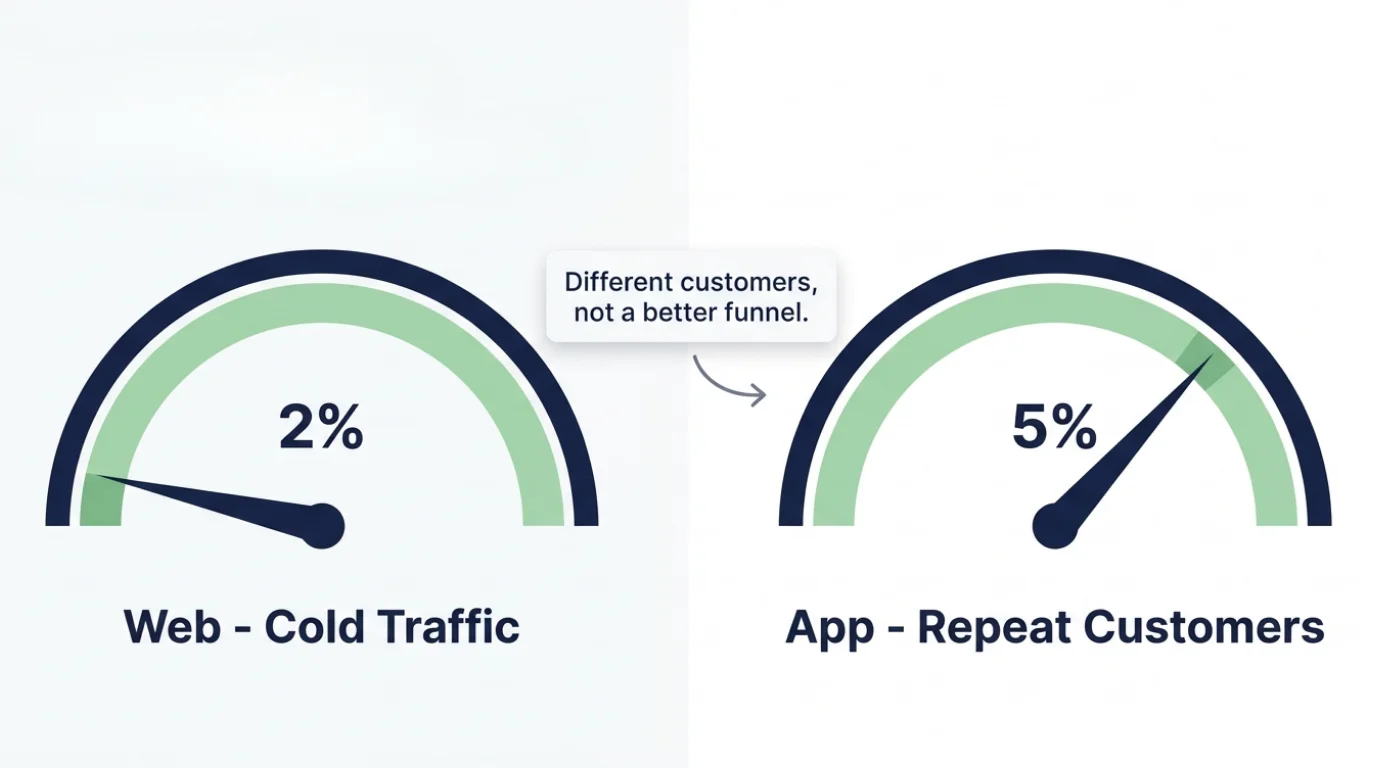
The conversion rate gap exists primarily because of who's shopping in each channel, not because apps inherently convert that much better.
A mobile website gets traffic from all kinds of sources, with wildly different levels of intent.
There’s someone coming back to reorder their staples, alongside someone who clicked a link from a Facebook ad, someone who made a Google search and opened five different brands’ sites, and someone who clicked a link from an email.
In an app, each visitor comes with a higher level of intent. They know you, they downloaded your app. They’re built to convert at a higher rate, no matter the surface.
Is There a Real Conversion Boost from the App Itself?
Strip out the audience effect for a second. Same customer, same intent, same product - does the app format actually convert better than mobile web?
Yes. Just not by as much as the headline stats suggest.
A few things genuinely drive higher conversion rates in an app:
- Fewer distractions. No browser tabs competing for attention, no cross-site retargeting, no banner ads, no auto-playing videos from other tabs.
- Persistent login and saved payment details. It’s generally smoother to check out in an app, and the user is likely already logged in, reducing the number of steps required to buy.
- Faster load times and smoother navigation. No reloads, no waiting for pages to render. The session stays warm.
- Stable cart state. Carts don't get lost when the browser crashes or the user multitasks.
- No price-comparison friction. A shopper in your app isn't toggling between five competitor tabs.
Add it all up, and yes, the same shopper will probably convert at a higher rate inside your app than on your mobile site.
It’s just not as high as the data suggests.
The bulk of the buying experience really isn’t that much different. And there’s not a lot you can do in an app that you can’t do on the mobile web (such as one-click payment options like Apple Pay and Shop Pay) in the first place.
Abandoned cart recovery in apps
Apps also give you a free, direct channel to recover would-be lost sales. A push notification an hour after a shopper bails on checkout (or the next morning) can pull them back in to complete the purchase. Functionally, that's a conversion lift on the same traffic, just measured a few hours later than the original session - and it's one of the highest-ROI features an app unlocks.
Why Conversion Rate Is the Wrong KPI for Your App
Conversion rate is fundamentally an efficiency metric. It measures how well you turn earned and paid traffic into revenue. It tells you whether you're squeezing enough value out of every visit.
That makes sense for your website. Website traffic is scarce and expensive. You're paying for clicks, fighting for SEO rankings, and competing for organic visibility against every other brand in your category. Every visit has to count.
Apps don't operate under the same economics.
App Sessions Aren't a Scarce Resource
Once a customer installs your app, opening it costs you nothing.
You're not paying per visit. You're not bidding against competitors for their attention. A push notification costs zero dollars and lands directly on the lock screen. A returning customer who opens the app because they saw your icon on their home screen also costs zero dollars.
When sessions are abundant and free, "what percentage of sessions convert?" stops being the metric that matters. The constraint that makes conversion rate most meaningful on your website (scarce, expensive traffic) doesn't apply.
Habitual Engagement Beats Per-Session Conversion
The job of an app isn't to maximize the conversion rate of every individual session. It's to drive repeat opens and habitual engagement.
A customer who opens your app eight times this week and buys once is more valuable than a customer who opens it once and buys once at a higher conversion rate.
The first customer is in your orbit. The second one might forget about you next month.
For most ecommerce brands, frequency multiplied by AOV beats raw conversion rate every time.
So Why Launch an App? Retention, AOV, and Repeat Engagement
If conversion rate isn't the reason to build an app, what is? Is there any difference?
Apps deliver the biggest uptick in the metrics that drive long-term revenue: retention, average order value, and engagement frequency. This is where the format genuinely changes the customer experience, and it's where you'll see the biggest delta if you launch one.
Retention and Repeat Purchase Rate
App users come back more often than web users. The mechanics are simple - your app icon sits on their home screen next to Amazon and Instagram, push notifications reach them directly, and re-entry takes one tap instead of typing your URL or digging through email.
A customer who shops with you once every three months on the web could be a customer who shops multiple times a month in the app. That shift compounds into significantly higher retention rates and customer LTV.
Average Order Value
App sessions run deeper than web sessions. Users browse longer, stack more items into carts, and use features like wishlists and recommendations more often. That depth shows up in average order value.
It's not unusual to see $70 mobile web AOV climb to $100+ in the app, with the same product catalog and pricing, just because the app keeps the shopper engaged for longer.
Engagement Frequency
Mobile web sessions are short. Three minutes is typical. App sessions routinely run double that.
More time in your store equals more product exposure, more discovery, and more repeat behavior. Over a 12-month window, that engagement gap is what produces the LTV difference between an app user and a web-only user.
Best KPIs to Track in Your App
So if conversion rate isn't the right KPI for your app, what is?
These are the core KPIs that track how your app is performing:
- Daily and monthly active users (DAU, MAU)
- Sessions per user per week
- Repeat purchase rate (app users vs web-only users)
- 30, 60, and 90-day retention curves
- LTV by channel over a 12-month window
- Push engagement - opt-in rate, open rate, attributed revenue
Monitor and optimize those numbers. Stop benchmarking your app against your mobile web conversion rate. It's not the same job.
The Real Fix for the Mobile Conversion Rate Problem
Now let's address the elephant in the room. If your mobile web conversion rate is sitting at 1.8% and you want to fix it, an app isn't the answer.
The fix is improving your mobile web experience. Not shifting your attention to a different surface.
This is where most operators get stuck. They see the conversion gap, assume the app is the magic fix, and skip past the actual problem - which is that their mobile site is underperforming.
Mobile Web Has Never Been More Capable
The tools available to build a high-converting mobile site today are dramatically better than they were even three years ago.
If you're on Shopify, you have access to themes, apps, and CRO tools that can move your mobile conversion rate substantially. Personalization, dynamic content, on-page recommendations, AI-assisted product discovery, smart search, instant checkout - all of it is available, much of it for cheap or free.
AI specifically has changed the game. Generative product descriptions, dynamic merchandising, image-based search, real-time chat agents, predictive personalization. Capabilities that required enterprise budgets two years ago now ship in $50/month apps (or even Shopify’s core features).
If your mobile site is converting at 1.8%, there's almost certainly significant low-hanging fruit on the table.
The Math of a 1.8% to 2.5% Lift
Even a small uptick in conversion rate on your website will likely drive a massive impact for your overall business economics.
Say you're driving 250,000 monthly mobile web visitors. Your mobile conversion rate is the industry average of 1.8%. Your AOV is $100.
- 250,000 visitors x 1.8% CVR = 4,500 orders
- 4,500 orders x $100 AOV = $450,000/month in mobile web revenue
Now run a CRO push and lift that conversion rate to 2.5%. Same traffic, same AOV, same product catalog.
- 250,000 visitors x 2.5% CVR = 6,250 orders
- 6,250 orders x $100 AOV = $625,000/month
That's an extra $175,000/month, or roughly $2.1M/year, from a single round of CRO improvements on your mobile site. No new traffic acquired, no new channel launched, no platform migration.
And there's nothing aspirational about 2.5%. Plenty of well-optimized mobile sites convert at 3% or higher. The ceiling is well above where most brands sit.
Fix your website first. The math is overwhelmingly in your favor.
The Bonus - Improve Your Website’s Conversion Rate, Improve Your App
A lot of operators want to ship a separate app, a completely different surface, as a way to “fix” conversion rates.
Realistically this is just fixing conversion rates for the top ~10% of your customers, and ignoring the rest - and now giving you a new channel to manage.
This is why launching an app with MobiLoud is so smart.
With MobiLoud, your app reflects your web experience. The checkout flow, design, UX, and everything else you build on the web carries over to the app.
When you do CRO work to improve your mobile website, that carries over to your app as well. You’re not treating the app and website as completely separate storefronts. When you ship improvements, you’re shipping them across every surface your customers shop on.
This makes your work compounding, rather than fragmented.
The Final Word on Mobile Apps & Conversion Rates
Mobile apps don't fix conversion rates. They're the wrong tool for that job.
What apps do is deepen the relationship with the customers who already love you - the top 10-15% who drive a disproportionate share of your revenue. That's where it’s worth launching an app - to boost retention, AOV, repeat engagement, and LTV.
If you want to lift your mobile conversion rate, fix your mobile website. That’s where most of your traffic lands, and modern tools mean that just about anything you can build in an app, you can realistically build on the web as well.
Don’t look at the problem backwards, like many operators. Build a perfectly optimized mobile website, and turn it into a mobile app that extends your improvements to a new, high-retention, high-engagement mobile channel.