Of all the arguments for and against a mobile app, the one that matters most is ROI.
What kind of return on investment are you getting from launching a mobile app? In simplest terms, how much am I getting back for every dollar I invest in it?
That’s what you need to know if you’re a business owner, or if you’re presenting the project to your board, your CEO, or your boss.
And that’s what we’re going to address here: the clear business case for a mobile app, specifically for fashion and apparel brands. We’ll look at the statistical benchmarks you can expect, where the ROI comes from, and how to maximize your chance of launching an app that adds multiples to your bottom line.
Data sources
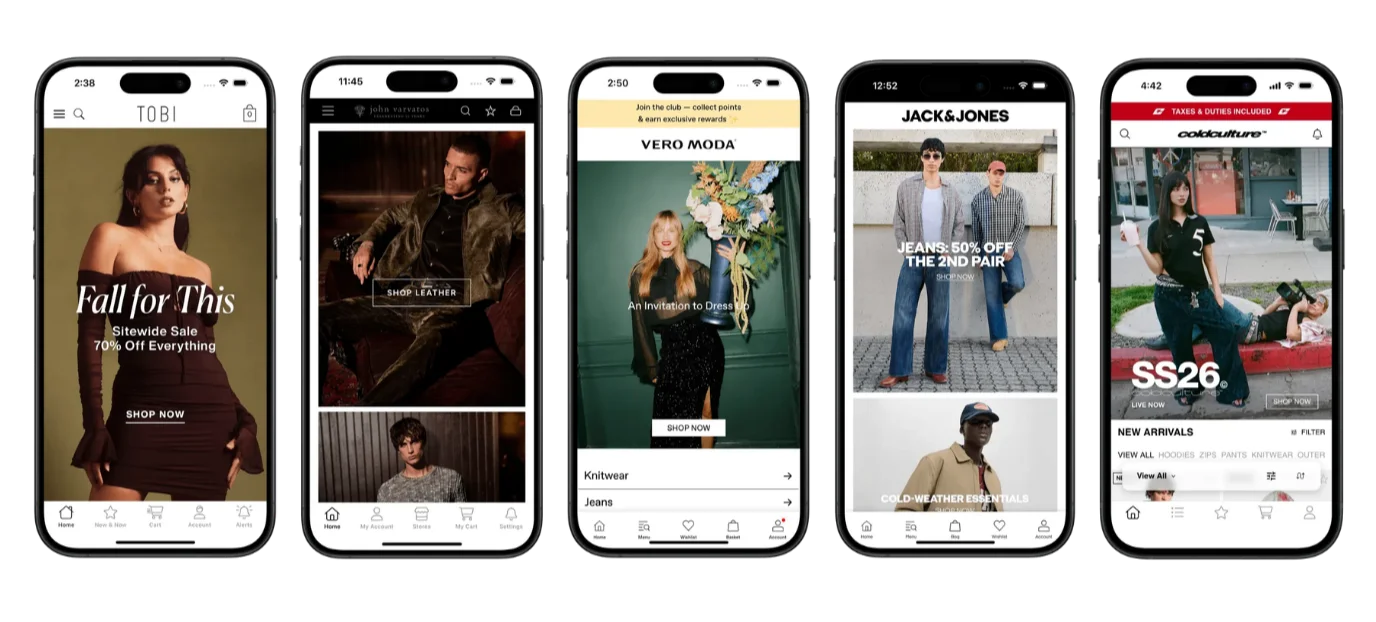
These numbers come from fashion brands we've worked with at MobiLoud (including brands like John Varvatos, Jack & Jones and Cold Culture), combined with industry benchmarks and data from publicly available case studies. Get a free consultation to discuss the business case in more detail.
What's the Typical ROI of a Fashion Mobile App?
Fashion brands with mobile apps typically generate 10-30% of total online revenue from the app, with top performers exceeding 30%. That revenue comes from a small slice of the customer base (5-15% of active users), which means revenue per app user runs 3-10x higher than mobile web visitors.
Here are some examples of the revenue impact of mobile apps for fashion brands:
- Tadashi Shoji (luxury fashion, Magento) sees 18% of total online revenue through their app, with 10x revenue per app user vs mobile web.
- John Varvatos (luxury fashion, Salesforce Commerce Cloud) gets 10x higher revenue per user through their mobile app.
- XCVI (women's fashion, Shopify) gets 4.8x higher revenue per app user, with 30% higher AOV in the app.
- Junior Couture (luxury childrenswear, Salesforce Commerce Cloud) saw around 50% of their BFCM sales in 2025 come through their app, despite app users making up just 5% of their customer base.
There are two primary things to take into account.
One is how app users contribute an outsized share of revenue. On a user for user basis, each app shopper is more valuable and more important to your business.
The second is the overall revenue potential of your mobile app.
Taking a benchmark of 20% revenue contribution, a mobile app could generate over $1M per year for a brand doing $5M+ in total online revenue.
That’s a real revenue channel.
The Four Drivers of ROI for Fashion Apps
So where does all that ROI come from?
It's not any one thing. Four main drivers stack on top of each other to produce the lift in the numbers above, and each one compounds the others.
Higher Average Order Value (10-50%+ Per Order)
App users spend more per order. The MobiLoud Ecommerce Mobile App Benchmark Report shows AOV lifts of 10-50% are typical across verticals, with fashion no different - such as XCVI, who sees +30% AOV in the app vs mobile web.
Apps keep shoppers engaged for longer, with fewer distractions pulling them away. And longer session times lead to larger baskets, more money spent in each order.
Higher Conversion Rates (2-8x Mobile Web)
Your app users convert at 2-8x the rate of mobile web shoppers. XCVI sees 2x higher conversion in the app. Tadashi Shoji sees 8.3x. The industry benchmark for fashion apps sits around 2.6% in-app vs 0.2% mobile web, an 11x gap.
Mobile apps are more convenient, built for the device, and easier to navigate without the browser chrome. That, plus the higher quality of shoppers who come to your app, means each session is more likely to end in a sale.
Repeat Purchase Rate and Customer Lifetime Value
This is the compounding driver, and it's the one that makes the case over the long term.
Fashion app users don't just spend more once. They spend more over months and years, and they buy more often.
That's the full force of compounding: more sessions, better retention, higher repeat rate, more purchases per year.
The mechanism is habit. A home screen icon next to a shopper's social apps gets opened. And once a customer hits three or four purchases with your brand, retention shifts from a monthly decision to a default.
Research from Smile.io across 1.1 billion shoppers shows that a first-time buyer has a 27% chance of a second purchase, a 49% chance of a third, and 62% after that.
Fashion sits at the high end of this curve, because customers who find brands they trust often become near-exclusive buyers in certain categories (jeans, basics, activewear, outerwear).
Your app is what gets them to the third or fourth purchase faster than any other channel.
"The app's been invaluable to us. The cost we're paying versus what we're getting back is tenfold."
-- Nick Barbarise, Director of IT at John Varvatos
Push Notifications as a Zero-Cost Retention Channel
Push is the channel that doesn't exist without an app. And it's the single most cost-efficient message you can send.
Push notifications reach customers who aren't on your site, aren't reading email, and aren't thinking about your brand at that moment. They cost effectively nothing per message. That means each sale you get as a result of a push notification is essentially found money.
For a fashion brand, the push plays are straightforward:
- Drop alerts. A new collection lands and a large share of app users open within the hour.
- Back-in-stock notifications. Shoppers who wanted a sold-out item buy fast when it returns.
- Loyalty tier nudges. "You're $30 away from free shipping" turns a browser into a buyer.
- Abandoned cart recovery. Push lands on the lock screen within minutes. Some MobiLoud brands see 10-22% conversion rates on abandoned cart push.
This matters more now than ever. Meta CPMs are up 19% year-over-year and ecommerce CAC has climbed roughly 40% since 2023. Push is how fashion brands keep their customer economics intact while acquisition costs climb everywhere else.
How to Model ROI for Your Own Fashion Brand
Industry averages are a useful starting point. The real question is what an app would look like for your specific brand. Here's the framework.
The Inputs You Need
Pull these from your analytics before you model anything:
- Annual online revenue. Total across channels.
- Mobile share of online revenue. For most fashion brands this is 50-80%.
- Current mobile web conversion rate. Your baseline.
- Current mobile AOV. Your baseline.
- Repeat purchase rate. How many customers buy more than once in 12 months.
If your repeat purchase rate is under 20%, the retention driver will do less of the heavy lifting for you. You'll lean more on conversion and AOV lift instead.
The Lift Assumptions (Conservative, Realistic, Aggressive)
Three scenarios using the benchmark ranges. Pick the one that matches your brand.
| Driver | Conservative | Realistic | Aggressive |
|---|---|---|---|
| App adoption | 5% of mobile users | 10% of mobile users | 15%+ of mobile users |
| Conversion lift | 2x mobile web | 3x mobile web | 5x+ mobile web |
| AOV lift | +10% | +20% | +30-50% |
| Repeat rate lift | 1.5x | 3x | 5-7x |
| Share of online revenue | 10% | 20% | 30%+ |
A small boutique with low mobile share and infrequent repeat purchases sits in conservative. A mid-sized DTC brand with strong email and SMS and a loyalty program sits in realistic. A drop-driven brand with a cult following and sub-$1,000 AOV sits in aggressive.
Want to see how much revenue you could get from an app? Use our free calculator to spin up an estimation in seconds.
How Much of That Revenue Is Incremental?
Here's the elephant in the room. How much of that app revenue is genuinely new, versus revenue that would have happened on your website anyway?
Some overlap always exists. A portion of your app purchases would have closed on mobile web if the app didn't exist. Pretending otherwise is dishonest.
But the useful question isn't "where did this sale happen?" It's "would this customer have spent this much, this often, at all?"
A conservative assumption is that 50% of your app revenue is net new. The other half shifts from mobile web to the app. Use that as your floor when you model.
In reality, the incremental share is usually higher. Four parts of the lift are genuinely new revenue:
- Push-driven revenue is incremental by definition. Every dollar you generate from push is new, because the channel doesn't exist without the app. Abandoned cart recovery alone generates anywhere from $20K to $200K per month for MobiLoud brands.
- AOV lift on purchases that would have happened anyway. A $100 order on mobile web becomes a $130 order in the app. The extra $30 is incremental.
- Increased session frequency. App users visit more often. John Varvatos sees 12x more sessions per app user vs mobile web. These extra sessions aren't cannibalized from the website; they're new touchpoints that drive new purchases.
- Compounded retention. App users stay customers longer and buy more over their lifetime. The long-tail LTV lift is net new.
Realistically the incremental share usually lands somewhere in the 60-80% range.
If you want a deeper breakdown with the math worked out, see our article where we answer the question once and for all: is mobile app revenue incremental?
For the rest of this article, we'll use the 50% conservative floor. Whatever ROI comes out of that math is the low end of what you'd actually see.
The Cost Side: What You Spend on Your Mobile App
Revenue lift is only half of the ROI equation. What you spend matters just as much, because the ROI multiple you earn depends entirely on the denominator.
The money you spend on developing an app can fall in a very wide range.
If you’re building a custom native app, you’re looking at $100K-$250K+ upfront, on top of the sizable recurring costs for OS updates, integration updates, bug fixes, and adding new features.
That cuts a long way into your ROI - and if your app doesn’t generate quite as much revenue as you hope (or takes longer to get there), you might not even make any profit after COGS and associated costs.
There are better options, though - which make a positive ROI essentially a given.
MobiLoud: The High-ROI Mobile App Builder for Fashion Brands
MobiLoud turns your existing fashion website into full-featured native iOS and Android apps. Your catalog, checkout, product pages, loyalty, subscriptions, and personalization all carry over. You get push notifications, app store presence, and a home screen icon on top of the user experience you’ve already built and perfected over years.
It’s faster and simpler than building a custom app - and significantly more cost-effective.
Instead of a six-figure cost (and a 6-12 month timeline), you’re looking at a cost starting from $1,499 per month, and a time to launch of weeks, not months.
The cost includes ongoing maintenance and updates (which can add up to another six figures in annual costs for custom app development), and means a ten to twenty times lower total investment - with the same revenue lift on the other end.
Payback Period
Alongside the total ROI, a more efficient approach like MobiLoud’s offers another big advantage: significantly faster payback period.
This is the first level of ROI: earning back the money you spent to build the app.
It’s not the whole story, but it’s an important part - because until you hit payback, the project is considered a loss.
With a custom app, you can expect six months, minimum, before you even get a working version of your app. You don’t start making any money back on your investment until at least this time.
With MobiLoud, you’re live in 6 to 8 weeks (for 10% of the cost). That makes the payback period just around a couple of months - and significantly reduces the risk, because you’re almost guaranteed to recoup your investment within a short time frame.
Does ROI Differ by Fashion Sub-Segment?
Of course, fashion is not just fashion. It’s brands like H&M, it’s independent boutiques, it’s designer labels, it’s streetwear brands.
We’ve worked with just about all of them - so we’ve got an idea of how the ROI differs across each sub-category.
Here’s an idea of what you can expect for different types of fashion brands.
Luxury Fashion
High AOV ($300-$2,000+) magnifies the dollar value of every conversion lift. A 2x conversion on a $500 AOV is worth more than a 5x conversion on a $40 AOV.
Low-friction checkout, saved addresses, and VIP-style treatment (like we’ve seen at Tadashi Shoji, John Varvatos, Moda di Andrea) push per-user revenue multiples to 10x mobile web or higher.
Luxury customers expect white-glove treatment; your app is how you deliver it at scale.
Mid-Market DTC Brands
This is where loyalty, drops, and repeat purchases do the work.
Most fashion brands are in this segment, and typically see app users generating 4.8-7x vs mobile web on revenue per user.
These brands win by making their app the native home of their loyalty program and their new-arrival calendar. Push notifications for drops and back-in-stock do disproportionate work.
Fast Fashion and Mass Market
This is where apps have the biggest impact. Realistically, the strategy for brands like Temu, Shein, and older players like H&M and ASOS is app-first.
For these brands, it’s all about volume, and building regular browsing habits, which the likes of Shein and Temu in particular have nailed to perfection.
Resale and Secondhand
Peer-to-peer marketplaces like Vinted, Depop, and Poshmark run a different model. But if you're a DTC fashion brand exploring a resale layer, your app is usually where that integration lives.
Resale has been the fastest-growing fashion app category in recent years, and having your own app lets you launch a resale experience without funneling customers to a third-party marketplace.
When a Fashion Mobile App Doesn't Deliver ROI
Not every fashion brand should necessarily have an app. The equations we’ve looked at here assume certain conditions - and without these conditions, the ROI question looks different.
You need to be above a certain revenue tier, and have the right customer base to justify an app.
Here are some times when an app may not be worth it (yet):
- You’re under $1M annual online revenue: Your app’s revenue potential at 20%+ of total revenue is a lot tighter. Typically better to focus on scaling further through acquisition first.
- Mobile traffic under 50% of total: If your customers don’t predominantly shop on mobile, app adoption will likely be a lot less.
- Your mobile experience is broken: The biggest mistake is launching a mobile app to fix a poor mobile website. That’s backwards - you’ll always get more traffic to your website, so fix this first (then extend it into an app with MobiLoud).
- One-and-done purchase brands: If your fashion brand has very low repeat purchase potential, the app might not make sense. You may be surprised, though (we’ve found high-AOV luxury brands typically get the highest ROI from an app).
It generally comes down to having an accessible market large enough to justify the cost of your app, plus having a customer base who would actually want to use it.
Don’t make the mistake of thinking that you need all your customers to download the app. You just need a small, engaged share of customers (5-15% of your total customer base) to justify launching an app.
How to Maximize Your Fashion App ROI
A mobile app can be a major revenue generator, and one of the best ROI plays a clothing brand can make.
That said, it’s not a given. You need to be smart about how you build, manage, and promote it.
- Make it visible: you don’t need to do a lot to promote it, but at the very least, make sure people know it exists. Your best customers want to use the app. Just tell them about it.
- Use push notifications: they’re your #1 engagement tool, and not only drive revenue, but maintain app retention as well.
- Keep your app up to date: a buggy or outdated app won’t hold on to users.
- Build the right way: a MobiLoud build comes with less than a tenth of the cost of a custom app, and even less of the ongoing complexity you get from managing a completely separate storefront. It completely changes the ROI equation.
MobiLoud builds, submits and manages your app for you. You get all the benefits of a mobile app, with minimal lift and expense.
All this with a short payback period, a consistent user experience with your website, and a team behind you to support your growth.
If you want to see what’s possible, get in touch and book a free preview of your app. We’ll show you an interactive preview of what it could look like, as well as walking you through the business case and the potential ROI that’s on the line.