Most of your customers are shopping on a phone right now. They're scrolling your site on the bus, abandoning their cart in line at a coffee shop, or watching a creator talk about your product inside TikTok.
Mobile commerce, or any shopping and buying that happens on a mobile device, is the dominant surface in ecommerce. And there’s a big gap between brands who build for mobile, and those who treat it as secondary.
Your mobile reach and user experience starts from the foundation you rely on; the mobile commerce platform(s) behind the scenes, powering your store on customers’ phones.
Keep reading and we’ll break down everything that goes into a powerful mobile commerce stack, from your website to other mobile-first surfaces that you need to be on.
The Top Mobile Commerce Platforms in 2026
We’ll dive deeper in a moment; first, here’s a quick overview of some of the top mobile commerce platforms running the world’s top ecommerce brands today:
| Platform | Type | Best for |
|---|---|---|
| Shopify | Mobile web | The default for most DTC and ecommerce brands; native one-tap checkout with Shop Pay |
| BigCommerce | Mobile web | Mid-market and B2B brands needing strong omnichannel and headless flexibility |
| Adobe Commerce (Magento) | Mobile web | Enterprise and complex catalogs with a dev team to customize |
| Salesforce Commerce Cloud | Mobile web | Enterprise retailers already on the Salesforce stack |
| WooCommerce | Mobile web | WordPress-native brands and teams comfortable in the WP ecosystem |
| Wix Stores | Mobile web | Small businesses and first-time stores wanting a drag-and-drop builder |
| Squarespace | Mobile web | Design-led brands launching fast with a polished storefront |
| MobiLoud | Mobile app | Mid-market and enterprise brands looking for a full-service mobile app solution |
| Tapcart | Mobile app | Shopify brands looking for a no-code, DIY app builder |
| TikTok Shop | Social commerce | Content-driven brands with strong creator partnerships |
| Instagram and Facebook Shopping | Social commerce | Brands already running Meta acquisition who want product tags on content |
| Whatnot, Bambuser, CommentSold | Live shopping | Collectibles, fashion drops, beauty, and F&B with theatrical fit |
What Is Mobile Commerce, Really?
Mobile commerce, or m-commerce, can be broadly defined as any commercial transaction that happens on a mobile device, typically a smartphone.
So that’s the stuffy dictionary definition. You can get that from ChatGPT.
But what does it really mean? Because mobile commerce is more than just one channel - it’s an idea that spans every part of a buyer’s experience when they’re on their phone.
This includes:
Mobile web
Your responsive ecommerce site, rendered on a phone browser. The mobile web is the largest single surface in mobile commerce - more people go online via mobile than desktop now, so the most likely way someone is going to find you is on the mobile web.
Mobile apps
Native iOS and Android shopping apps for individual brands and marketplaces. Another core mobile commerce channel. There are hundreds of billions of mobile apps downloaded each year, and a large number of these downloads come from shopping apps, from huge names like Amazon, Walmart and Temu, to independent DTC brands and retailers.
Social and live shopping
Buying directly inside TikTok, Instagram, Facebook, or a live-stream marketplace like Whatnot. Social/live shopping is the fastest-growing slice of mobile commerce, though it's still smaller in the US than in China, where live commerce already drives a meaningful share of retail.
Mobile payments and wallets
Apple Pay, Google Pay, Shop Pay, PayPal one-click, and Buy Now Pay Later options like Klarna and Affirm. Digital wallets account for 53% of global online purchases (Statista). These are not "platforms" in the same sense, but they are core elements of the mobile commerce ecosystem.
Why Mobile Commerce Is Where Brands Need to Win
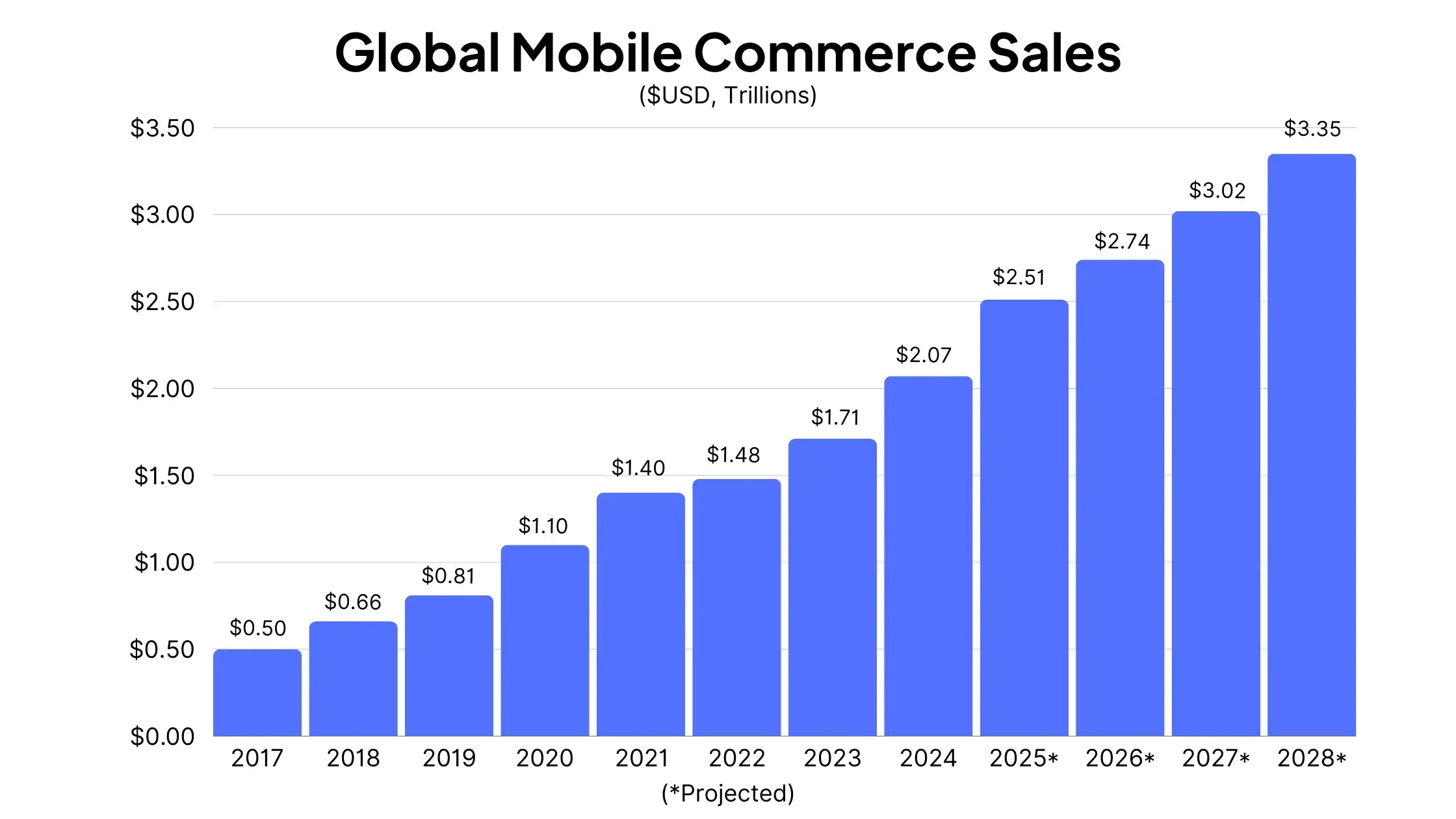
Mobile has officially become the way most people prefer to shop.
75-77% of all ecommerce website traffic comes from a phone (Statista, SimilarWeb). During the holiday season, that figure has hit as high as 79% globally (Salesforce Shopping Index).
And it’s not just window shopping, but revenue too. 56.4% of all US online sales in the 2025 holiday season came from mobile, up from 54.5% the year before. On Thanksgiving Day, mobile reached 61.6%. On Christmas Day, 66.5%.
The US has historically lagged the global average on mobile commerce share. Globally, mobile already accounts for around 57% of ecommerce sales (Statista). In the US, it's roughly 44.6% of all ecommerce sales (eMarketer), with growth on pace to push past 49% by 2027.
But holiday data suggests the US is getting there faster than the forecasts assume.
Whatever data you look at, it should be clear that mobile commerce is a major factor in ecommerce today - if not the factor.
Ecommerce businesses should be building mobile-first. Not the other way around.
The Best Mobile Commerce Platforms (Mobile Web)
Now let’s take a look at the platforms powering mobile commerce today. We’re going to break it down into several different categories, covering the three major categories of mobile commerce: starting with your mobile ecommerce website.
Shopify
Shopify is the largest ecommerce platform in the US, powering roughly 2.8 million US stores and 4.8 million globally. It processes over $500 billion in GMV per year and reached 561 million unique customers in 2022.
Mobile is where Shopify stands out the most. Every paid Shopify theme is responsive out of the box. Shop Pay, Shopify's accelerated checkout, is one of the fastest one-tap mobile checkouts in ecommerce, and Shopify's own data shows it converts up to 50% better than guest checkout.
For most brands, Shopify is the safest mobile web foundation you can build on.
BigCommerce
BigCommerce holds a smaller share of the overall market than Shopify but punches above its weight with mid-market and B2B brands. The platform includes capabilities other platforms charge for as apps: multi-currency, multi-storefront, B2B price lists, and advanced SEO are built in.
For mobile, BigCommerce offers responsive themes and native mobile checkout, plus a more mature headless story than Shopify for brands building custom mobile front-ends via API.
If you're a brand that needs flexibility on the front-end without leaving a hosted backend, BigCommerce is the strongest mobile web platform in its tier.
Adobe Commerce (Magento)
Adobe Commerce, formerly Magento, is the open-source platform behind a lot of the world's complex ecommerce builds. It powers around 113,000 stores globally and shows up in roughly 9% of the top one million ecommerce sites by traffic, where you'd expect to find brands with B2B complexity, regulatory constraints, or catalogs in the tens of thousands of SKUs.
For mobile web, Adobe Commerce supports progressive web app storefronts through PWA Studio, plus standard responsive themes for brands not going headless. It assumes you have a development team or partner agency on hand. The most flexible mobile web foundation on this list, with the highest cost of ownership to match.
Salesforce Commerce Cloud
Salesforce Commerce Cloud doesn't show up in overall store count rankings, but it's a major player at the enterprise end: roughly 8% of the top 10,000 ecommerce sites by traffic run on it.
These are mostly large, complex retailers that need tight integration between commerce, CRM, and marketing automation.
For mobile, SFCC offers the Composable Storefront (formerly PWA Kit) for progressive web app builds and headless APIs for custom mobile front-ends.
It’s a powerful platform - the complexity and cost are overkill for independent DTC brands, but it’s a great fit for large organizations that need more than just a simple website builder.
WooCommerce
WooCommerce is an open-source WordPress plugin and the most widely used ecommerce platform globally, with around 4.3 million active stores. In the US it sits at around 14% market share, behind Shopify, Wix, and Squarespace, but among the top one million ecommerce sites by traffic its share jumps to 18%, closer to Shopify's 29%.
Every modern WordPress theme is responsive, and the plugin ecosystem covers Apple Pay, Google Pay, Stripe, PayPal, Klarna, and effectively every mobile payment method you'd want.
WooCommerce is the cheapest way to run a serious mobile-friendly store, provided you (or your team) are comfortable in WordPress. The flexibility is the point: if you can describe the feature, there's a plugin or a custom build that gets you there.
Wix Stores
Wix has grown from a general-purpose website builder into the second-largest ecommerce platform in the US, with around 23% share and over a million stores. Its drag-and-drop visual editor makes it the easiest no-developer way to launch a mobile-friendly store.
Wix Stores includes hosting, mobile-responsive templates, native Apple Pay and Google Pay integration, and a built-in mobile checkout. It's particularly common among brick-and-mortar businesses adding an online sales channel for the first time.
There’s not as big of an ecosystem as Shopify or WooCommerce, but more than enough to run a clean mobile-friendly store at smaller scale.
Squarespace
Squarespace holds around 16% of the US ecommerce market, built on the strength of its design-first templates and a polished editing experience.
When it comes to mobile, Squarespace templates are responsive by default, Apple Pay and Google Pay integrate natively, and the mobile checkout works cleanly out of the box. It’s primarily targeted towards creative businesses, artists, and brands where visual presentation matters most. Less depth on the integrations side than Shopify or WooCommerce, but easier to launch a beautiful mobile-friendly store on faster.
Mobile Commerce Platforms (Mobile Apps)
A mobile-friendly site is the baseline mobile commerce platform every brand needs (and, by now, has). It’s the first place a customer is going to find you, and the most important part of your mobile commerce stack.
The part fewer brands have? A mobile app. Yet it’s another crucial part of a complete mobile commerce strategy.
Here are the mobile commerce platforms driving this part of the ecosystem.
MobiLoud
MobiLoud builds native iOS and Android apps powered by your existing website.
It works with every mobile web platform out there - including Shopify, BigCommerce, Adobe Commerce, Salesforce Commerce Cloud, WooCommerce, as well as fully custom stacks and legacy platforms.
As a mobile commerce platform, MobiLoud lets you run a custom mobile app, without having to maintain a separate codebase. The platform comes with a dedicated team to manage your app, letting you be present on multiple facets of mobile commerce, without multiplying the work for your team.
Tapcart
Tapcart is a no-code mobile app builder for Shopify stores, and another platform for extending your mobile commerce strategy to a mobile app.
Brands install it from the Shopify App Store, configure their app through a self-serve dashboard, and manage the day-to-day themselves.
It's a long-standing name in the category, with brands like Princess Polly, BÉIS, and BruMate among its customers, and a focus increasingly on AI-driven personalization and in-app marketing. It only works with Shopify, but if that’s not a blocker, this (and other app builders on the Shopify App Store) is a solid way to launch a new mobile channel for your brand.
Social and Live Shopping Platforms
Mobile commerce isn't only happening on your own surfaces. A growing share of mobile shopping starts (and increasingly finishes) inside the social apps where customers already spend hours a day. These aren't replacements for your storefront, but they're surfaces a serious mobile commerce strategy plans for.
TikTok Shop
TikTok Shop puts checkout directly inside the TikTok app. After a year of regulatory uncertainty, TikTok's US operations formally transitioned to the TikTok USDS Joint Venture in January 2026 under American ownership, and TikTok Shop is operating in the US as part of that entity.
TikTok Shop is a powerful channel for brands with content-driven discovery, strong creator partnerships, and a product mix that lends itself to impulse buys: beauty, apparel, supplements, food and beverage, accessories. It's been one of the fastest-growing slices of mobile commerce since the US Shop rollout, and now that the ownership question has settled, it's a more realistic channel to plan around.
Instagram and Facebook Shopping
Meta's social shopping setup looks different than it did two years ago. As of September 2025, Shops on Facebook and Instagram in the US now redirect to your website for checkout rather than completing the transaction in-app (Meta). Native in-app checkout was retired.
What's left is still useful: product tagging in posts, Reels, and Stories that links customers directly to product pages on your site. It's a low-friction product-tag layer on top of content marketing you're already doing on Meta.
For brands running Meta as a primary acquisition channel, Shops is worth keeping live, but the dynamic has shifted from "buy without leaving" to "tap to land on the right page faster."
Live Shopping Platforms (Whatnot, Bambuser, and others)
Live shopping is the format that's been "about to break out in the US" for several years, and 2025 was the year it finally moved past pilot mode. Whatnot, the largest live-shopping marketplace in the US, drove over $8 billion in GMV in 2025, more than double the year before.
Marketplaces like Whatnot are standalone platforms where shoppers come to discover and buy from many sellers at once; they fit collectibles, fashion drops, beauty, and trading cards particularly well.
On the other hand, white-label tools like Bambuser and CommentSold let brands embed live shopping directly into their own site or app, which keeps the customer relationship on your side of the wall.
Live shopping is still smaller in the US than in China and other Southeast Asia markets, where it's a meaningful share of total ecommerce. But the format is now real enough that brands in the right categories should at least be running it as an experiment.
Putting Your Mobile Commerce Stack Together
Mobile commerce is not just one channel. It’s not just your website; it’s not just your app or your TikTok livestream.
It’s everything. It’s how you appear to customers on mobile, how you sell to these customers, and how you keep them engaged and keep them coming back.
Here’s how you build a holistic strategy, tying multiple mobile commerce platforms together:
- Start with your mobile website. Whichever ecommerce platform you're on, get the user experience dialed in for mobile. Mobile-friendly checkout, one-tap payment options, and a theme that’s fast and mobile-usable.
- Add a mobile app for your repeat customers. Your mobile website is the generalist: the channel built for new customers, and casual returning customers. The app is a home base for your VIPs. It’s easier for return customers, and can be optimized to provide the ideal experience for people who already know and love your brand.
- Layer social and live commerce if they fit your category. TikTok Shop, Instagram tags, and live drops are real channels for brands in the right verticals. Use them for discovery and acquisition, and to round out your mobile commerce strategy.
The holistic approach is important because not all mobile shoppers are the same.
There’s someone wasting an afternoon on TikTok, browsing livestreams. There’s someone putting a high-intent search into Google. There’s a loyal customer, window shopping the latest product drops on your site. There’s a consumable buyer coming back to re-up because they’re about to run out.
Different buyers might come to you from different angles. It might be your website, it might be a livestream, or the ideal surface might be a mobile app.
You need to be present everywhere.
“Our apps never had any functionality or usability beyond the web experience. The reason to have an app is not to have something that isn’t on the website, but for people who prefer that way to access Rainbow content.”
-- David Cost, VP of Ecommerce at Rainbow Shops
Final Thoughts
Mobile is clearly the dominant surface in ecommerce today. And it’s a trend that’s unlikely to reverse.
Success as an ecommerce brand is strongly tied to how well you can capture (and keep) mobile shoppers. The brands that still see ecommerce as desktop-first are going the same way as the dinosaurs.
If you don’t want your business to become a fossil, it’s time to get serious about mobile. That means more than just having a responsive website that loads pretty fast; but having a website that feels like it was designed for mobile, and also having additional mobile commerce channels to complement your site, like a mobile app.
If you don’t have an app yet, MobiLoud makes it easy. No hiring developers, no juggling multiple codebases. You manage everything from your site, and still get to ship a custom, VIP-first experience, in an app that lives on your best customers’ phones.
Get in touch and get a free app preview to see what’s possible, and learn everything you need to know about going live with your own branded app.