Do Customers Really Use Retail Apps?

Yes, customers really do use retail apps. Roughly 88% of US consumers have at least one mobile shopping app installed on their phone, and nearly one in three says they prefer shopping in-app over any other channel. The channel exists, customers use it, and a measurable share of US ecommerce already happens inside apps rather than on mobile websites.
Yes, customers really do use retail apps. Roughly 88% of US consumers have at least one mobile shopping app installed on their phone, and nearly one in three says they prefer shopping in-app over any other channel. The channel exists, customers use it, and a measurable share of US ecommerce already happens inside apps rather than on mobile websites.
The biggest pushback I see online when someone suggests you should launch a mobile app (or asks for recommendations on how to launch one) is something along the lines of “why? No one uses apps.”
But "do customers use retail apps" isn't quite the question most operators are really asking. The real version is closer to "do enough of MY customers use apps to make this worth doing for my store?"
That version has a more interesting answer.
And the short answer: while there’s some truth behind the objection - a lot of shoppers are not going to download your app - there’s a subset of customers who will, and that segment does not need to be very large to justify the decision to build one.
Here's who uses retail apps, why people like to claim that "nobody uses apps", what the slice of your customers who would install your app looks like, and what the math comes out to for a $10M-revenue brand thinking about the channel.
Yes, Customers Do Use Retail Apps
Shopping apps are mainstream consumer behavior in the US and globally. The data is unambiguous.
A 2022 NewStore survey of 610 American consumers found that 88% have at least one mobile shopping app installed on their phone, half have four or more, and 9% have more than ten.
31% prefer shopping in-app over shopping in-store or via mobile or desktop web. Among consumers under 44, the percentage of people with at least one shopping app on their phone hits 96%, and shopping apps rank as the preferred shopping method for the segment.
Research from ironSource puts the engagement number higher: 90% of consumers have multiple shopping apps on their phones, and 95% use at least one of those apps at least once a month.
Two-thirds of respondents named a shopping app among their top ten most-used apps.
In-store behavior tracks the same way. According to Airship research reported by eMarketer, 74% of consumers worldwide use a retailer's app while they're shopping in a physical store, up from 65% the year before. eMarketer also forecasts that two-thirds of US smartphone users will use shopping or retail apps by 2025.
If you look at some of the biggest names in retail, it’s clear that at least some people use retail apps.
Amazon's shopping app sits at around 197 million monthly active users globally, with most of them in the United States.
The app isn't a niche channel for Amazon; it's the dominant way Amazon's customers interact with the brand.
Other big-name retailers (Walmart, Target, Sephora, Nike, Shein, Temu) are pulling enormous in-app volume, and the same pattern shows up at a smaller scale in DTC.
The existence question is settled. The interesting question is who those users are.
The "Nobody Uses Apps" Misconception (And Why You Feel This Way)
This is what I often see on Reddit, on LinkedIn posts, and other places online.
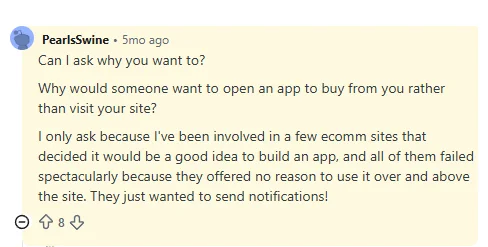
One person asks for recommendations on how to build an app for their store. The peanut gallery scoffs at why they’d want to do such a thing in the first place.
.webp)
.webp)
The thing is, the objection is not totally random. It’s based on a few core misconceptions related to mobile apps and consumer shopping behavior.
1. "I Don't Use Apps"
The first is the "I don't use retail apps" projection.
Your personal phone is one data point; your customer base is not. People who manage ecommerce stores tend to skew toward direct, intentional shopping behavior on the web.
People who buy from those stores skew toward whatever channel makes the next purchase easier. The 88% of US consumers with a shopping app installed includes plenty of people who would tell you, if asked in passing, that they don't really use shopping apps.
2. "Hardly Anyone Will Use It"
The second is the "most of my customers won't download the app" reasoning.
That's actually true. Most of your customers won’t download the app.
Typical install rates land between 5% and 20% of the active customer base. But that hides what that small share represents: the brand's highest-LTV customers, the ones who've already bought repeatedly and want a faster way to keep buying.
A small slice of your total customer base routinely produces a disproportionate share of brand revenue through the app. The install rate is a small input feeding a much larger output.
3. "Apps Are Useless"
The third idea is the "what does an app even add for the customer" objection. (see Reddit comments above)
It’s assuming that launching an app is completely self-serving; that convincing someone to download your app is just a con job so you can ruin their life with spam notifications.
Apps provide real value for certain customers.
- Quicker, more convenient access to your store (one tap from the home screen)
- A smoother shopping experience (not affected by whatever the latest thing iOS did to break Safari)
- Direct updates from the brand about promos, new products, other perks (some customers actually do want to hear from brands)
- A user experience built for returning customers (a brand’s website is often optimized to convert new customers; an app can be built to make it easier for regular customers to reorder/discover new products)
- VIP perks (many brands use the app as a defacto VIP list, giving app users first dibs on promos or product drops)
There’s a lot you can do in a new channel - especially when you can optimize every part of the user experience for people who already know your brand.
Who Uses Retail Apps
The through-line with all the common objections about mobile apps is that it assumes you’re launching one for everyone; that your goal is to have as many app users as email subscribers.
The customers who install a brand's mobile app are typically a small slice of the total customer base - often under 10%, sometimes 15-20% for brands where repeat purchases are natural (F&B, beauty).
That segment is the most valuable segment a brand has.
They've already bought, usually more than once. They liked the brand enough to install the app. They self-select toward the lower-friction channel because they want to buy from this brand more often, faster, with fewer steps.
For these customers, the app does provide real value. They do want to receive push notifications. They want a more convenient way to interact with the brand, to buy from the brand.
David Cost, VP of Ecommerce at Rainbow Shops, said this (which sums up the case for mobile apps perfectly:
"In our experience, users break into two camps. There are users who prefer to buy on the app and users who prefer using the browser. You can't convince one to go the other way, you need to meet them where they are.
Our apps never had any functionality or usability beyond the web experience. The reason to have an app is not to have something that isn't on the website, but for people who prefer that way to access Rainbow content."
The key line? “You need to meet them where they are.”
Some people just prefer to use apps. Some specifically want an app from the brands they visit the most.
You’re just giving them what they want.
The Impact of Giving Your Best Customers an App
When you give your best customers what they want, you see some real, positive results that make launching it more than worthwhile (even if only a small share of your customers download it).
This is where the incrementality debate comes in - and is again disproven.
When you offer an app, the customers who download it:
- Shop more often (since it’s easier, less friction to come back to your store)
- Shop for longer (because the shopping experience is smoother, with fewer distractions)
- Convert more, spend more in each order (because of the improved user experience, tailored to repeat customers)
- Churn less (the app icon keeps your brand top of mind. Customers who otherwise might have stopped buying from you, out of atrophy, stay for longer)
The last one might be the most important; someone who downloads your app is inherently more valuable to your brand, because they had the kind of intent to want to download your app in the first place.
But without consistent touchpoints, brand loyalty atrophies, even for once hyper-engaged customers.
App users have stronger revenue metrics across the board (see our Ecommerce Mobile App Benchmark Report for more on this).
And the most important metric that improves is LTV - which often just comes from holding on to your best customers for longer, which naturally leads to more revenue and stronger profit margins over time.
The Math: Even Small Adoption Pays Off
We mentioned up top that you don’t need a large slice of your customer base to download the app in order for it to be a success.
Here’s the math to show what we mean.
Take a $10M-revenue ecommerce brand. Assume 5% of the total customer base installs and uses the app (that's deliberately conservative by the way).
That 5% naturally spends more; partly because of the better experience in the app, partly because they’re just wired to spend more from the average customer.
Brands we work with always see a disproportionate revenue contribution from app users. So if 5% of your customers use the app, it’s likely that you’ll see at least 10% of total revenue come through the app - closer to 15-20% in most cases.
(the disparity can be even greater. Junior Couture saw 50% of their peak season revenue through the app, from just 5% of their customers. Pharmazone gets 63% of their online revenue through their app, from around 15% of their customers).
So if we take the deliberately conservative estimates - 5% of your customers contributing 10% of total revenue - the mobile app for a $10M brand is a sales channel doing $1M annually.
It comes out to the same figure for a brand half the size ($5M annually) doing stronger in their app (20% of total revenue - which is in the midpoint of the 10-35% average revenue share we generally see from apps).
Cost to Revenue (ROI) of the App
It shouldn't be hard to see the value in a channel contributing $1M in annual revenue.
But the case gets even better if you take the cost into account.
With MobiLoud, the cost to build and maintain your app starts at $1,499 per month, with a one-time, four-figure setup fee upfront.
That’s nearly $100K in monthly revenue, on a cost of a little over a thousand per month. With MobiLoud, everything’s done for you, there’s no separate system to manage, and no major workflow changes coming along with your app.
That cost to benefit math makes having an app a no-brainer.
The Straight Answer
Yes, customers really do use retail apps.
They use the apps from massive brands like Amazon, Sephora, Gymshark. They also use apps from smaller brands, brands that aren’t household names, but are well-known in smaller ecommerce niches like men’s grooming and skincare, or clean protein and fitness supplements.
The big misconception is the idea that you’re launching an app for everyone. You’re not.
An app is for a small slice of a brand’s customer base. The most engaged, the most dialed in to the brand.
That could only be 5% of their total active customer base. But 5% is more than enough to make an app worthwhile.
If you’re a brand doing seven figures plus and see the case - or if you need more convincing - get in touch with us.
Book a free strategy call and we’ll walk through it with you, show you what an app could look like, and help you decide if launching a mobile app is the right move for your brand.
FAQs

Convert your website into a mobile app