What Is Headless Ecommerce? A Complete Guide for 2026

Headless ecommerce separates your store's frontend (what customers see) from the backend (where products, orders, and data live). This gives you full control over the shopping experience across every channel, from your website to native mobile apps, without being locked into one platform's templates. It's not right for everyone, but for brands outgrowing their current platform, it's a meaningful architectural upgrade.
Headless ecommerce separates your store's frontend (what customers see) from the backend (where products, orders, and data live). This gives you full control over the shopping experience across every channel, from your website to native mobile apps, without being locked into one platform's templates. It's not right for everyone, but for brands outgrowing their current platform, it's a meaningful architectural upgrade.
Most ecommerce platforms are built as a single, tightly bundled system. Shopify, BigCommerce, WooCommerce: they all work this way out of the box. Pick a theme, customize within the platform's boundaries, manage everything in one place.
That model works well until it doesn't.
At some point, growing brands run into limits: the checkout can't be customized past a certain point, the page builder won't support a new layout, or launching a mobile app means starting from scratch because the platform was only designed to serve a website.
Headless ecommerce is the architectural response to those limits. This guide covers what it actually is, how it works, where it shines, and where it creates problems you didn't have before.
What Is Headless Ecommerce?
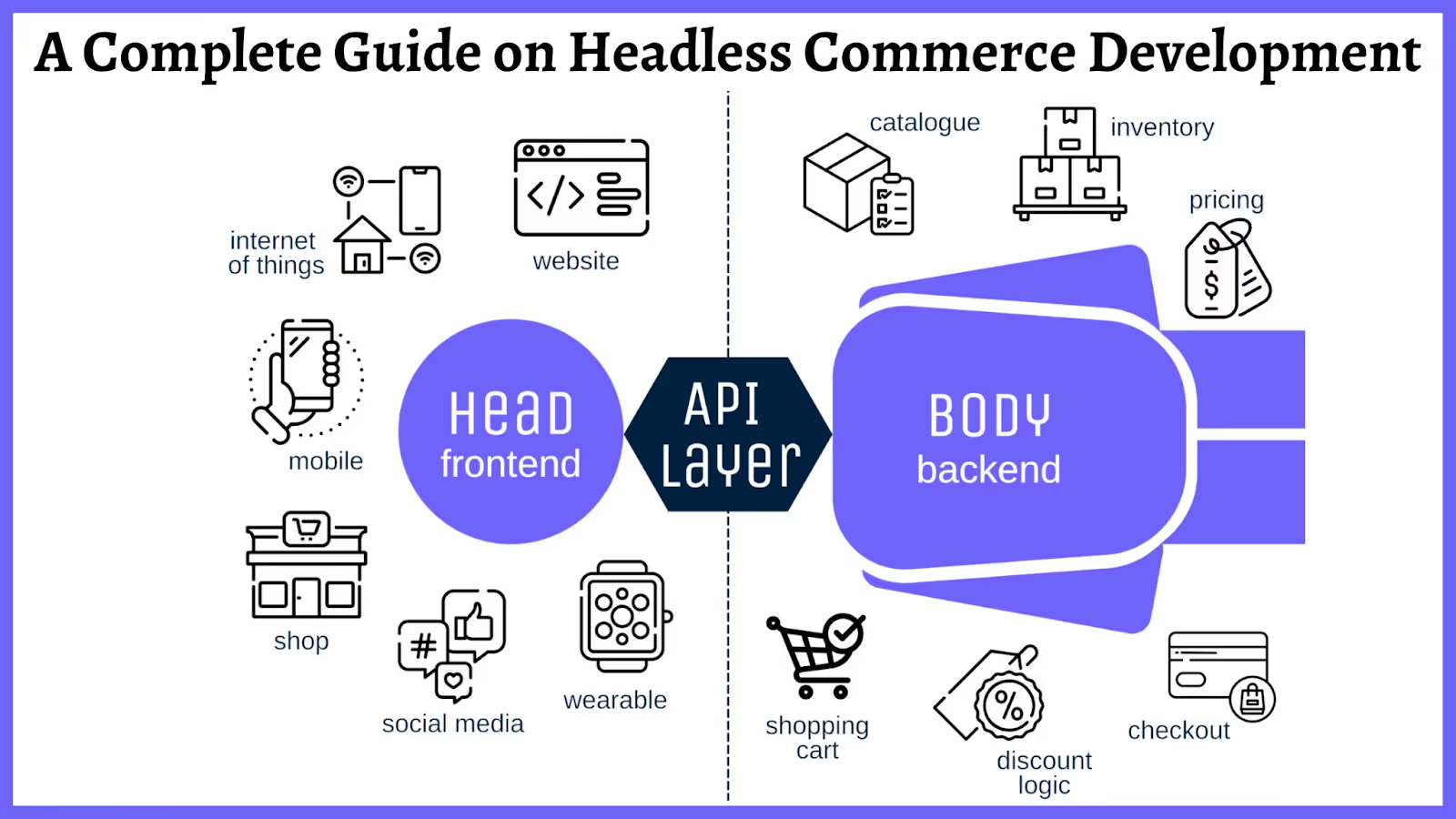
Headless ecommerce (or headless commerce) decouples the frontend of your store (the storefront customers interact with) from the backend (the commerce engine that handles products, inventory, pricing, orders, and payments).
The two layers communicate through APIs instead of being wired together in one system.
In a traditional setup, the backend dictates what the frontend can do. Your storefront is a layer of the platform itself, built within its templating system.
In a headless setup, the backend provides data and functionality through APIs, and the frontend can be anything: a custom React website, a native mobile app, a voice interface, a kiosk in a physical store. The commerce engine doesn't care how the data is displayed. It just delivers it on request.
This separation is what makes headless flexible. Your developers aren't constrained by a platform's theme editor. They can build exactly the experience they want, with whatever frontend technology makes sense for the channel.
Headless vs Traditional: At a Glance
How Headless Commerce Works
On a technical level, APIs (Application Programming Interfaces) act as messengers between the backend and whatever frontends you build.
Here's the simplified breakdown:
- A customer visits your store (on web, in your app, or through another channel)
- The frontend sends a request to the backend via API: "Show me the products in 'New Arrivals'"
- The backend processes the request and returns the data: product names, prices, images, inventory status
- The frontend receives that data and renders it according to its own design
This happens for everything: product pages, search results, cart updates, checkout, order tracking. Every interaction between the customer-facing experience and the data layer goes through APIs.
The practical upshot of this is you can run multiple frontends off the same backend. Your website, your iOS app, your Android app, and your in-store displays all pull from the same product catalog, share the same inventory, and process orders through the same system.
Update a price in the backend and it's reflected everywhere, instantly.
Benefits of Headless Ecommerce
Here are some of the top reasons brands go headless:
Full Frontend Flexibility
This is the primary reason brands go headless. You're no longer limited to what a theme editor allows.
- A completely custom product page layout
- An unconventional checkout flow
- An interactive lookbook that doesn't fit any template
All this is possible when your frontend is decoupled from the commerce engine.
This matters most for brands where the shopping experience is the differentiator, like luxury, fashion, lifestyle brands where a generic storefront undermines the brand often hit the template ceiling first.
Better Performance
When the frontend is built independently, developers can optimize it specifically for speed.
They're not loading an entire platform's framework just to render a product page. Modern frontend frameworks (Next.js, Nuxt, Remix) enable static generation, edge caching, and code splitting that are difficult or impossible within traditional platform themes.
The performance impact compounds at scale. Google's research on Core Web Vitals consistently shows that faster page loads correlate with higher conversion rates and lower bounce rates.
True Omnichannel Delivery
Traditional platforms are built for one primary channel: the web. If you want a native mobile app, you either build it from scratch or use a service that connects to your backend separately.
Headless makes omnichannel native to the architecture. The same commerce engine powers your website, your mobile apps, your in-store displays, and whatever channel comes next. One product catalog, one inventory system, multiple storefronts.
This is where headless delivers the most long-term value. As commerce expands beyond the browser (into apps, voice, social, and physical retail), having an API-first backend means you can meet customers on new channels without rebuilding your infrastructure each time.
Scalability
API-based architectures handle traffic spikes differently than monolithic platforms. Because the frontend and backend are separate, you can scale each independently. A surge during a product drop or flash sale? Scale the frontend delivery layer without touching the backend.
For brands running on cloud infrastructure, this means more efficient resource allocation and more graceful handling of peak traffic.
Technology Freedom
Headless doesn't lock you into one vendor's ecosystem. You can swap your CMS without touching your commerce engine. You can rebuild your frontend in a different framework without migrating product data. Each component of your stack can be upgraded independently.
This is the foundation of composable commerce: the idea that your tech stack is assembled from best-in-class components rather than relying on one platform to do everything.
Challenges of Going Headless
Headless isn't a universal upgrade. It comes with real tradeoffs that make it the wrong choice for many brands.
Higher Complexity
With a traditional platform, one vendor handles everything. With headless, you're managing multiple systems: a commerce engine, a CMS, a frontend framework, potentially separate services for search, payments, and personalization.
Each integration point is something that needs to be built, maintained, and monitored.
This isn't insurmountable, but it requires either an in-house technical team or reliable agency partners. Brands without developer resources shouldn't go headless.
Higher Upfront Cost
Building a custom headless frontend costs more upfront than using a platform's built-in templates. Depending on the complexity, a custom headless build can run from $50,000 to well over $500,000 for enterprise implementations.
That's before factoring in the headless CMS, search, personalization, and other services that a traditional platform bundles in.
The cost equation shifts over time. Headless typically reduces the cost of ongoing changes and new channel launches. But the initial investment is significant, and you need enough revenue to justify it.
Content Management Gets Harder
In a traditional setup, your marketing team edits pages and updates banners through the platform's built-in editor. In headless, content management usually requires a separate headless CMS, and the editing experience depends entirely on how well it's set up.
Some headless CMS platforms (Builder.io, Contentful, Sanity) offer visual editing that approaches the ease of traditional platforms. But it's an additional system to configure, maintain, and pay for.
Mobile App Delivery Isn't Automatic
Going headless solves the web frontend problem. It does not automatically give you a native mobile app.
Your headless backend can absolutely power an app (the APIs are there), but someone still needs to build, submit, maintain, and update that app on iOS and Android.
This is where many headless brands stall when it comes to launching the last piece of their omnichannel strategy. They build the core infrastructure, but realize that building and managing multiple frontends is a lot more costly and complicated than expected.
Headless Commerce in Practice
Brands across categories have adopted headless for different reasons - some of these brands among the world’s biggest merchants.
Nike rebuilt its digital experience on a headless architecture to support personalized, market-specific storefronts across dozens of countries, all powered by the same backend. The performance and personalization gains directly supported their shift toward direct-to-consumer sales.
Target uses a headless approach to unify its web, app, and in-store experiences. The same commerce backend powers product data, pricing, and inventory across channels, which is critical for services like same-day pickup and delivery.
Burberry went headless to deliver the kind of immersive, editorial shopping experience that luxury brands need but traditional ecommerce templates can't support.
Who Should Consider Headless Ecommerce?
Headless makes sense when:
- You've outgrown your platform's templates. Your brand needs custom experiences that can't be built within a theme editor or page builder.
- You're selling across multiple channels. Web, mobile app, marketplace, in-store, and you need them all pulling from the same backend.
- You have developer resources (in-house or agency) to build and maintain custom frontends.
- Your revenue justifies the investment. Most brands that benefit from headless are doing $10M+ annually. Below that, the ROI rarely justifies the added complexity.
- You want to own your frontend roadmap. If you're tired of waiting for platform updates or workarounds, headless puts the pace of innovation in your hands.
Headless probably isn't right if:
- You're early-stage and still iterating on product-market fit
- Your team doesn't include developers (and you don't want to hire an agency)
- A traditional platform meets your current and near-term needs
- You're looking for simpler, not more complex
Popular Headless Ecommerce Platforms
The platform you choose as your headless backend matters. Some are built headless-first; others are traditional platforms that now offer headless capabilities.
- Headless-first platforms: Commercetools, Fabric, Medusa, Saleor
- Traditional platforms with headless options: Shopify Plus (via Hydrogen/Oxygen), BigCommerce, Adobe Commerce (Magento), Salesforce Commerce Cloud
Each has different strengths depending on your scale, team size, and technical requirements. See our full comparison of headless ecommerce platforms for detailed breakdowns.
Getting Started with Headless Commerce
If you're evaluating whether to go headless, here are some tips for how to decide if it’s the right move; and to set yourself up for success.
- Audit your current limits. What's actually holding you back? Is it frontend customization, performance, multi-channel delivery, or something else? Your constraints should drive the architecture, not the other way around.
- Choose your commerce engine carefully. This is the most consequential decision. Migrating commerce platforms later is expensive and disruptive. Pick one that matches your scale and team.
- Plan for mobile from day one. Modern brands need an app. A done-for-you service like MobiLoud can launch a native app from your headless storefront in weeks, while a custom build takes months. Plan the channel strategy upfront.
- Build incrementally. You don't have to go fully headless overnight. Many brands start by decoupling one part of their frontend (like the product page or checkout) and expanding from there. This reduces risk and lets you validate the approach before committing fully.
Headless can be a great way to build and maintain flexibility in ecommerce. It’s not everything, and it’s not always the way to go. Assess the options and weigh up for your own store whether or not this makes sense.
FAQs

Convert your website into a mobile app