Table of contents
Build vs buy is one of the oldest frameworks in enterprise technology.
The question is simple: should your company build a piece of software internally, or buy an existing solution?
The thing is, the answer looks very different depending on the use case. Build vs buy for a CRM or ERP is a lot different than for a mobile app. The latter can get complicated.
In this article, we’ll clearly explain the framework for you, plus the problem with build vs buy for mobile apps. We’ll give our recommendation for the best approach - including a solution that gives you the best of both worlds.
What "Build vs Buy" Means
Build vs buy is a decision framework for whether to develop software internally or purchase an existing solution.
A classic example would be a CRM. You could “build” your own CRM internally; every line of code built and managed in-house. Or you could “buy” access to a platform like Salesforce or HubSpot.
For mobile apps, "build" means hiring developers or an agency to create a custom app from scratch, while the "buy" path typically means using an app builder platform.
However, the lines are blurrier than with other software categories. This means it’s hard to rely on the same build vs buy pros and cons matrix you’ve read everywhere else when it comes to launching your app.
Where the Framework Breaks Down for Mobile Apps
With a CRM, an email marketing platform, an ERP, a help desk, "buy" means you sign up, configure it, and you have a working product.
Salesforce is a CRM. Klaviyo is an email platform. The product is fully formed. You're buying a finished solution and adapting it to your needs.
With mobile apps, "buy" doesn't work like that.
No app builder hands you a finished app. You buy access to a platform, then build your app inside it: choosing a template, configuring your navigation and pay layouts, connecting data sources, populating content, testing across devices, iterating on the experience.
The platform gives you tools, but you still do the work.
The reason this is important is that many of the traditional benefits of buying don't fully apply with mobile apps. Buying software typically means:
- Immediate time to value. You sign up, configure, and start using it within days or weeks.
- No engineering resources required. Your team uses the product; they don't build it.
- Automatic updates. The vendor improves the product for everyone.
- Predictable, low maintenance. The vendor handles the infrastructure.
With app builders, you get some of these benefits, but not all.
You still need time to build and configure the app. You still need someone to manage it. You’re responsible for a lot more technical maintenance (even if you’re not managing the underlying code) than if you were just installing an app or using a SaaS.
The Case for Building Your Own Ecommerce App
So - while understanding that build vs buy is not as clear cut in this arena - let’s get into the main debate.
Should you “build” your app?
Building custom gives you the most control. You define every screen, every interaction, every pixel.
You can, objectively, ship the best possible version of your app (assuming you have the budget for it).
You’ve got:
- Full creative control over UX and design
- Ability to build features that don't exist on the web (AR try-on, barcode scanning, complex offline workflows, hardware integration)
- Potential competitive moat if your app experience is truly differentiated
- No dependency on a third-party platform's roadmap or limitations
Sounds perfect, right?
So what’s the downside?
The Cost of Building Your Own App
Custom ecommerce app development costs typically start around $150K, for any moderately complex ecommerce store.
It’s a project with a lot of moving parts, lasting anywhere from 6-18 months.
And when you go live, that’s not the end. You’ve got the classic downside of building vs buying: maintenance.
Building your own app can cost six figures plus per year to maintain; and that’s being relatively conservative.
“If we had unlimited time and money, we would probably go for a custom native app, but that is half a million to a million a year to maintain.”
- David Cost, VP of Ecommerce at Rainbow Shops
The integration problem
Think of all the tools running your ecommerce website.
You might have:
- Search (Algolia)
- Email and SMS (Klaviyo)
- Reviews (Yotpo, Judge.me)
- Loyalty (Smile.io, LoyaltyLion)
- Subscriptions (ReCharge)
- Personalization (Nosto, Dynamic Yield)
- Live chat (Gorgias)
- Payment processing
- Shipping
- Tax calculation
- Fraud detection.
A typical mid-market ecommerce store runs 20-40 integrations that directly touch the customer experience. Enterprise stores can run 80-100+.
When you build a custom app, you need to build a custom integration for each of these things, if you want them to work with your app like they do on your website.
A single integration takes roughly 150 engineering hours to build and 300 hours per year to maintain. At 20 integrations, that's 3,000 hours just for the initial build, and 6,000 hours per year to keep them current.
At typical US agency rates of $100-$200/hour, the integration work alone can cost $300,000-$600,000.
The two-codebase problem
Your website changes constantly. New products, updated pricing, seasonal promotions, redesigned pages, new integrations, A/B tests. Your ecommerce team ships changes weekly, sometimes daily.
With a custom app, every one of those changes needs to be repeated in the mobile codebase. It doesn’t seem like much at first, but the dev hours - and the bandwidth - stacks up fast.
It adds a huge amount of operational complexity, which doesn’t just cost a lot, it can start dragging down other areas of your business as well.
The project risk
70% of digital transformation initiatives fail to meet their objectives, according to McKinsey. Custom app projects are no exception.
Scope creep, integration surprises, timeline overruns, and budget blowouts are the norm, not the exception.
The question to ask: Is your mobile app experience so fundamentally different from your website that it justifies a ground-up build, with all the cost, risk, and ongoing maintenance that comes with it?
For most ecommerce brands, the honest answer is no.
The Case for Buying (App Builder Platforms)
Template-driven, no-code app builders promise a faster, cheaper alternative.
Instead of building from scratch, you use templates, drag-and-drop tools, and pre-built connectors to get an app into the App Store faster.
There are a lot of advantages to this approach:
- Lower upfront cost ($200-$500/month typically)
- Faster time to market (weeks instead of months)
- No engineering team required for initial setup
- Pre-built templates and connectors for common use cases
But "buying" an app builder isn't really buying in the traditional sense.
When you “buy” Salesforce, you have a working CRM by the end of the week. When you “buy” an app builder, you have access to a platform. But you still need to:
- Choose and customize templates
- Build out your navigation and page structure
- Connect your data sources and catalog
- Configure your checkout flow
- Set up push notification campaigns
- Test across devices and OS versions
- Submit to the App Store (and handle rejections)
- Keep the app updated as your website changes
You're doing less engineering than a custom build, but you're still building. And you take on ongoing maintenance responsibility that a true "buy" decision typically doesn't require.
The platform limitations
This whole debate assumes there are viable “buy” options that work for you.
Most app builders are Shopify-only. If you’re on Shopify, Shopify Plus, you’re good.
But if you're on Adobe Commerce, Salesforce Commerce Cloud, BigCommerce, or a custom platform, they simply don't work for you.
There are some template-based app builders that work with these platforms, but not many. The complexity of an Adobe Commerce store or a SFCC site is just not a great fit for a no-code app builder.
The API problem
Even if there’s a solution that works with your web platform, there are constraints.
Shopify’s Storefront API has limitations. You may not be able to do everything you do on your website inside the app.
The same thing applies for BigCommerce, Adobe Commerce, WooCommerce, or whichever platform you’re built on.
The integrations you use on your website all rely on custom APIs to work in your app as well.
If the app builder doesn’t support an integration you need, or if the functionality offered by the API isn’t enough, you need to ditch it, or build a custom API (and now you’re “building” not “buying”).
Plus, every API means a potential point of failure; something that can break when the vendor makes an update and unknowingly introduces a conflict with another tool or disrupts custom functionality you’ve built, putting you at risk of downtime and lost sales.
The sync problem
If you’re like most ecommerce brands, your website is your preferred source of truth.
When you add a product, change a price, update a landing page, or launch a promotion, you do so on your website. Launching an app introduces a new channel - essentially a new storefront to update.
With most app builders, those changes don't automatically flow to the app. Someone on your team needs to manage the app as a separate channel, keeping it in sync with the website manually.
This is the gap between "buying" an app builder and truly buying a finished solution. You've bought a tool, but you still own the ongoing work of building and maintaining the app inside it.
What Does Your Ecommerce Brand Actually Need?
You want a mobile app - but have you stopped to think about what that really means?
It’s not a fundamental re-imaginging of your user experience. Your mobile website already does everything you need, and a mobile app is not that much different.
It’s a product catalog, a homepage, collections, a search bar, a loyalty widget, a checkout.
App shoppers aren’t engaging in a fundamentally different way than a mobile web shopper. The differences are peripheral.
- A framework that lets customers download your store and open it from their homescreen
- Removing the browser tabs and other distractions of the mobile browser
- Native push notifications that reach customers on their lock screen
- A persistent, contained experience
Do you need to rebuild that? Do you need to “buy” a solution that operates independently from your website?
Or do you just need to extend your website into a mobile app?
The Third Path: Creating a Custom Native App (Synced with Your Site) with MobiLoud
MobiLoud takes a different approach to the classic build vs buy options.
Instead of building a new app or buying a platform to build one inside, MobiLoud delivers your existing mobile website as a native iOS and Android app.
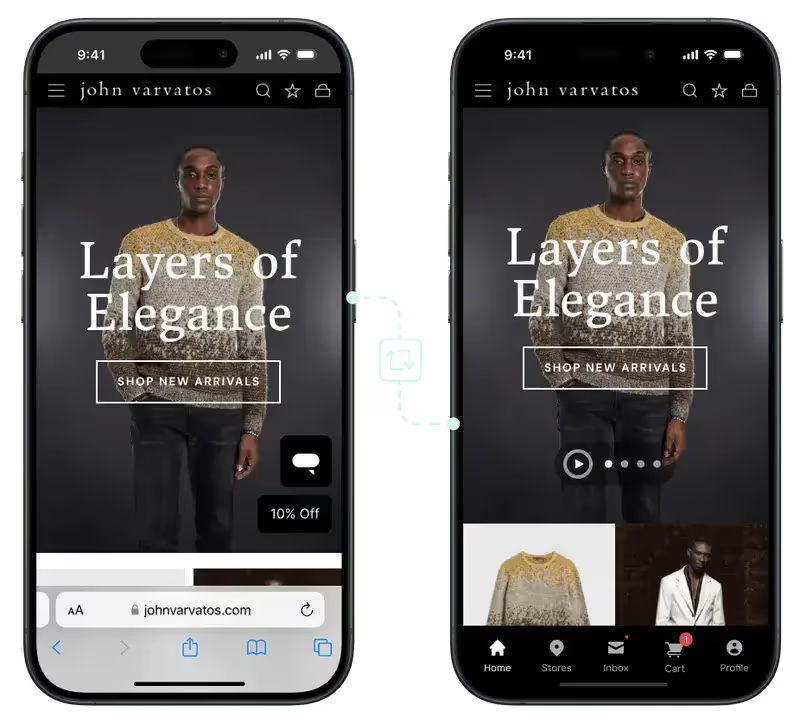
Everything carries over. Product pages, collections, every integration, your checkout flow. If it works on your website, it works in the app.
- Algolia search
- Klaviyo CRM
- ReCharge subscriptions
- Yotpo reviews
- Gorgias live chat
You’re not rebuilding integrations, or sacrificing anything.
And, crucially, your website and app are 100% in sync. There’s no maintaining a separate platform, no duplicate work.
MobiLoud is the best parts of build and best parts of buy, in one.
From "build" you get:
- A real native app in the App Store (not a PWA, not a lite version of a mobile app)
- Full design and brand flexibility - because anything you can build on the web carries over to your app
From "buy" you get:
- Speed: live in the App Store in 6-8 weeks
- Cost: a fraction of custom development (both upfront and ongoing)
- A partner that handles all the the technical aspects of your app for you
It’s a different architectural approach: giving you all of what you really need in a mobile app, with none of the complexity and cost of custom builds, none of the limitations of a “buy” approach.
Comparison: Build vs Buy (vs MobiLoud)
| Custom Build | App Builder | Extend (MobiLoud) | |
|---|---|---|---|
| Upfront Cost | $150K - $500K+ | $200-$1500 | ~$5K |
| Monthly Cost | $12K - $33K (maintenance) | $200 - $1500 | From $1,499 |
| Time to App Store | 6 - 18 months | 2 - 8 weeks | 6-8 weeks |
| Integration Parity | Rebuild each one | Partial | Full |
| Website Sync | Manual | Manual | Automatic, real-time |
| Customization Ceiling | Unlimited | Template-limited | Matches your website |
| Platform Support | Any (at a cost) | Mostly Shopify only | Any website/platform |
| Ongoing Maintenance | Your team or agency | Your team + platform | Fully managed by MobiLoud |
| Engineering Required | Full mobile team | Minimal | None |
| 3-Year TCO | $550K - $1.1M+ | $10K - $25K | ~$50K |
Custom development wins on one dimension: maximum flexibility.
If you need an app that does things your website cannot do, custom is the only path. But for most ecommerce brands, the app needs to do what the website does, plus push notifications and native delivery.
App builders are the cheapest option upfront. But the lower price comes with trade-offs in platform support, integration depth, customization, and the ongoing effort of keeping the app in sync with your site.
It works for smaller Shopify stores with straightforward needs. For mid-market and enterprise brands with complex tech stacks, the limitations become blockers.
MobiLoud's cost is higher than a basic app builder, but it's a fully managed service, with no engineering time required, and no template constraints or integration gaps.
When you factor in the internal team effort that app builders still require, the total cost of ownership could actually be comparable or lower.
Want to discuss which option is right for your ecommerce app? Get a free strategy call and talk over the process, pros and cons.
How to Decide Which Path Is Right for Your Brand
Consider custom development if:
- Your mobile app needs to do things your website fundamentally can't (AR try-on, complex offline workflows, hardware integration like NFC or Bluetooth)
- The mobile app is your primary product, not just a channel
- You have the budget ($500K+), timeline (12+ months), and internal resources to sustain a mobile engineering effort long-term
Consider an app builder if:
- You’re at a lower revenue stage (<$2M annual)
- You're on Shopify, with a relatively standard store setup
- You want your mobile app UX to deviate strongly from your mobile website
- You're comfortable managing the app as a separate channel and handling the sync with your website
Consider extending your website (MobiLoud) if:
- You want your full ecommerce experience in a native app, without rebuilding your tech stack
- You're on any platform - particularly more complex, headless platforms (Shopify Plus, Adobe Commerce, SFCC, BigCommerce)
- You need full integration parity: every tool on your website working in the app, automatically
- You don't want to hire mobile engineers or dedicate internal resources to app maintenance
- You want to be live in the App Store in weeks, not months
Questions to ask before committing to any approach
- What happens to our integrations? How many of our 20-40+ customer-facing tools carry over to the app, and how much work is required to make them work?
- What's the real time to launch? Not the sales pitch. From signed contract to live in the App Store, what does the timeline actually look like?
- Who maintains the app after launch? When iOS 20 drops, when we redesign our checkout, when we swap out our search provider, who does the work?
- Does the app stay in sync with our website? If we launch a promotion at 9 AM, is it live in the app at 9 AM? Or does someone need to update the app separately?
- What's our total cost of ownership over three years? Not just the subscription or build cost. Internal team time, integration work, ongoing maintenance, opportunity cost.
The Build vs Buy Framework: In Summary
Build vs buy is a good starting point any time you think about adding functionality to your business. It forces you to think about cost, control, speed, and strategic value.
When we’re talking about ecommerce mobile apps, we’re talking about a lot more than “functionality”. We’re talking about a whole new channel for your business.
That’s why build vs buy doesn’t always cover the whole picture.
Most ecommerce brands don't need to build a new user experience from the ground up. They just need to extend the one they've already invested in.
A native app powered by the website you’ve spent years perfecting, with push notifications to drive retention, home screen presence to stay top of mind, is all you really need; and understanding this will help you pick the option with the best long-term ROI.
If that sounds like what your brand needs, book a quick strategy call. We'll talk through your website, your tech stack, and help you figure out whether extending makes sense for your situation. No pressure, no commitment.

Andrew Buck
Head of Content
Andrew is a content marketer with close to 10 years' experience creating digitally-native content. He has written extensively on topics related to Shopify, Amazon, ecommerce and digital marketing, drawing on previous experience in high-traffic retail and customer service. He started his marketing career with LandingCube, a SaaS tool for Amazon sellers, and has since progressed to work with numerous successful startups, creating helpful and engaging content, which has been referenced in thousands of publications, including Forbes, the New York Times, and many more leading websites. Now, Andrew runs all content operations for MobiLoud.
Frequently asked questions
How much does it cost to build a custom ecommerce mobile app? +
Custom ecommerce app development typically costs $150,000-$500,000+ upfront, with ongoing maintenance running $150,000-$300,000+ per year. The biggest hidden cost is rebuilding your website's integrations (search, reviews, loyalty, subscriptions, personalization), which can cost as much as the core app itself. Three-year total cost of ownership often reaches $550,000-$1.1M+.
What's the difference between a custom app and an app builder? +
A custom app is built from scratch by developers, giving you maximum control but at significant cost ($150K-$500K+) and timeline (6-18 months). An app builder is a platform you use to create an app from templates, which is cheaper ($200-$500/month) and faster, but limits your customization and typically only supports Shopify. A third option, extending your website into a native app, preserves your existing experience and integrations without rebuilding.
Is there an alternative to building or buying a mobile app? +
Yes. Instead of building from scratch or buying a template-based builder, brands can extend their existing website into a native mobile app. This approach (used by MobiLoud) delivers your full website experience as a native iOS and Android app, inheriting all integrations, content, and features automatically. It combines the native app benefits of a custom build with the speed and cost efficiency of a "buy" decision, typically launching in a matter of weeks.
How long does it take to build an ecommerce mobile app? +
Custom development takes 6-18 months. App builders can get you live in 4-8 weeks, though you'll spend additional time configuring and refining. Extending your website into a native app (MobiLoud's approach) typically takes 6-8 weeks (sometimes less) from kickoff to live in the App Store, because there's no rebuild required.