Composable Commerce: What It Is, How It Works, and When It Makes Sense

Composable commerce is the philosophy of building your ecommerce tech stack from independent, interchangeable components rather than relying on a single monolithic platform. It's an evolution of headless commerce: headless decouples the frontend from the backend, composable decouples everything from everything. The result is maximum flexibility, but also maximum complexity. It's the right approach for enterprise brands with the resources to manage it.
Composable commerce is the philosophy of building your ecommerce tech stack from independent, interchangeable components rather than relying on a single monolithic platform. It's an evolution of headless commerce: headless decouples the frontend from the backend, composable decouples everything from everything. The result is maximum flexibility, but also maximum complexity. It's the right approach for enterprise brands with the resources to manage it.
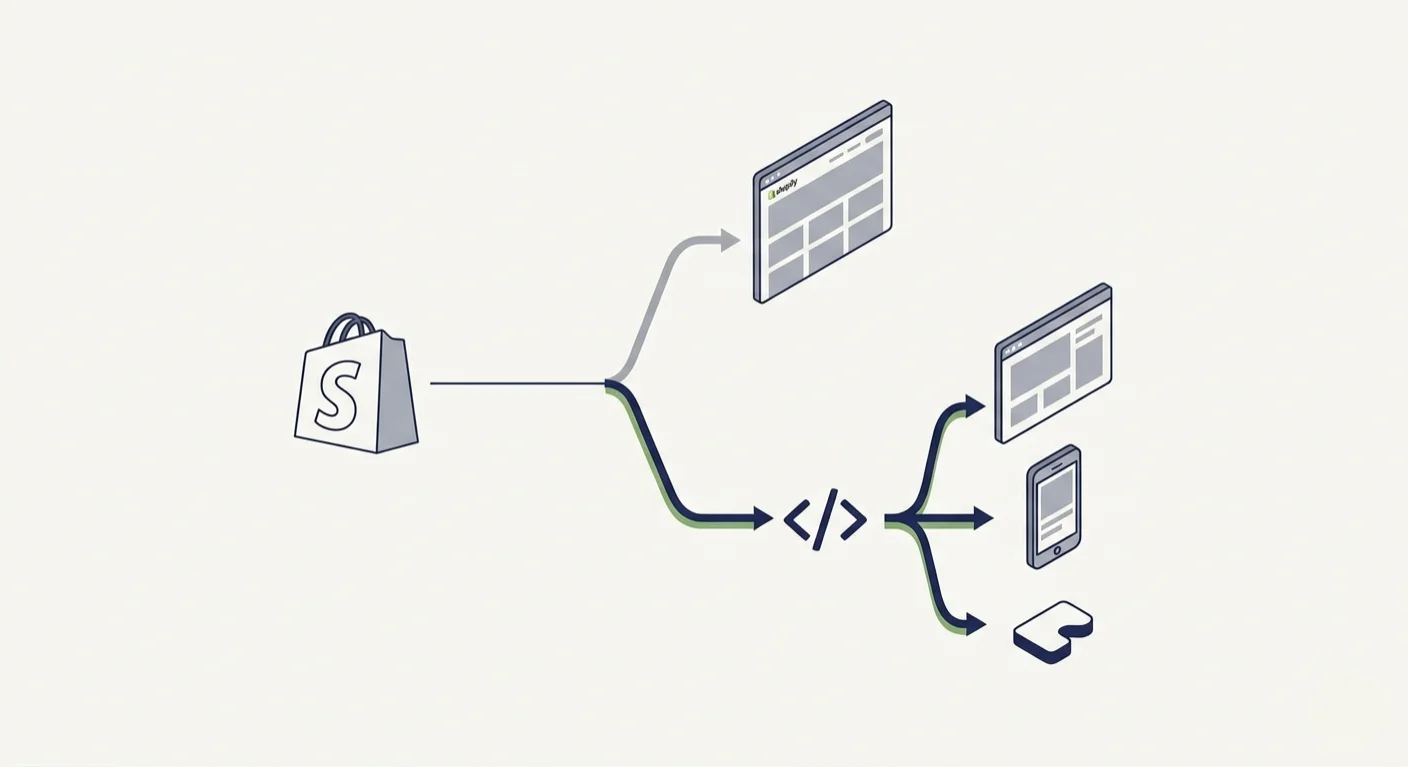
If you've followed the ecommerce architecture conversation over the past few years, you've heard "headless" evolve into "composable." The terms get used interchangeably sometimes, which creates confusion. They're related but not the same thing.
Headless commerce solves one specific problem: separating the frontend from the backend so you can build any customer-facing experience you want.
Composable commerce takes that further. It's the idea that every part of your ecommerce stack should be an independent, swappable component. Not just the frontend, but the search engine, the CMS, the payment processor, the personalization layer, the checkout, the order management, the mobile app delivery.
Each one is a modular service that communicates via APIs, and each one can be replaced without affecting the others.
What Is Composable Commerce?
Composable commerce is an architectural approach where your ecommerce technology stack is assembled from independent, best-in-class components.
Instead of buying one platform that handles everything (commerce, content, search, payments, personalization), you select the best tool for each job and connect them through APIs.
The term was coined by Gartner to describe a shift from monolithic platforms to modular, API-connected architectures. It builds on several principles that the industry groups under the MACH acronym.
The MACH Framework
MACH stands for:
- Microservices: Each capability (search, checkout, content) is an independent service with its own logic and data
- API-first: All functionality is accessible through APIs, so any component can communicate with any other
- Cloud-native: The infrastructure runs on cloud services, enabling independent scaling and deployment
- Headless: The frontend is decoupled from the backend (headless is one element of composable, not the whole thing)
The MACH Alliance is an industry group of vendors that certify their products against these principles. Members include Commercetools, Contentful, Algolia, and others who build the components that make up a composable stack.
If a vendor meets the MACH criteria, their product should plug into a composable stack without forcing you to adopt the rest of their ecosystem.
Composable vs Headless: What's the Difference?
Headless is a subset of composable. All composable architectures are headless, but not all headless setups are composable.
Here's the distinction:
- Headless decouples the frontend from the backend. You might still be running a single monolithic platform on the backend side (Shopify Plus, BigCommerce), with the frontend built separately. The backend is still one system handling commerce, content, search, and checkout.
- Composable decouples everything. The commerce engine, the CMS, the search engine, the personalization layer, the payment system, and the frontend are all independent services. Each can be swapped, upgraded, or scaled without touching the others.
A Practical Example
The above might be difficult to turn into a real image in your head. Here’s a practical example of the difference.
- With a traditional setup: Shopify handles your storefront, products, checkout, content, and basic search. Everything is in one place.
- With a headless setup: Shopify handles your backend (products, checkout, orders). You've built a custom React frontend connected via Shopify's Storefront API. The frontend is decoupled, but the backend is still one system.
- With a composable setup: Commercetools handles commerce (products, pricing, inventory). Contentful handles content. Algolia handles search. Stripe handles payments. Segment handles customer data. Your frontend is custom-built on Next.js. Each component is independent and connected via APIs.
Each step further divides your tech stack into independent silos, each doing their own job.
Benefits of Composable Commerce
Here are some of the reasons a brand might want to go down the composable commerce route:
Best-in-Class Everything
The core promise: instead of accepting one platform's "good enough" version of search, content management, and personalization, you pick the best tool for each job.
- Algolia for search.
- Contentful for content.
- Dynamic Yield for personalization.
- Stripe for payments.
Each vendor is an expert at their specific function.
This matters most when the quality of a specific capability directly impacts revenue. A generic platform search might be adequate for a small catalog. For a brand with 10,000+ SKUs and complex filtering needs, Algolia's search quality can measurably lift conversion.
True Vendor Independence
In a composable stack, no single vendor has lock-in over your entire operation. If your search provider raises prices or falls behind, you can swap it for a competitor without touching your commerce engine, CMS, or frontend. The APIs are the contract, not the vendor.
This is a significant advantage over monolithic platforms where migrating away means migrating everything at once. In composable, migrations happen one component at a time.
Independent Scaling
Each component scales independently. A traffic surge on your frontend doesn't require scaling your CMS or payment processor. A product catalog expansion doesn't require upgrading your search infrastructure unless search performance actually degrades.
For enterprise brands with variable traffic patterns (seasonal, launch-driven, campaign-driven), this means more efficient infrastructure spending.
Faster Innovation Per Component
When each component is independent, teams can update, test, and deploy changes to one service without coordinating across the entire stack.
Your search team can improve relevance without waiting for a platform release. Your content team can restructure the CMS without touching commerce logic.
This is one of the biggest practical benefits for large teams. Composable reduces the coordination overhead that slows down monolithic platforms.
Challenges of Composable Commerce
Composable isn't simple, and the complexity is the primary reason most brands shouldn't adopt it.
Integration Complexity
Every connection between components is an integration you build and maintain. A composable stack with 8-10 components means dozens of API connections, data flows, and potential failure points.
When something breaks, the debugging spans multiple systems, potentially from different vendors with different support teams.
This requires either a sophisticated internal engineering team or a systems integrator with composable experience. It's not a DIY project.
Higher Total Cost
Composable can be more expensive than a monolithic platform, especially initially. You're paying for multiple vendor subscriptions, custom integration work, and a more complex hosting environment.
Some brands report total cost of ownership 2-3x higher than a monolithic platform, though the value is in the flexibility and performance gains.
The economics make sense at enterprise scale, where the revenue impact of better search, personalization, and multi-channel delivery outweighs the infrastructure cost. For mid-market brands, the math often doesn't work.
Talent Requirements
Managing a composable stack requires developers who understand distributed systems, API design, and multi-vendor architectures. This is a narrower talent pool than developers who can build on Shopify or BigCommerce. Hiring and retention costs are higher.
Governance and Standards
With multiple independent components, someone needs to set standards for how data flows between them, how errors are handled, and how releases are coordinated. Without governance, a composable stack can become a fragmented mess where no one has a complete picture of how the system works.
Who Should Consider Composable Commerce?
Composable commerce is an enterprise architecture. That's not gatekeeping; it's a practical assessment of the resources required.
Composable makes sense when:
- Your annual revenue justifies the infrastructure investment (typically $10M+, often $50M+)
- You have an engineering team (or agency) capable of managing distributed systems
- The quality of specific capabilities (search, personalization, content) directly impacts your revenue
- You need to serve multiple channels, markets, or brands from a shared infrastructure
- Vendor independence is strategically important to your business
Composable is overkill when:
- A headless setup on Shopify Plus or BigCommerce meets your needs
- Your team is small and needs to move fast with minimal infrastructure overhead
- The marginal improvement from best-in-class components doesn't justify the integration cost
- You're under $10M in annual revenue and don't have enterprise-level complexity
For most growing ecommerce brands, headless commerce provides the frontend flexibility they need without the full complexity of composable. Many brands adopt headless first and evolve toward composable as their scale and requirements grow.
Where Mobile Apps Fit in a Composable Stack
One component that's often missing from composable architecture discussions is native mobile app delivery.
A composable stack gives you the commerce engine, the CMS, the search, the personalization, and a custom web frontend. But it doesn't give you an iOS and Android app.
Just like headless, composable solves the backend flexibility problem without addressing the mobile channel.
The composable approach to mobile apps follows the same philosophy: choose a best-in-class component for mobile app delivery and plug it into your stack.
However, unlike an on-site search plugin or loyalty program, native mobile apps (even just the frontend) cost a lot, and take a lot of work to manage.
You need dedicated devs on staff, managing your apps in parallel with your website. That’s inefficient, when your mobile website already does 90% of what your app should do.
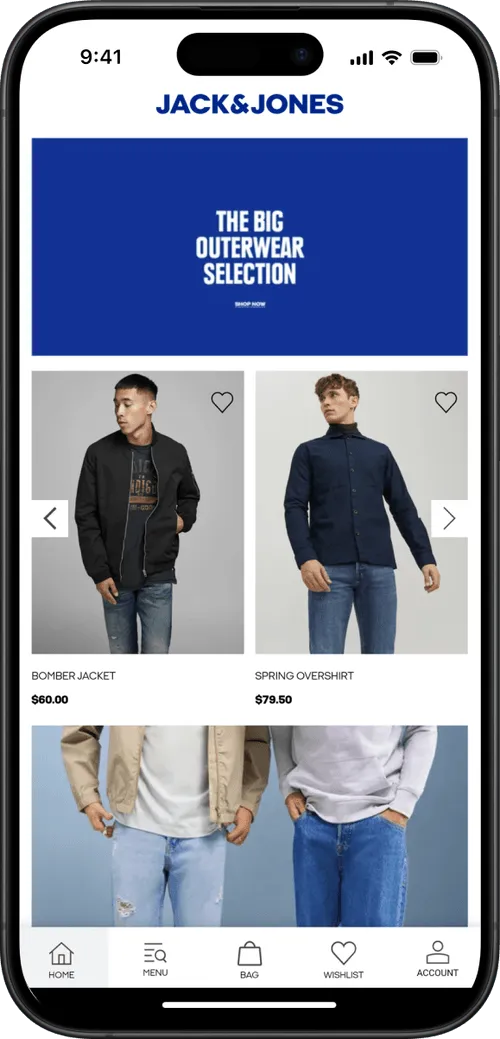
MobiLoud fits into a composable architecture as the mobile app delivery layer. It takes whatever web frontend you've built (regardless of the commerce engine, CMS, or search provider behind it) and delivers it as a native iOS and Android app with push notifications, deep linking, and an icon on your customer’s home screen.
The fit is natural: MobiLoud is API-independent (it works with any web frontend), it doesn't require backend changes, and it operates as an independent service that can be added or removed without affecting the rest of your stack.
It’s not a flashy, custom build. But you don’t need that.
MobiLoud is, realistically, the composable model applied to mobile.
For a deeper look at how this works technically, see our guide to headless commerce mobile apps.
Key Composable Commerce Platforms
Composable commerce boils down to picking and choosing the best tools to manage different elements of your business.
If you're evaluating composable, these are the components most commonly seen in production stacks:
- Commerce engines: Commercetools, Fabric, Medusa, Saleor
- Content management: Contentful, Sanity, Builder.io, Strapi
- Search: Algolia, Elasticsearch, Typesense
- Personalization: Dynamic Yield, Nosto, Bloomreach
- Payments: Stripe, Adyen
- Mobile app delivery: MobiLoud
- Frontend frameworks: Next.js, Nuxt, Remix, Hydrogen
For platform-level comparisons (especially if you're deciding between headless and composable), see our headless ecommerce platforms guide.
Headless First, Composable Later
Most brands don't start composable. They start by going headless: decoupling the frontend from a platform like Shopify Plus or BigCommerce.
As they grow and their needs become more specialized, they begin replacing individual backend components with best-in-class alternatives. Search gets swapped first (Algolia is a common early move). Then the CMS. Then personalization.
This incremental path is more realistic and less risky than attempting a full composable buildout on day one. It lets you validate the architecture at each step and only add complexity where it creates clear value.
The key is building on an API-first foundation from the start, even if you're only going headless initially.
If your commerce engine and frontend communicate via clean APIs, adding composable components later is straightforward. If you're tightly coupled from the start, going composable later means a full rebuild.
Plan for composable. Start with headless. Add components as your scale demands them.
FAQs

Convert your website into a mobile app




.webp)