Mobile is now the dominant surface in ecommerce. Adobe Digital Insights pegged mobile at 51.4% of US online spend in October 2025, up 11.6% year over year, on track to keep climbing through 2026.
And with mobile driving most of your traffic, the case for launching a dedicated mobile app keeps getting stronger.
The path you pick for ecommerce mobile app development locks in your cost structure, time-to-market, and team workload for years, so picking it the right way matters more than picking it fast.
There are four real decisions to make, in order:
- What type of app does your brand need? Fully native, hybrid, PWA, or a native app powered by your existing website?
- What build approach fits your team? In-house engineering, an agency, a DIY app builder, or a fully managed website-powered service?
- What does the path cost over three years, not just at launch?
- Which specific vendor or agency should you engage inside the category you've picked?
Each section below answers one of those decisions. By the end, you'll have a solid understanding of how ecommerce mobile apps get built, what you want yours to look like, and the best way to get there.
The Different Types of Mobile App
A "mobile app" can be multiple, meaningfully different products.
This is important to know before you start building your app may save you a lot of wasted time and money.
Fully native
These are separate iOS and Android codebases written in platform-native languages (Swift, Kotlin). Native apps have the best possible performance and full access to every native device feature, though two codebases mean more work to build, higher cost, and a lot more work to maintain.
Cross-platform
Cross-platform apps have a single shared codebase that compiles to both iOS and Android. The dominant frameworks are React Native and Flutter. When a brand says "we built a native app from scratch," they almost always mean a React Native or Flutter app. It’s faster and cheaper than fully native; with small performance trade-offs on heavy interactions. Most modern custom ecommerce apps fall in this category.
WebView
A basic native shell wrapped around the brand's website. Cheap, fast to build, but Apple specifically scrutinizes WebView-only apps and routinely rejects them under App Store Review Guideline 4.2. What the customer downloads doesn't feel native, and the App Store presence is fragile.
Template native apps
This is what you get with most SaaS app builders. The codebase is usually something like React Native under the hood, but the apps are assembled from templates rather than built feature by feature. Fast to launch and inexpensive to start, but the nature of these apps means limitations you have to work with.
Hybrid apps
Hybrid apps are apps that utilize web code alongside native app code. Your app ships as a real, fully-functioning mobile app, but a lot of the design and features are carried over from your existing web codebase.
Progressive Web Apps (PWAs)
A PWA is a website built to feel more like an app, and is installable to the home screen (albeit not a one-click install), with some access to push notifications. PWAs aren't real native apps, and not a realistic substitute for the kind of app you find in the App Store, but it is a solid first step if you want to provide a better mobile user experience.
The Four Most Common Ways to Build an Ecommerce Mobile App
It’s important to know the difference between native, cross-platform, PWA, etc - but the real decision is in the kind of vendor you’re going to go with.
In this sense, there are generally four different ways your mobile app gets built. And the investment, payback period, end result and recurring overhead can be very different, depending on which you choose.
In-house development
In-house means your brand hires mobile engineers and ships the app from inside the company.
It treats the app as a permanent product the team owns, with everything that implies: roadmap ownership, release cycles, on-call coverage for production issues, and the headcount to support it.
The realistic team is two or more mobile engineers, sometimes a backend lead and a designer, a project manager or product manager, and QA capacity.
It’ll likely take six to twelve months to launch v1 of your app, if everything goes well. You’ll also need to keep your team in place to maintain the app, and keeping your app and website in sync means coordination between your web and app teams has to be on point.
"When you develop an app you can't just have one person. When we built the app, the maintenance became very heavy. To keep a platform like this in-house I feel like you'd probably need around six people."
-- Kenneth Chan, Founder & CEO, Tobi
Agency or dev shop
It’s a lot more common for brands to hire an agency or mobile development shop to build their app.
It could be a full-stack agency or a specialist mobile firm. This is the common path when a brand wants a custom build but doesn't want to hire engineers permanently.
This can be costly. ScienceSoft's published software development cost calculator estimates a moderate-complexity cross-platform mobile app at $30,000-$70,000 and a native app for a regulated sector at $150,000-$250,000.
Specialty mobile agencies for ecommerce typically come in higher: a custom branded ecommerce mobile app from an established agency commonly costs $150,000 to $500,000+ for a launched v1, plus a maintenance retainer or hourly rates afterward.
It is generally more cost-effective than hiring an in-house team (as you don’t need to worry about hiring, and all the extras that come with having staff on the payroll). But it’s still, honestly, overkill for most ecommerce mobile apps.
DIY no-code app builder
A DIY app builder is a SaaS platform that converts your storefront into a mobile app via a drag-and-drop editor. The brand owns the configuration; the vendor owns the codebase.
Builders are faster than an agency, cheaper than in-house, and don't require engineers. And realistically, a much better way to build an ecommerce app.
Cost-wise, you’re looking at a recurring subscription of anywhere from $200-$1500 per month (with the cost of your team’s time on top of that; potentially somewhere in the range of 40 hours per month).
That’s a much better deal than a mid-six figure bill, plus the recurring overhead, for a native app from an agency. The difference in quality (real, but marginal) from a custom native build is not worth the difference in what it costs you.
MobiLoud
MobiLoud builds and maintains a native iOS and Android app powered by your existing web platform.
It’s basically a category of its own. You get a custom app, with app-exclusive experiences and features - yet without a separate codebase, no compatibility issues with your website (everything from your website works in the app automatically), and without the cost and time investment of “native” development.
The cost is comparable to that of most app builders, but the effort required from your team is less, because MobiLoud’s team does virtually everything for you.
Brands like Jack & Jones, John Varvatos, Kiokii, and Pharmazone are a few examples of brands that shipped apps with MobiLoud. Our partners see app users routinely contribute 20-30% of their total online revenue (and up to 60% for top performers, like Pharmazone) - proving their apps really resonate with their audience.
"We couldn’t find another company that could offer the same features at the same price point, same time to market, and make it as easy as MobiLoud could."
-- Svend Hansen, Product Owner at Bestseller
"MobiLoud keeps this whole thing simple and streamlined. No more juggling two different platforms, no more wasted time on maintenance."
-- Eric Lowe, Director of Ecommerce at XCVI
It’s essentially an agency, except you get more control over the app (you manage the bulk of the experience though your web platform), and it’s nowhere near the cost and complexity of an agency maintaining a separate codebase.
Ecommerce Mobile App Vendors and Agencies Compared
Now let’s get practical. Let’s look at some of the actual companies operating in the ecommerce mobile app space, helping ecommerce brands go live with branded mobile apps.
We’re not going to go too deep into the pros and cons of each - that would be dishonest, since we haven’t worked with all of them hands-on. And regardless, most of the upsides/downsides are shared across the category.
Use this as a starting point for your vendor search, then go out and research each one in more detail, based on what seems like the best fit for your needs.
DIY Shopify-focused builders
Most DIY app builders are built specifically for Shopify. You’ll find and install the app from the Shopify App Store, sign up, (usually) compile the app yourself, and manage the day-to-day of the app yourself as well.
Some of the popular names here include:
- Tapcart
- Shopney
- Superfans
- SimiCart
- OneMobile
- MageNative
All up, there are nearly 100 apps on the Shopify App Store in the “mobile app builder” category; so you’re not short of choice.
Tapcart (widest reach; one of the oldest tools in the category), Shopney (over 700 reviews on the app store), Superfans (over 800 reviews - formerly known as Vajro) are probably the most widely used.
You’ll want to do your own research here. But before you do, consider the other options, and whether there’s a more efficient way to get to the app you want.
Multi-platform app builders
The bulk of the DIY app builder ecosystem targets Shopify merchants.
The reason is that template-driven tools use platform APIs to sync up with your store’s product and order data. Most tools focus on building and maintaining only an integration with Shopify, since that’s the biggest market.
Brands on other platforms typically have a much smaller market to choose from, if they’re looking for a DIY app builder.
Some options that work for non-Shopify brands include:
- JMango360
- Twinr
- AppMySite
- BuildFire
JMango360 is an API-driven app builder, supporting a few different platforms (Magento, BigCommerce, and Salesforce Commerce Cloud included).
Twinr and AppMySite are both built around webviews, which lets them convert websites from various platforms into mobile apps.
BuildFire is more general-purpose, with a plugin marketplace and broader use cases, but it isn't built specifically for ecommerce, so its integrations with the major platforms aren't as deep as the alternatives.
As with the Shopify-focused category, do your own research before picking one. But before you do, consider whether one of the other categories fits your situation better.
Ecommerce development agencies
There are thousands of development agencies across the world, most of whom could build you a good mobile app.
Whether it’s the best option or not is up for debate - we covered that above. If you are looking for a custom “from scratch” build, here are some mobile app development companies to look at:
The best tip to find a development agency is to head to Clutch and look through the options, look at reviews, and narrow the choices down.
It’s important to do your due diligence before signing a contract here, as you’re looking at a mid-five figures cost (at the bare minimum), so the cost of choosing the wrong partner is significant.
MobiLoud
MobiLoud is really in a category of its own: the cost of an app builder, but the attention, care and flexibility of an agency.
MobiLoud has published 2,000+ apps since 2013, for brands including Jack & Jones, Bestseller, John Varvatos, Tadashi Shoji, Kiokii, and Pharmazone.
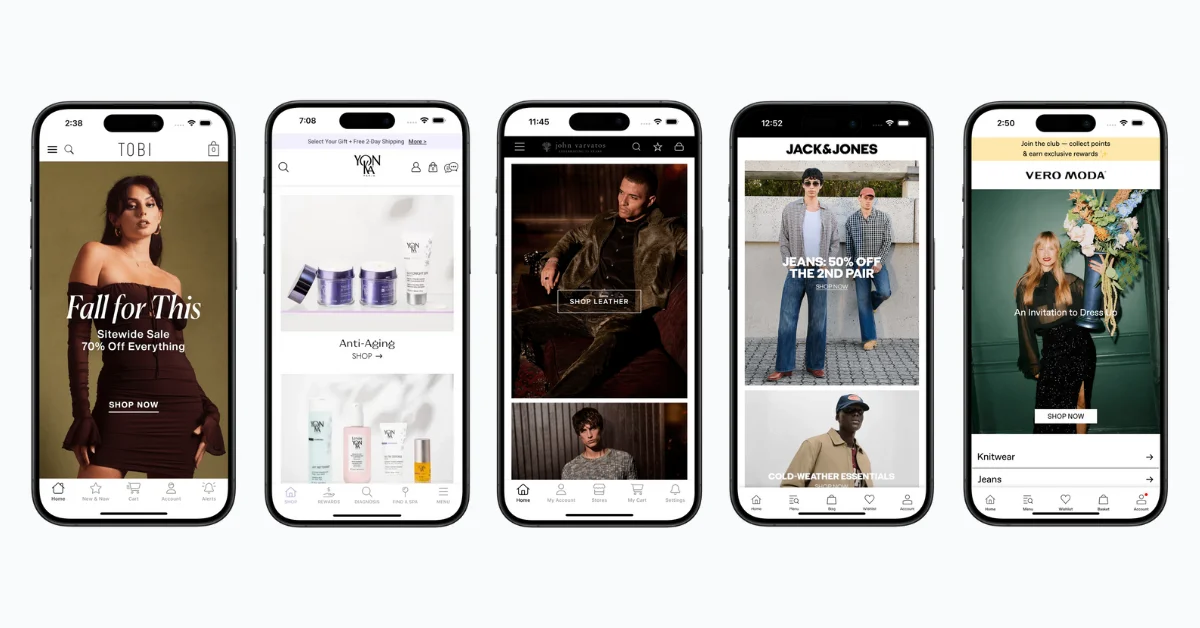
Some concrete outcomes:
- Pharmazone runs 63% of online revenue through its app and sees 15x revenue per app user
- Tadashi Shoji sees 10x ARPU and 18% of total online revenue from the app
- John Varvatos has done close to $1M in app sales with 10x revenue per user
- Kiokii gets close to 40% of total online revenue through the app from a small fraction of total users.
It’s the best option if you want an app that builds on top of your existing systems, not parallel to them, and you don’t want to be limited by templates, platform APIs, and the lag times of a native dev team.
How to Choose: A Decision Framework for Ecommerce Brands
The best development approach can end up being different from brand to brand.
The right approach for your business depends on revenue band, ecommerce platform, internal dev capacity, customization needs, and business model.
Here’s a rough breakdown:
- If you want a managed solution, with relatively low overhead, low operational lift, that builds on top of your existing website (and works with any ecommerce platform): choose MobiLoud.
- If you want to manage and iterate on the app yourself; perhaps you’re in a lower revenue band (<$1M annually), and you’re on Shopify: look at a Shopify-specific app builder like Tapcart.
- If you want the same, but you’re not on Shopify: consider a general-purpose app builder like AppMySite or JMango360.
- If you need heavy app-specific customizations, heavy native device integrations (and you have the budget): look for a custom development agency.
Alternatively, if you’re not sure about launching an app yet? Don’t rush into it. Consider shipping a PWA first, perhaps gather some intel on mobile app vendors, but don’t jump in and launch an app just because you think you’re supposed to have one.
Take your time, map out the business case - then come back to our guide once you’re comfortable it’s time to launch your app.
Final Thoughts
A mobile app could be the best investment you make for your brand. But like any investment, it depends on what you put in.
If you overpay, or build an app that takes too much time, effort and money to run, your investment won’t look so good.
Same thing goes if you build an app that doesn’t provide the kind of experience your users expect - you’ll end up with few users, minimal revenue, and an investment that provides very little return.
We can’t tell you the best option for your specific business, your tech stack, your requirements.
We can, however, present MobiLoud as the best ecommerce mobile app solution for the widest range of brands - from Shopify to Magento, from luxury fashion to automotive parts brands.
If you want to see what MobiLoud is capable of, and discuss your options in-depth with our app experts, get in touch and get a free preview of your app.
We’ll walk you through the process, and give an honest assessment on the best long-term approach for your app.