Feature Lag: Why Your Mobile App Falls Behind Your Website (And How to Stop It)

Feature lag is one of the biggest hurdles for ecommerce brands launching their own mobile apps. It’s the time it takes between shipping a feature or update on your site and the same feature going live in your app. Traditional app development makes feature lag almost unavoidable; but with MobiLoud, your app is always consistent and in sync with your website, by default.
Feature lag is one of the biggest hurdles for ecommerce brands launching their own mobile apps. It’s the time it takes between shipping a feature or update on your site and the same feature going live in your app. Traditional app development makes feature lag almost unavoidable; but with MobiLoud, your app is always consistent and in sync with your website, by default.
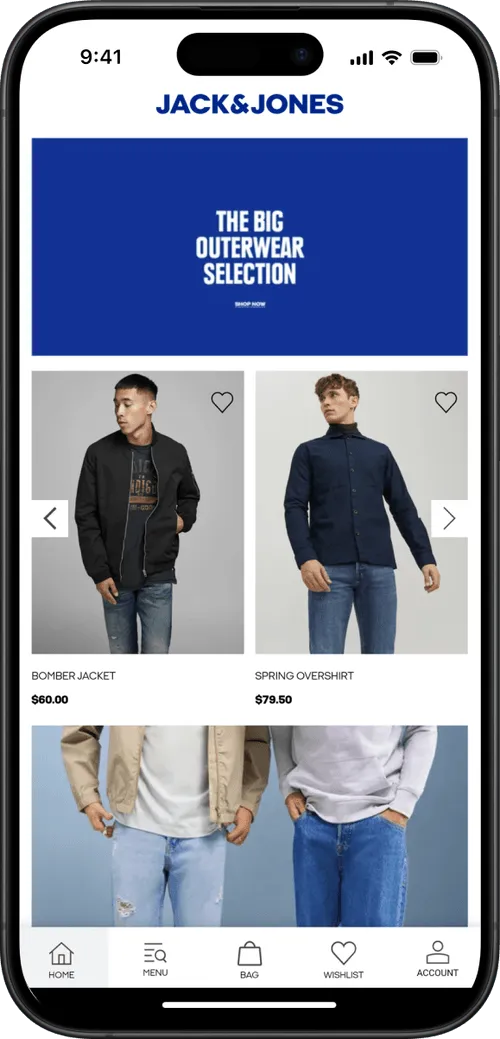
Most ecommerce brands only think of all the unique native features they can ship as part of their mobile app, and overlook one of the most important parts of any ecommerce app.
The core user experience in the app, in 99% of cases, needs to match what’s on your website.
Unless each surface is just a fundamentally different storefront, the customers need to get the same experience, features and content. It becomes a major problem specifically when your app falls behind your website - because it’s the surface that should be a premium experience for your VIPs.
Feature lag is a common affliction; but not incurable. Read on and we’ll explain how to avoid it when you launch an app for your store.
What Is Feature Lag?
Feature lag is when there’s a delay between new features or changes on your website, and the equivalent change going live in your mobile app.
It’s important because the core goal of a shopper on your site and a shopper in your app is more or less the same. They want to find a product and buy the product. That’s the crux of it.
You want the user experience to be consistent across different surfaces. If someone decides to download your app and shop in your app, then one day goes on their desktop and buys via your site, they shouldn’t see two different storefronts.
It’s all the same brand. And unless there’s a strategic reason for the difference in UX on different platforms, it should be predominantly the same storefront.
Why Feature Lag Happens with Ecommerce Apps
Feature lag is a very common thing. It’s just a reality with how most shopping apps are built.
The traditional approach to launching a mobile app for your store is either:
- Use a no-code app builder to create your app
- Hire a development team or agency to build a custom app from scratch
With both of these approaches, you’re building an app that exists as a separate system, with its own codebase, development cycles and maintenance.
That means, unless your development teams are in complete sync, all the time, there’s a gap between something showing up on the web and showing up in the app.
With a no-code app builder, someone needs to go in separately and make the update. It could be as simple as a new promotional banner or pricing change, or something more complicated like setting up and configuring a new loyalty integration.
With a custom-coded app, you’re dealing with the same thing; except developers (your in-house team, or an external agency) needs to write and edit code, which takes a lot longer (and racks up billable dev hours).
In either case, you’re managing two surfaces, and it’s inevitable that there’s going to be a gap between the update cycles of each one.
The Three Ways Feature Lag Plays Out
Feature lag shows up in a few different ways:
1. The App and Website Show Different Storefronts While the App Catches Up
You ship a change or a new feature on your site. Then the work goes to adding it to your app. In the time it takes to do that, you have two different user experiences showing to shoppers on different channels.
It could be quick; a small copy change, for example. Or, for a more complex feature, there could be a significant lag between adding it on your site, then communicating with your app team, telling them what you need, and them getting around to building, QAing and shipping the feature.
2. Website Updates Wait for the App
The alternative is to coordinate updates so that everything goes out at the same time.
Again, this can be relatively simple for small changes, more complicated for larger features.
In both cases, it slows you down. A feature that you’re thinking could go live in a couple of weeks actually takes a month, after you pass it to the app team and test to make sure it works the same on both channels.
Even with small updates, it multiplies the work required for every change. You’re making each change in multiple places. And it may not even be that quick to update in your app, if you still need to go through a developer to make the changes in the app.
This kind of coordination is the kind of thing that’s fine if it’s a one-off. When it becomes a thing for every single update, you really start to feel the operational drag.
3. Feature Drift
The third outcome is one I’ve seen far too often.
For whatever reason, updates on the site aren’t replicated in the app, and the experiences steadily drift apart until they’re completely different stores.
One is Coke, one is Mountain Dew.
I see this sometimes from brands who come to us looking to relaunch their app, and I’ve even seen it from downloading apps from popular brands, and finding that what’s in the app is vastly different from what’s on their site.
The reason this happens (initially, at least) varies. It’s often a genuine mistake; someone forgot to update the app, no one thought to check if a feature needed to be built for the app as well.
But you also get the case where the team just sees it as too much work to keep everything aligned. So they start making concessions:
- “We don’t need this in the app.”
- “We’ll add it in the app later.”
- “The app is too far behind now… let’s not bother updating it.”
This regularly happens with brands who build a custom app in-house.
The hard part about a fully custom app isn’t building it; you could hire freelancers to do this, or you may even have people in your team who could learn how to build an app. The hard part is keeping it up to date.
This is one of the most common reasons ecommerce apps fail; because it ended up being too much work to maintain, and after a few years it falls into disrepair, and no one wants to use it.
“When you develop an app you can't just have one person. When we built the app in 2014, the maintenance became very heavy. You also have to maintain a good user experience. To keep a platform like this in-house I feel like you’d probably need around six people.”
– Kenneth Chan, CEO and Co-founder, TOBI
Why Preventing Feature Lag is So Important for Ecommerce Apps
Feature lag is not a small problem. It breaks the point of launching an app in the first place.
Your app users aren’t just a random slice of your customer base. They’re your best customers. They downloaded your app because they buy from you often enough to make the install worthwhile.
These are the customers who need to get the best experience. If there’s a constant delay between new features showing up on your site and in the app, the opposite is happening.
David Cost, VP of Ecommerce at massive retailer Rainbow Shops, summed it up well:
“Our apps never had any functionality or usability beyond the web experience. The reason to have an app is not to have something that isn’t on the website, but for people who prefer that way to access Rainbow content.
The app needs to be at least as functional as the website. It doesn’t need to be better than the website, but the user experience can’t be worse.”
This is what’s often missed.
An app, just by showing the same content, design and features as your website, inherently is a better user experience by removing the browser and removing friction for the user.
That’s the baseline. You can improve on that; but if you’re not even delivering the same user experience as your website, you’re falling below the baseline. And there’s fundamentally no reason for someone to keep your app installed.
How MobiLoud Eliminates Feature Lag
At MobiLoud, we’re built to eliminate feature lag.
Our approach works differently to the typical way ecommerce brands launch mobile apps. We let you launch an app that’s fully synced with your site, by default.
It’s not a separate system, with a separate codebase. The app is built on top of the same tech stack as your website, with the two channels fundamentally in sync.
You make a small copy change to your homepage, it shows up in your app at the same time. You rearrange your PDP, it updates in your app as well.
The user experience is all managed through the same system as your website. So there’s no going through a development team and waiting on them to make changes to your app for every change to your website, big or small.
You’ll feel it the most during highly volatile times like BFCM, when the constant updates on your site can seriously slow you down, if they all need to be duplicated across different channels.
MobiLoud saves you a huge amount of time, and ensures your app doesn’t drift away from your website or serve a sub-standard UX to your best customers.
Final Thoughts: Your App Should Move at the Speed of Your Website
Feature lag is the number one reason most ecommerce mobile apps fail.
It’s usually not a case of people or platforms not doing their job. It’s just a misunderstanding of what it takes to run a storefront on multiple channels.
The day you accept that your app is going to be a few weeks behind your website is the day you accept that your best customers are going to get your second-best experience. And that’s the first step towards eventually sunsetting your app.
If you’ve been in this situation with an app in the past, or you’re planning to launch your app and want to avoid this, we may be able to help.
Book a free consultation and we’ll discuss your situation, walk you through the process of building your app (and keeping it up to date), and help you decide whether MobiLoud is the right way to launch your brand’s mobile app.
FAQs

Convert your website into a mobile app