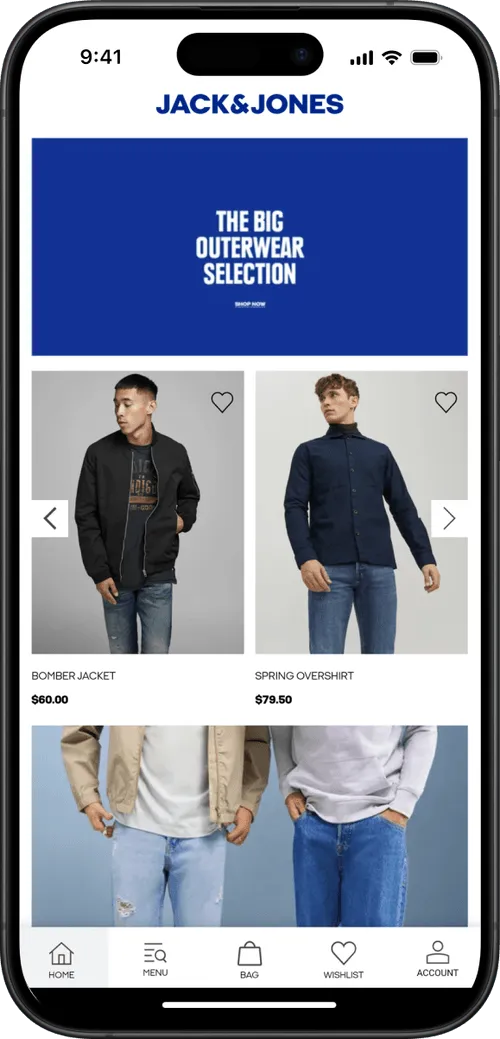


Shopney is not free, but they do offer a 30-day free trial. Their pricing starts at a monthly fee for basic features, with many advanced integrations or capabilities available on higher-tier plans.
Yes. Many brands switch from block-based builders like Shopney or Tapcart to unlock their custom web features in a fully branded app, and we handle the whole migration for you, including setup, app store submissions, and a smooth transition for existing users.
Yes. Apps usually drive higher revenue per user, because your best customers return more often, browse more, and respond to push notifications that often outperform email, so the real win is in repeat purchases, retention, and lifetime value rather than a small conversion bump.


Mobile apps are no longer just "nice to have" for ecommerce brands, they are one of the most powerful retention channels available.
With mobile commerce projected to account for nearly 60% of total retail ecommerce sales by 2025 and 76% of adults having purchased via mobile, the gap between having a mobile site and a dedicated app is where your most loyal customers live.
Shopney has helped thousands of merchants cross that bridge with easy-to-use design tools.
But "easy to use" can sometimes mean "hard to customize."
Many growing brands start with Shopney and similar builders but eventually feel the limits of a template-based approach.
You might want a specific checkout flow, a custom product customizer, or a third-party integration that isn't in a pre-approved block library. When any app builder starts to dictate your strategy rather than enabling it, it's a sign to look for an alternative.
In this guide, we cut through the noise to compare the top Shopney alternatives. We look at options for every stage, from budget-friendly builders for startups to premium, fully managed partners for 7- and 8-figure brands ready to own their mobile audience.
Use this snapshot to compare who each tool is best for, how much support you get, how flexible integrations are, and what to expect from pricing and revenue models.
Template-based app builders often focus heavily on design. Drag-and-drop editors make for slick demos and attractive interfaces, but a polished UI doesn’t always translate into a high-performing revenue channel.
As brands grow, many run into a template ceiling. You’re forced to build the app from the builder’s own widgets.
If your reviews, loyalty, sizing, or other key tools aren’t supported, they may not work in the app at all, or only via clunky workarounds.
In practice, you end up choosing between keeping your preferred tech stack or adapting to whatever the builder supports.
For Shopify-style ecommerce stacks, these tools also often combine a base subscription with usage- or performance-based fees, so mid-market brands can quickly move from inexpensive starter tiers to paying hundreds or even low four figures per month as they scale.
Common trade-offs with template-based builders include:
For many brands, the goal is not just to have an app, but to have a mobile channel that drives real retention. That requires a platform that adapts to your business, not the other way around.
If you’ve outgrown Shopney’s drag-and-drop blocks and need more flexibility, these alternatives offer different levels of customization, support, and pricing as you scale. Below are five of the strongest options in 2026.
Best for: Established brands ($1M+ revenue) that want a complete, branded mobile app without compromises or revenue share.
MobiLoud is the "no-compromise" Shopney alternative. Unlike Shopney or Tapcart, we don't force you into a drag-and-drop editor with limited blocks. Instead, we convert your entire existing mobile website into a fully native app experience.
This approach solves the biggest pain point of app builders: feature parity.
Because your app is powered by your actual website, everything that works on your site works in the app. Instantly. If you have a complex "Build Your Own Bundle" flow, a custom quiz, or a niche loyalty plugin, it functions smoothly in the app because the app experience is powered by your existing site.
Why MobiLoud is the the best alternative?
For brands focused on ROI and retention, MobiLoud offers the power of custom development without the six-figure price tag or six-month wait.
Pros:
Cons:
If you are tired of hearing "our builder doesn't support that feature yet," MobiLoud is your answer.
Best for: Medium-sized brands that want a standardized, "app-like" experience and don't mind template limits.
Tapcart is one of the biggest names in the Shopify app builder space, known for its slick drag-and-drop editor and wide integration ecosystem.
Like Shopney, it gives you a library of pre-built blocks such as hero images, product grids, and countdown timers, so you can assemble a professional-looking app layout quickly.
The same limitation still applies: if something is not available as a block, adding it can be difficult or require custom work.
Tapcart works well if your store fits standard ecommerce patterns, but custom features or niche Shopify apps can run into roadblocks. Its pricing is also higher than Shopney, with Enterprise plans for key features often reaching into the four-figure-per-month range.
For a deeper dive, read our full Tapcart Alternative comparison.
Pros:
Cons:
Best for: Brands that want a mix of customization and template structure, with a focus on guidance and consulting.
Plobal Apps offers a more guided, template-based experience than Shopney, with success managers on higher tiers to help mid-market brands build and scale.
It has solid integrations and features like uninstall tracking, but its focus on native commerce and its own navigation can limit flexibility if you want to closely mirror a custom web experience.
Pros:
Cons:
For more options in this category, check our list of Best Shopify Mobile App Builders.
Best for: Budget-conscious stores and brands heavily focused on live selling.
Vajro is a budget-friendly option for boutiques and smaller stores that rely on live selling, with built-in streaming so customers can watch and buy in one place.
It is typically cheaper than Tapcart or Plobal and works well when your main goal is to launch an app for push and live events, but its more standardized layouts and less flexible builder mean fewer options for polished, custom UX.
Pros:
Cons:
Best for: Global enterprises (Nike, Zara) with unique, non-commerce requirements (AR, VR, complex gamification).
Strictly speaking, the "ultimate" alternative to a builder like Shopney is to build it yourself (or hire an agency). This is the traditional route: hiring a dev shop to code a native iOS app in Swift and an Android app in Kotlin from scratch.
For almost all Shopify merchants, custom agency development is a poor fit.
It costs roughly 50,000 to 150,000 dollars, takes 6 to 9 months, needs constant developer maintenance, and really only makes sense for advanced AR, 3D, or hardware use cases (the cost to turn a Shopify store into an app is often higher than most brands expect); everyone else can get most of that custom feel with MobiLoud for a fraction of the cost and effort.
Pros:
Cons:
Shopney is a great tool for what it is, a design-forward, entry-level app builder. If you are just starting out and need a simple, beautiful app to send push notifications, it is a worthy choice.
But as you scale, your app needs to do more than just look good. It needs to be sold. It needs to be retained. It needs to embody your unique brand experience, not a template shared by thousands of others, and it needs to do that without forcing you into rigid blocks, integration limits, or revenue share.
MobiLoud is the only Shopney alternative that gives you the freedom of custom development with the ease of a managed service.
We take the high-converting mobile site you’ve already built and transform it into a world-class retention channel, without rebuilding, without extra tech debt, and without revenue share.
Ready to see the difference? Book a demo today and let’s build something your customers will love.