

Drobile was a Shopify app builder that let merchants create native mobile apps for their stores. It appeared in several "best Shopify app builder" roundups over the years, so it's understandable if you came across the name and wanted to check it out.
But if you've been searching for Drobile, you've probably already figured out that it's no longer around. The app has been delisted from the Shopify App Store, and the service is no longer operational.
But it's gone, and if you're an ecommerce brand looking for a mobile app, you'll need to look elsewhere.
What Happened to Drobile?
Drobile has been removed from the Shopify App Store and its website is no longer active. There's been no official announcement about a shutdown or acquisition. For practical purposes, the product no longer exists and can't be used.
If you were a Drobile customer, your app is likely no longer functional in the App Store or Google Play.
MobiLoud: A Different Kind of App Builder
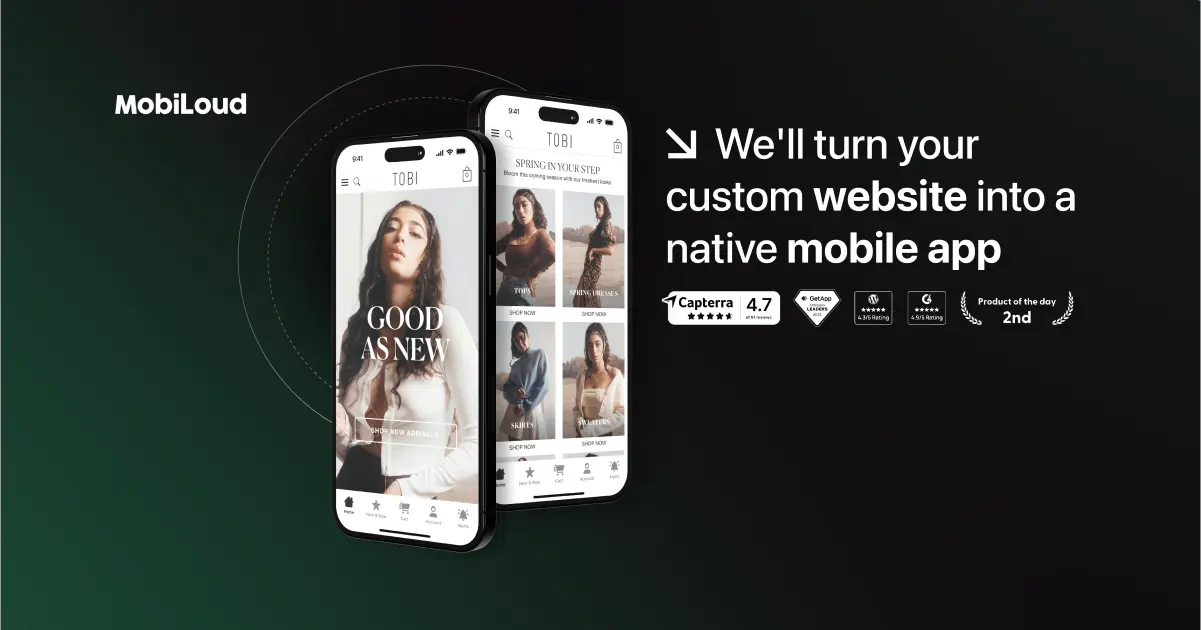
MobiLoud takes a fundamentally different approach to mobile apps than most tools in this space, including Drobile.
Rather than giving you a drag-and-drop editor to build an app from scratch, MobiLoud takes your existing ecommerce website and extends it into a native iOS and Android app.
Everything you've already built on your site - your product pages, checkout flow, loyalty programs, reviews, search, all of it works in the app from day one.
That includes third-party tools. If you use Klaviyo for email, Yotpo for reviews, Rebuy for recommendations, or any other integration on your site, it works in the app automatically. There's nothing to re-integrate or rebuild.
This is one of the biggest practical differences from traditional app builders, where each integration needs to be supported natively by the builder (and many aren't).
What you get
MobiLoud apps are real native apps, listed on the App Store and Google Play. Your customers download them, and your brand sits on their home screen alongside Amazon, Instagram, and everything else they use daily.
The app includes native features you'd expect: push notifications with segmentation and scheduling, deep linking so URLs open directly in the app, a persistent navigation bar, and smart app banners to drive downloads from your mobile site. Your checkout is your actual website checkout, not an API-based recreation, so it works exactly the way your customers are used to.
A fully managed service
MobiLoud isn't a tool you log into and configure. It's a managed service. Their team handles the initial build, App Store and Google Play submissions, QA testing, and ongoing maintenance.
When Apple or Google releases a new OS version, MobiLoud handles compatibility updates. When you want to adjust your app's navigation or push notification strategy, their team makes the changes.
Most brands go from first conversation to a live app in about 6-8 weeks, with minimal involvement from their own team.
Who MobiLoud is built for
MobiLoud works best for established ecommerce brands that already have a mobile-optimized website and meaningful traffic. It's not an entry-level tool and it's not the cheapest option out there. It's designed for brands doing enough revenue that a mobile app will meaningfully improve retention and lifetime value.
Typical MobiLoud customers are doing seven figures or more in online revenue and want to give their best customers a dedicated shopping experience on their phones. Brands like John Varvatos, Kiokii, and XCVI use MobiLoud to drive repeat purchases and grow customer lifetime value.
"Nothing out there provided us with the ease and accessibility that MobiLoud did to our team. You can't beat the price they provided to get an app together."
-- Nick Barbarise, Director of IT at John Varvatos
MobiLoud isn't limited to Shopify, either. It works with any ecommerce platform: Shopify, BigCommerce, Magento, WooCommerce, Salesforce Commerce Cloud, Shopware, custom builds, and more. If your site runs in a browser, it can power a MobiLoud app.
MobiLoud vs DIY App Builders
If you're evaluating your options, you'll probably come across two types of solutions: done-for-you services like MobiLoud and self-service app builders where you design and manage the app yourself.
Both approaches are legitimate, and the right choice depends on your situation.
Reasons to choose a done-for-you service like MobiLoud
- You already have a website that works well and you don't want to rebuild your shopping experience from scratch in a separate tool
- You want full parity with your site, including every integration, plugin, and customization you've added
- You use a complex tech stack with multiple third-party tools that would be difficult or impossible to replicate in a standalone app builder
- You don't have a mobile developer on staff and don't want to manage app updates yourself
- You'd rather invest your team's time in marketing and growth than in configuring an app builder
- You want your app live quickly without weeks of design and configuration work
Reasons to choose a DIY app builder
- You want full control over the app's design and layout, independent of your website
- You have a developer or designer available to build and maintain the app
- You're looking for the most affordable entry point and are comfortable with a more hands-on process
- You want app-specific features or screens that don't exist on your website
- You want to create a mobile experience that's intentionally different from your website
Neither approach is objectively better. It comes down to how much control you want versus how much time and resources you're willing to invest.
One thing worth understanding: with a DIY app builder, you're effectively maintaining two storefronts. When you run a new promotion, update your product pages, or add a new landing page on your site, you'll need to do the same in your app separately.
With MobiLoud, your site is the app, so any change you make to your website is reflected instantly.
See How It Works
If you want to explore MobiLoud as a Drobile replacement, you’re in the right place.
Here’s how to learn more:
- Browse MobiLoud's customer case studies to see how other ecommerce brands are using our service and the results they're getting.
- Check out these examples of previous apps we’ve built.
- Book a strategy call. Schedule a free, no-commitment call to discuss your goals and figure out if MobiLoud is the right fit for your brand.
Ready to move forward with your app? Get in touch now and let's see how MobiLoud can help.