


Companies in the United States spent an estimated $5.4 billion on PR services in 2025, and press release distribution remains one of the most accessible entry points for businesses of any size. The challenge is not finding a service; it is finding one that delivers impact quality worth the investment.
For ecommerce and DTC brands, a steady stream of newsworthy moments (a product or collection launch, a funding round, a store expansion, or your mobile app going live) makes distribution a recurring need rather than a one-off. The challenge is not finding a service; it is finding one that delivers impact quality worth the investment.
The press release distribution market splits into three tiers. Legacy wire services charge $700 or more per release for text-only distribution and add fees for images, video, word count, and geographic targeting. Mid-range services offer major publisher placements at $250 to $700 per release with simpler pricing. Budget services distribute for under $200 but often place releases on low-authority syndication sites that can lead to your site getting marked as spam.
A newer dimension is changing the evaluation criteria: AI search visibility. With AI search tools processing millions of queries daily, whether your press release gets indexed by AI chatbots is becoming as relevant as traditional media placement.
This matters more for ecommerce brands than most: a growing share of shoppers now start product and brand research inside AI assistants, and a release that gets indexed becomes a lasting source those tools can surface and cite.
Not every service addresses this channel yet. Below, we compare eight platforms across pricing, publisher quality, AI capabilities, and contract terms.
How press release distribution services work (and why you need one)
Press release distribution services act as intermediaries between companies and media outlets. You submit a press release, and the service pushes it across a network of news sites, journalists, financial terminals, and online publishers.
The quality of that network determines the value you receive. Top-tier services place your content on major national news sites, financial media platforms, news aggregators, and leading digital publishers.
This helps it reach real audiences and generate meaningful SEO signals. Lower-tier services syndicate to networks of small sites with minimal traffic and domain authority.
Distribution used to end at publication. In 2026, the most forward-looking services extend distribution to AI search tools, ensuring your content surfaces when people ask AI chatbots industry-related questions.
This capability is still uncommon, but it represents a shift in what "reach" means for a press release.
Best press release distribution platforms in 2026
To start with, here's a quick overview of the top platforms to choose from:
| Platform | Best For | Starting Price | AI Indexing | Contract |
|---|---|---|---|---|
| Press Ranger | All-inclusive distribution with AI chatbot indexing | $299/release | Yes (AIWire) | No |
| Send2Press | Boutique editorial quality at accessible pricing, beware fees | $289/release | No | No |
| eReleases | Small businesses wanting PR Newswire access | $399/release | No | No |
| 24-7 Press Release | First-time senders on tight budgets | $49/release | No | No |
| EIN Presswire | Minimum cost, but minimal impact | $149/release | No | No |
| PRWeb | Basic digital syndication through Cision | ~$120/release | No | No |
| PR Newswire | Enterprise regulatory and IR communications | ~$700+/release | No | Yes |
| Business Wire | Public company compliance and global financial distribution | ~$700+/release | No | Yes |
Now, let's elaborate, with a full review of the top press release distribution platforms to choose from right now.
1. Press Ranger
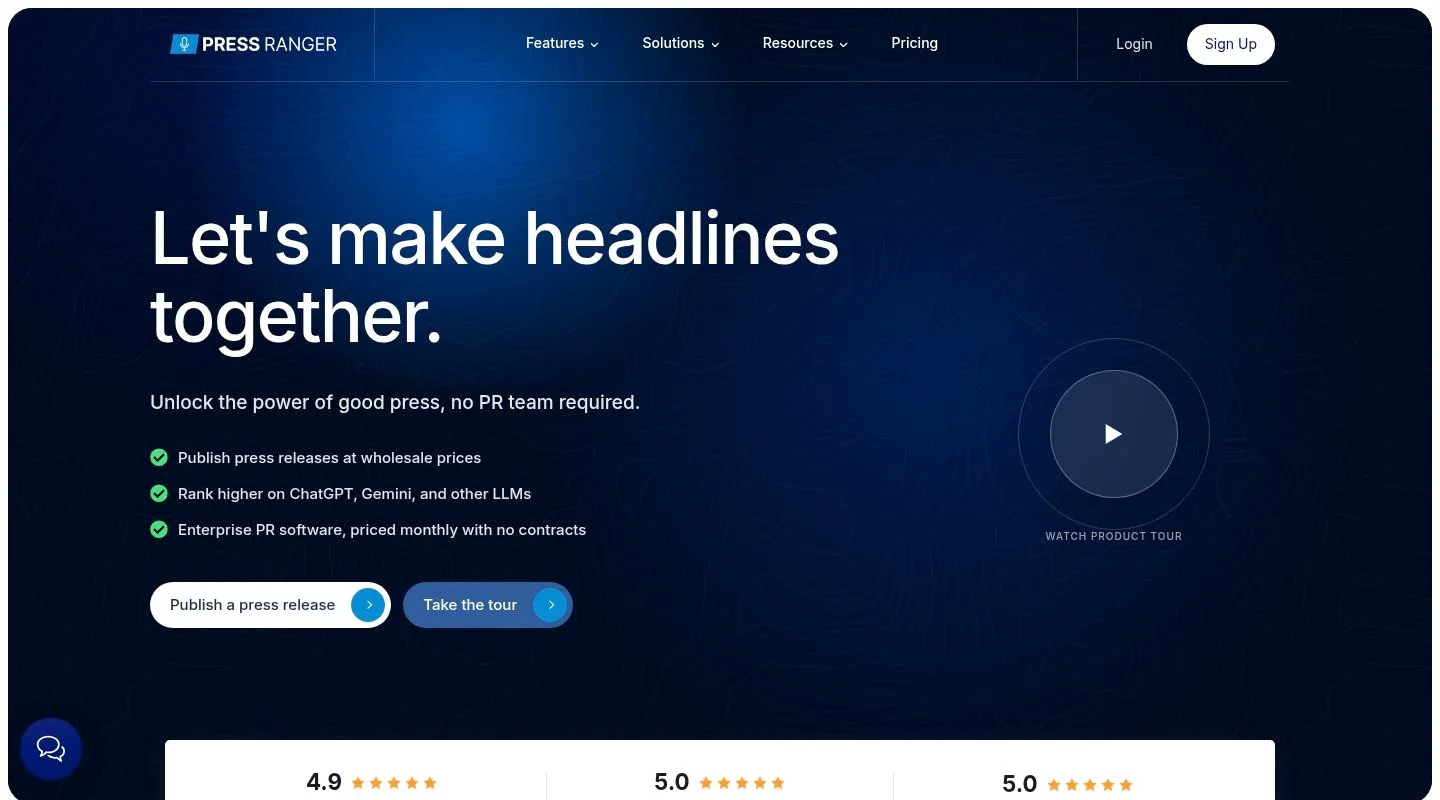
Best for: Companies that want major publisher placements with transparent pricing, no contracts, and AI search visibility in a single platform.
Press Ranger competes with legacy wire services on placement quality while eliminating the pricing complexity that defines the traditional wire model. The result is a service where the sticker price is the actual price; both tiers include images, video, multimedia, and word count at no extra cost.
The Premium tier ($299 per release) places content on 400+ outlets including major national news sites, financial media platforms, leading news aggregators, and top digital publishers. The Gold tier ($399 per release) expands to 500+ outlets and adds three features no other service in this list offers: AIWire technology for guaranteed AI chatbot indexing, podcast distribution to major podcast and audio platforms, and newsroom terminal distribution to leading financial data terminals.
Beyond distribution, Press Ranger operates as a full PR software platform. Users get access to databases of 500,000+ journalists, 160,000+ publishers, and 200,000+ podcasts. AI campaign tools assist with press release drafting, pitch emails, media list building, and targeted outreach. A built-in CRM tracks media mentions and journalist relationships.
Agencies benefit from a white-label reseller program with wholesale pricing and brandable reports.
Pros:
- Industry leading transparent pricing with no add-on fees for images, video, or multimedia
- AIWire guarantees AI chatbot indexing (Gold tier) for ChatGPT, Perplexity, Gemini, Grok, Copilot
- Publisher quality comparable to legacy wires at 50-80% lower cost
- No contracts, no annual commitments, no account required
- Full PR software platform included (media databases, AI tools, CRM)
- Podcast distribution and newsroom terminal access (Gold tier)
- White-label reseller program for agencies
- Generative Engine Optimization (GEO) and Answer Engine Optimization (AEO) optimization is built in
Cons:
- Newer service compared to decades-old legacy wires
- No SEC regulatory filing integration or XBRL tagging for compliance-heavy IR use cases
Pricing: Premium $299/release. Gold $399/release. No contracts.
2. Send2Press
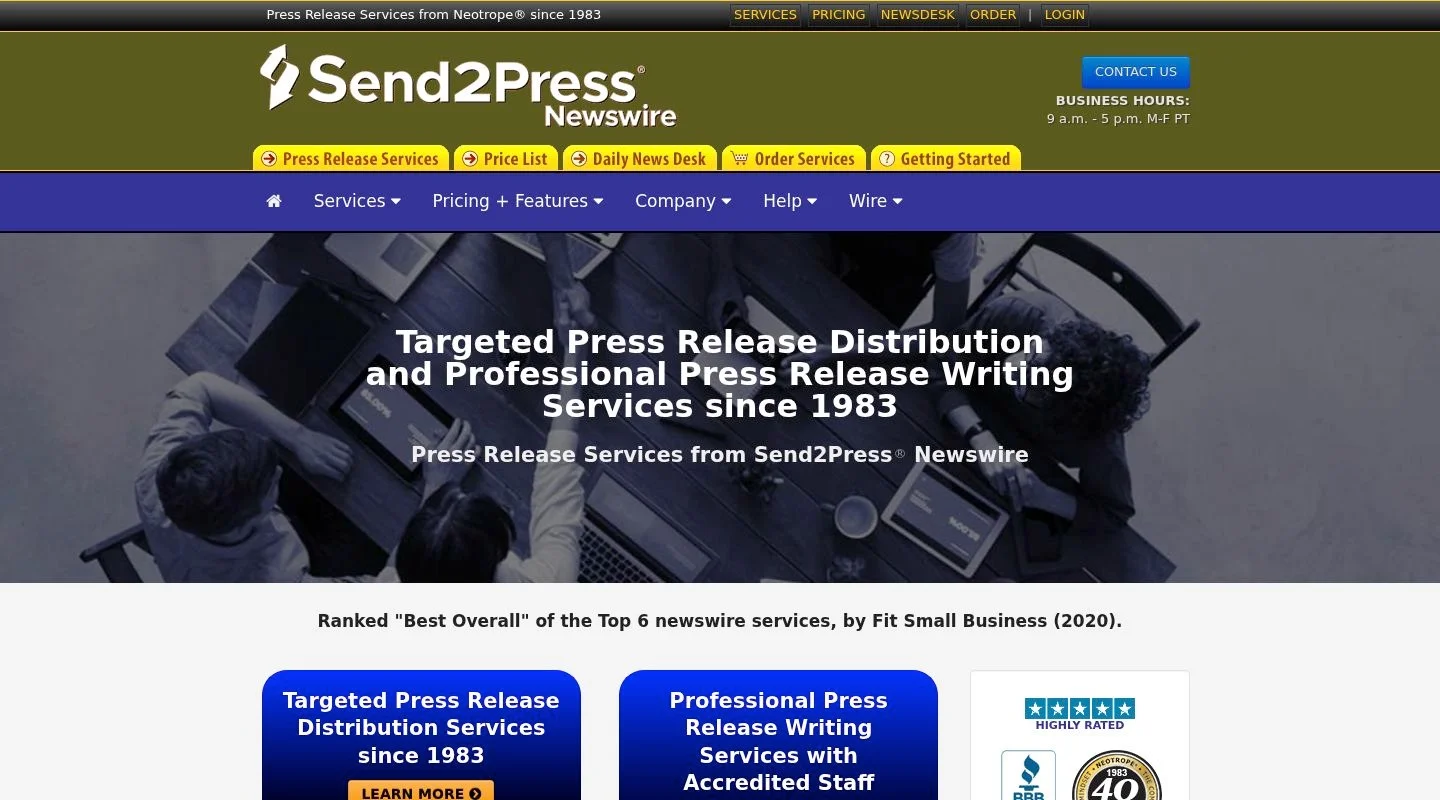
Best for: Companies that want a real person editing and guiding their release, with US distribution and AP-style review, without a subscription.
Send2Press, operated by Neotrope, has run its newswire since 1997 and traces its PR roots to 1983. It differentiates on editorial involvement rather than raw network size: accredited staff conform every release to AP style and review it before it goes out, and an optional writing service ($199) will draft the release for you.
Distribution reaches AP newsrooms, Apple News, Google News, and a syndication network of national and regional sites, with US national, regional, and state options.
Reviewers single out the hands-on service, with owner Christopher Simmons frequently named for personally reviewing copy and responding quickly. It holds a 4.9/5 Trustpilot score across 257 reviews (ranked first in its category) and 4.5/5 on G2, and parent company Neotrope carries an A+ BBB rating.
Pros:
- AP-style editorial review and human quality control on every release
- Hands-on, responsive service that occasional and first-time senders value
- Transparent per-release pricing from around $89, no subscription
- Optional professional writing service ($199)
- Strong review record (4.9/5 Trustpilot across 257 reviews; 4.5/5 G2)
Cons:
- US distribution only; no international reach
- Smaller syndication network than the major wires
- No free trial, and pricing can be steep for the smallest budgets
Pricing: $289/release for US national distribution. Writing service $199 additional.
3. eReleases
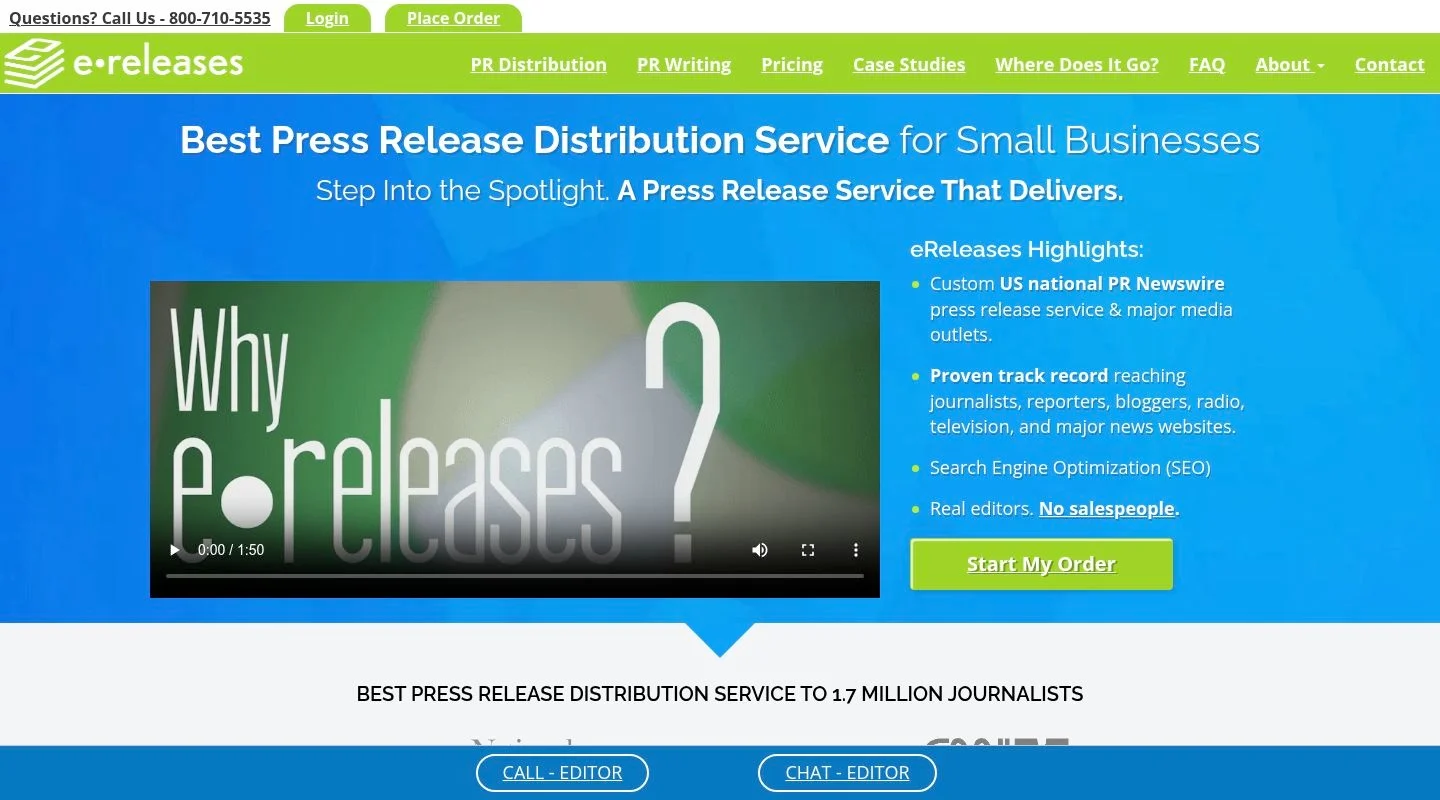
Best for: Small and midsize businesses that want genuine national newswire reach through PR Newswire, plus human editorial help, without an enterprise contract.
eReleases has served the small-business market since 1998, packaging full national distribution over Cision's PR Newswire network at prices below a direct PR Newswire contract. Every release includes editorial review, and the company offers an optional professional writing service ($300).
Its WireWatch report shows where a release was picked up, and journalist targeting draws on a database it puts at 1.7 million journalists and influencers (with roughly 100,000+ working journalists in the targetable subset).
It isn't the cheapest option; entry is $399 and most useful configurations land between $499 and $699. What you pay for is the PR Newswire backbone and the editorial support, which reviewers consistently praise (4.2/5 on both G2 and Trustpilot).
Pros:
- Full national distribution through Cision's PR Newswire network, included on every tier
- Human editorial review, plus an optional professional writing service
- WireWatch proof-of-pickup reporting
- Large journalist and influencer database for targeting
- International distribution available as a paid add-on (22 countries)
Cons:
- Premium pricing relative to budget syndication services
- Per-release pricing with no subscription, so costs add up for frequent senders
- A single release rarely moves the needle; results come from a sustained campaign
Pricing: Buzz Builder $399. Newsmaker $499. PR Pro $699. Writing add-on $300.
4. 24-7 Press Release
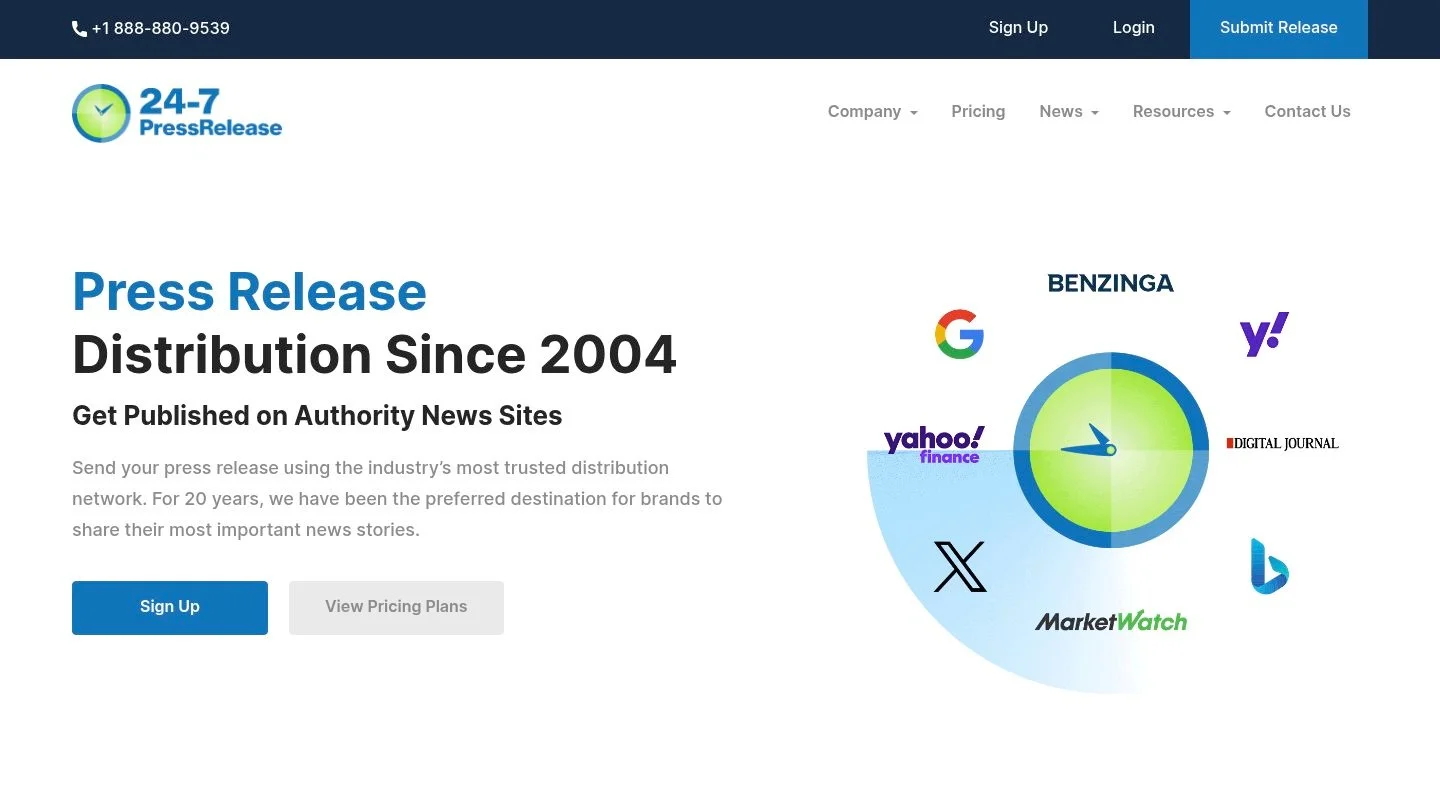
Best for: First-time senders and budget-conscious businesses that want self-serve, pay-per-release distribution for online visibility and backlinks.
24-7 Press Release offers one of the lowest entry points here, with on-site posting from $29 and distribution plans starting at $49. It's fully self-serve with no subscription: you buy releases as you need them, and submissions sent by 5pm PT go out the next business day.
The lower tiers distribute to regional and digital aggregators such as Digital Journal and GoMedia, while the top Mass Media Visibility tier ($479) routes through PR Newswire and the Associated Press for genuine national wire reach.
It holds up reasonably well for a budget service, with 3.8/5 on G2 across 33 reviews and 4.7/5 on Capterra across 24. Reviewers cite ease of use and clear distribution reports; the trade-off at the cheaper tiers is reach and outlet authority.
Pros:
- Low entry cost and true pay-per-release flexibility, no subscription
- Simple self-serve interface with next-business-day turnaround
- Top tier reaches PR Newswire and AP for national distribution
- Solid third-party ratings for the price (3.8/5 G2; 4.7/5 Capterra)
Cons:
- Cheaper tiers reach regional and digital aggregators rather than premium wires
- Limited journalist targeting and basic analytics
- Higher tiers ($199-$479) approach the cost of more established services
Pricing: From $29 (on-site only) and $49 (Visibility Boost). PR Network Plus $89, Integrated Media Pro $139, Integrated Media Pro+ $199, Mass Media Visibility $479.
5. EIN Presswire
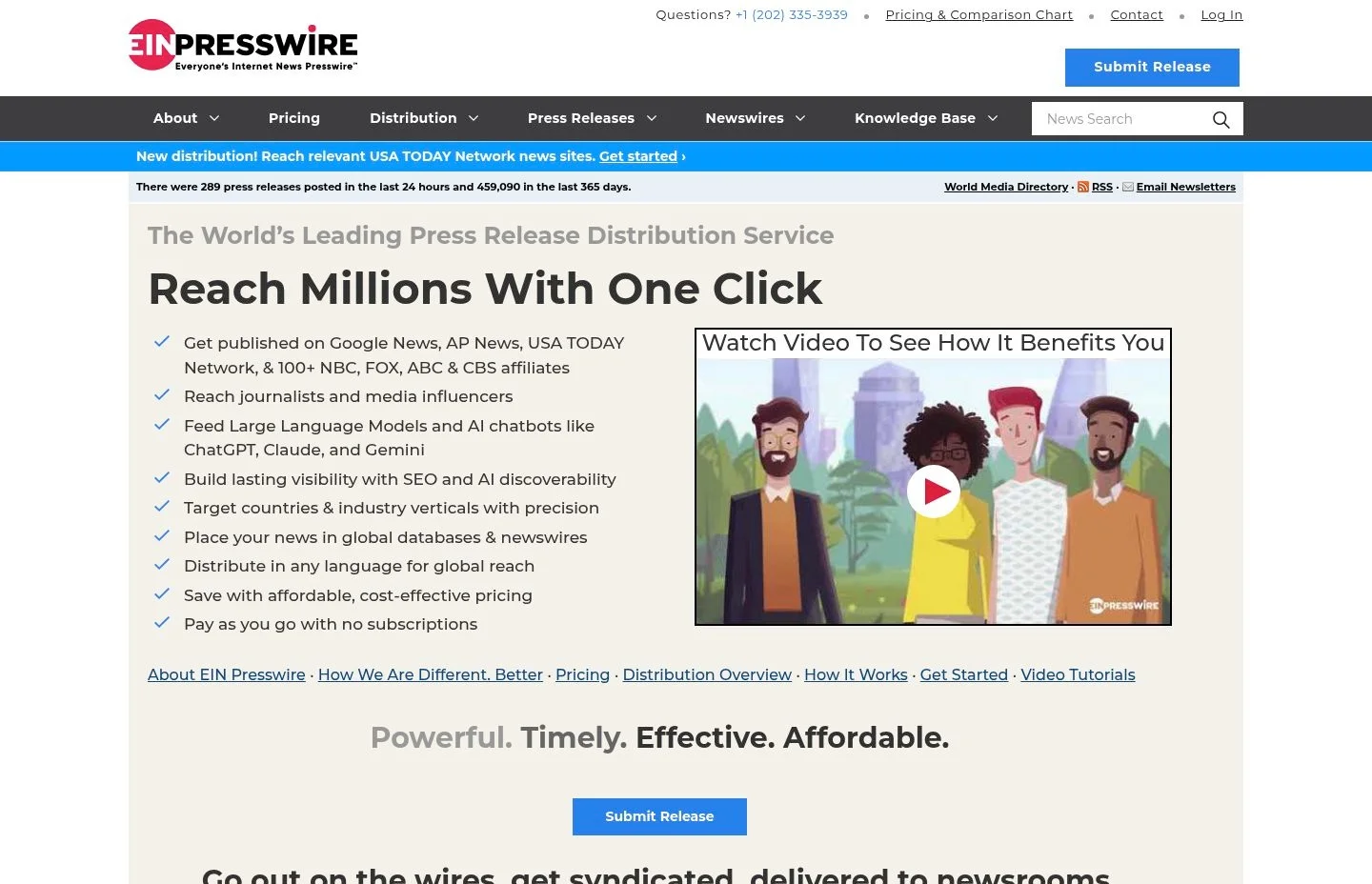
Best for: Businesses and agencies that want affordable, high-volume distribution to a broad syndication network, especially frequent senders who benefit from bulk pricing.
EIN Presswire, operated by Newsmatics, competes on price and volume. A single release is $149, and bulk packs bring the effective per-release cost down to roughly $50-$70, with a full year to use them.
Despite the low price, the network is legitimate: even the entry release distributes to AP News, the USA TODAY Network, Nexstar Media Group, Bloomberg Terminals, MuckRack, and Google News, with placement based on relevance.
It's a widely adopted service with a large review base: 4.5/5 on G2 across 184 reviews, and 3.5/5 on Trustpilot across 168. The Trustpilot reviews are more polarized, largely over releases that were rejected at the editorial gate, so factor in that EIN does screen submissions rather than publish everything automatically.
Pros:
- Among the lowest per-release pricing, with steep bulk discounts
- Real distribution partners (AP News, USA TODAY Network, Bloomberg Terminals, MuckRack) even on the entry tier
- Large, well-reviewed user base (4.5/5 on G2 across 184 reviews)
- Fast, often same-day turnaround for verified accounts
Cons:
- Reach is relevance-based syndication, not guaranteed earned coverage
- More polarized Trustpilot reviews, mostly tied to rejected-submission disputes
- Single-release pricing is far less economical than the bulk packs
Pricing: Basic $149 (1 release). Pro+ $499 (5 releases, plus bonus releases in current promotions). Corporate $999 (15 releases, plus bonus). Effective cost as low as ~$50-$70/release on the larger packs.
6. PRWeb
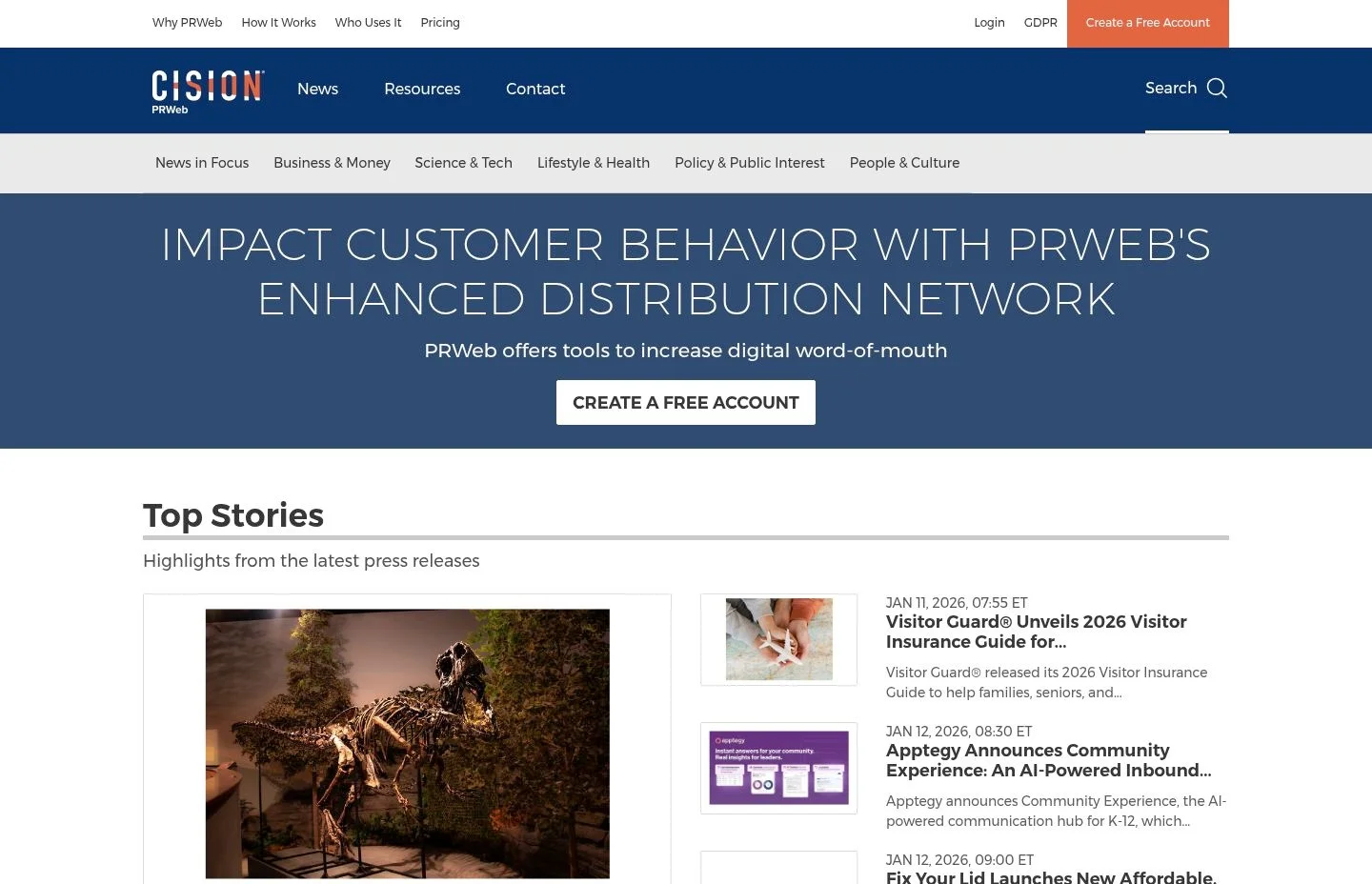
Best for: Early-stage startups, small businesses, and first-time senders who want an affordable, easy way onto a real syndication network for online visibility.
PRWeb is Cision's digital-first distribution brand, positioned below PR Newswire. Pricing runs from $120 (Basic) up through $245, $360, and $480 tiers, with the paid tiers adding online syndication to a network of 1,200+ websites powered by PR Newswire, plus optional Cision journalist email lists. It's self-serve and easy to use, with editorial proofreading and SEO keyword tagging included.
Reviews are mixed. It scores 3.8/5 on G2 across 142 reviews, the largest review base in this comparison, where customers praise the price and ease of use but flag upsells and uneven support. Its Trustpilot score is low at 1.6/5, though that rests on just 22 unsolicited reviews, and low Trustpilot scores are common across the whole wire category. Some longtime users say the service has lost ground since Cision consolidated it.
Pros:
- Low entry price ($120) for getting a release onto a real syndication network
- Straightforward self-serve platform with editorial proofreading included
- Part of the Cision and PR Newswire ecosystem
- Largest third-party review base here (142 G2 reviews)
Cons:
- Support and billing draw recurring complaints in reviews
- Reach and targeting are broad rather than granular
- Some longtime customers feel it has declined since the Cision acquisition
Pricing: Basic $120, Standard $245, Advanced $360, Premium $480 per release (plus contact-sales enterprise tiers).
7. PR Newswire
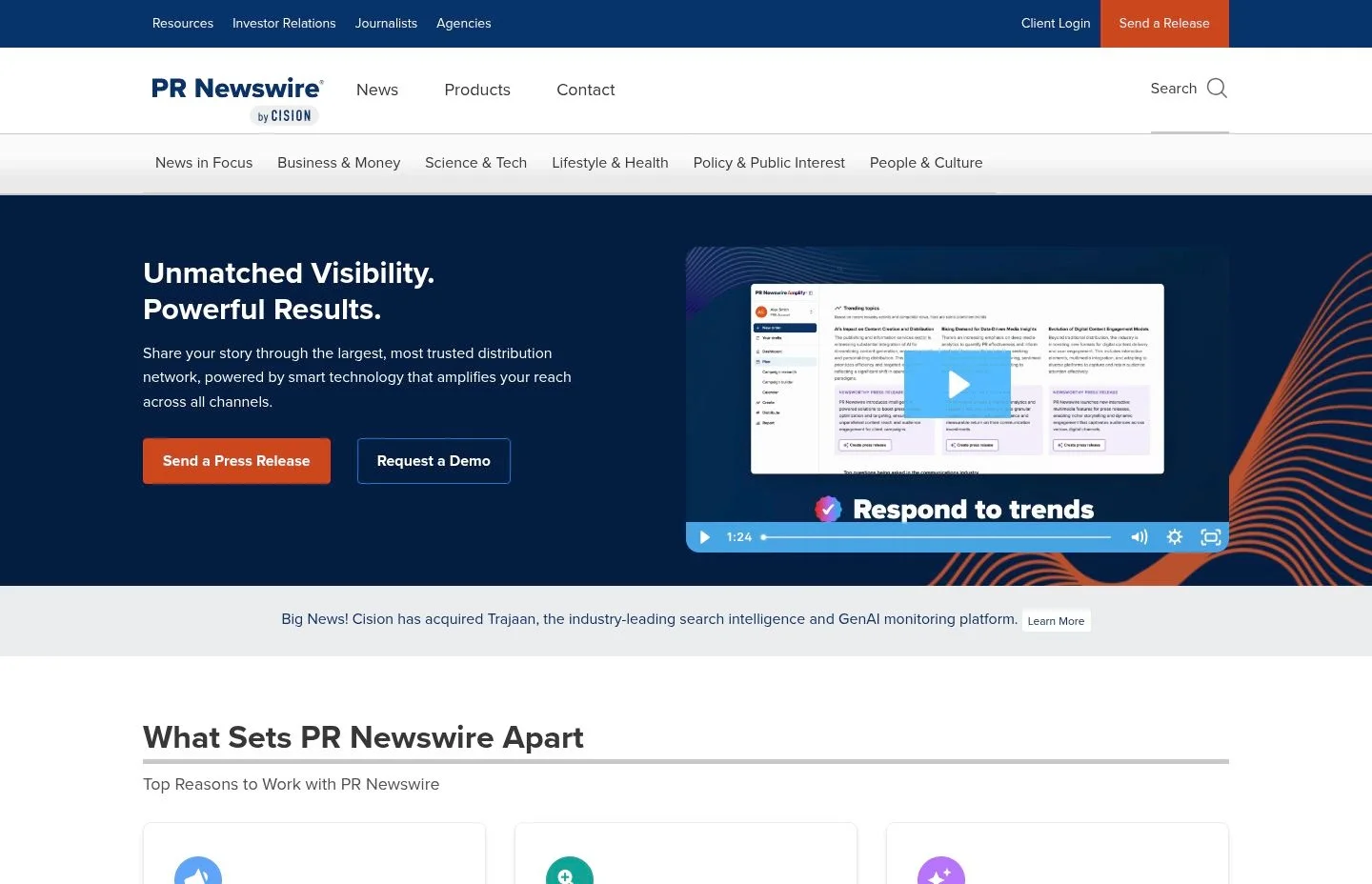
Best for: Large enterprises, public companies, and regulated industries that need broad, credible national or global distribution with editorial and compliance support.
PR Newswire, owned by Cision and founded in 1954, is the most established name in the category. It markets reach to hundreds of thousands of journalists and thousands of websites worldwide, across roughly 170 countries and 40 languages, and is a standard choice for IR, regulatory, and financial communications.
Membership ($195/year) includes editorial proofreading, regulatory support, and account management.
The cost is real. A national release starts around $805 for 400 words, with per-100-word overages and per-item charges for images, video, and logos that can push a multimedia release toward $3,000, and pricing is quote-based rather than published. It holds 3.9/5 on G2 across 765 reviews, the deepest review base of the legacy wires, where reach and credibility are praised and cost and billing complexity are the recurring complaints.
Pros:
- Among the broadest, most credible distribution networks, US and global
- Trusted by journalists and financial media
- Editorial, regulatory, and IR/compliance support included
- Strong SEO and pickup-tracking value
Cons:
- High, quote-based pricing with word-count and per-item add-ons that stack quickly
- Annual membership required
- Reviewers report billing surprises and complex cost structures
- Heavier process than newer self-serve services
Pricing: National releases from ~$805 (400 words), plus a $195/year membership. Total often $800-$3,000+ with multimedia and overages. Quote-based.
8. Business Wire
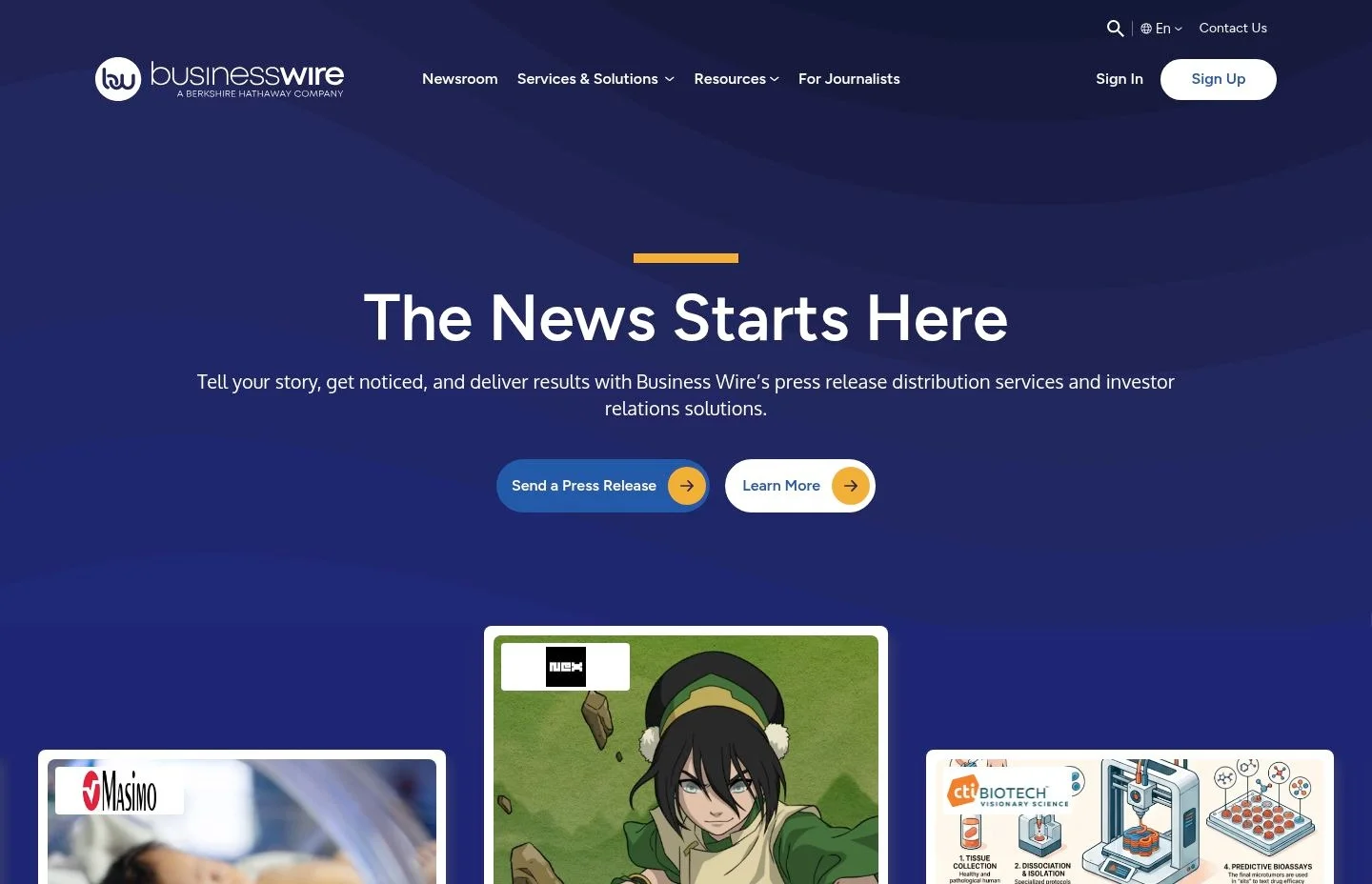
Best for: Public companies, investor relations teams, and regulated industries that need compliance-grade distribution with SEC and regulatory filing support.
Business Wire, a Berkshire Hathaway company founded in 1961, is the other premium legacy wire and the one most associated with regulatory disclosure. SEC and EU regulatory filing support, XBRL/ESEF tagging, investor-relations services, and distribution it cites at 92,000+ media outlets across 160+ countries make it a default for earnings announcements and compliance-sensitive releases. The company says roughly half the Fortune 100 use it.
Published pricing starts at $475 for a 400-word local release; national distribution and multimedia run higher (third-party estimates put a national release around $760 and up), and pricing is otherwise quote-based. Pay-per-release is available, so a contract isn't mandatory for one-off sends. It holds 4.1/5 on G2 across 199 reviews, where editorial quality and reach are praised and cost is the dominant complaint.
Pros:
- Berkshire Hathaway credibility and a regulatory-grade reputation
- SEC and EU regulatory filing support with XBRL tagging
- Broad global distribution, including international that some rivals charge extra for
- Strong editorial review (well-rated on G2 across 199 reviews)
Cons:
- Among the most expensive options, with add-ons that stack up
- Pricing is quote-based and hard to estimate upfront
- Heavier editorial process can slow publication
- More than most non-regulatory senders need
Pricing: From $475 (400 words, local); national and multimedia higher, quote-based. Pay-per-release available; no mandatory contract.
Features to look for in the best press release distribution
If you're weighing up platforms on their own, here are some things to look for from the platform
Publisher quality and domain authority
The outlets where your release appears determine its visibility impact. Look for services that guarantee placements on recognizable, high-domain-authority publishers.
A release on a major financial news site or national business publisher carries far more weight than placement across dozens of low-authority syndication sites.
Pricing transparency
Legacy wire pricing models include base rates that exclude images, video, word count, and geographic targeting.
These add-ons can double or triple the sticker price. Services with all-inclusive, per-release pricing eliminate this ambiguity.
AI search distribution
AI chatbots process millions of queries each day. Press releases indexed by these tools gain a persistent visibility channel beyond traditional search and media placement. As of 2026, Press Ranger's AIWire is the only distribution feature that guarantees AI chatbot indexing.
Reporting and verification
Quality reports include specific placement URLs, domain authority scores, impression data, and geographic breakdowns.
Avoid services that provide only aggregate "potential reach" numbers without verifiable proof of placement.
Contract flexibility
Per-release pricing with no contract gives you the freedom to use the service when you have news and skip it when you don't.
Annual contracts and prepaid credit bundles lock you into spending whether you have announcements or not.
Multimedia support
Releases with images and video generate more engagement. Verify whether the base price covers multimedia or whether the service charges it as an add-on.
Legacy wires charge extra in most cases; newer services tend to include it.
Turnaround and editorial review
Most services publish within 24-48 hours. Services with human editorial review (Send2Press, eReleases) may take a bit longer but deliver higher-quality output.
If timing is critical, confirm expedited options before purchasing.
Reseller and agency features
Agencies managing distribution for multiple clients should evaluate white-label capabilities, bulk pricing, multi-brand account management, and reporting options.
Several services here cater to agencies: Press Ranger offers a white-label reseller program with brandable reports, while the legacy wires and eReleases provide agency accounts and volume pricing.
How to select the best press release distribution platform
The best press release distribution platform depends on where you sit in the market. Enterprise teams handling SEC filings and investor communications may still need the compliance infrastructure of PR Newswire or Business Wire, despite the premium pricing and contract requirements.
For everyone else, ecommerce and DTC brands included, the value equation has shifted. Services like Press Ranger deliver comparable publisher quality to legacy wires at a fraction of the cost, with transparent pricing, no contracts, all-inclusive multimedia, and the only guaranteed AI chatbot indexing in the market.
As AI search becomes a larger share of how people discover information, getting your press releases indexed by the leading AI chatbots is moving from a nice-to-have to a competitive necessity.
Frequently asked questions
What should a press release include?
A standard press release includes a compelling headline, dateline (city and date), lead paragraph summarizing the announcement, supporting details with quotes from company leadership, relevant data points or statistics, boilerplate company description, and media contact information. Most distribution services provide formatting templates. Press releases that include images or multimedia attachments tend to generate higher engagement rates.
Are free press release distribution services effective?
Free services place releases on very low-authority sites with minimal traffic and no editorial oversight. The SEO value is negligible, journalist visibility is close to zero, and releases often appear alongside low-quality content. A single release through a quality mid-range service will generate more meaningful results than dozens of free distributions.
How do I measure press release ROI?
Track specific metrics: placement URLs and domain authority scores, referral traffic from placement sites, media pickups beyond paid distribution, social media engagement, and brand search volume changes following the release. Advanced services like Press Ranger also track AI chatbot indexing, showing whether AI search tools can surface your content in response to relevant queries.
Should startups use press release distribution?
Yes, with a clear strategy. Startups benefit most from press release distribution around funding announcements, product launches, key hires, and partnerships. These milestones carry real news value and give journalists a reason to cover the company. Sending releases about routine updates or minor features wastes budget and can dilute credibility with media contacts.
What file formats do distribution services accept?
Most services accept press releases as plain text, Word documents, or through their web-based submission forms. Images should be high-resolution JPEG or PNG files. Video can often be embedded via links or uploaded on services that support native video hosting. Most platforms also accept PDF attachments for supplementary materials like fact sheets or reports.
How many press releases should a company send per year?
Frequency depends on genuine news volume. Most businesses benefit from 4 to 12 releases per year tied to meaningful milestones: product launches, funding rounds, major partnerships, research reports, executive appointments, or award recognition. Sending releases without genuine news value dilutes credibility. Quality and newsworthiness outperform volume every time.