Flutter vs Expo: Which Cross-Platform Framework Should You Choose?

Flutter compiles Dart to native machine code and controls every pixel on screen, making it the stronger choice for graphically demanding apps. Expo streamlines React Native development using JavaScript and React, making it faster and easier for web-focused teams. Both are excellent cross-platform frameworks. But if you already have a website that works, neither may be the most efficient path to the app stores.
Flutter compiles Dart to native machine code and controls every pixel on screen, making it the stronger choice for graphically demanding apps. Expo streamlines React Native development using JavaScript and React, making it faster and easier for web-focused teams. Both are excellent cross-platform frameworks. But if you already have a website that works, neither may be the most efficient path to the app stores.
Flutter and Expo are two of the most popular ways to build mobile apps for iOS and Android from a single codebase. But they take fundamentally different approaches to the same goal.
Flutter is a full framework from Google, with its own language and rendering engine. Expo is an extension of React Native, built to make React Native development faster and more accessible.
At MobiLoud, we’ve developed thousands of apps over the past 10 years, so we’ve learned a few things about the mobile world and mobile tech.
In this article, we'll break down how both Flutter and Expo work, where they excel, and how to pick the right one for your project.
We'll also explain when you might not need either - when converting your website into an app with MobiLoud may be a better choice.
What Is Flutter?
Flutter is Google's open-source framework for building cross-platform apps.
Released in 2017, it has grown into one of the most widely adopted mobile development frameworks in the world, with over 1 million monthly active developers and nearly 30% of new iOS apps built with it.
Flutter uses Dart, a programming language originally created by Google. Dart compiles ahead-of-time (AOT) into native machine code for each platform, which is a big part of why Flutter apps perform as well as they do.

What makes Flutter distinctive is its rendering approach. Instead of relying on the platform's native UI components, Flutter draws every pixel on screen using its own rendering engine.
On mobile, this is now Impeller, a purpose-built engine that replaced Skia (which Flutter still uses for web and desktop).
Impeller eliminates shader compilation jank and delivers up to 50% faster frame rasterization compared to the old Skia pipeline.
The result: pixel-perfect control over the UI, consistent rendering across platforms, and performance that rivals truly native apps.
Flutter also supports web, Windows, macOS, and Linux from the same codebase, though mobile remains its primary strength. We covered Flutter's fundamentals in more detail in our Flutter 101 guide.
What Is Expo?
To understand Expo, you need to understand React Native.
React Native is Meta's open-source framework for building mobile apps using JavaScript and React. Unlike Flutter, which draws its own UI, React Native translates your JavaScript components into actual native platform views: UIKit on iOS, Android Views on Android.
The end result uses real native components, not a custom rendering engine.

Expo is built on top of React Native. It started as a way to simplify the setup and development process, but it has grown into something much more integral.
As of 2026, Expo is the officially recommended way to start new React Native projects, according to React Native's own documentation.
Here's what Expo adds to the React Native experience:
- Managed workflow and EAS (Expo Application Services): Cloud-based build, submit, and update services. You don't need Xcode or Android Studio installed locally to ship an app.
- Expo Router: A file-based routing system (similar to Next.js) that handles deep linking, navigation, and universal links out of the box.
- Expo Modules API: A modern way to write native modules in Swift and Kotlin without ejecting from the managed workflow.
- Over-the-air updates: Push code changes to users instantly, bypassing app store review cycles for non-native changes.
- Expo Go: A companion app that lets you preview your project on real devices during development, without compiling a full build.
Expo has matured well beyond a "convenience layer." Over 2,200 top-trending iOS apps use Expo libraries, and the framework handles everything from build tooling to deployment pipelines.
Flutter vs Expo: Key Differences
Here's a side-by-side look at the core differences.
Architecture
This is where the two frameworks differ most fundamentally.
Flutter compiles Dart code directly to native ARM machine code (or x64 for desktop). At runtime, Flutter doesn't use the platform's native UI toolkit at all. It renders everything through Impeller (on mobile) or Skia (on web/desktop), giving developers complete control over every pixel on screen.
Expo / React Native takes a different approach. Your JavaScript code runs in a JavaScript engine (Hermes, by default) within the app. Since January 2026, React Native uses the New Architecture exclusively: JSI (JavaScript Interface) allows JavaScript to call native code directly through C++ bindings, Fabric handles UI rendering using real native components, and TurboModules provide lazy-loaded, type-safe access to native APIs.
This is a significant change from React Native's earlier design, which used an asynchronous "bridge" to serialize messages between JavaScript and native code.
That bridge has been completely removed as of React Native 0.82. The performance gap between the two frameworks has narrowed considerably as a result.
Both approaches are "cross-platform native" in different ways. Flutter controls rendering at the pixel level. React Native delegates rendering to the platform's own native components. Neither is a "hybrid" framework in the traditional sense (that term properly refers to WebView-based tools like Cordova or Ionic).
UI and Design
Flutter is known for design freedom. Its extensive widget catalog includes components that follow both Material Design (Android) and Cupertino (iOS) guidelines, plus the ability to build entirely custom UIs.
Because Flutter controls every pixel, you can create animations, transitions, and visual effects that would be difficult or impossible to achieve by relying on native components alone.
Expo / React Native renders actual native UI components, which means your app automatically looks and feels like it belongs on each platform. This is an advantage for apps that should feel "native" to iOS or Android users.
The component library is solid for standard interfaces, and Expo's UI library (heading toward 1.0 in mid-2026) aims for API parity with SwiftUI and Jetpack Compose.
For most business applications, both frameworks produce clean, professional interfaces. Flutter has the edge for apps with heavy custom animations, complex graphics, or UIs that need to look identical across platforms. Expo has the edge when you want platform-native look and feel with less effort.
Performance
Flutter has traditionally held a performance advantage, particularly for graphically intensive workloads.
A SynergyBoat benchmark found Flutter iOS frame times of 1.72ms vs. React Native's 16.65ms, with Flutter achieving 117.75 FPS at 120Hz on Android.
That said, the New Architecture has closed a lot of this gap for typical app workloads. JSI's synchronous native calls and Fabric's optimized rendering mean most business apps built with Expo will perform indistinguishably from Flutter equivalents in real-world use.
The difference shows up primarily in:
- High-frame-rate animations and transitions
- Custom rendering and drawing
- Apps with extremely complex, layered UIs
- Games or media-heavy interfaces
For standard ecommerce apps, content apps, productivity tools, and most B2B applications, both frameworks deliver smooth, responsive experiences.
Learning Curve and Developer Experience
Flutter requires learning Dart, which most developers won't know already. Dart itself is approachable (similar to Java, Kotlin, or TypeScript in syntax), but Flutter's widget-based architecture and reactive programming model have their own learning curve.
The payoff is a well-integrated development experience where the language, framework, and tooling were all designed to work together.
Expo benefits enormously from the JavaScript/React ecosystem. If your team already builds with React on the web, the transition to React Native + Expo is significantly smoother.
You're using familiar patterns (components, hooks, state management) in a familiar language, with an ecosystem of npm packages you already know.
This is the single biggest factor in most teams' decisions. The Stack Overflow 2025 survey shows React Native slightly ahead among professional developers (13.62% vs 12.56%), and React Native job postings outnumber Flutter's roughly 6:1 in the US market.
Ecosystem and Community
Both frameworks have massive, active communities.
Flutter: ~175,000 GitHub stars, 12,400+ contributors, and a strong package ecosystem through pub.dev. Google's investment has been consistent, with eight stable releases shipped in 2025 alone. The ecosystem is particularly strong in Europe and Asia.
React Native + Expo: ~121,000 GitHub stars for React Native, with Expo adding its own extensive library ecosystem. The npm ecosystem gives React Native access to a broader pool of JavaScript packages. Weekly npm downloads for React Native have grown to approximately 4.5 million. The ecosystem dominates in North America.
Apps Built with Each Framework
Both frameworks power apps at the highest scale.
Expo / React Native apps include:
- Coinbase - crypto trading
- Discord - communications
- Burger King - food ordering
- NFL - sports media
- Shopify - ecommerce management
- Microsoft Authenticator - security
Flutter apps include:
- Alibaba's Xianyu - used goods marketplace (50M+ users)
- BMW - connected vehicle interface
- eBay Motors - automotive marketplace
- Google Ads - advertising management
- Google Pay - payments
- Toyota - connected services
These aren't hobby projects. Both frameworks handle the performance, scale, and reliability requirements of apps with millions of daily active users.
Which Should You Choose?
The honest answer: it depends on your team and your project.
Expo (React Native) is likely the better choice if:
- Your team already works with JavaScript, TypeScript, or React
- You want the fastest path from idea to app store
- Your app uses standard UI patterns (lists, forms, navigation, media)
- You need over-the-air updates for rapid iteration
- You're hiring in the US market (larger talent pool)
Flutter is likely the better choice if:
- Your app relies on custom animations, complex graphics, or pixel-perfect design
- You need to target desktop platforms (Windows, macOS, Linux) alongside mobile
- You're building something visually distinctive that doesn't follow standard platform patterns
- You want a single framework that handles its own rendering end-to-end
- Your team is open to learning Dart (or already knows it)
Both are excellent, production-proven frameworks. For most business applications, either one will deliver a solid result.
The deciding factor is usually your team's existing skills, not the frameworks' technical capabilities.
The Shared Challenge: Time, Cost, and Risk
Whether you choose Flutter or Expo, you're committing to a significant investment.
Building a production-quality app with either framework typically means:
- $100K+ in development costs (see our cost breakdown)
- 3-6 months to reach the app stores with a v1
- Ongoing maintenance, including OS updates, dependency management, and feature work, often costing $30K-50K+ annually
- Separate QA, deployment, and monitoring processes for your mobile codebase
For companies building something genuinely new, like a social platform, a game, a fintech tool, or an app with novel interactions, that investment makes sense. These frameworks exist to build things that don't exist yet.
But many businesses aren't in that situation. If you already have a website or web app that does what your customers need, rebuilding that functionality from scratch in Dart or React Native may not be the best use of your budget.
When Your Website Is Already the Product
If your mobile app needs to deliver the same experience as your website (which is the case for most ecommerce brands, content publishers, SaaS products, and membership businesses) there's a faster path.
MobiLoud takes your existing website and extends it into native iOS and Android apps.
Your full site, including every feature, integration, and piece of custom functionality, works in the app from day one.
On top of that, you get the native capabilities that make apps worth having: push notifications, app store presence, native navigation, and deep linking.

Here's the practical difference:
This isn't the right fit for everyone. If you're building a game, a camera app, or something that doesn't have a web equivalent, you need Flutter or Expo.
But if you already have a website that works well on mobile and you want that same experience in the app stores with push notifications and native UX, rebuilding it from scratch is hard to justify.
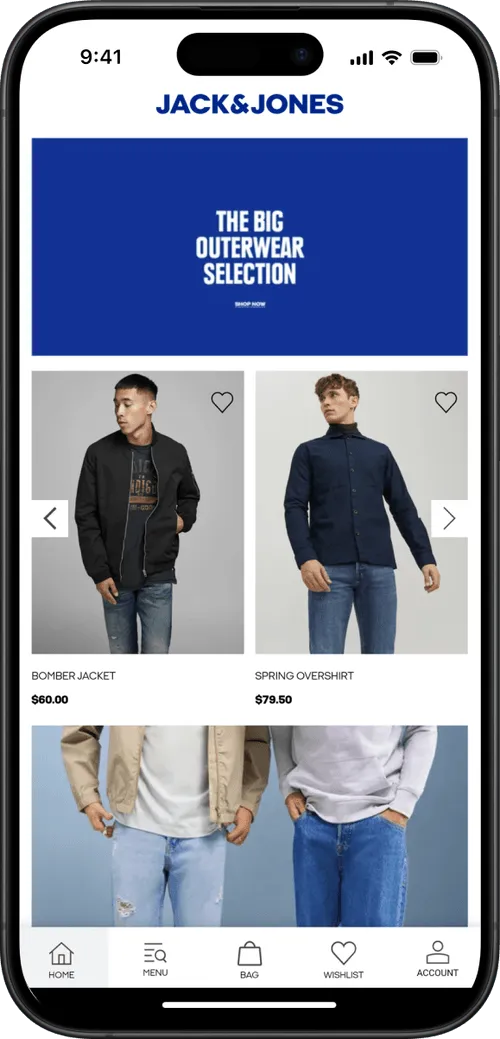
MobiLoud powers apps for 2,000+ businesses, from startups to global brands like Jack & Jones and John Varvatos. The model is straightforward:
- Book a strategy call. We'll look at your site, talk about your goals, and assess whether it's a good fit.
- Get a custom app preview. Our team builds a working preview so you can see exactly how your app will look and feel.
- Launch in 30 days. We handle the build, configuration, testing, and app store submission. You focus on your business.
Want to see what your site would look like as an app? Get a free strategy call now - no commitment required.
FAQs

Convert your website into a mobile app