Progressive Web App Examples: 30 PWAs Worth Studying in 2026

Progressive web apps have gone from experimental to expected. The biggest brands in ecommerce, media, and tech use them to deliver faster mobile experiences without forcing an app download. Here are 30 real-world examples across every major industry, what makes each one work, and where PWAs still fall short.
Progressive web apps have gone from experimental to expected. The biggest brands in ecommerce, media, and tech use them to deliver faster mobile experiences without forcing an app download. Here are 30 real-world examples across every major industry, what makes each one work, and where PWAs still fall short.
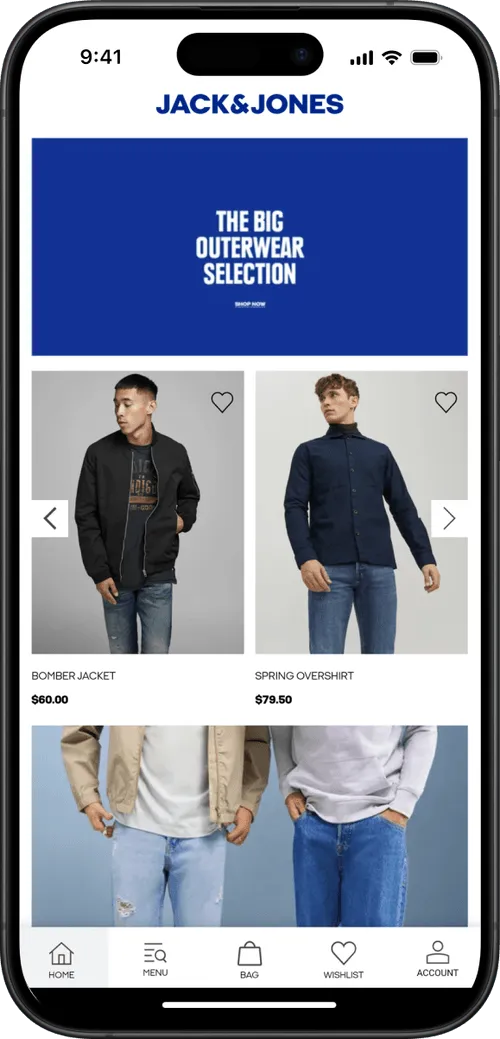
Progressive web apps sit in an interesting middle ground in the website vs app debate. They're websites that behave like apps: they load fast, work offline (or at least try to), send push notifications, and can be installed on a home screen without going through an app store.
The appeal is obvious. You get a lot of native app functionality without the cost of building and maintaining a separate iOS and Android app. For many brands, that's enough. For others, it's a starting point.
Whether you’re thinking of launching a PWA, or just curious about the technology, we put together a list of notable examples to show you what’s possible.
Below is a list of 30+ PWA examples you can visit today on your phone, test for yourself, and install to your home screen.
Progressive Web Apps are a great way to improve mobile UX - but they're not a true substitute for a real mobile app. Luckily, there's an easy way to turn your PWA into a native app: MobiLoud.
What Is a Progressive Web App?
A progressive web app is a website built with modern web technologies that delivers an app-like experience.
PWAs can:
- Load instantly, even on slow or unreliable networks
- Work offline, using cached content when there's no connection
- Send push notifications to re-engage users without an app install
- Be installed on the home screen, without going through an app store
The term "progressive" refers to how these apps work for every user, regardless of browser or device, while progressively enhancing the experience for users with modern browsers.
Major brands use PWAs to reduce load times, increase engagement, and reach users who won't download a native app. The examples below show how different industries apply PWA technology.
Quick Reference: Top PWAs (And Results)
Ecommerce and Retail PWAs
Ecommerce is where PWAs have had the most measurable impact.
Faster load times translate directly to lower bounce rates and higher conversion. For brands serving customers on slow connections or older devices, the difference can be dramatic.
Learn more: all you need to know about Ecommerce PWAs
Starbucks
Starbucks built one of the most cited PWAs in existence, and for good reason. Their progressive web app lets customers browse the full menu, customize drinks, and add items to their cart, all while offline. When connectivity returns, the order goes through.
The PWA is 99.84% smaller than the native iOS app (233KB vs. 148MB), which matters a lot for users on limited storage or slower networks. Starbucks reported doubling daily active web users after launching the PWA, with web-based orders reaching near-parity with mobile app orders.
Alibaba
Alibaba's PWA was one of the earliest high-profile implementations, and the results set the benchmark for the industry. After launching their progressive web app, Alibaba saw a 76% increase in conversion rates across browsers. The PWA focused on fast load times and re-engagement through push notifications and home screen installation prompts, targeting the massive segment of users in markets where app downloads are a barrier.
AliExpress
AliExpress took a similar approach and saw even more granular results: a 104% increase in conversion rates for new users, with iOS conversions specifically rising 82%. Users viewed twice as many pages per session and spent 74% more time on site. For a marketplace handling millions of SKUs across global markets, the PWA's fast loading on slow connections was a major driver.
Flipkart
India's largest ecommerce platform went all-in on PWA with Flipkart Lite, effectively replacing their mobile website entirely. The results: 70% increase in conversions and a 40% higher re-engagement rate. Push notifications drove a significant share of return visits. For a market where data costs and storage space matter, the lightweight PWA was a better entry point than asking users to download a 50MB+ app.
Lancome
Luxury beauty brand Lancome rebuilt their mobile experience as a PWA and saw push notifications contribute to a 12% lift in conversions. Page load times dropped by 84%, and mobile sessions increased 53%. The case is notable because luxury brands typically resist anything that doesn't feel premium, but the PWA delivered a fast, polished experience that matched the brand.
Debenhams
UK retailer Debenhams implemented a PWA that made their mobile shopping journey 2-4x faster, leading to a 40% increase in mobile revenue and 20% higher conversion rates. The speed improvement alone, cutting seconds off every page load for millions of mobile visitors, drove the revenue uplift.
Kaporal
French fashion brand Kaporal's PWA (built on a headless commerce architecture) delivered a 60% reduction in bounce rate, 15% increase in desktop conversions, and 40% longer visit duration. It's a good example of a mid-market brand getting outsized results from the technology.
Butcher of Blue
Dutch fashion label Butcher of Blue saw some of the most dramatic PWA results in ecommerce: 169% increase in conversion rate, 154% more monthly active users, and pages loading 85% faster. Proof that PWA benefits aren't limited to enterprise-scale brands.
Lilly Pulitzer
The American fashion brand's PWA delivers a fast, image-heavy shopping experience optimized for mobile browsing. Product pages load quickly with high-resolution imagery, and the site supports home screen installation. It's a strong example of a fashion brand that prioritized mobile performance without sacrificing visual richness.
News, Media, and Publishing PWAs
News sites were early PWA adopters because their core challenge is speed. Readers abandon slow-loading articles, and the difference between a 2-second and 6-second load can cut an audience in half.
Financial Times
The Financial Times was one of the very first major publishers to ship a PWA, and they did it to get away from Apple's App Store revenue sharing. Their PWA offers offline reading, push notifications for breaking news, and a fast, clean reading experience. The FT has maintained and iterated on their PWA for years, making it one of the most mature implementations in any industry.
The Washington Post
The Washington Post's PWA loads 88% faster than their previous mobile site. Content starts rendering almost immediately, with articles loading in under a second on repeat visits thanks to aggressive service worker caching. For a publication that publishes hundreds of articles daily, the performance gain compounds across millions of page views.
Forbes
Forbes rebuilt their mobile experience as a PWA and reported a 50% increase in session completions and a 3x increase in scroll depth. The faster loading times meant readers actually stayed long enough to engage with content rather than bouncing on a slow initial load. Ad viewability improved as a direct result.
Telegram
Telegram's web client is a full-featured PWA that handles real-time messaging, file sharing, group chats, and voice messages in the browser. It supports offline message queuing and push notifications. Telegram reported 50% more sessions per user after launching their PWA. The web version is functionally close to the native app, which is rare for messaging platforms.
Social, Community, and Communication PWAs
Pinterest's PWA was a response to a specific problem: their old mobile web experience had terrible engagement in emerging markets. The rebuild delivered a 40% increase in time spent, 44% more ad revenue from those users, and a 60% increase in core engagement metrics. The PWA loads in under 5 seconds on 3G connections, compared to 23 seconds for the previous site.
X (formerly Twitter)
Twitter Lite launched as a PWA specifically for markets with slow connectivity. It uses less than 3% of the data of the native app, loads in under 5 seconds on 3G, and saw 65% more pages per session, 75% more tweets sent, and a 20% drop in bounce rate. X has continued to maintain the progressive web app, and it remains one of the most feature-complete social PWAs available.
Tinder
Tinder's PWA cut load times dramatically while delivering the core swiping experience in a fraction of the size. The PWA is just 2.8MB compared to the native app's 30MB+. The lightweight approach made Tinder accessible in markets where app downloads are a barrier, expanding their user base into regions with limited bandwidth and storage.
Travel, Transportation, and Booking PWAs
Uber
Uber's PWA was built to work on 2G networks and low-end devices. The core ride-hailing flow (set pickup, choose destination, request ride) works in a 50KB initial payload. It's engineered for the absolute worst-case connectivity scenario, which makes it useful in markets where the native app is too heavy. The PWA supports location services, real-time driver tracking, and push notifications for ride updates.
Trivago
Hotel search engine Trivago rebuilt their mobile experience as a PWA and saw 150% more engagement from users who added it to their home screen. Push notification opt-ins increased significantly, giving Trivago a direct re-engagement channel that bypassed email and paid ads.
MakeMyTrip
India's largest travel company reported 160% increase in shopper sessions and a 3x improvement in conversion rate after implementing their PWA. The offline-capable booking flow was particularly impactful for users in areas with intermittent connectivity, which describes much of India's mobile user base.
Tajawal
Middle Eastern travel platform Tajawal saw their conversion rate triple (from 0.3% to 1.2%) after launching a PWA that cut time-to-interactive from 13 seconds down to 3.6. In markets where mobile web is the primary shopping channel, those seconds matter enormously.
Automotive and Lifestyle PWAs
BMW
BMW rebuilt their mobile presence using a PWA approach (combining AMP content with a progressive web app shell) and the results were significant: the site loads 4x faster than the previous version, mobile visitors grew 50%, and click-throughs from BMW.com to sales sites jumped from 8% to 30%. That last number is the standout. A 4x increase in sales-qualified traffic, driven primarily by faster page loads.
Entertainment and Productivity PWAs
Spotify
Spotify's web player is a fully functional PWA that mirrors most of the native app's features: streaming, playlists, search, recommendations, and offline playback for Premium subscribers. It's installable to the home screen and runs in its own window without browser chrome. The main advantage is accessibility. No download required, works on any device with a modern browser, and it's significantly lighter than the native client.
Hulu
Hulu's PWA delivers their streaming catalog through the browser with support for installability and push notifications for new releases. The progressive web app approach lets Hulu reach users on devices where a native app isn't practical (older smart TVs, Chromebooks, Linux machines) while maintaining a consistent viewing experience.
Photopea
Photopea deserves a spot on this list because it demonstrates what's technically possible with PWA technology. It's a full Photoshop-alternative image editor that runs entirely in the browser, supports PSD/AI/Sketch files, and works offline. The fact that professional-grade image editing runs as a progressive web app would have been science fiction a few years ago.
Food Delivery and Marketplace PWAs
Swiggy
India's food delivery giant built a PWA to address the same challenge Flipkart faced: millions of potential users on low-end devices and slow connections. The PWA delivers the full ordering flow (browse restaurants, customize orders, track delivery) at a fraction of the size and data cost of the native app.
OLX
Classifieds marketplace OLX saw an 80% reduction in bounce rate after launching their PWA. The combination of faster loading, push notification re-engagement, and offline browsing of saved listings transformed their mobile metrics in markets across India, Brazil, and Southeast Asia.
Jumia
Africa's largest ecommerce platform built their PWA for a user base where data is expensive and smartphones have limited storage. The results: 33% higher conversion rates, 50% lower bounce rates, and 12x more users compared to their native app in key markets. Jumia's PWA is a textbook example of the technology solving a real distribution problem.
What PWAs Can (and Can't) Do
PWAs have come a long way, but they still have limitations compared to native apps:
PWAs can:
- Load instantly and work offline
- Send push notifications (on Android; limited on iOS)
- Be installed on the home screen
- Access camera, location, and other device features
- Work across all browsers and devices
PWAs can't (or struggle to):
- Access all native device APIs (Bluetooth, NFC, etc.)
- Send push notifications reliably on iOS
- Appear in app store search results
- Achieve the same performance as native apps for complex interactions
- Leverage platform-specific features (widgets, Siri, etc.)
The bottom line: PWAs have limitations, and while they're an excellent improvement on regular mobile websites, having a PWA isn't a reason to say no to launching a "real" mobile app.
For many brands, the answer is both: use a PWA for broad reach and low friction, and a native app for your most engaged users who want the full experience.
Turning Your Website Into a Native App (Without Rebuilding)
The brands in this list invested in PWA technology and saw measurable results: faster load times, higher engagement, and better conversion rates.
But PWAs have limits. They can't access all native device features, and many users still prefer apps they can find in the App Store or Google Play. Push notifications - one of the most powerful engagement tools - remain limited on iOS for PWAs.
If you already have a website that works well on mobile, or if you've invested in a PWA, you don't have to start from scratch to get a native app.
MobiLoud extends your existing website into native iOS and Android apps. Your site's design, functionality, checkout flow, and every integration you've already built carries over. You get native app capabilities on top: reliable push notifications (including on iOS), App Store and Google Play presence, and the performance and trust that come with a native app.
It works for any website platform and any tech stack. There's no rebuild, no separate codebase to maintain, and no features to sacrifice.
How it works
- Book a strategy call. Share your website URL. We'll discuss your goals, answer questions, and assess fit.
- Get a custom app preview. Our team builds a personalized preview of your app so you can see exactly how it looks and performs.
- Launch in 30 days. We handle the build, App Store submission, and launch. Your app goes live while you focus on running your business.
We've built 2,000+ apps over the last ten years, including numerous global ecommerce brands. We give you a way to go live with your own native apps, with no revenue share, predictable pricing, and a fully managed service from start to finish.
Book a free strategy call to see how your website becomes a native app.
FAQs

Convert your website into a mobile app