The case for launching a mobile app is clear: app users come back more often, spend more per order, and cost less to reach than customers on the mobile web.
An app is a powerful, owned asset. It’s a direct line to your best customers. Yet many brands still don’t have their own app.
If you run a Shopify Plus store, the scale of your business demands that you have a mobile app. You just need to find a way to do it that doesn’t blow out your budget, or drag your team into a lingering, never-ending project that slows everything down.
It can feel difficult with all the moving parts below the surface of a Shopify Plus store. But it’s far from impossible.
Keep reading and we’ll explain, in-depth, all you need to know about Shopify Plus mobile app development.
What a Shopify Plus Mobile App Needs to Do (and What It Doesn't)
For an ecommerce brand, a mobile app should be an extension of your web storefront. It’s one piece of your multi-channel, digital presence.
It should run off the same backend as your website (inventory, accounts, product details, etc) and, ideally, should carry over the same features that customers find on your website.
David Cost, VP of Ecommerce and Marketing at Rainbow Shops, put it this way when we talked with him:
"Our apps never had any functionality or usability beyond the web experience. The reason to have an app is not to have something that isn't on the website, but for people who prefer that way to access Rainbow content."
He outlined a crucial misconception with mobile apps: that it has to be a completely new, completely unique surface.
That’s not what you need. You just need a more convenient way for customers to access your store.
In trying to create a mobile app that’s fundamentally different from their website, many brands fall into one of the biggest traps that David pointed out to us:
"The app needs to be at least as functional as the website. It doesn't need to be better than the website, but the user experience can't be worse."
That's the bar every mobile app has to clear. If mobile app users have a worse experience than website users, there’s no reason for them to use the app - and there’s no reason for it to exist.
But that’s where it gets a little more complicated for Shopify Plus brands than your standard Shopify Store.
The Feature Parity Problem for Shopify Plus Brands
With all the customization going on under the hood, carrying all of this over into a mobile app becomes tricky.
We’re talking things like:
- Custom checkout (Checkout Extensibility, Shopify Functions, and the Branding API)
- Native B2B for wholesale buyers
- Shopify Markets or Expansion Stores for international,
- Headless frontends (Hydrogen, Oxygen, or a custom Next.js build)
- Heavily customized themes
- Shopify Flow automation
- Custom-built features
- Granular CRO & AOV improvements
Technically, and feature-wise, your site may be unrecognizable from a standard Shopify store.
Launching a mobile app that strips away all of this is not an option. It defeats the purpose of launching a mobile app in the first place.
That’s why the biggest challenge with Shopify Plus mobile app development is feature parity. Can you get your mobile app to at least deliver the same features and functionality that you have on your website?
With certain approaches, that’s difficult (if not impossible).
How to Build a Mobile App for a Shopify Plus Store
Shopify has the largest mobile app builder ecosystem of any ecommerce platform. Nearly 100 apps on the Shopify App Store, all which let you build a mobile app with relatively low effort and cost.
The problem? Off-the-shelf app builders typically can’t keep up with everything your Shopify Plus store does.
They’re built using pre-built templates, and powered by Shopify’s APIs, which only expose a limited set of data.
For any mildly complex Shopify Plus store, you’re almost guaranteed to get a mobile app that’s a stripped down version of your website - which, as mentioned, is not what you’re looking for.
What About Custom Development?
On the other hand, you could hire devs, or an agency, to build your custom app from scratch.
That gets around the feature parity problem, since you can build custom integrations for all the custom features on your website.
But that gets expensive, fast. It gets more expensive the more unique features you need to rebuild in the app.
Worse than that, once you go through the long and costly process (likely 6-12 months, and hundreds of thousands of dollars) to launch your app, you’re stuck with a platform that exists separate from your website, and requires a whole team and six figures per year to maintain.
It’s a mountain of a project - and the work never stops.
Alternatively, there’s MobiLoud: another way to build a mobile app, one that lets you get a custom app without the limitations of an app builder, and without the cost and operational overhead of a “from scratch” build.
How MobiLoud Handles the Complexity of Shopify Plus Stores
MobiLoud lets you launch a custom mobile app, powered by your existing website.
All your Shopify Plus features, integrations, and even custom features, work in your app by default.
This is because MobiLoud’s approach starts with your website - not from scratch.
It’s a full-featured mobile app, but the underlying content and functionality comes from your existing web platform.
You build features, customize your design, integrate with third-party tools, through your website, and MobiLoud lets you ship that as a custom mobile app.
It’s a fundamentally different architecture to the app builder approach, which means virtually no limitations. The only limitation is what you can build in Shopify Plus - and you should know that that’s really not much.
You can build and iterate on the web and on your mobile app, all through one platform.
The Hidden Cost of Building It Any Other Way
With a templated builder or a custom build, the app is a separate product. Even if it works perfectly on day one, you've now got a second storefront to maintain.
Every time you make a design change, add a new feature, a new integration, run a promo, you need to do the work twice.
Development, testing, bug fixes - twice the work on everything.
An app is never a one-time launch cost. It’s not something you can build once, and then just sit on forever. It's a permanent operational weight on your team.
Aside from the cost, it slows you down, and stops you from iterating on your website or implementing new features, because you know it will just create more work to ship these changes in your app.
It tends to go one of two ways. Either your team drowns under the work, and you realize that the app is adding too much overhead to your business - or you cut corners, stop maintaining the app, and soon the app and website drift apart, and no one uses the app because it’s consistently out of date.
Why Shopify Plus Brands Choose MobiLoud
At MobiLoud, we've built more than 2,000 apps over the last decade. A growing share are for Shopify Plus brands, and other enterprise-level ecommerce brands, who want to have a custom mobile app, without the long-term overhead of maintaining a separate platform.
Every Shopify Plus feature works on day one
Everything that you can build on the web works in your app.
With a “from scratch” build, whether it’s custom dev or an app builder, you’re putting untold effort into recreating what already works.
With MobiLoud, there’s none of that. No feature gaps, no duplicate work.
A real custom app, not a template
You’re not squeezing your website into a stock template. You’re getting a real custom app.
The app is custom-built for your requirements. You can create app-exclusive experiences, pricing and discounts, app-only screens, and other tweaks and customizations to ship the app you want, without the tax of custom development.
A managed service, not a tool you have to run
A key difference between MobiLoud and traditional app builders is that MobiLoud is a managed service, not a SaaS app.
MobiLoud handles the whole setup and launch for you - design, configuration, App Store and Google Play submission, QA, push notification setup.
After launch, the MobiLoud team handles technical app maintenance, keeping your app running through Shopify updates, OS updates, and new feature additions or design changes.
Your team doesn't have to learn a new tool, run a new platform, or maintain a second codebase. You keep running your website, as you normally do.
Predictable pricing, no revenue share
MobiLoud can be a slightly higher cost than a SaaS app builder - but that reflects the extra service you get vs a self-serve tool.
Pricing is customized to your requirements, but is generally in the low-four figure range per month. That makes launching an app significantly more viable compared to a six figure upfront cost for a from-scratch build.
There aren’t the variable costs that come with custom development, or app builders that offer customizations, which can spiral out of control for difficult features.
And unlike some app builders, there’s no revenue share taking a cut of your profits. It’s a predictable cost that lets you scale app revenue freely.
Launch (and payback) in weeks, not months
You can go live in around 6-8 weeks - not the months (or years) it typically takes to launch a custom app.
This means you can see the impact of your app much quicker. And, combined with the lower upfront cost, the time it takes to pay back the cost of building your app is significantly shorter.
A proven track record at Shopify Plus scale
We work with multiple high-end enterprise brands, across fashion, retail, lifestyle and more, with complex tech stacks that no off-the-shelf app builder can adequately support.
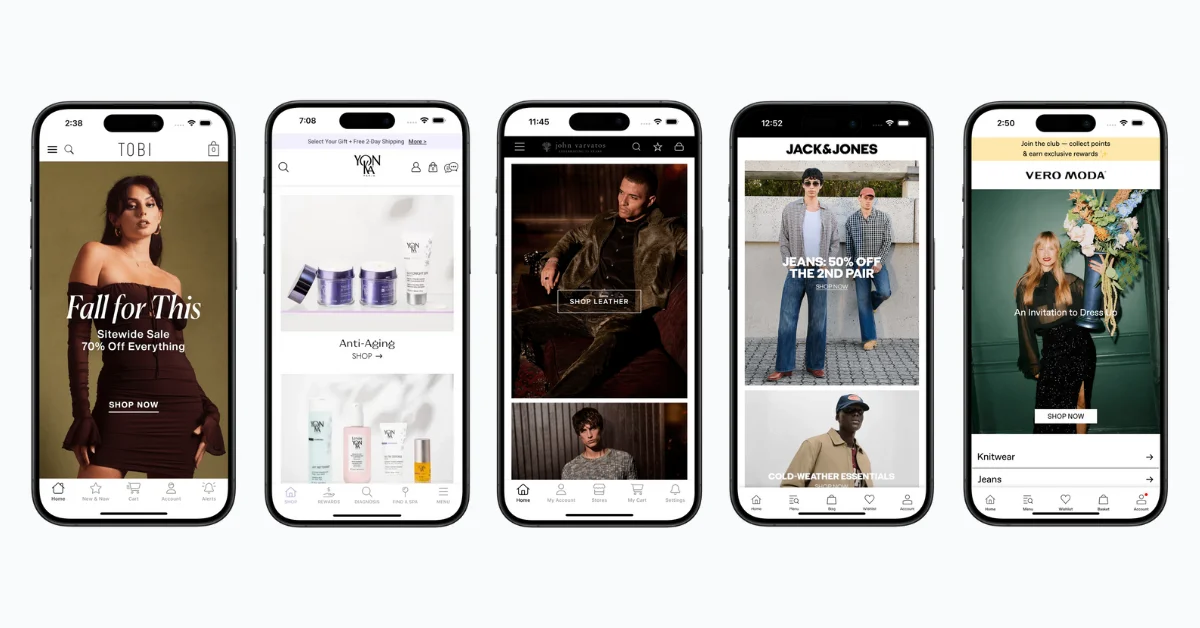
Bestseller uses MobiLoud for multiple apps, including Jack & Jones, Vero Moda, and ONLY. John Varvatos launched their app with a lean internal team and saw 10x revenue per user from app users versus mobile web.
Svend Hansen, Product Owner at Bestseller, put it this way:
"We couldn't find another company that could offer the same features at the same price point, same time to market, and make it as easy as MobiLoud could."
And Nick Barbarise, Director of IT at John Varvatos:
"There is no real business case for building an app from scratch for $1M+ when our mobile website is already good enough."
The Bottom Line on Shopify Plus Mobile App Development
Almost every Shopify Plus brand should have a mobile app. At this scale, the potential revenue from launching an app, even if you get a relatively small share of users to adopt it, is too much to ignore.
The blocker: finding a mobile app development solution that’s compatible with your setup, and that doesn’t come with a $250K+ price tag, just for the first version (which won’t even see the app store until a year from now).
MobiLoud is built for the Shopify Plus brand that wants to skip the templates, skip the stripped-down, simplified mobile apps, and doesn’t want to deal with the tax of a “from-scratch” build.
MobiLoud turns the store you already run into a native iOS and Android app, in about 6-8 weeks, with no rebuild and no parallel codebase to maintain.
If your website is doing the work, your app should build on that, not alongside it.
Get a free app preview and we'll show you exactly what your store would look like as a native app.