How to Build a Marketplace App: The Complete Guide for 2026

MobiLoud is the best way to turn an existing, web-based marketplace app into a full-functioning mobile app. MobiLoud turns your site into an app in just a few weeks, with full feature parity, push notifications for buyers and sellers, and no separate codebase to maintain, putting your marketplace in the same league as Amazon, eBay and Airbnb.
MobiLoud is the best way to turn an existing, web-based marketplace app into a full-functioning mobile app. MobiLoud turns your site into an app in just a few weeks, with full feature parity, push notifications for buyers and sellers, and no separate codebase to maintain, putting your marketplace in the same league as Amazon, eBay and Airbnb.
Marketplaces can be a phenomenal business model. Whether it’s an ecommerce marketplace like Amazon or eBay, a service marketplace like Upwork or Airbnb, or any other form of platform connecting buyers and sellers, the upside is huge.
But the biggest hurdle: getting and maintaining activity. For a marketplace, this is everything.
In this article, we’re going to explain how to launch the asset that every marketplace needs: a mobile app.
We’re assuming that you’ve already got a functioning marketplace on the web, and want to bring it to life as a mobile app. If this is you - keep reading. We’ll explain how to do it in just a few weeks, without sacrificing any of the features that make your marketplace great.
Why Every Marketplace Needs a Mobile App
Three words define whether your business thrives or withers away: The Network Effect.
Marketplaces live and die by activity. The more buyers on your platform, the more sellers. The more sellers, the more selection, the more likely for buyers to come back.
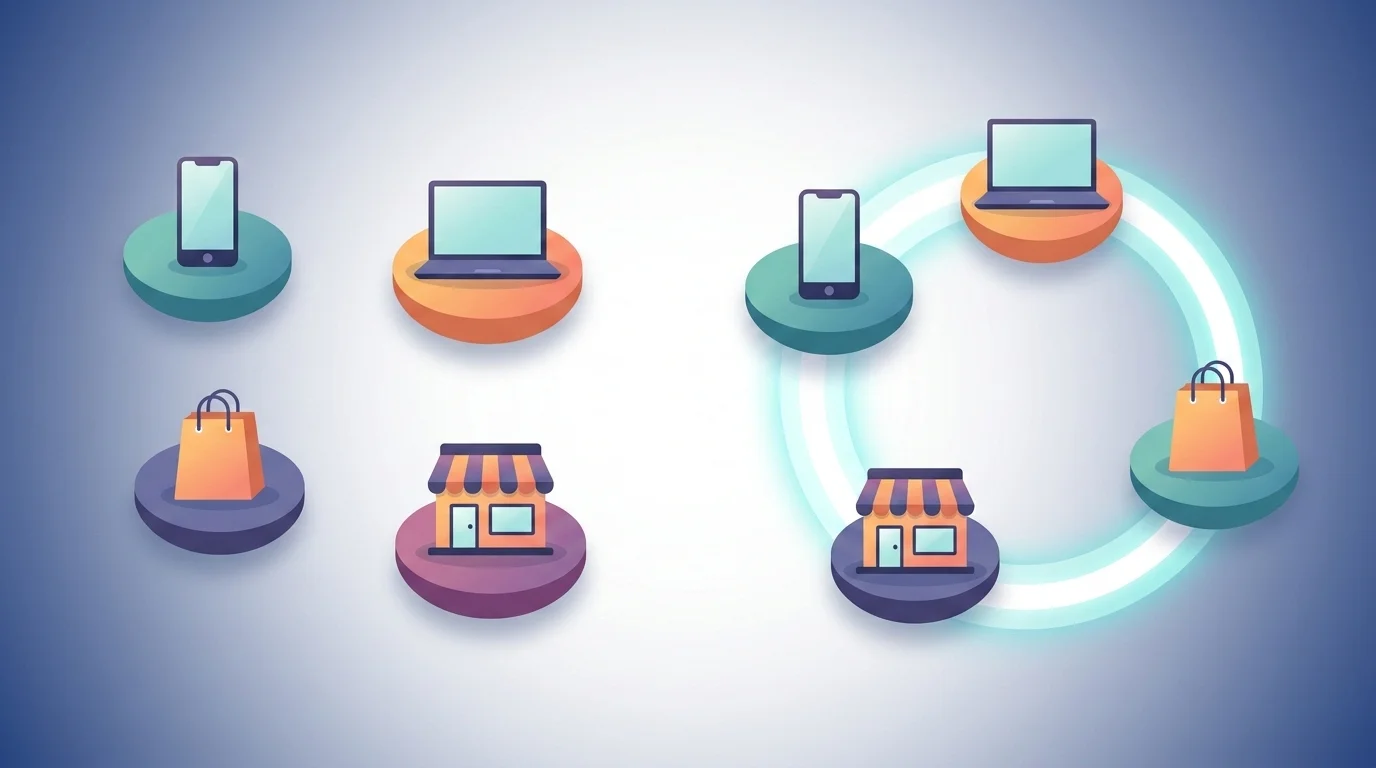
This flywheel depends on one thing: how easy it is for both sides to show up, repeatedly.
That's exactly what mobile apps do better than any other channel.
A mobile app puts your marketplace one tap away on your users' home screens. There's no URL to type, no search to run, no bookmark to dig up.
The result is measurably higher session frequency: brands with mobile apps typically see 3-7x more sessions per user compared to mobile web visitors (via MobiLoud’s Mobile App Benchmark Report).
According to Adjust's 2025 Shopping App report, marketplace apps have the highest Day 1 retention of any shopping app category at 24.8%, and the longest average session length at nearly 11 minutes.
For a marketplace, that higher session frequency has a compounding effect. When buyers check in more often, they discover more listings. When sellers see faster responses and more inquiries, they list more inventory.
The marketplace gets more liquid, and both sides get more value.
Push Notifications: The Biggest Reason to Build a Marketplace App
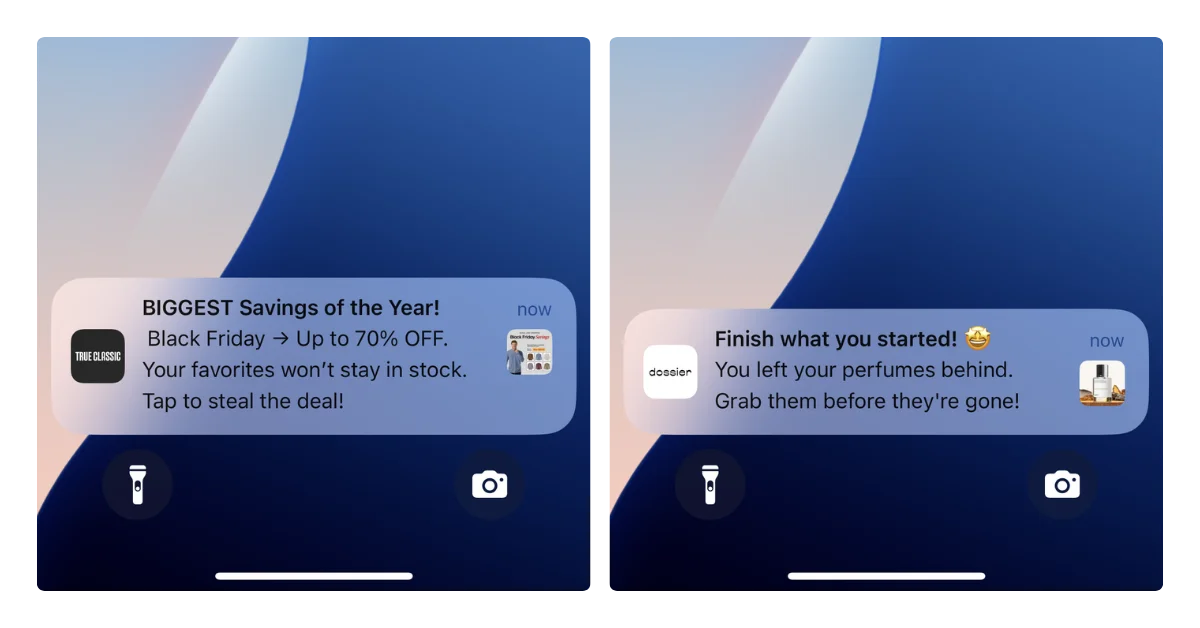
Push notifications are the single best reason for a marketplace to have a mobile app. They're also a channel that literally does not exist without one.
Think about what notifications mean for a two-sided marketplace:
- For buyers: new listing alerts, price drop notifications, back-in-stock updates, order status, personalized recommendations
- For sellers: new order alerts, buyer inquiries, review notifications, inventory reminders, payout confirmations
These aren't marketing emails that sit unread, getting lost in a secondary inbox, or only seen two days after they’re sent.
Push notifications show up instantly, directly on the lock screen (and cost nothing to send).
For marketplaces specifically, faster seller response times mean better buyer experiences, which means more transactions, which means more sellers want to join.
Higher Conversion Rates and Larger Orders
Mobile apps consistently outperform mobile web on conversion metrics. Apps convert at roughly 3x the rate of mobile websites in ecommerce (Criteo), and across MobiLoud's customer data specifically, apps deliver 1.7-3x higher conversion rates and 10-50% higher average order values compared to mobile web.
Apps load faster, have fewer distractions (no browser tabs, no URL bar, no competing sites), and offer a focused experience that keeps users engaged longer. That leads to more completed transactions (and higher AOVs when people do check out).
The Marketplaces Setting the Standard
Look at the most successful marketplaces in the world, and you'll notice something they all have in common: their app is the primary experience for most users.
- Amazon dominates mobile commerce. The Amazon Shopping app had 60 million downloads in a single month in 2025, and mobile devices accounted for 53% of total online sales during Prime Day 2025.
- Airbnb processes 58% of guest bookings through its app, up from 53% the year before. Instant booking, real-time host messaging, and push notification alerts for price changes all happen through the app.
- Etsy generates 46% of gross merchandise sales from its buyer app alone (Q3 2025 earnings), with app users visiting 5x more often and viewing 3x more pages than non-app users.
- eBay generates an estimated 60%+ of its GMV through mobile, with push notifications powering auction alerts, outbid warnings, and seller messages: features that don't work without a native app.
Your users have the same expectations. They expect to browse, buy, and communicate from their phone, with the same speed and convenience they get from the apps they already use.
Luckily, you don’t need Amazon’s engineering budget to do it.
What Your Marketplace App Needs
A common misconception is that a mobile app needs to be a brand new channel, reinventing how you do business.
If your marketplace website already handles the full buyer and seller experience, then your app needs to do exactly the same thing.
Your core goal isn’t to think up a whole new user experience. It’s feature parity with your website.
Here's what that means for a marketplace:
Buyer experience:
- Search and filtering across listings
- Detailed listing pages with images, descriptions, reviews
- Messaging with sellers
- Secure checkout and payment
- Order tracking and history
- Wishlist or saved items
Seller experience:
- Vendor dashboard (listings, orders, earnings)
- Inventory and catalog management
- Buyer communication
- Analytics and sales data
- Payout tracking
Marketplace-wide:
- Push notifications (for both buyers and sellers)
- Home screen icon and app store presence
- Multi-language and multi-currency support (if applicable)
- Location-based discovery (if applicable)
How to Build a Marketplace Mobile App
There are a number of different ways to build and launch a mobile app. But not all are necessarily the right fit.
You might already be making thin margins as you try to grow your marketplace, putting money into acquisition and keeping fees low to incentivize activity.
So you want a solution that’s not another massive expense denting your profitability. Yet at the same time, it needs to be powerful enough to grow and scale with you.
Turn Your Existing Marketplace into a Native App with MobiLoud
If your marketplace already works on the web, the most practical way to launch a mobile app is converting what you've already built into native iOS and Android apps.
MobiLoud takes your existing marketplace website and turns it into native apps that are published to the Apple App Store and Google Play.
Everything your site already does, your checkout flow, vendor dashboards, search, messaging, reviews, all of it works in the app because it's powered by your existing website.
On top of that, you get the features that make native apps valuable in the first place: push notifications, a home screen icon, and full app store distribution.

MobiLoud works with any web platform. Whether your marketplace runs on WooCommerce with Dokan, Magento, CS-Cart Multi-Vendor, Sharetribe, or a fully custom build, MobiLoud can convert it into a fast and powerful mobile app.
The timeline is roughly 6-8 weeks from kickoff to app store launch. Pricing starts from $1,499/month, with a one-time setup fee that covers custom design, configuration, testing, and app store submission.
MobiLoud handles the full build and all ongoing technical maintenance, so there’s very little for you to worry about regarding the app. You just keep running your website, and the app looks after itself.
Kazderni, an Airbnb-style booking marketplace for Lebanon, built their marketplace on WordPress and WooCommerce, then used MobiLoud to launch their mobile app. The result: 400,000+ downloads and the #1 travel app in Lebanon.
"17 apps in Lebanon do what we do. We have more downloads than all of them combined."
-- Mohamad, CEO, Kazderni
Their CEO put it well when explaining why they went web-first: "The web market is just so much more mature, and it's so much easier to build a website than it is to build an app." MobiLoud let them get both without building twice.
MobiLoud vs Custom Native Development
The traditional way to build a mobile app means coding it from scratch, and building custom APIs to link all the backend data with your website.
Custom native development gives you full control over every screen, animation, and interaction.
But it also costs a lot. And ultimately, for a marketplace, there’s little you really need that absolutely has to be built natively.
You’re looking at likely a $150K+ development cost, 6-12 months to go live, then significant ongoing maintenance costs. All to more or less recreate what your website already does.
You’ve built everything already. Vendor dashboards, checkout flows, search, messaging. Rebuilding it in an app means a huge cost, but more importantly, adds a lot of ongoing complexity, because you’re now maintaining two separate surfaces.
MobiLoud's approach eliminates that duplication. When you update your website, your app updates automatically. One codebase, one team, two platforms.
Alternative Marketplace App Solutions
Full-stack marketplace platforms like Sharetribe, Arcadier, and CS-Cart Multi-Vendor bundle the web marketplace and mobile app together. If you're starting a marketplace from scratch and want an all-in-one solution, these platforms can be a convenient starting point.
However, if you've already built your marketplace on a widely used ecommerce platform (WooCommerce, Magento, Shopify) or a custom stack, rebuilding on a full-stack marketplace platform to get an app doesn't make much sense.
You'd be migrating your entire business, including all your data, seller relationships, and integrations, to a new platform just to get mobile functionality.
It's generally more scalable to build your marketplace on established, flexible infrastructure and then use MobiLoud to extend it to a mobile app.
You keep full control over your web platform, avoid vendor lock-in, and benefit from the much larger ecosystem of plugins, integrations, and developer talent that comes with mainstream ecommerce platforms.
These full-stack solutions also tend to have limitations in customization and scalability compared to building on open platforms. What works at 50 sellers may not work at 500 or 5,000.
Marketplace App Cost: MobiLoud vs Custom Development
Here's a straightforward comparison of what it costs to build a custom marketplace app, and what it costs with MobiLoud:
The total cost of ownership for a custom app can easily exceed $1 million when you account for the initial build, ongoing maintenance, feature parity updates, and the team required to manage it all.
MobiLoud's total cost over the same period is a fraction of that, and you launch months sooner.
For the majority of marketplace operators, the web experience IS the product, and MobiLoud is the most efficient way to turn it into an app.
Even some of the world’s biggest marketplace apps don’t use a fully custom approach with their mobile apps. They integrate parts of their website with native elements, like MobiLoud does.
That should tell you all you need to know about which approach is the most effective way to launch a mobile app.
How To Launch Your Marketplace App with MobiLoud
MobiLoud's process is designed to get marketplace operators from website to live app as efficiently as possible. Here's what it looks like:
- Free consultation and app preview. MobiLoud's team walks you through a preview of what your marketplace would look like as a native app. You'll see your actual website, rendered as it would appear in an app, discuss any customizations, and get an exact quote on the cost.
- MobiLoud builds the app. The MobiLoud team handles everything: app design, configuration, native feature setup (push notifications, deep linking), and thorough testing across devices. You're involved in the design process, but you're not managing developers.
- App store submission. MobiLoud submits your app to both the Apple App Store and Google Play, handles the review process, and ensures approval. We’ve done this for 2,000+ brands, so we know what the app stores expect.
- Ongoing maintenance. After launch, MobiLoud handles all technical maintenance, OS updates, app store compliance changes, and infrastructure management. When you update your marketplace website, your app updates automatically. No separate deployment process.
For marketplaces, the most important detail is that you get full feature parity with your web marketplace, by default.
Your vendor dashboards, checkout flows, search functionality, buyer-seller messaging, review systems, and whatever else your website does, all of it works in the app, because the app is powered by your website.
On your free strategy call, you’ll get an interactive preview of your site as an app, so you can see for yourself how MobiLoud ensures all of these crucial elements carry over to your app.
Build the Perfect Mobile App for Your Online Marketplace
If your marketplace already works on the web, you don't need to hire a development team and spend six figures rebuilding it from scratch.
MobiLoud turns your existing marketplace into native iOS and Android apps, with full feature parity, push notifications for buyers and sellers, and app store distribution. Your web team keeps managing one codebase. MobiLoud handles the rest.
Here's how to get started:
- Book a free strategy call. MobiLoud's team will walk you through a free app preview, answer your questions, and break down the business case for your marketplace app.
- MobiLoud builds the app. The team handles everything: setup, design, configuration, testing, and app store submission.
- Go live. Your marketplace app launches on iOS and Android. MobiLoud handles all ongoing technical maintenance.
Your marketplace needs an app. MobiLoud is the most efficient way to launch it. Get in touch and see how we’ll help you put your brand next to Amazon and Airbnb on your customers’ phones.
FAQs

Convert your website into a mobile app