



















If you're still searching for "Demandware," you already know the story. Salesforce acquired Demandware in 2016, folded it into Commerce Cloud (and has since renamed it again to Agentforce Commerce).
But the platform underneath, the one running your storefront, hasn't changed as dramatically as the branding.
You've got a mature commerce operation. Whether you're on SiteGenesis, SFRA, or a composable storefront built with PWA Kit, there are years of development work behind what your customers see.
Catalog logic, promotions, personalization rules, Einstein recommendations, integrations with Marketing Cloud and Service Cloud. All of it tuned to your business.
Now you want a native mobile app. Or maybe you already have one, but it's lagging behind your website, costing a fortune to maintain, or slowly falling out of sync with the storefront your team actually invests in.
Either way, you're probably assuming this means another massive project. Another six-figure SOW from your SI. Another year of development.
It doesn't have to be.
Can You Build a Mobile App with Demandware (Salesforce Commerce Cloud)?
Not directly. Salesforce Commerce Cloud is a commerce engine. It handles your catalog, pricing, promotions, orders, and customer data. It was never designed to produce consumer-facing mobile apps.
Here's what Salesforce does offer on the mobile front:
PWA Kit and Managed Runtime
If you're on a newer composable architecture, Salesforce provides PWA Kit, a React-based toolkit for building Progressive Web Apps hosted on their Managed Runtime. Your storefront is technically "installable" from the browser.
But here's the reality: the add-to-home-screen process is not intuitive, and very few customers actually do it. You don't get App Store or Google Play presence.
Push notification support is limited (especially on iOS, where it only works if the PWA is already installed to the home screen). And there's no way for customers to find you by browsing the App Store.
For enterprise brands spending six or seven figures on their commerce infrastructure, a PWA alone isn't enough.
Your customers expect to find you in the App Store. Your marketing team needs reliable push notifications for abandoned cart recovery, flash sales, and loyalty engagement. A PWA can't reliably deliver that.
Composable Commerce APIs
Salesforce Commerce Cloud provides APIs that could theoretically power a custom native app. The platform supports headless architectures, and you could build iOS and Android apps that connect to these APIs.
But that's a custom development project, not a feature. There's no shortcut, no starter kit that gets you 80% of the way there. You're building from scratch.
No app builder ecosystem
Unlike platforms with active app builder marketplaces, Salesforce Commerce Cloud has no third-party app builders designed to generate mobile apps from your storefront.
The AppExchange has CRM and marketing tools, but nothing that produces a consumer-facing shopping app.
If you want a native mobile app, you're looking at two paths: build it custom, or take your existing storefront and extend it into an app.
Your Options for Launching a Mobile App
For Salesforce Commerce Cloud brands, the realistic paths to a native mobile app come down to two options.
Custom Native or Cross-Platform Development
You can build a native iOS and Android app (or use React Native or Flutter) that connects to your Commerce Cloud APIs.
This is the traditional route, and it's what most enterprise brands have done historically. You engage your system integrator or a mobile development agency, go through discovery, design, API integration, frontend development, testing, and deployment.
The problem is you're essentially rebuilding your storefront from scratch in a different technology.
All the work that went into your SFRA templates or composable frontend (your checkout flow, your promotion logic, your Einstein personalization, your Content Slots, your integration with Marketing Cloud) doesn't transfer. You're starting over.
Realistic costs for enterprise Commerce Cloud apps run from $300,000 to $750,000+ for the initial build, with annual maintenance running $75,000 to $150,000+ to keep pace with OS updates, app store policy changes, and feature parity with your website.
Complex multi-brand, multi-region implementations can exceed $1M.
And then there's the operational reality: you now have two separate frontends. Every campaign, every merchandising update, every UX improvement has to be implemented twice. Most brands eventually start prioritizing one over the other.
The most likely scenario is your app falls behind your website and slowly falls into disrepair.
Custom development makes sense if your mobile app needs to do things your website fundamentally can't, like hardware integrations, complex offline workflows, or an entirely different mobile-only experience.
For most Commerce Cloud brands, though, the goal is simpler: get the storefront you've already built into customers' hands as a native app.
Website-to-App with MobiLoud
There's a better way: take your existing Commerce Cloud storefront and extend it into a native mobile app, with MobiLoud.
MobiLoud takes the web storefront you've already built and delivers it as a native iOS and Android app.
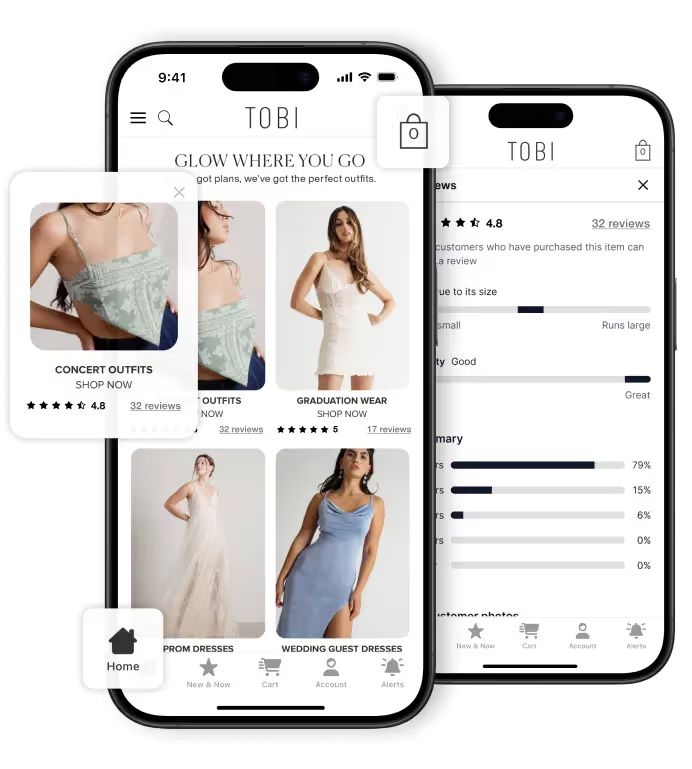
Your storefront is the app. Everything you've invested in (your SFRA templates, your Einstein personalization, your checkout flow, your Content Slots, your integrations) carries over automatically.
On top of that, MobiLoud adds native capabilities: push notifications, native navigation, deep linking, app icon, splash screen, and full App Store and Google Play presence.
The cost is a fraction of custom development. The launch timeline is weeks, not months. And because the app renders your live website, every update you make to your storefront is immediately reflected in the app. No duplicate work, no channels drifting out of sync.
Why MobiLoud is the Best Way for Demandware/Commerce Cloud Brands to Launch an App
MobiLoud converts your existing Salesforce Commerce Cloud storefront into native iOS and Android apps.
It's 100x more efficient than building a custom native app, yet the end result is essentially the same as you'd get if you built from scratch.
Here's why this approach is a natural fit for brands using Demandware (aka Commerce Cloud):
Your entire Salesforce ecosystem stays connected
This is the big one. You didn't just pick Commerce Cloud. You bought into the Salesforce ecosystem. Marketing Cloud campaigns, Service Cloud case routing, Einstein recommendations, Commerce Cloud promotions, Order Management, maybe even Loyalty Management.
All of it feeds into your storefront experience.
With a custom native app, every one of those touchpoints has to be rebuilt or adapted for mobile. Some integrations may not have native mobile SDKs. The personalization logic that Marketing Cloud drives on your website has to be replicated in a completely different frontend. It's months of integration work just to get back to where your website already is.
With MobiLoud, your app renders your storefront. Every Salesforce integration that works on the web works in the app, automatically. No new API connections. No compatibility concerns. No integration layer to build or maintain.
Works regardless of your architecture generation
Whether you're on SiteGenesis, SFRA, or a composable storefront built with PWA Kit, it doesn't matter. MobiLoud works with the rendered storefront your customers see, not with a specific architecture or API version.
This is especially valuable if you're still on an older architecture. Migrating from SiteGenesis to SFRA, or from SFRA to composable, is already a significant project. Adding a native app rebuild on top of that migration would be overwhelming.
MobiLoud lets you launch an app now, on whatever architecture you're currently running, and it keeps working if and when you migrate.
Multi-brand, multi-region, multi-currency
MobiLoud specializes in helping global brands with complex setups simplify this when launching mobile apps. Whether you serve 15 countries or 50, whether you need a single app for all regions or separate apps for different brands and locales, we can help you make it happen.
Your existing localization, currency handling, and regional catalog logic all carry over. There's no per-region rebuild.
No new codebase to maintain
When your team updates the storefront, the app reflects it automatically.
New campaign landing page? It's in the app. Updated checkout flow? It's in the app. Seasonal merchandising refresh? It's in the app.
You're not coordinating releases across web, iOS, and Android. You're not worrying about version parity. You make changes in one place and they're live everywhere.
Real push notifications, not PWA push
This is where MobiLoud fills the gap your PWA leaves open. Native push notifications have significantly higher opt-in rates than web push.
For abandoned cart recovery, flash sale alerts, back-in-stock notifications, and loyalty engagement, that difference translates directly to revenue.
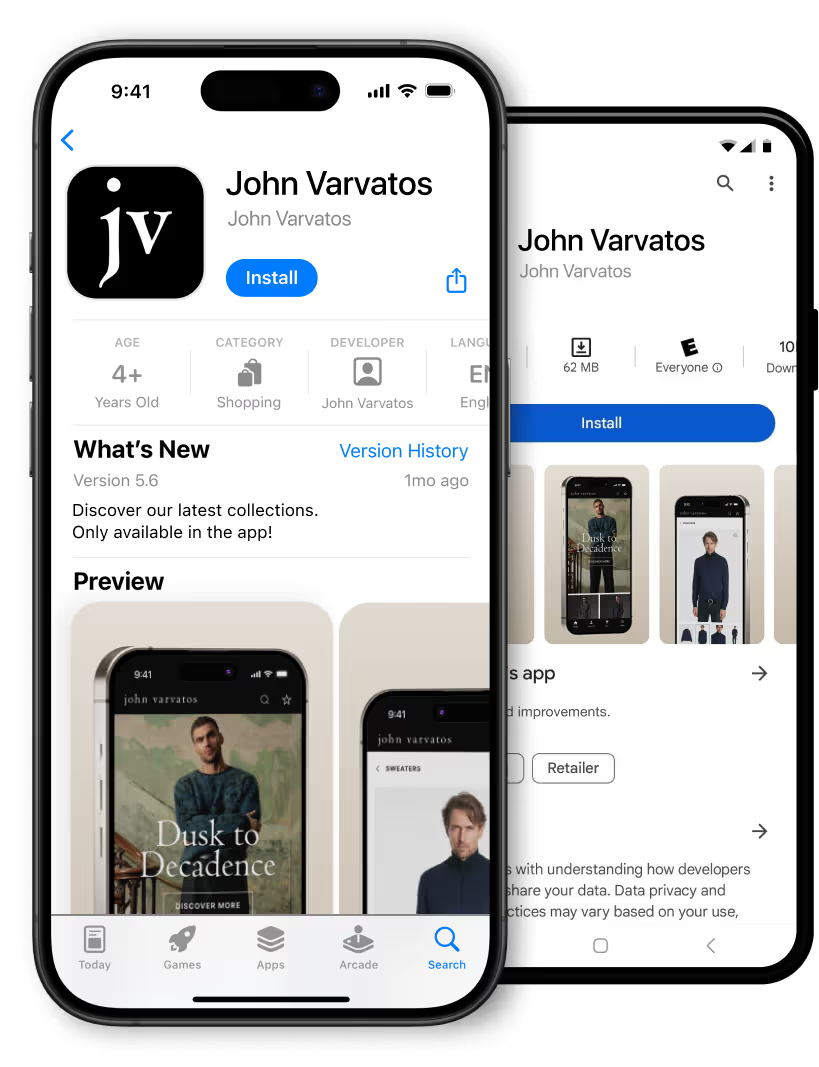
You also get App Store and Google Play presence, which means customers can find and download your app the way they expect to.
Launch in weeks, not months
A custom Commerce Cloud mobile app takes 6-12+ months just to reach the first version. MobiLoud apps typically launch in about 4 weeks. And you already know what you're going to get, because the app is a direct reflection of what already works on your website.
Fully managed service
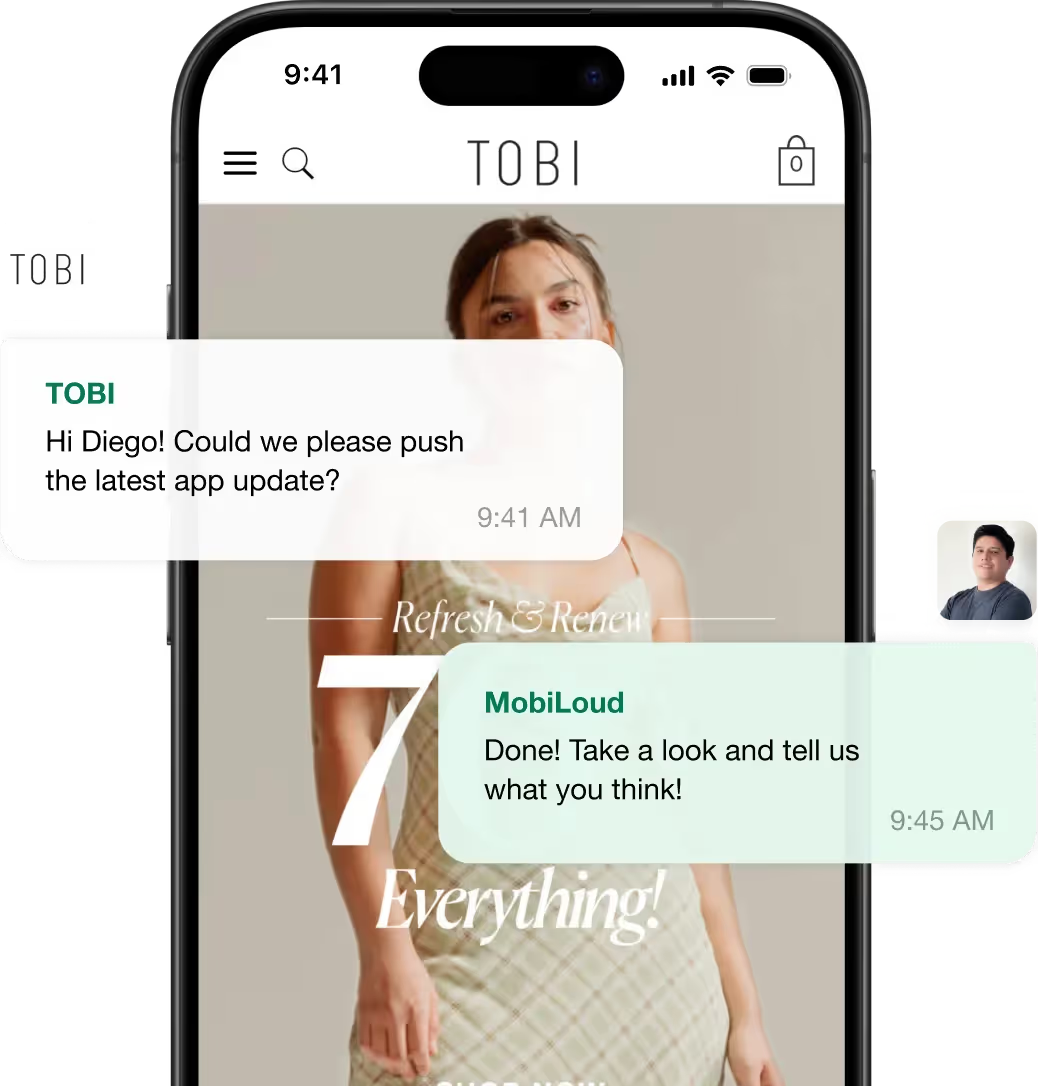
MobiLoud handles everything: the build, app store submission (Apple and Google), ongoing maintenance, and support. Your team stays focused on your storefront and your commerce stack. We handle everything to do with your app.
How It Works
The process is straightforward, and it doesn't require your engineering team to take on a new project.
- Get a free preview. We'll put together an interactive preview so you can see exactly what your Commerce Cloud storefront looks like as a native app before committing to anything.
- App build. Once you give the go-ahead, we put your apps together. Native layer with push notifications, native navigation, app icon, splash screen, deep linking, and any extras needed to meet your requirements.
- Testing and QA. We run comprehensive tests across iOS and Android devices. You test on your own devices and provide feedback.
- App store submission. MobiLoud handles Apple App Store and Google Play submission, including all compliance requirements and metadata.
- Launch and ongoing support. Your app goes live. MobiLoud handles OS updates, app store policy changes, maintenance, and support on an ongoing basis. You keep working on your website.
Your Commerce Cloud infrastructure isn't touched. Your Salesforce ecosystem keeps running exactly as it does today. The storefront you've already built and optimized becomes a native app, with a native channel for push-driven engagement and re-engagement.
Next Steps
If you're running on Salesforce Commerce Cloud, whether you still call it Demandware or not, and you want to extend that same experience to a native app, MobiLoud is the single best way to make it happen.
The cost could be less than 1% of what it takes to launch a custom mobile app.
Your website already works. It's been through years of iteration. Your Salesforce integrations are live. Your merchandising, personalization, and checkout flows are dialed in.
Why spend $500K or more rebuilding all of that from scratch?
MobiLoud lets you launch a mobile app risk-free, building off everything you've already invested in.
If you want to see what your app could look like, book a consultation to talk through whether this is the right fit for your business.
Your brand deserves a mobile app that lives up to what you've built on the web. MobiLoud's here to help you make it happen.


